Table of contents

A fractional CMO for SaaS is a senior marketing leader who owns strategy, priorities and accountability for part of a week — typically 10 to 20 hours — instead of joining full time. In software, the role is defined by pipeline maths rather than brand stewardship.
That distinction matters. SaaS companies buy leadership to fix acquisition economics under investor scrutiny, which changes what the role owns, how it is measured, and when it stops being the right answer.
Key Takeaways
- Typical SaaS engagements run 10–20 hours a week on a fixed monthly retainer, with pipeline accountability attached.
- Reported market ranges cluster at $5,000–$25,000 per month, most commonly $10,000–$12,000.
- Median B2B SaaS CAC payback sits at 16 months; top quartile reaches 6 months or fewer.
- SaaS and startup CMO tenure averages roughly 1.8 years across 14,000 executives — the shortest of any function.
- A full-time SaaS marketing leader's loaded cost commonly passes $400,000 a year once benefits, equity and search fees land.
- Fractional supply has grown fast: profile counts and postings rose 149% year over year in the fractional work market.
What the role actually owns in a SaaS company
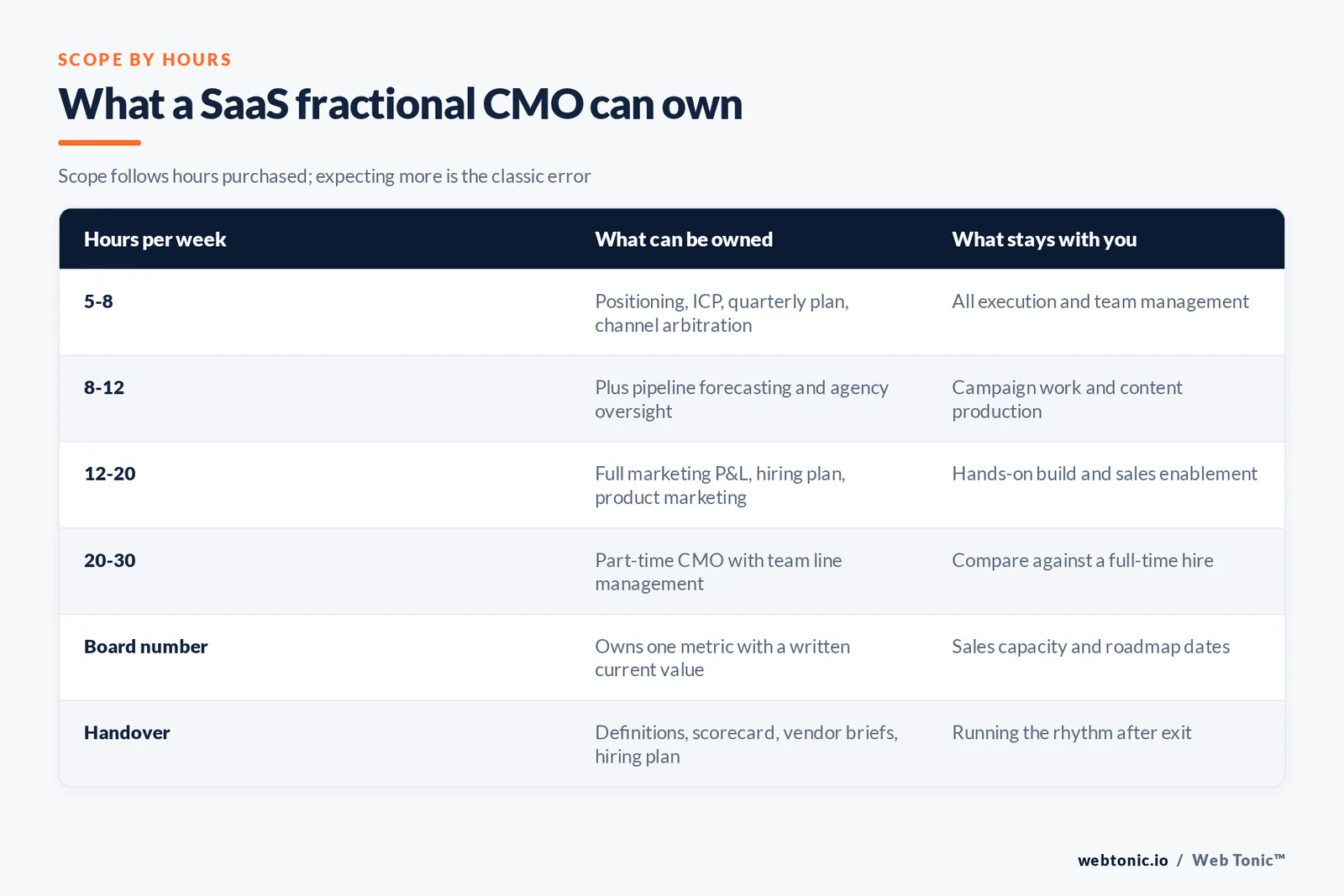
The honest scope depends almost entirely on hours purchased. Buying 6 hours a week and expecting demand generation, product marketing and lifecycle to all improve is the single most reliable way to waste the retainer.
| Hours per week | What can be owned | What stays with you |
|---|---|---|
| 5–8 | Positioning, ICP definition, quarterly plan, channel arbitration | All execution and all team management |
| 8–12 | The above plus pipeline forecasting and agency oversight | Day-to-day campaign work and content production |
| 12–20 | Full marketing P&L, hiring plan, product marketing sequencing | Hands-on build work and sales enablement delivery |
| 20–30 | Effectively a part-time CMO with team line management | Little — at this level, compare against a full-time hire |
In SaaS specifically, three responsibilities separate a real fractional CMO from a senior consultant: owning a pipeline number in the board pack, arbitrating between self-serve and sales-led motions, and deciding what product marketing ships alongside the roadmap. If those three sit elsewhere, you have bought advice rather than leadership.
Why SaaS buys this differently
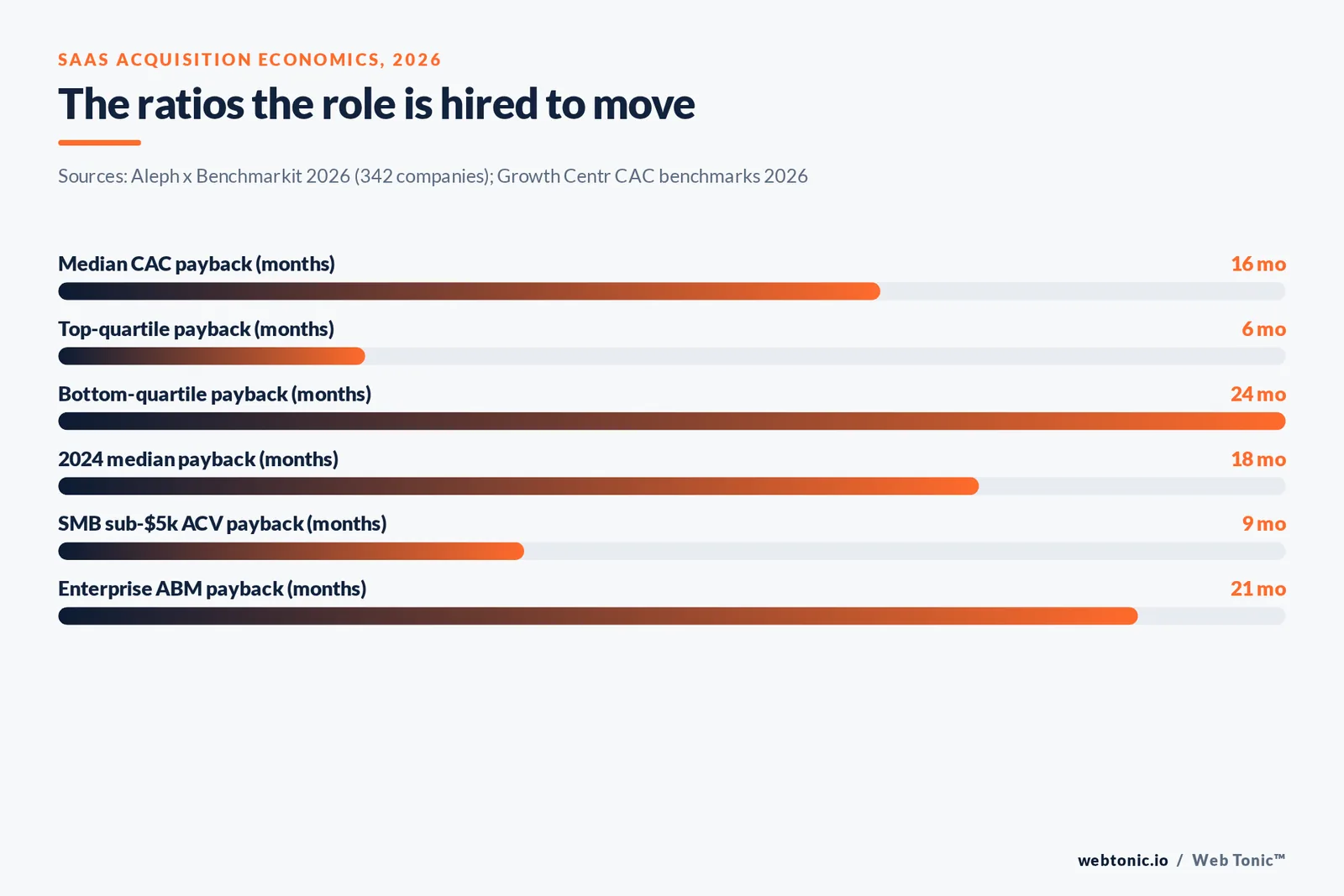
Software companies live and die on acquisition efficiency, and the benchmarks have moved. The 2026 Aleph and Benchmarkit study, built on full-year actuals from 342 SaaS and AI-native companies, puts median CAC payback at 16 months, with the top quartile at 6 months or fewer and the bottom quartile beyond 24 months. Analysis of the same dataset notes the median improved from 18 months in 2024, an 11% gain.
Cost per dollar of revenue is the other half. 2026 CAC benchmark work reports a blended ratio of $1.30 of sales and marketing spend per $1 of ARR, rising to $1.63 for new-name business. Stage changes everything: stage-level benchmarks published by Data-Mania show deals under $5,000 ACV paying back in 8–9 months while enterprise contracts above $50,000 stretch far longer.
A fractional CMO in SaaS is therefore hired to change a ratio, not to run campaigns. The first question in a competent scoping conversation is which of payback, win rate or expansion revenue the engagement is meant to move — and what the current number actually is.
The tenure problem this solves
Senior marketing seats in software turn over fast. Analysis of 14,000 executives found CMOs and CROs averaging just 1.8 years in role, the shortest of any executive function. Spencer Stuart's 2026 tenure snapshot puts S&P 500 CMO tenure at 4.1 years against 5.0 years for all C-suite roles at those companies — and smaller software companies sit well below that.
Segment data narrows it further: tenure analysis by sector places B2B SaaS at 3.0–3.5 years, and a 2026 Couch & Associates study of 3,773 marketing leaders reports a median 3.1 years in seat, dropping to 2.6 years at smaller companies with a quarter of leaders under 19 months.
The practical read is not that full-time leaders fail. It is that a two-quarter commitment is a reasonable planning horizon in software, and a fractional arrangement prices that reality honestly instead of pretending a five-year hire is being made.
When you actually need one
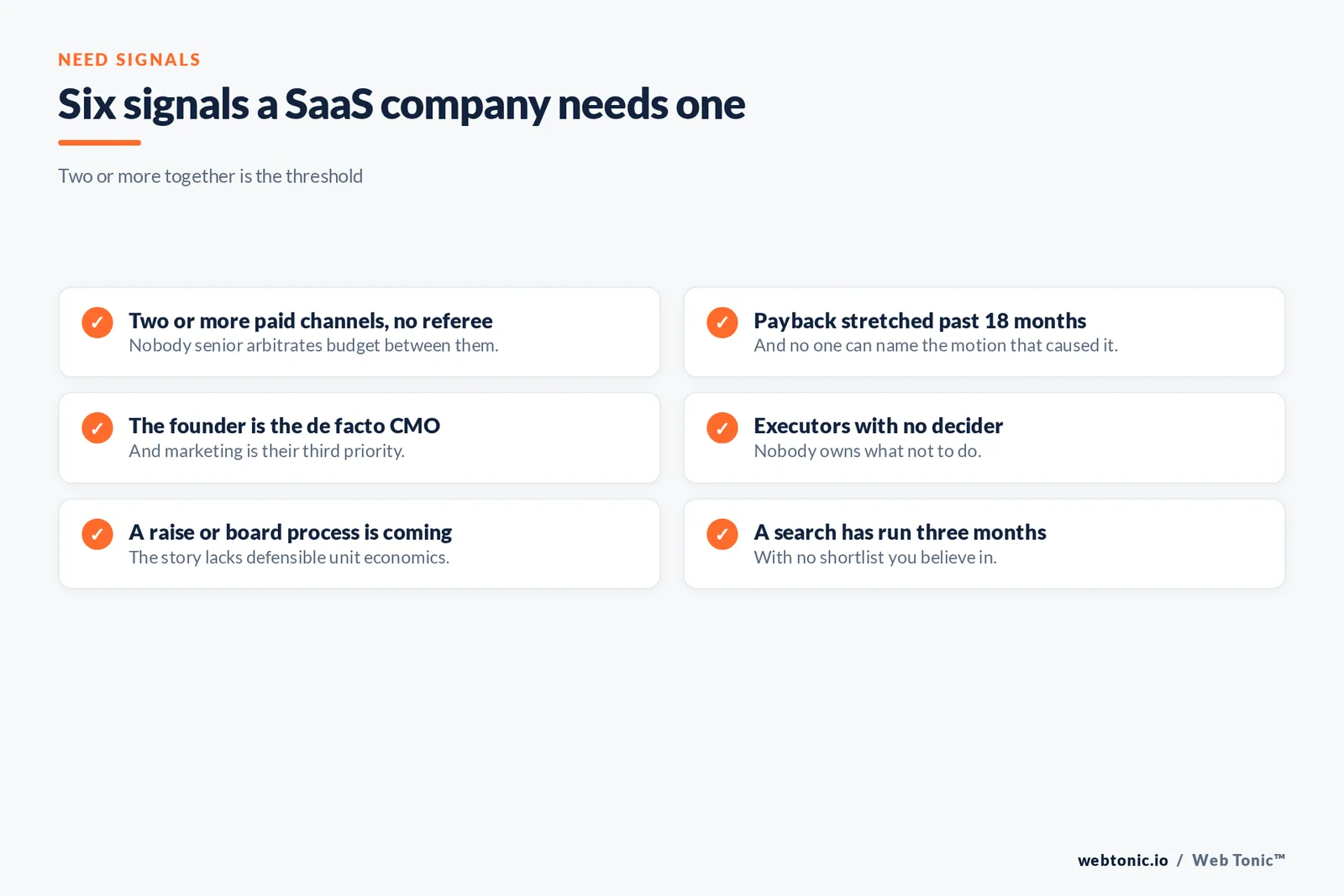
Two or more of these together is the threshold. Any single one is usually solvable with a project.
- You have 2 or more paid channels running with nobody senior arbitrating budget between them.
- ARR is growing but CAC payback has stretched past 18 months and no one can explain which motion caused it.
- The founder is still the de facto head of marketing and it is now their third priority.
- You employ marketers who execute well but have no one to decide what not to do.
- A raise or board process is coming and the marketing story has no defensible unit economics behind it.
- A full-time search has run 3+ months without a shortlist you believe in.
If the answer is "we need more output", this is the wrong hire. Leadership reduces the number of things being attempted; capacity increases them. Confusing the two is why some retainers feel expensive at month three.
When it is the wrong call
Three situations come up repeatedly where the answer is no. First, pre-product-market-fit software with under roughly $500,000 ARR and a founder still doing customer discovery: the decisions that matter are product decisions, and a marketing leader will be optimising a message that has not stabilised. Second, a company whose real problem is sales capacity — if opportunities are created and not worked, adding marketing leadership widens a queue that is already backing up.
Third, an organisation that cannot give up decision rights. If every recommendation must be re-argued with a founder who reserves the final call on channel budgets, you are paying senior rates for consulting and getting neither speed nor accountability. That case is better served by a short strategy project with a defined output, then a review.
There is also a timing test. With SaaS and startup marketing tenure averaging around 1.8 years, the fractional route is a fair way to buy two to four quarters of senior judgement without a five-year story. But if you know you need a permanent leader within six months, use the engagement to write the role definition and scorecard the eventual hire will inherit, and say so at kickoff.
What it costs in a SaaS context
Published market ranges are consistent enough to plan against. One 2026 pricing analysis reports $5,000–$25,000 per month, or $200–$500 an hour for advisory-only work, at 10–20 hours a week. A separate 2026 rate report centres the market at $10,000–$12,000 monthly and notes full-time CMO total compensation of $293,575–$316,076, with loaded cost often above $400,000.
| Stage | Typical hours | Reported monthly range |
|---|---|---|
| Seed | 15–20 per month | $5,000–$10,000 |
| Series A | 20–30 per month | $8,000–$15,000 |
| Scale-up ($2M–$10M ARR) | 10–20 per week | $8,000–$18,000 |
| Growth (past $30M ARR) | 30–40 per month | $15,000–$25,000 |
Those bands come from retainer structure research and B2B SaaS retainer analysis, which also notes fixed monthly retainers now dominate over percentage-of-spend models. Billing-mix data puts roughly 40% of fractional CMOs on hourly terms and 60% on retainer, with hourly rates of $300–$700 at the senior end.
Compare against the alternative honestly. SaaS salary benchmarks put median VP of Marketing base pay at $157,500 across 120 verified salaries, before equity, benefits, tooling and recruiter fees. Web Tonic does not publish rates on this page; scope drives them, and we would rather quote after seeing the numbers.
Fractional CMO, agency or advisor: which shape fits
Software companies usually have four options on the table at once, and the proposals look deceptively similar. The separating question is what each one is allowed to decide.
| Option | Decides | Best fit | Weak spot |
|---|---|---|---|
| Fractional CMO | Strategy, budget split, hiring plan, what to stop | No senior owner and a pipeline number to defend | Limited hours; not an execution engine |
| Advisor or coach | Nothing; recommends only | A capable in-house lead who needs a sounding board | No accountability when a quarter slips |
| Agency retainer | Channel tactics inside an agreed strategy | Strategy settled, execution capacity missing | Will not arbitrate against its own scope |
| Full-time VP or CMO | Everything, full availability | 30+ leadership hours a week of real demand | Search time, loaded cost, tenure risk |
The most expensive misdiagnosis is buying an agency when the real gap is arbitration. Channel teams optimise inside their own lane by design, so a scattered budget with three vendors each hitting their targets can still produce a worsening blended payback. Somebody has to be able to say "we are stopping this" — and mean it.
Vetting a candidate in SaaS: five evidence tests
Interviewing on philosophy produces a good conversation and a bad decision. Ask for evidence instead, and make the evidence specific to your motion.
- Test 1 — the ratio. Ask for one engagement where CAC payback or the S&M-to-ARR ratio moved, with the before and after numbers. Median payback sits at 16 months; a credible answer references a starting point.
- Test 2 — the stop list. Ask what they discontinued in their last two engagements. A leader who has never removed a channel, tool or content line has never actually held the budget.
- Test 3 — motion match. Sales-led and product-led SaaS reward opposite instincts. Ask for one example in your motion, at roughly your ACV band, whether that is under $5,000 or above $50,000.
- Test 4 — continuity. With 10–20 hours a week committed to you, ask how many other clients they hold and who covers a two-week absence.
- Test 5 — handover. Ask what artifacts your team keeps at the end: definitions, scorecard, hiring plan, vendor briefs. Anything held in the consultant's own tooling is not a handover.
Two structural clauses matter as much as the interview. Fix a notice period, commonly 30 days, and fix a review point at day 90 where scope is re-cut rather than silently extended. Both protect the buyer, and a good operator will suggest them first.
What good looks like by day 90
Three artifacts should exist, and none of them is a campaign. First, a written ICP with evidence — which segments actually close and expand, not which ones the deck describes. Second, a one-page scorecard where each row has a source, an owner and a target, so the pipeline number in the board pack has a lineage. Third, a stop list: the channels, tools and content lines being discontinued, with dates.

If month three arrives and the only visible change is more activity, the engagement is drifting toward capacity work. Raise it then, not at renewal. Web Tonic's differentiator here is that the diagnosis and the scorecard come first and the execution decision comes second, which is how our fractional CMO engagements are structured. Where execution is the real gap, growth marketing and data intelligence take it from there. More on how we sequence this sits on the Web Tonic blog, or you can tell us your numbers and we will say which of the four shapes above you actually need.
Related reading
- Fractional CMO: what it is and when you actually need one
- Fractional CGO / Head of Growth: what it is and when you actually need one
- Marketing Audit / Growth Audit: what it is and when you actually need one
- Fractional CMO services at Web Tonic
Frequently Asked Questions
How many hours a week does a SaaS company actually need?
Most land at 10–20 hours weekly. Below 8, expect strategy and arbitration only. Above 30, run the comparison against a full-time hire, because the cost gap narrows and availability becomes the deciding factor.
Can a fractional CMO own a pipeline number?
Yes, and they should. What they cannot own alone is a number that depends on sales capacity or product shipping dates. Write the dependency into the scope so the accountability survives a missed quarter.
How long should the engagement run?
Two to four quarters is typical in software. One quarter is enough to diagnose but rarely enough to prove a change in CAC payback, which moves on a 16-month median cycle.
Does this work for product-led SaaS?
It works, with a different emphasis: activation and expansion metrics replace lead volume, and the leader spends more time with product than with sales. Ask candidates for a product-led example with retention numbers attached.
What is the biggest failure mode?
Unclear ownership. If nobody can say which decisions the fractional CMO makes without asking, the retainer becomes an advisory subscription. Settle decision rights in week one, in writing.
Sources: Aleph × Benchmarkit SaaS & AI benchmarks 2026 · B2B Centr CAC payback analysis 2026 · Growth Centr B2B SaaS CAC benchmarks 2026 · Data-Mania B2B SaaS benchmarks 2026 · SaaStr executive tenure analysis · Spencer Stuart CMO Tenure 2026 · Behind the CMO tenure statistics 2026 · Couch & Associates State of the CMO 2026 · RankedCMO fractional CMO cost 2026 · MarkCMO fractional CMO rate report 2026 · Fractional Pulse retainer guide 2026 · SaaSHero retainer structure 2026 · ApplyGRO fractional CMO cost 2026 · Founderpath SaaS salary benchmarks.