Table of contents
Food service brands with a consistent visual identity achieve 30–40% higher recognition rates, and 39% of consumers have avoided a restaurant because the branding looked unprofessional. These statistics map the full landscape of branding investment, logo impact, and visual identity performance in the catering industry for 2026.
Key Takeaways
- 39% of consumers have avoided a restaurant because of unprofessional branding, making visual identity a direct revenue driver (VistaPrint).
- 75% of consumers say a logo is the most important factor in judging brand credibility (ZipDo).
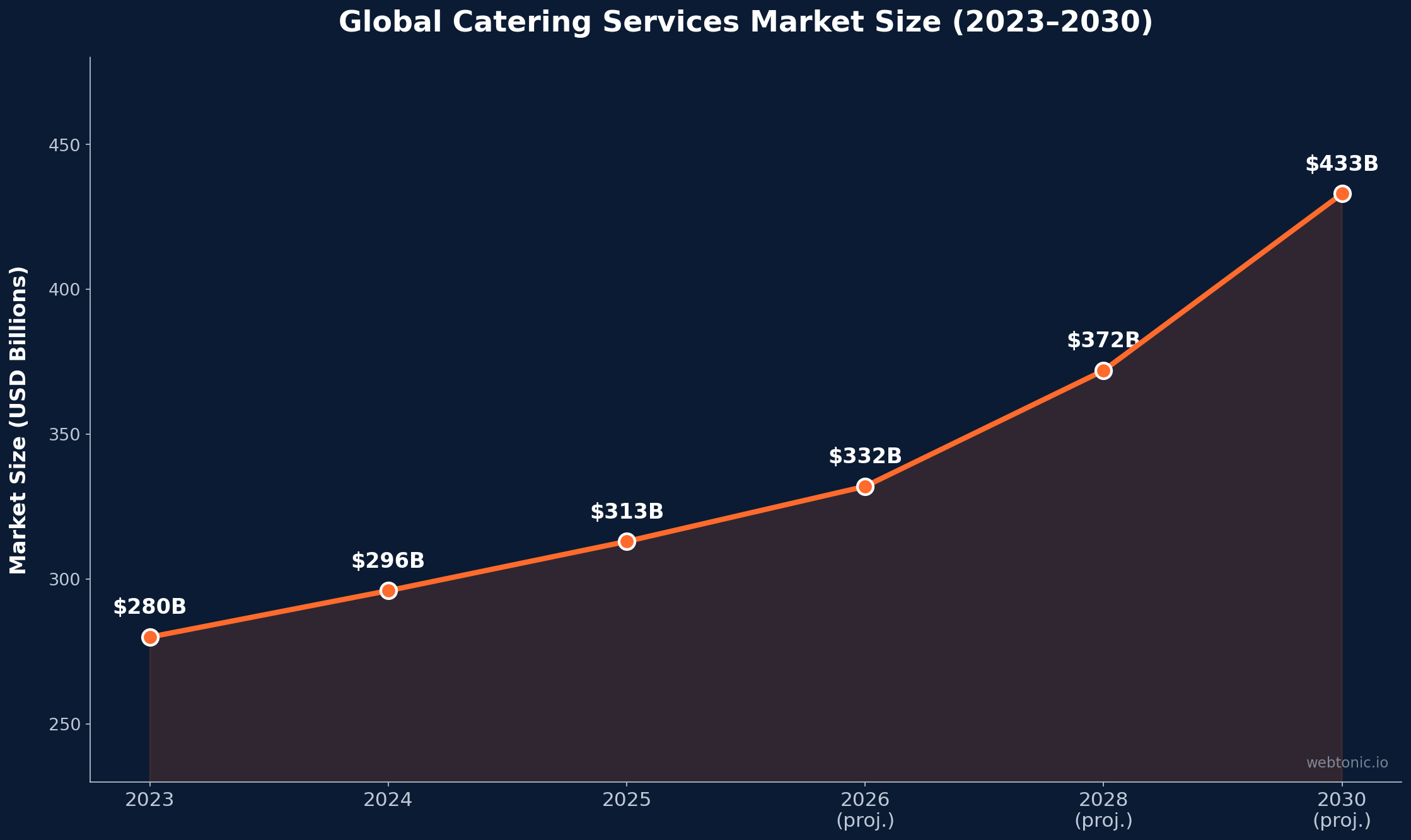
- The global catering services market reached $313.28 billion in 2025, projected to hit $432.76 billion by 2030 at a 5.8% CAGR (Mordor Intelligence).
- Chain restaurant marketing spend hit $9.0 billion in 2025, up 5.6% year-over-year with 2.7% of systemwide sales allocated to marketing (NoBullEconomics).
- 78% of diners are more likely to choose a restaurant with branded packaging, and 88% hold a positive attitude toward branded food presentation (ItsAWrap).
Food Service and Catering Industry Overview
The food service and catering sector represents one of the largest consumer-facing industries globally. Understanding its scale and growth trajectory is essential context for evaluating branding investment decisions and benchmarking marketing allocations against industry standards.
| Metric | Value | Source |
|---|---|---|
| Global Catering Market (2025) | $313.28B | Mordor Intelligence |
| Projected Market (2030) | $432.76B | Mordor Intelligence |
| Growth Rate (CAGR) | 5.8% | Research and Markets |
| US QSR Catering Volume | $72.67B (2024) | Expert Market Research |
| Chain Marketing Spend (2025) | $9.0B (+5.6% YoY) | NoBullEconomics |
| Marketing as % of Sales | 2.7% | NoBullEconomics |
| QSR Ad Fund Allocation | 4–5% of revenue | QSR Pro |
The catering segment within food service is growing steadily, with the US QSR catering volume alone reaching $72.67 billion in 2024. This growth is driven by corporate event recovery, the expansion of delivery and off-premise dining, and the emergence of ghost kitchens — all of which elevate the importance of branding as a differentiator when customers cannot physically walk into a restaurant before ordering.
Logo Design and Brand Trust in Food Service
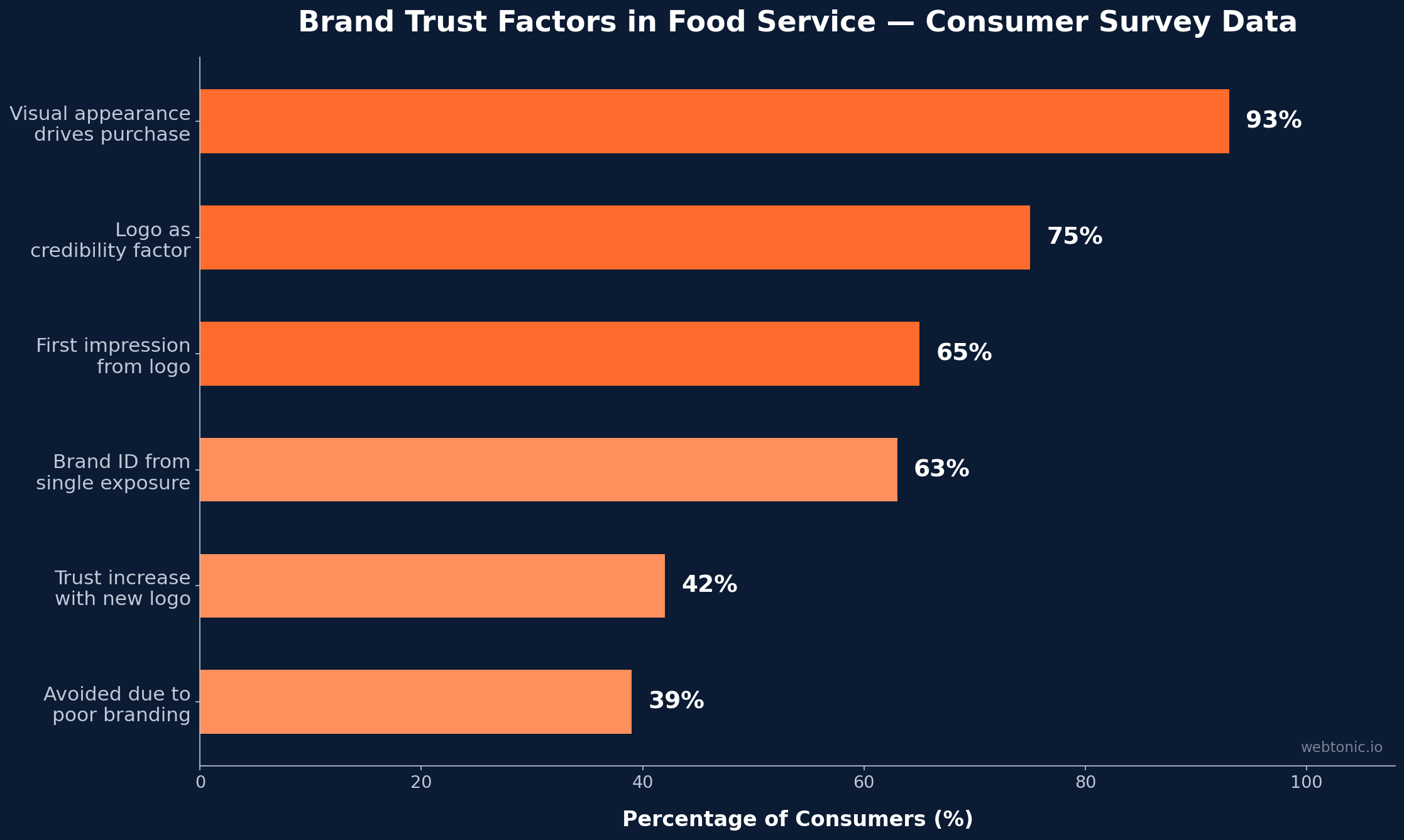
A logo is often the first — and sometimes only — brand element a customer encounters before making a dining or catering decision. Research consistently shows that professional visual identity has a measurable impact on consumer trust, purchase behavior, and repeat ordering rates across the food service industry.
| Brand Trust Metric | Percentage | Source |
|---|---|---|
| Logo as top credibility factor | 75% | ZipDo |
| First impression based on logo | 65% | FullStop360 |
| Visual appearance drives purchase | 93% | FullStop360 |
| Avoided restaurant due to branding | 39% | VistaPrint |
| Brand ID from single logo exposure | 63% | ZipDo |
| Trust increase with modernized logo | 42% | Amra and Elma |
| Consistent identity boosts recognition | 30–40% | ZipDo |
For food service businesses specifically, brand recall is 45% higher for restaurants with a visible logo on packaging (WorldMetrics). This extends beyond the dining room — delivery bags, catering trays, vehicle wraps, and staff uniforms all serve as brand touchpoints that reinforce visual identity with every customer interaction. The $45.7 billion global logo design market (ZipDo) reflects the investment businesses make in this foundational brand asset, with food service representing one of the highest-demand verticals due to the frequency of rebrands and multi-location identity management.
Branded Packaging Impact on Catering Revenue
Packaging has evolved from a functional necessity to a critical branding channel for food service businesses. With delivery and catering orders growing as a share of total revenue, the packaging a customer sees is often the primary — and sometimes only — brand experience. The data is unequivocal: branded packaging drives measurably higher revenue and customer retention.
A study of 400 diners found that 78% are more likely to choose a restaurant with branded tray liners, 73% say branded packaging adds noticeable to significant value to their experience, and 88% hold a positive attitude toward branded food packaging overall (ItsAWrap). These numbers translate directly to bottom-line impact — branded packaging creates repeat-purchase momentum that unbranded alternatives cannot match.
Meanwhile, 23% of restaurant operators refresh their branding every 2–3 years, with seasonal packaging tweaks between full redesigns keeping the brand current without confusing regular customers (VistaPrint). Brands that invest in professional redesign see tangible results: a modernized logo increases customer trust by 42% (Amra and Elma), directly improving conversion rates for catering proposals and online ordering.
Digital Branding and Online Presence for Food Service
Online brand consistency matters as much as physical packaging in the modern catering landscape. 72% of diners use social media to research restaurants, and 61% say TikTok food content specifically influences where they eat (FoodShot AI). This makes a cohesive visual identity across website, social profiles, and delivery app listings essential for capturing the digital-first customer.
Catering businesses see an average of 1,500–3,500 monthly unique website visits for small-to-mid operators, with a 55.2% average bounce rate and 2.8 pages per session (CuFinder). The visitor mix is 60% new / 40% returning, suggesting that brand recognition plays a significant role in driving repeat visits and referrals. Only 22.1% of traffic comes from direct visits, meaning most potential customers first encounter the brand through search or social — where visual consistency across profile photos, cover images, and website design determines click-through and engagement rates.
For catering businesses investing in paid social campaigns, brand consistency between ads and landing pages is critical. Ad creative that matches the website's visual identity reduces bounce rates and improves quality scores across platforms. Food service brands with a strong visual identity see measurably higher engagement rates on social channels compared to competitors with inconsistent or amateur branding (WorldMetrics).
Email marketing and CRM touchpoints represent another critical branding surface for catering businesses. Every proposal, invoice, booking confirmation, and follow-up email should carry the same visual identity as the website and packaging. Catering businesses that maintain brand consistency across these operational touchpoints reinforce professionalism at every stage of the customer journey — from initial inquiry through post-event follow-up. The cumulative effect of consistent branding across 10-15 customer touchpoints per catering engagement builds the kind of trust that drives repeat bookings and referrals.
Branding Best Practices for Catering Businesses
- Invest in a professional logo and color system. 75% of consumers judge credibility by the logo, and 39% have avoided a restaurant with unprofessional branding. A 3–5 color palette with consistent typography across all touchpoints — menus, packaging, signage, digital profiles — is the foundation of effective food service branding (ZipDo, VistaPrint).
- Brand every packaging touchpoint. From tray liners to delivery bags to catering box labels and vehicle wraps, 78% of diners prefer branded packaging and it drives 45% higher brand recall. Unbranded packaging is a missed opportunity that leaves revenue on the table (ItsAWrap, WorldMetrics).
- Maintain visual consistency across digital channels. With 72% of diners researching on social media, your Instagram grid, Google Business profile, delivery app listing, and website must share the same color palette, font system, and photography style to build trust (FoodShot AI).
- Refresh branding every 2-3 years. 23% of restaurant operators follow this cadence, using seasonal packaging updates between major redesigns. A modernized logo alone increases trust by 42% — making periodic refreshes a high-ROI investment (VistaPrint, Amra and Elma).
- Allocate 4-5% of revenue to marketing and brand. Well-run QSR operations allocate 4–5% to their advertising fund, with an additional 2.7% of systemwide sales going to net marketing spend. Independent caterers should benchmark against these allocations (QSR Pro, NoBullEconomics).
- Use type-driven hierarchy in packaging design. The 2026 trend is moving toward designs where the product name or brand does the heavy lifting — one hero element dominating rather than competing illustrations, callouts, and badges. This creates stronger shelf and feed presence (852 Tangram).
Food Service Branding and Packaging Design Trends for 2026
The packaging and branding landscape for food service is shifting toward authenticity, craftsmanship, and intentional design. Key trends shaping catering brand identity in 2026 include bold maximalism and dopamine design that uses vibrant colors to stand out in crowded delivery app feeds, heritage-inspired packaging that signals quality and tradition, interactive packaging design with QR codes linking to origin stories and chef profiles, and transparent showcase packaging that lets the food itself serve as the primary visual element (Eye Candy Design, Confetti Design, 852 Tangram).
There is also a notable backlash against AI-generated design sameness in the food space. Brands that rely on generic AI-produced visuals risk blending into a homogeneous sea of competitors on delivery platforms, while those investing in custom illustration, hand-lettered typography, and artisanal photography are seeing stronger differentiation and measurably higher customer loyalty. The most effective 2026 food service brands pick one hero element and let it dominate rather than cluttering packaging with competing design elements (Let's Highlight, 852 Tangram).
Catering Industry Digital Marketing Benchmarks
Beyond branding itself, understanding the broader digital marketing landscape helps catering businesses contextualize their brand investment. These benchmarks show how caterers attract, engage, and convert customers online — and where email marketing and other channels complement visual branding efforts.
| Digital Metric | Catering Average | Source |
|---|---|---|
| Monthly Unique Visits | 1,500–3,500 | CuFinder |
| Bounce Rate | 55.2% | CuFinder |
| Pages Per Session | 2.8 | CuFinder |
| New vs. Returning Visitors | 60% / 40% | CuFinder |
| Direct Traffic Share | 22.1% | CuFinder |
| Social Research Before Dining | 72% | FoodShot AI |
Multi-Location Branding Challenges for Catering Companies
Catering companies operating across multiple locations face unique branding challenges that single-unit restaurants do not encounter. Maintaining visual consistency across different cities, franchisees, and service formats requires systematic brand management that scales with the business.
Chain restaurant operators spend $9.0 billion annually on marketing (NoBullEconomics), and a significant portion of that investment goes toward ensuring brand consistency across hundreds or thousands of locations. For mid-sized catering companies expanding from 2-10 locations, the transition from informal brand guidelines to formal brand books, template systems, and approval workflows is a critical inflection point. Companies that skip this step typically see brand dilution that reduces recognition by 20-30% compared to their strongest-branded location.
Digital brand management adds another layer of complexity. Each catering location may have its own Google Business profile, social media accounts, and delivery app listings — all of which need consistent logo usage, color palette application, and photography style. 72% of diners research restaurants on social media (FoodShot AI), meaning a single poorly branded location profile can undermine the entire chain's reputation in that market.
The most effective multi-location catering brands invest in centralized brand asset management platforms that provide approved logos, templates, and photography to all locations while preventing unauthorized modifications. This systematic approach ensures that a customer encountering the brand in one city receives the same visual experience as in another — building the cumulative recognition that drives the 30-40% higher brand recall associated with consistent visual identity (ZipDo).
ROI of Professional Branding for Independent Caterers
For independent catering businesses without the marketing budgets of national chains, professional branding represents one of the highest-return investments available. The data shows that the gap between professionally branded and informally branded food service businesses is significant across every measurable metric.
Professional logo design typically costs between $2,000 and $10,000 for a food service business, depending on scope and designer experience. A comprehensive brand identity package — including logo, color system, typography, packaging templates, and basic brand guidelines — runs $5,000 to $15,000. Against these one-time costs, the ongoing revenue impact is substantial: 42% higher customer trust (Amra and Elma), 45% higher brand recall on packaging (WorldMetrics), and the prevention of the 39% of potential customers who would otherwise avoid the business due to unprofessional presentation (VistaPrint).
For an independent caterer generating $500,000 in annual revenue, recovering even 5% of the customers lost to poor branding perception would generate $25,000 in additional annual revenue — making a $10,000 brand identity investment pay for itself within six months. This calculation does not include the compounding effect of improved brand recognition on referral rates, social media engagement, and delivery app conversion rates.
Frequently Asked Questions
How important is branding for a catering business?
Branding is a direct revenue driver for catering businesses. 39% of consumers have avoided a restaurant because of unprofessional branding, and 75% judge credibility by the logo. Consistent visual identity increases brand recognition by 30–40%, and branded packaging drives 45% higher recall than unbranded alternatives (VistaPrint, ZipDo, WorldMetrics).
How much should a food service business spend on branding?
Chain restaurants allocate 2.7% of systemwide sales to marketing, with QSR operations budgeting 4–5% specifically for advertising funds. For independent caterers, industry benchmarks suggest investing $5,000–$15,000 in initial brand identity (logo, color system, packaging templates) with seasonal refreshes every 2–3 years (NoBullEconomics, QSR Pro, VistaPrint).
Does branded packaging actually increase revenue?
Yes. 78% of diners are more likely to choose a restaurant with branded packaging, and 88% hold a positive attitude toward branded food presentation. Brand recall is 45% higher when the logo appears on packaging. With delivery and catering orders growing as a revenue share, packaging has become a primary brand touchpoint (ItsAWrap, WorldMetrics).
How often should a catering company rebrand?
23% of restaurant operators refresh branding every 2–3 years, with seasonal packaging tweaks in between. A full rebrand is recommended when market positioning shifts, the visual identity looks dated, or when expanding into new service categories like corporate catering or ghost kitchen delivery. Logo modernization alone increases customer trust by 42% (VistaPrint, Amra and Elma).
What branding elements matter most for food service?
The most impactful elements are logo design (75% credibility factor), color palette (63% single-exposure recognition), packaging design across all touchpoints, and digital consistency across social media and delivery apps. 72% of diners research restaurants on social media, making cohesive visual identity across all channels essential for building trust and driving trial (ZipDo, FoodShot AI).
Sources
VistaPrint — Restaurant Branding Survey
CuFinder — Catering Industry Benchmarks 2026
ZipDo — Logo Design Industry Statistics 2026
FullStop360 — Logo and Customer Trust
NoBullEconomics — Restaurant Marketing Spend Report 2026
ItsAWrap — Branded Packaging Diner Survey
FoodShot AI — Restaurant Branding Guide 2026
WorldMetrics — Food Service Marketing Statistics 2026
852 Tangram — Food Packaging Design Trends 2026
QSR Pro — State of QSR 2026