Table of contents
81 million Americans belonged to a gym, studio, or fitness facility in 2025 - an all-time high, up 5.2% in a single year. That growth is the budget case for review management in this category: a bigger, younger, more review-literate membership base is comparing facilities on ratings and reply behavior before it ever walks through the door.
Key Takeaways
- 81 million Americans held a fitness facility membership in 2025, a record high.
- That is a 5.2% increase over 2024.
- Counting day-pass and guest use, over 100 million people used a facility in 2025.
- Membership penetration reached 26.1% of the U.S. population aged 6+.
- Gen Z adults 18-24 have the highest penetration of any age group at 35.5%.
- Members aged 65+ are the fastest-growing cohort, up 8.6% year over year.
- Cross-industry, 31% of consumers only use businesses rated 4.5 stars or higher.
- 47% of consumers won't use a business with fewer than 20 reviews.
- 74% of consumers only weigh reviews from the last three months.
- 89% of consumers expect a reply to their review.
- 19% now expect a same-day reply, up from 6% a year earlier.
- 80% are more likely to use a business replying to every review.
- 42% are unlikely to use a business that never replies.
- Podium and Birdeye publish quote-only pricing - no public list price exists for either at any location tier.
- Whitespark's 2026 Local Search Ranking Factors names review signals among the local-pack factor groups gaining the most weight year over year.
A record membership year, and what it means for review volume
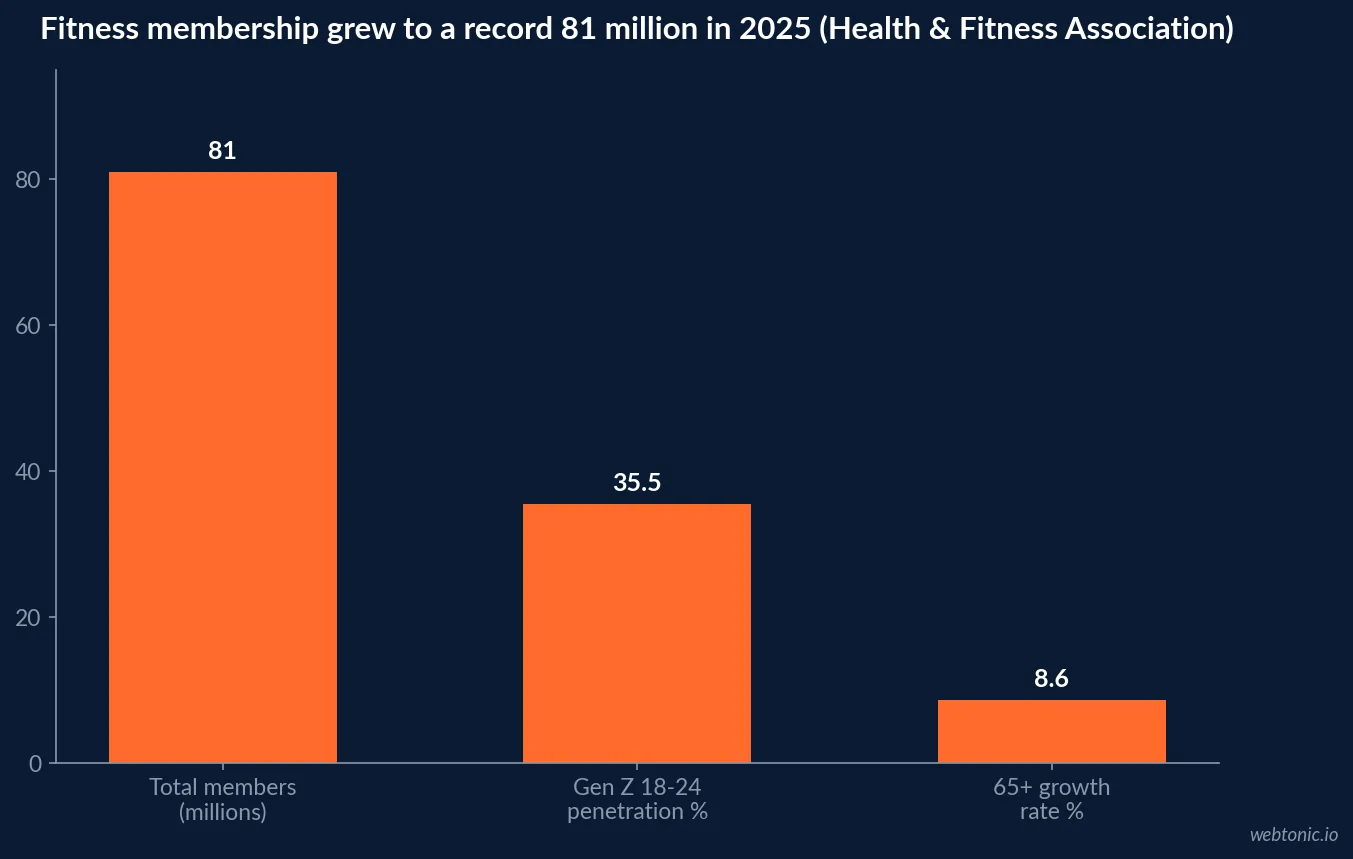
The Health & Fitness Association's 2026 US Health & Fitness Consumer Report (the trade body formerly known as IHRSA) found 81 million Americans belonged to a gym, studio, or other fitness facility in 2025 - an all-time high, and a 5.2% increase over 2024. Including non-members who used a facility through day passes, guest privileges, or other flexible access, more than 100 million people used a fitness facility over the year, pushing penetration to 26.1% of the population aged 6 and older.
Growth was broad-based across age, income, and gender, but two cohorts define where the review conversation is headed: Gen Z adults aged 18-24 hold the highest penetration of any age group at 35.5%, while members aged 65 and older are the fastest-growing cohort, up 8.6% year over year. A facility marketing to both audiences with the same static review-response style is answering to only one of them.
| Metric | 2025/2026 figure | Source |
|---|---|---|
| Total fitness facility members | 81 million | HFA 2026 Consumer Report |
| Year-over-year membership growth | 5.2% | HFA 2026 Consumer Report |
| Total facility users incl. non-members | 100+ million | HFA 2026 Consumer Report |
| Membership penetration, population 6+ | 26.1% | HFA 2026 Consumer Report |
| Gen Z (18-24) penetration | 35.5% | HFA 2026 Consumer Report |
| 65+ member growth, year over year | 8.6% | HFA 2026 Consumer Report |
The review thresholds a growing membership base is applying
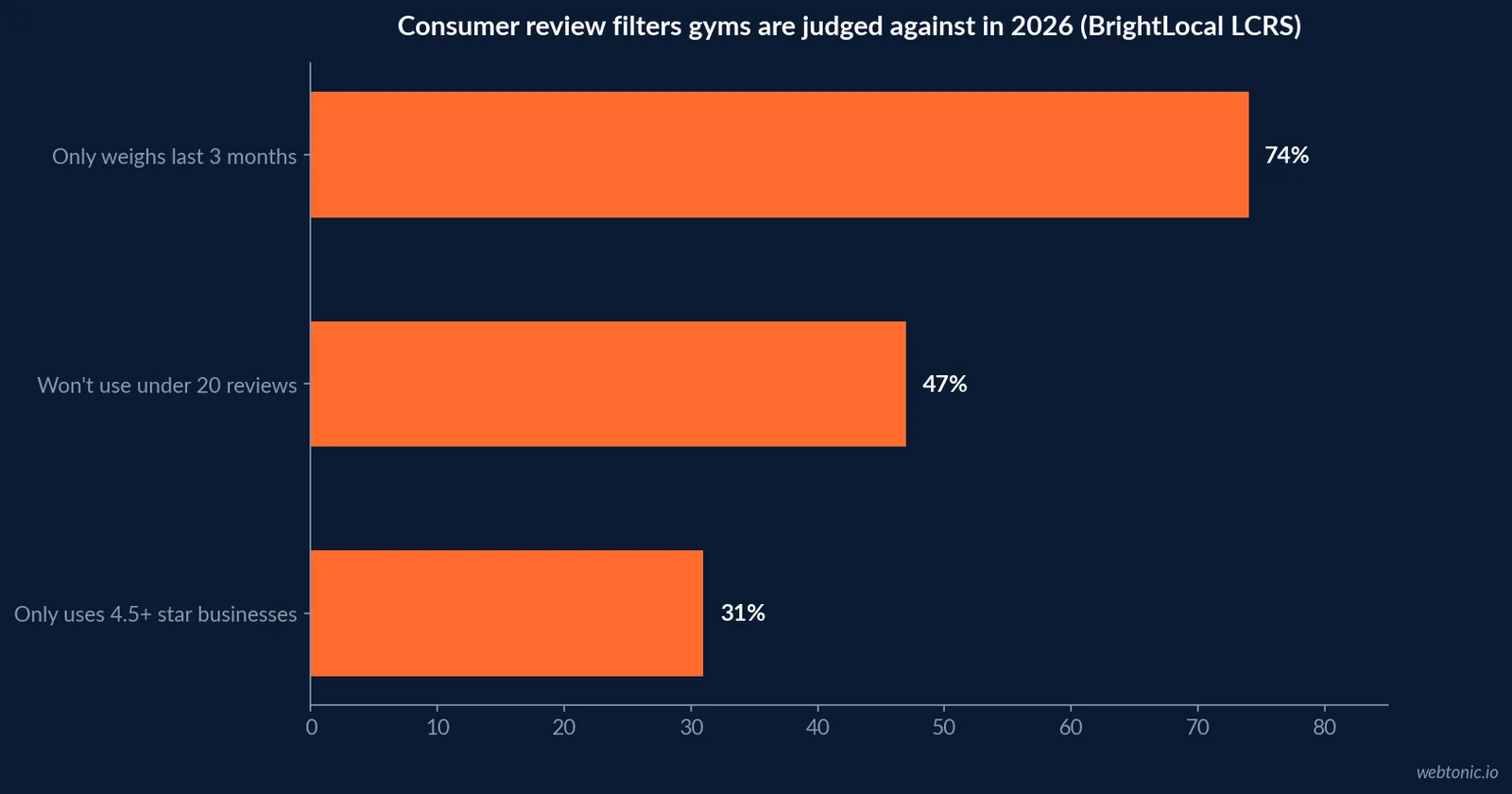
BrightLocal's 2026 Local Consumer Review Survey is cross-industry, not fitness-specific, but its thresholds are the ones a prospective gym member is applying whether or not the study measured gyms directly: 47% will not use a business with fewer than 20 reviews, 31% will only use one rated 4.5 stars or higher (up from 17% a year earlier), and 74% only weigh reviews from the last three months. Labelled as the cross-industry benchmark it is, that last figure matters most for a membership business: a facility's rating reflects last quarter's experience far more than the five-star reviews it earned when it opened three years ago.
| Consumer filter | Share applying it in 2026 | What it means for a gym listing |
|---|---|---|
| Won't use a business under 20 reviews | 47% | A near-empty profile filters out roughly half of searchers |
| Only uses businesses rated 4.5+ stars | 31% | Up from 17% - the bar rose fast in one year |
| Only weighs reviews from the last 3 months | 74% | A stale review pipeline reads as a stale facility |
| Expects a reply to any review posted | 89% | Silence is itself a negative signal |
| Expects a same-day reply | 19% | Up from 6% - front-desk response time is now a factor |
Where review signals sit in local ranking, per Whitespark
Whitespark's 2026 Local Search Ranking Factors report, based on its recurring survey of local SEO practitioners, groups Google's local ranking signals into categories including Google Business Profile signals, on-page signals, review signals (first- and third-party reviews, review quantity, and review velocity), link signals, behavioral signals, citation signals, and social signals. For 2026, Whitespark's own analysis flags review signals and behavioral signals as the groups gaining the most relative weight, while on-page and link signals eased back - directionally consistent with what a membership business competing on Google Maps should expect: review velocity and freshness increasingly compete with, rather than trail, on-page optimization for local pack visibility.
Budgeting for the review-management line without a vendor price list
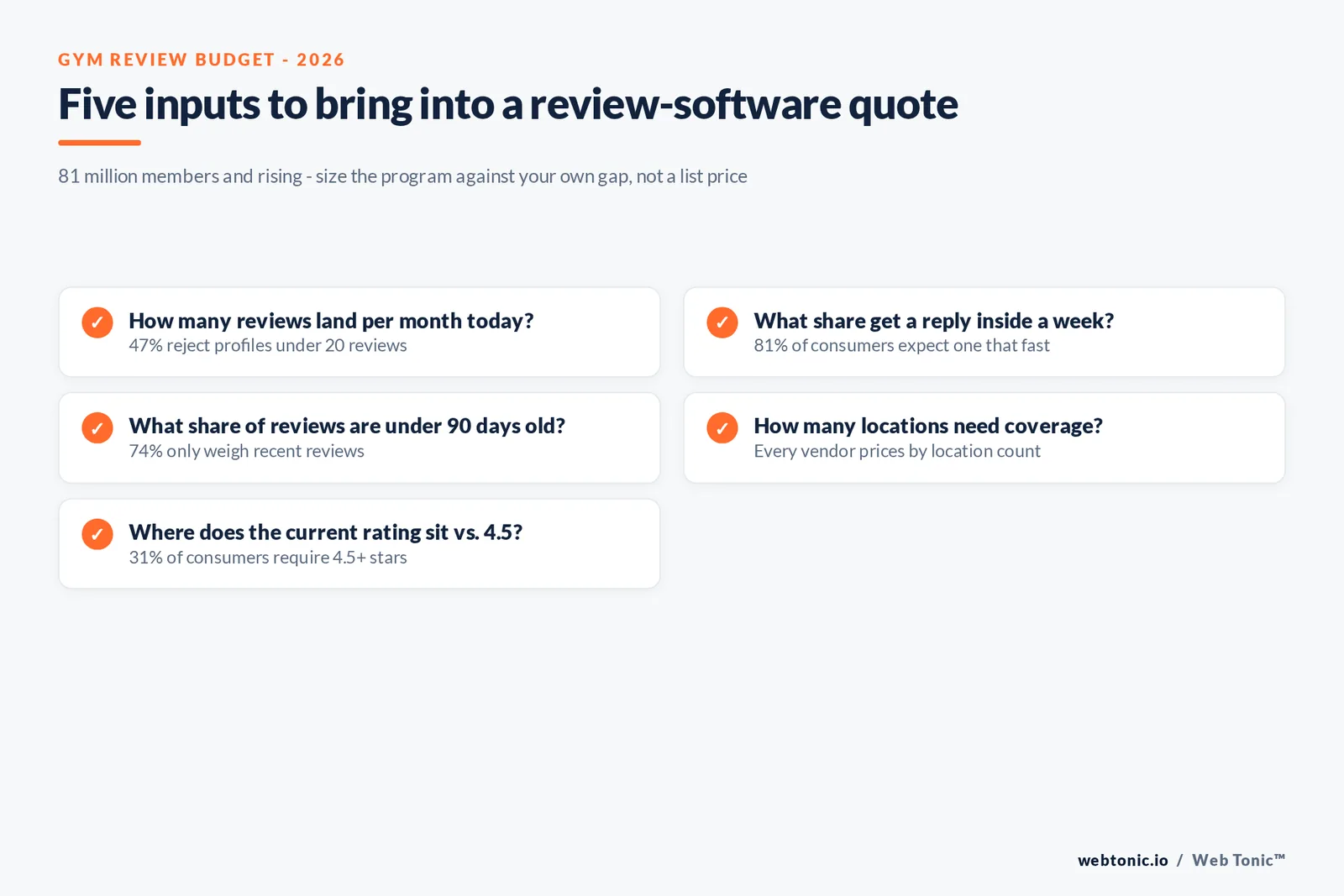
Neither Podium nor Birdeye publishes a public list price - both route every inquiry to a custom quote, priced by location count and feature scope. For a gym owner, the budget conversation is more productively framed around outcomes than a target dollar figure: how many net-new reviews per month does the current front-desk process generate without software, how many of those are answered inside a week, and how far below the 74%-recency and 47%-volume thresholds above does the current profile sit. Those three numbers turn a vendor's custom quote into a comparison against a defined gap, rather than a number with nothing to benchmark it against.
| Budget-conversation input | Why it matters | Where the number comes from |
|---|---|---|
| Reviews generated per month, current baseline | Sets the gap against the 47%/20-review filter | Your own GBP insights |
| Share of reviews replied to within 7 days | Benchmark against BrightLocal's 81% expectation | Your own reply logs |
| Share of reviews from the last 90 days | Benchmark against the 74% recency filter | Your own GBP insights |
| Number of active locations | Every vendor prices by location tier | Your own footprint |
| Current star rating vs. 4.5 | Sets distance from the 31% high-bar segment | Your own GBP profile |
A membership-specific review-request cadence
Because gym membership is recurring rather than one-time, the highest-yield moment to request a review is not the sign-up itself but a milestone inside the first 60-90 days - a completed onboarding program, a first class streak, or a measurable fitness result. That window lines up with the 74% recency filter: requesting reviews continuously across the member lifecycle, rather than only at signup, is what keeps a facility's rating inside the window consumers are actually reading.
What a review-request cadence looks like for three gym formats
Membership businesses are not uniform, and the moment worth requesting a review differs by format. A boutique studio's highest-emotion moment is a completed challenge or class-pack; a big-box gym's is a personal-training milestone or a measurable body-composition result; a franchise location's is often the 90-day renewal decision itself, when a member has enough data to describe a real outcome. Building the ask around that moment, rather than a fixed day-after-signup email, is what keeps the review pipeline inside the 90-day recency window BrightLocal's data says the majority of consumers are actually reading.
| Gym format | Highest-emotion review moment | Why it works |
|---|---|---|
| Boutique studio (CrossFit, F45-style) | Completed challenge or class-pack | Peak community feeling, easy to describe |
| Big-box gym | Personal-training milestone or measurable result | Concrete before/after the member can cite |
| Multi-location franchise | 90-day renewal decision | Enough tenure to describe a real outcome |
Internal resources worth reading alongside this one
For the broader local-search visibility picture, see Web Tonic's fitness local SEO statistics page, and the cross-industry reputation management statistics benchmark this page compares against. Facility owners scoping a broader growth-marketing partner can start from our growth marketing services page or get in touch directly.
What member churn data says about the cost of staying silent
Fitness membership is a recurring-revenue business, which makes reputation a retention lever as much as an acquisition one. A prospective member scanning a facility's profile before a tour is applying the same 31% only-4.5-stars and 47% won't-use-under-20-reviews filters described above, but an existing member deciding whether to renew is reading the same profile too - and a visible pattern of the manager engaging with feedback, positive or negative, is one of the few signals a renewing member can point to as evidence the facility is actively run rather than coasting. That is the same dynamic BrightLocal's broader data describes when it finds 80% of consumers more likely to use a business that answers every review: for a membership business, "use" includes the renewal decision, not only the first sign-up.
| Signal a renewing member can check | What it implies | Where it comes from |
|---|---|---|
| Reply present on recent reviews | Facility is actively managed | Business's own GBP profile |
| Reviews from the last 90 days | Facility still delivering a current experience | Business's own GBP profile |
| Rating trend over the last year | Improving, flat, or declining service | Business's own GBP profile |
| Response tone on negative reviews | How disputes get handled as a member | Business's own GBP profile |
Frequently Asked Questions
How big is the U.S. fitness membership market in 2026?
The Health & Fitness Association's 2026 US Health & Fitness Consumer Report found 81 million Americans belonged to a gym, studio, or other fitness facility in 2025 - an all-time high and a 5.2% increase over 2024. Counting non-members who used a facility through day passes or guest privileges, more than 100 million people used a fitness facility during the year. Membership penetration reached 26.1% of the U.S. population aged 6 and older.
Who is driving that growth, and why does it matter for reviews?
Growth is broad-based across age, income, and gender, but two groups stand out: Gen Z adults aged 18-24 have the highest penetration of any age group at 35.5%, and members aged 65 and older are the fastest-growing cohort, up 8.6% year over year. Those two groups research differently before joining - Gen Z leans on recent reviews and short-form content, older adults lean on trust signals like reply consistency - so a single review-response style will not read the same to both audiences.
What does review management software cost for a gym?
As with most vertical SaaS in this space, the leading platforms (Podium, Birdeye) publish quote-only pricing with no public list price, so there is no vendor number to cite. The useful comparison is scope: a single-location boutique studio and a 40-location franchise are priced on entirely different tiers by every vendor in this category, and a quote should be requested against your actual location count, not a published range that does not exist.
How fast do gym members expect a reply to their review?
BrightLocal's 2026 Local Consumer Review Survey found reply-speed expectations have compressed sharply: 19% of consumers now expect a same-day response, up from 6% a year earlier, and 81% expect a reply within a week. Gyms with a front-desk or member-services team already checking in daily are well placed to hit that window without new headcount - the review reply just needs to be added to that existing daily task list.
Does responding to reviews actually change whether someone joins?
BrightLocal's data says yes, directionally: 80% of consumers are more likely to use a business that responds to every review, against 42% who are unlikely to use one that never replies at all. For a gym specifically, where the buying decision is a recurring membership rather than a one-time purchase, a visible pattern of the owner or manager engaging with feedback is one of the few signals a prospective member can check before touring the facility.
Sources
Health & Fitness Association - 2026 US Health & Fitness Consumer Report
BrightLocal - Local Consumer Review Survey 2026
Whitespark - Local Search Ranking Factors 2026
Podium - Official Pricing Page (quote-only, checked 2026)
Birdeye - Official Pricing Page (quote-only, checked 2026)