Table of contents
Fitness and wellness operators are not the leading adopters of the automation tools that define the category. Mindbody's 2025 survey of the same broad industry found SMS, loyalty programs and AI adoption all trailing spas and salons -- this page prices what closing that gap costs in 2026, using vendors' own pricing pages, not a Web Tonic quote.
Key Takeaways
- 37% of fitness and wellness operators use SMS at least once a month.
- Loyalty programs are a primary retention tactic for just 21% of businesses overall.
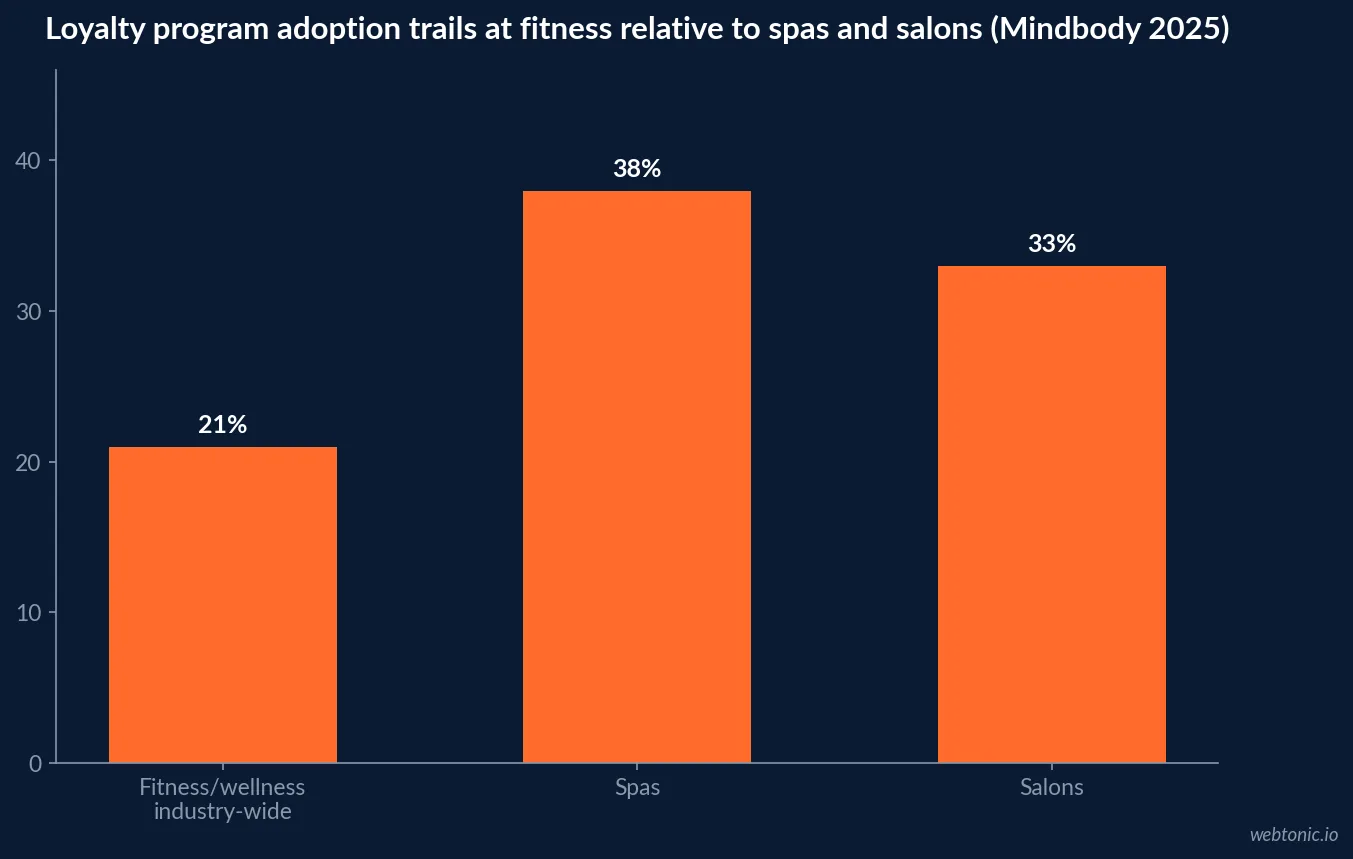
- Spas report loyalty-program adoption at 38%, salons at 33%.
- 72% of operators are optimistic about the year ahead.
- AI-investing operators are 1.6 times more likely to describe themselves as very optimistic.
- 54% of AI users plan to expand marketing, versus 37% of non-users.
- 46% of AI users plan to hire more staff, versus 32% of non-users.
- 21% of AI users plan to open new locations, versus 14% of non-users.
- Only 4% of businesses cut staff because of AI, the lowest of any industry surveyed.
- HubSpot's Starter tier runs $9 a seat a month billed annually.
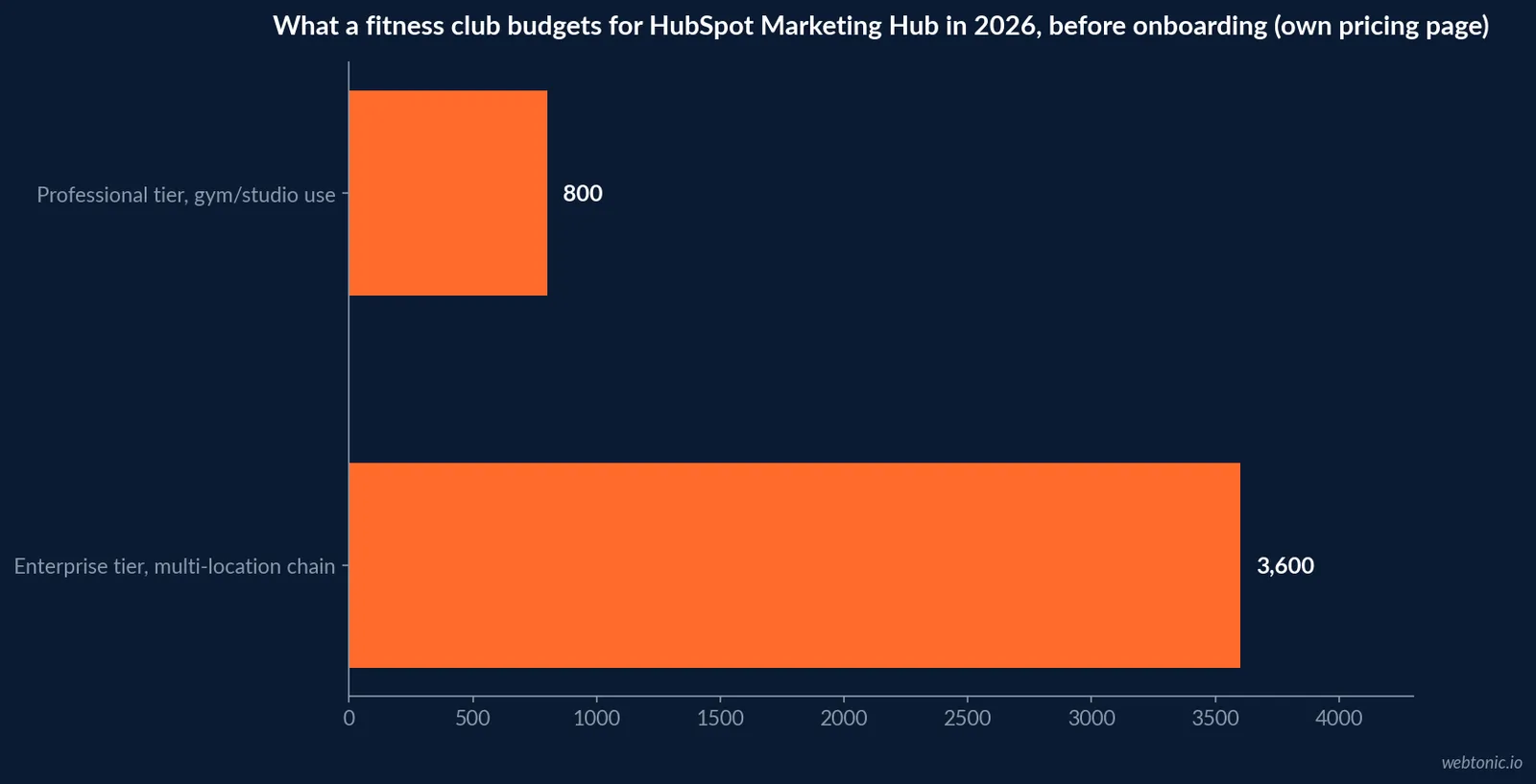
- HubSpot Professional runs $800 a month annual, plus a $3,000 onboarding fee.
- HubSpot Enterprise runs $3,600 a month, plus a $7,000 onboarding fee.
- ABC Fitness markets its own automation as a 30% growth lever for clubs, a vendor claim.
- Only 37% of companies across industries respond to leads within an hour, per a 2011 study.
- 23% of companies never respond to a lead at all, the same cross-industry study found.
- January 24, 2025: the 11th Circuit vacated the FCC's one-to-one consent rule before it took effect; TCPA prior express written consent still gates automated texts.
Fitness trails spas and salons on the tactics that define automation
Mindbody's 2025 State of the Industry Report, covering fitness, beauty and wellness businesses, found loyalty programs cited as a primary retention tactic by just 21% of businesses overall, with adoption notably higher among spas (38%) and salons (33%). A separate finding from the same survey put SMS usage at 37% of operators messaging clients at least monthly -- described in the report itself as "a sleeping giant" precisely because adoption still lags the channel's reliability. Fitness clubs specifically were not called out as leaders in either category.
| Automation/retention tactic (Mindbody 2025 survey) | Adoption |
|---|---|
| Loyalty program as primary retention tactic, industry-wide | 21% |
| Same, at spas | 38% |
| Same, at salons | 33% |
| Operators using SMS at least monthly | 37% |
| Operators optimistic about the year ahead | 72% |
| Operators describing themselves as pessimistic | 9% |
What AI adoption actually correlates with
The same survey ties technology investment to growth posture, not just sentiment. Operators already using AI were 1.6 times more likely to describe themselves as very optimistic (50% versus 31% of non-tech-forward operators). AI adopters were also more likely to plan expansion across every dimension tested: 54% planned to expand marketing efforts versus 37% of non-users, 42% versus 32% planned to add new services, 46% versus 32% planned to hire more staff, and 21% versus 14% planned to open new locations. Only 4% of fitness and wellness businesses reported reducing staff because of AI, the lowest share of any industry the survey covered.
| Growth plan (Mindbody 2025) | AI users | Non-users |
|---|---|---|
| Plan to expand marketing efforts | 54% | 37% |
| Plan to add new services | 42% | 32% |
| Plan to hire more staff | 46% | 32% |
| Plan to open new locations | 21% | 14% |
| Describe themselves as very optimistic | 50% | 31% |
What a general-purpose automation platform costs
No fitness-specific automation platform publishes a public price list, so this budgets from a general-purpose vendor's own pricing. HubSpot's Marketing Hub pricing guide lists a free tier (up to 2 users, 2,000 marketing emails a month), Starter at $9 a seat monthly on annual billing ($10 monthly), Professional at $800 a month annual ($890 monthly) with 3 core seats and a $3,000 onboarding fee, and Enterprise at $3,600 a month with 5 core seats and a $7,000 onboarding fee. A single-location boutique studio typically fits the Starter-to-Professional range; a multi-location chain needs Enterprise-level contact volume.
| HubSpot Marketing Hub tier (own pricing page) | Monthly price | One-time onboarding |
|---|---|---|
| Free | $0 | None |
| Starter | $9/seat (annual) / $10/seat (monthly) | None |
| Professional | $800 (annual) / $890 (monthly) | $3,000 |
| Enterprise | $3,600 | $7,000 |
The club-management platforms already selling automation as a feature
Club-management vendors market automation directly rather than pricing it separately. ABC Fitness, whose own site states its platforms help clubs "automate sales, member engagement, and operations" to grow a fitness business by 30% -- a vendor claim, not an independent benchmark, and worth reading with that label attached. Its own mid-2026 Wellness Watch data, covered on our companion lifecycle page, shows gym cancellations rising even as the vendor's own marketing leans on automation as the answer, which is a reasonable prompt to ask any vendor for the retention data behind the growth number before buying.
Speed to lead: the cross-industry baseline nobody has beaten
No fitness-specific lead-response study is publicly available, so the honest baseline is the cross-industry one. Harvard Business Review's "The Short Life of Online Sales Leads" (2011) found only 37% of companies responding to a web-generated lead within an hour, 16% within one to 24 hours, 24% taking more than 24 hours, and 23% never responding at all. That study predates most of today's automation tooling, which is exactly the argument for using automated first-response messaging as the floor, not the whole strategy, for a gym or studio's lead flow.
| Lead response window (cross-industry, HBR 2011) | Share of companies |
|---|---|
| Within 1 hour | 37% |
| 1 to 24 hours | 16% |
| More than 24 hours | 24% |
| Never responded | 23% |
The compliance line item for SMS automation
Text automation to U.S. members runs under the Telephone Consumer Protection Act's prior express written consent requirement (the FCC's 2023 one-to-one consent rule was vacated by the 11th Circuit on January 24, 2025, before its January 27 start date), plus CTIA's A2P 10DLC messaging principles for registered business texting campaigns. Neither rule is fitness-specific, but both determine whether an automated renewal reminder or win-back text is actually deliverable, independent of which platform sends it.
Building the 2026 automation line item for a club or studio
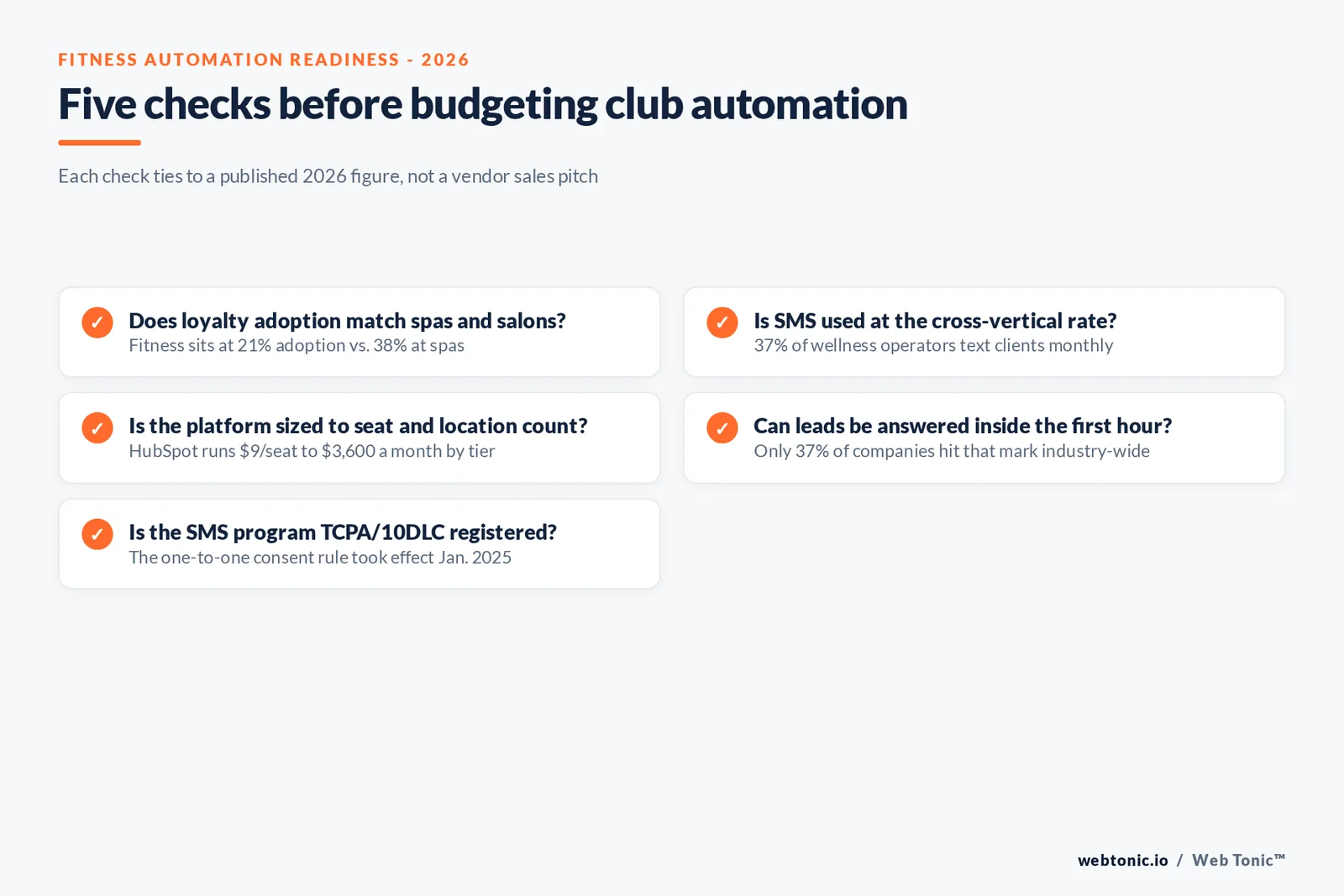
A defensible budget starts with the adoption gap: fitness sits behind spas and salons on loyalty programs (21% vs. 38%) and likely behind on SMS relative to the 37% cross-vertical average, so closing that gap is the first lever, not a new acquisition channel. Layer a platform sized to contact volume (HubSpot's own tiers run $9 a seat to $3,600 a month before onboarding), commit to a fast first-response message inside the automation flow, and register the SMS program under TCPA and A2P 10DLC before sending the first campaign. Our growth marketing team sizes exactly this stack against a club's member volume, and our marketing automation statistics hub tracks the same questions across other verticals. See our companion piece on what paid search costs before adding automation spend on top of an acquisition budget.
Sizing the platform to the club, not the category average
Neither the loyalty-adoption gap nor the SMS figure above is fitness-specific by design — both come from a survey spanning fitness, beauty and wellness, so a single boutique studio and a 27,000-facility chain are averaged into the same 21% and 37%. A single-location studio evaluating HubSpot's own tiers should size to its actual contact list and seat count against the Starter and Professional thresholds above, not the enterprise tier a multi-location chain needs. Buying Enterprise capacity for Starter-level contact volume is the single most common automation overspend this data set can be used to catch.
| Club profile | Realistic HubSpot tier (own pricing) | Why |
|---|---|---|
| Single studio, under 1,000 contacts | Starter, $9-10/seat | Fits the included contact tier |
| Multi-location, 2,000-10,000 contacts | Professional, $800-890/mo | Matches Professional's included range |
| Franchise/chain, 10,000+ contacts | Enterprise, $3,600/mo | Only tier built for that contact volume |
Why the adoption gap is an opportunity, not just a deficit
A category trailing spas and salons on loyalty tech and likely on SMS is also a category where the easy wins have not been taken yet. Mindbody's data shows AI-adopting operators across the same fitness-and-wellness survey outperforming non-adopters on every expansion metric tracked — marketing effort, new services, hiring and new locations — without a matching increase in layoffs. A club or studio that closes the loyalty and SMS gap first, before competitors do, is applying tooling that is already proven in adjacent verticals rather than piloting something unproven. That is a materially lower-risk automation bet than most categories get to make.
Frequently Asked Questions
How many fitness businesses actually use marketing automation tools?
Mindbody's 2025 State of the Industry Report found 37% of fitness and wellness operators using SMS at least once a month for client communication, and loyalty programs cited as a primary retention tactic by 21% of businesses overall, with adoption notably higher among spas (38%) and salons (33%). Fitness clubs specifically were not the leading adopters in either category within that survey.
What does a marketing automation platform cost a fitness club?
There is no fitness-specific price list, so budget from general-purpose platform pricing. HubSpot's own Marketing Hub pricing guide lists Starter at $9 a seat monthly (annual billing), Professional at $800 a month annual ($890 monthly) with 3 core seats plus a $3,000 onboarding fee, and Enterprise at $3,600 a month with 5 core seats plus a $7,000 onboarding fee. A single-location boutique studio realistically sits in the Starter-to-Professional range; a multi-location chain needs Enterprise.
Does adopting AI actually change growth plans for fitness operators?
Mindbody's 2025 data says yes, directionally. Operators already using AI were 54% likely to plan marketing-effort expansion versus 37% of non-users, 42% versus 32% planned to add new services, 46% versus 32% planned to hire more staff, and 21% versus 14% planned to open new locations. Only 4% of fitness and wellness businesses reported reducing staff because of AI, the lowest of any industry surveyed.
Is speed of lead response as important for gyms as it is for other local services?
The specific evidence is cross-industry, not fitness-specific, so state it that way. Harvard Business Review's 2011 study 'The Short Life of Online Sales Leads' found only 37% of companies across industries responding to a web lead within an hour, and 23% never responding at all. No fitness-club specific response-time study exists publicly, but the mechanism -- a lead that goes cold before a human replies -- is not industry-specific either.
What compliance rules apply to automated texting for gym members?
SMS and app-push automation to U.S. members falls under the Telephone Consumer Protection Act (TCPA) prior express written consent requirement (the FCC's one-to-one consent rule was vacated by the 11th Circuit on January 24, 2025, before it took effect) and CTIA's A2P 10DLC registration and messaging principles for business texting campaigns. Neither is fitness-specific, but both gate whether an automated reminder or promotion is legally deliverable in the first place.
Sources
Mindbody - Top 5 Takeaways from the 2025 State of the Industry Report
Mindbody - 2025 State of the Industry Report (full PDF)
HubSpot - Marketing Hub pricing guide
ABC Fitness - Mid-Year 2026 Wellness Watch Report press release
Harvard Business Review - The Short Life of Online Sales Leads, 2011
FCC - One-to-One Consent Rule for TCPA, Prior Express Written Consent FAQs
CTIA - Messaging Principles and Best Practices