Table of contents
A gym's Google Business Profile is read by Google mechanically before a single member ever reads it - category, hours, photo count and review recency all feed a ranking weight before a prospective member sees a star rating. This page benchmarks that mechanical side: what the Performance report measures, how much of the local ranking a profile itself carries, and what gets a profile suspended.
Key Takeaways
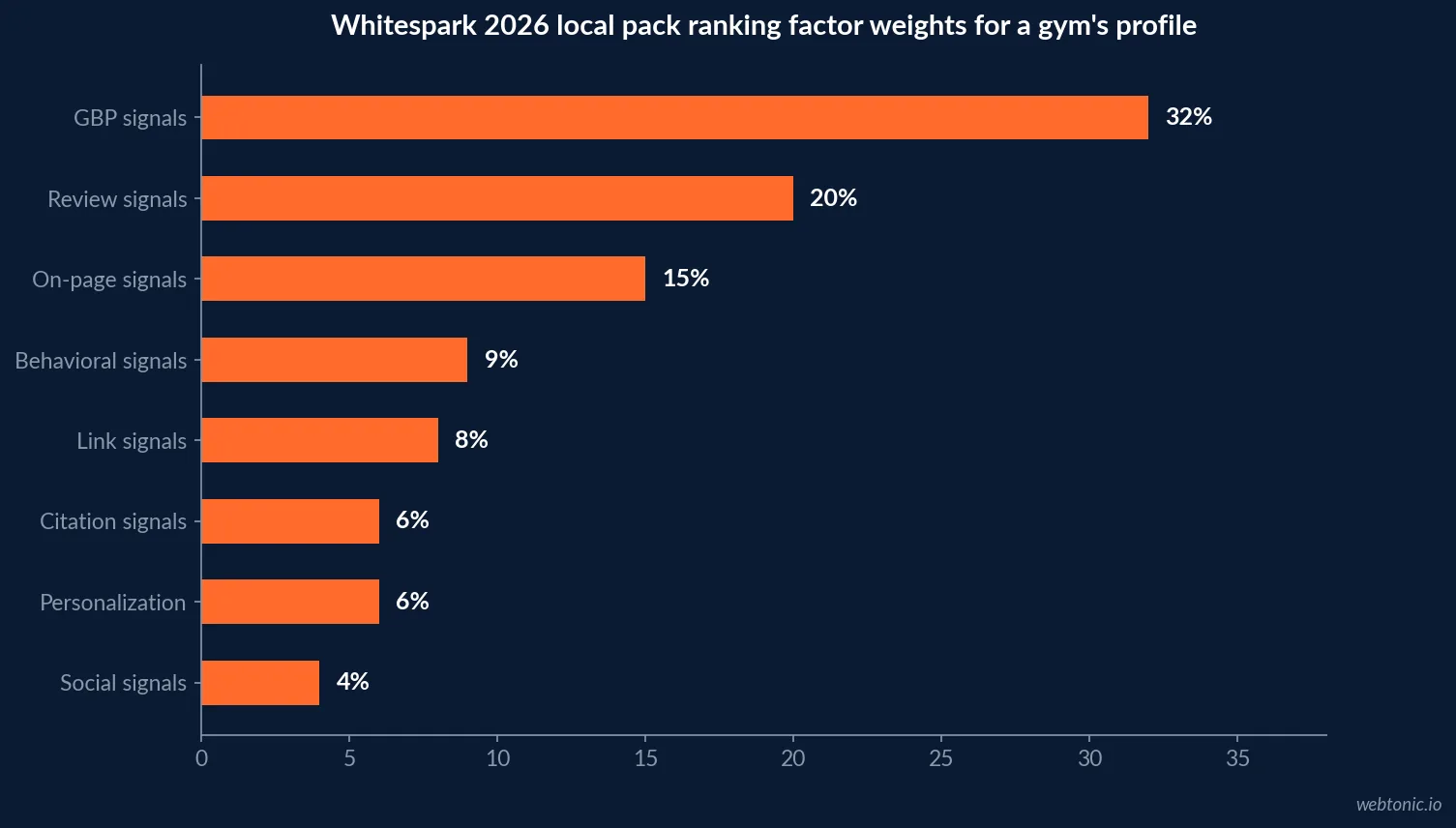
- Google Business Profile signals carry 32% of local pack ranking weight in 2026.
- Review signals are the second-largest bucket at 20%.
- On-page signals rank third at 15%, behavioral signals fourth at 9%.
- 81 million Americans belonged to a gym, studio or fitness facility in 2025.
- That is a 5.2% increase year over year, an all-time high.
- Membership penetration reached 26.1% of the US population aged 6-plus.
- Industry-wide churn fell to 7.1%, its lowest level in a decade.
- Average membership tenure rose to 5 years, also a decade high.
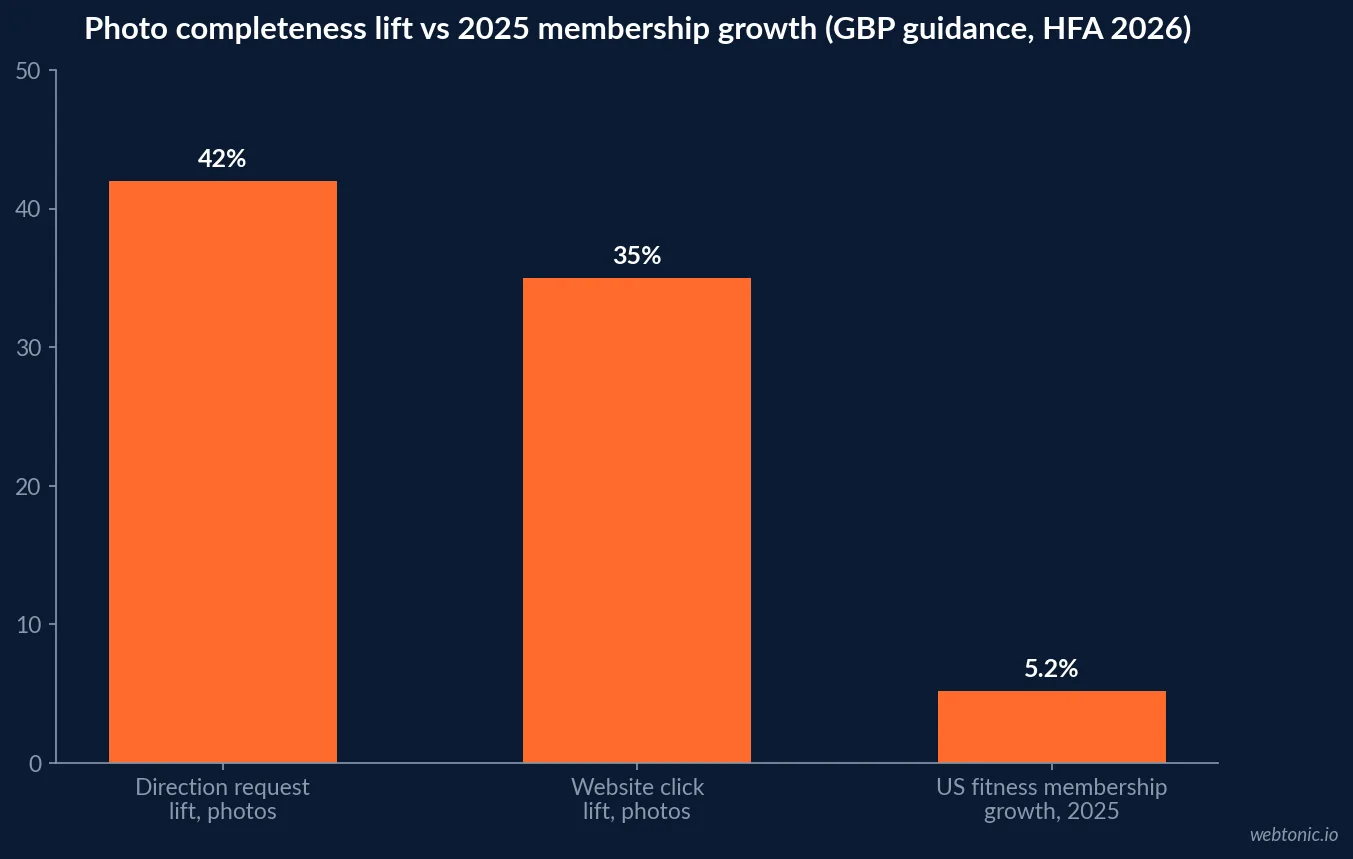
- Complete profiles with photos see 42% more direction requests.
- Photo-equipped listings also see 35% more website clicks.
- A business may hold only one profile per location under Google's guidelines.
- Reporting operators posted 9.9% median revenue growth in the 2025 benchmarking year.
- Median EBITDA margin reached 23.6% for the same reporting cohort.
- Median net membership growth was 5.5% across reporting operators.
- Fitness search ads saw a cost per lead of USD 67.36 in 2026.
- That cost per click rose about 23% year over year to USD 6.17.
- Health and Fitness click-through rate fell 19.08% year over year, to 5.81%.
- A suspended profile only comes back via an evidence-backed appeal.
Where a gym's ranking weight actually comes from
Whitespark's 2026 Local Search Ranking Factors report, a survey of 47 local search practitioners now in its eighth edition since Darren Shaw took it over in 2017, puts Google Business Profile signals at 32% of local pack ranking weight, ahead of review signals at 20%, on-page signals at 15%, behavioral signals at 9%, link signals at 8%, citation signals at 6%, personalization at 6% and social signals at 4%. That is not a fitness-specific weighting - it is the cross-industry local-pack model every storefront business competes inside, gyms included.
The practical read for a gym operator: the profile itself outweighs the website by roughly two to one for map-pack purposes. A beautiful site with a stale profile loses to a plain site with an active one.
| Ranking signal group | Share of local pack weight (2026) | What it covers for a gym |
|---|---|---|
| Google Business Profile signals | 32% | Category, hours, photos, posts, Q&A, attributes |
| Review signals | 20% | Star rating, review volume, recency, owner replies |
| On-page signals | 15% | Location page content, NAP match, service detail |
| Behavioral signals | 9% | Click-through and engagement on the listing |
| Link signals | 8% | Backlinks to the domain and location page |
| Citation signals | 6% | NAP consistency across directories |
| Personalization | 6% | Searcher history and proximity to the searcher |
| Social signals | 4% | Social profile activity and engagement |
Picking the right category is not cosmetic
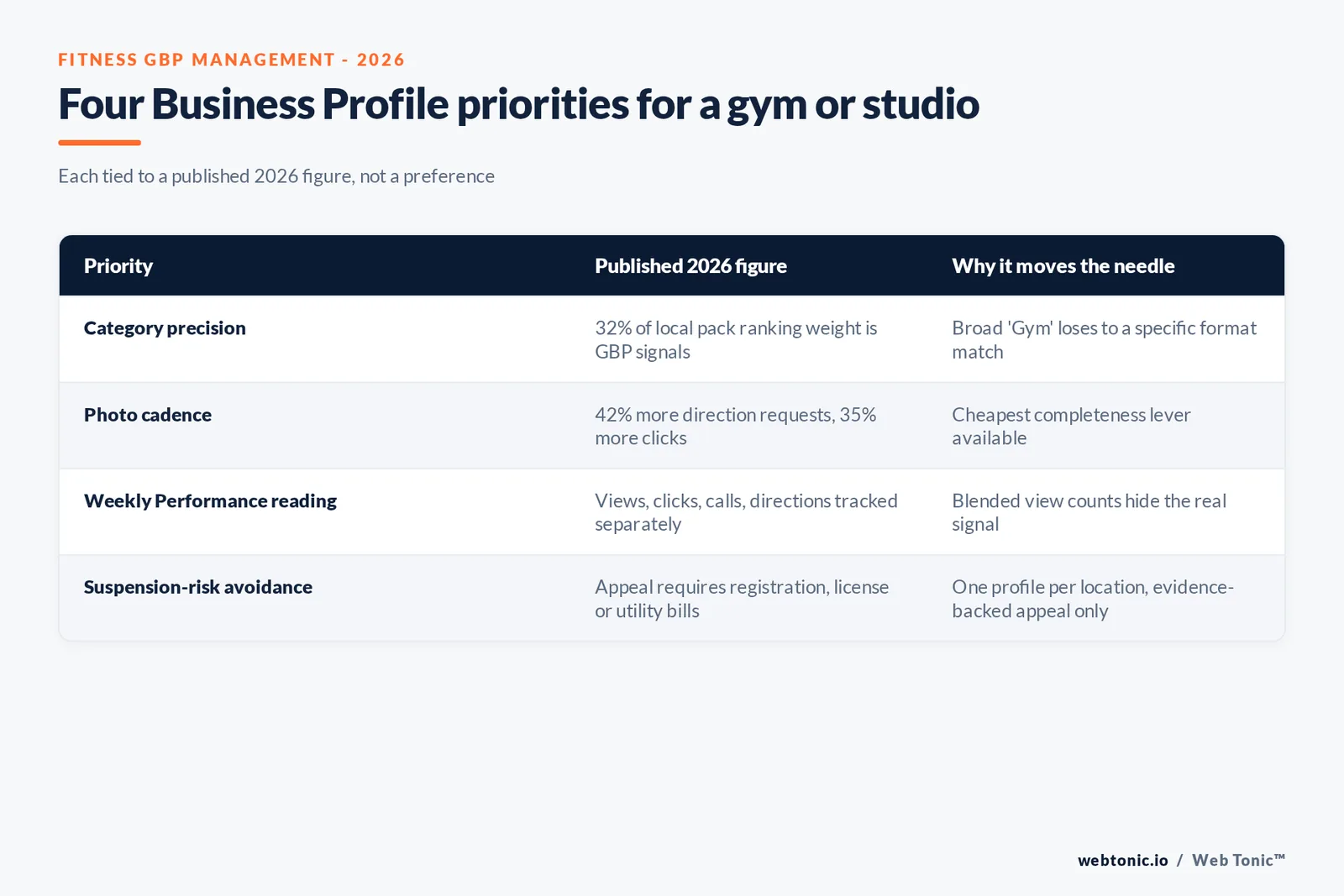
Google's own guidance for managing your business category is to select the category that completes "this business IS a," not a list of everything the location offers, and its guidelines for representing your business reinforce the same rule for every profile, all locations sharing one primary category. For fitness that means a CrossFit box, a Pilates studio and a boxing gym should each pick their specific category over the generic "Gym" or "Health club" that fits a 24-hour chain location - Google's algorithm rewards the narrower match to what a searcher actually typed.
Multi-location operators run into this the most: a chain that lets every location default to "Gym" during bulk upload is leaving category-match ranking on the table at every boutique-format location in the portfolio.
| Fitness format | Recommended primary category | Category to avoid as primary |
|---|---|---|
| 24-hour chain gym | Gym | Health club (too broad for this format) |
| Boutique strength studio | CrossFit gym / Personal trainer | Gym |
| Pilates or barre studio | Pilates studio | Health club |
| Yoga studio | Yoga studio | Gym |
| Boxing or combat sports gym | Boxing gym | Gym |
| Medically supervised fitness | Physical fitness program | Gym |
Photos and completeness: still the easiest lever
Across Google Business Profile management guidance, complete profiles with photos are credited with 42% more direction requests and 35% more website clicks than photo-light listings. Fitness locations are a natural fit for this lever - a facility tour, class photos and equipment shots are cheap to produce and directly address what a "gym near me" searcher is trying to judge before walking in.
There is no published fitness-specific photo-count ceiling, so treat photo cadence, not photo total, as the metric that matters: five current photos beat forty photos from a facility that has since been renovated.
Reading the Performance report for a gym location
Google's own documentation on Business Profile performance and insights is explicit that performance data is available only for verified profiles, and it breaks the metric set into what customers saw (searches and views) and what they did next (calls, clicks, direction requests). For a gym that means the report separates "how many people found the class schedule page" from "how many people picked up the phone to ask about a trial" - two very different signals that get conflated when an owner only checks the top-line view count.
The practical habit worth building: read views, website clicks, calls and direction requests as four separate weekly numbers, not one blended score, because a facility running a walk-in promotion wants direction requests to move, while a facility selling phone-booked personal training wants calls to move.
| Performance metric | What it measures for a gym | What a change in it usually means |
|---|---|---|
| Search views | How many searches surfaced the profile | Category or keyword match shift |
| Map views | Discovery via Google Maps browsing | Nearby competitor density or radius change |
| Website clicks | Traffic sent from the profile to the site | Interest in class schedule or pricing |
| Calls | Direct calls placed from the profile | Trial or membership inquiry intent |
| Direction requests | Requests for driving directions | Walk-in or drop-in intent |
Suspension and verification risk for a fitness location
Google's guidelines for representing your business require one profile per location, an address and category that reflect the business as it exists in the real world, and compliance with its prohibited-content rules; profiles that fall short can be suspended or disabled, and reinstatement runs through Google's appeal tool with business registration, a license, or utility bills matching the profile's name and address as evidence. Separately, Business Profile restrictions for policy violations cover fake or incentivized reviews specifically, and can block a profile from receiving new reviews or unpublish existing ones for a set period, independent of a suspension.
A gym running a "leave us five stars for a free class" promotion at the front desk is the single most common way an otherwise clean profile trips the fake-engagement restriction, not the suspension rule - the two are enforced separately and worth treating as separate risks.
The membership backdrop the profile work sits inside
The Health & Fitness Association's 2026 US Health & Fitness Consumer Report (HFA, formerly IHRSA) counts 81 million Americans as gym, studio or fitness-facility members in 2025, a 5.2% increase year over year and an all-time high, pushing membership penetration to 26.1% of the US population aged 6 and older. The same research line reports industry-wide churn falling to 7.1%, a decade low, down from 10.2% in 2024, with average membership tenure rising to five years, also a decade high.
HFA's 2025 Fitness Industry Benchmarking Report, covering 175 companies representing more than 17,000 facilities, put median operator revenue growth at 9.9%, median EBITDA margin at 23.6%, and median net membership growth at 5.5%, with reported member retention averaging 66.4% for the reporting year.
| Fitness industry metric (2025-26) | Figure | Source |
|---|---|---|
| US gym/studio membership | 81 million members | HFA 2026 Consumer Report |
| Membership growth YoY | +5.2% | HFA 2026 Consumer Report |
| Membership penetration, US pop. 6+ | 26.1% | HFA 2026 Consumer Report |
| Industry churn rate | 7.1% (decade low) | HFA/HFB Survey, May 2026 |
| Average membership tenure | 5 years (decade high) | HFA/HFB Survey, May 2026 |
| Median operator revenue growth | 9.9% | HFA 2025 Benchmarking Report |
| Median EBITDA margin | 23.6% | HFA 2025 Benchmarking Report |
What a paid-search comparison tells you about how much this matters
WordStream/LocaliQ's 2026 Search Advertising Benchmarks by Industry report, drawn from over 13,000 campaigns across 23 industries, tracks Health and Fitness cost per click rising roughly 23% year over year to about USD 6.17, with click-through rate falling 19.08% to 5.81% and cost per lead landing near USD 67.36. Free organic visibility through a well-managed profile is not a replacement for paid search, but it is the one channel in this comparison whose marginal cost per additional view is zero once the profile is verified and complete.
That is the honest argument for prioritizing profile management before scaling paid search spend: it is the cheapest lever in the stack, even though it is not the only one a gym needs.
What management actually costs versus doing it in-house
Published vendor pricing pages, not any single agency's rate card, put dedicated GBP management tools at roughly USD 49 to USD 89 a month for single-to-small-multi-location tiers (GBPcentral), rising to USD 349 a month for its agency tier managing multiple clients' profiles. Broader local-listing and reputation platforms price similarly at scale: Vendasta lists plans starting at USD 99 a month, and GatherUp lists USD 99 a month for a single location, dropping to about USD 60 a month per location across a 2-to-10-location account. For a single-location gym the cheaper tiers cover posting cadence and review monitoring; for a regional chain managing dozens of locations, the higher tiers buy bulk category and hours consistency that a manual process cannot hold at scale.
Whichever route a gym takes, the work itself is the same four things this page benchmarks: category precision, photo cadence, weekly Performance reading and suspension-risk avoidance. If a location needs that built out and reported on, our growth marketing practice runs local visibility programs end to end, and our team can scope what a specific portfolio of locations needs.
Posts, Q&A and messaging for a gym profile
Beyond the static fields, Google's own documentation covers three interactive surfaces worth running deliberately on a gym profile. Edit your Business Profile confirms owners and managers can answer questions in the profile's public Q&A section - useful for the "do you have a trial class" question that otherwise sits unanswered for weeks. Chat with customers from your Business Profile documents that a claimed and verified profile can add a text or WhatsApp messaging option, giving a gym a real-time channel that doesn't require a phone call for a simple class-schedule question.
Neither surface is optional maintenance in a category where the buying decision often hinges on one quick logistical question - hours, trial availability, parking - that a prospect will not always wait for an email reply to answer.
| Interactive surface | What it's for | Risk if left unmanaged |
|---|---|---|
| Q&A section | Public questions any searcher can post and answer | Wrong or stale answers from strangers stand uncorrected |
| Messaging (text/WhatsApp) | Real-time contact once the profile is verified | Missed messages read as unresponsiveness |
| Posts | Time-limited updates (offers, classes, events) | A stale post signals an inactive business |
What reviews add once the profile itself is complete
BrightLocal's 2026 Local Consumer Review Survey found 47% of consumers won't use a business with fewer than 20 reviews, 68% expect at least a 4-star average, and 74% only weight reviews from the last three months as relevant. It also found 89% of consumers expect a business to reply to reviews, with reply speed itself tiered: 19% expect a reply within a day, 32% within three days, and 81% within a week. BrightLocal's 2025 edition separately found 96% of consumers open to writing a review when asked, though only 4% say they never read reviews at all, and 40% now check two or more review sites before deciding.
For a gym specifically, the 20-review and 3-month-recency thresholds are the two easiest to miss: a location with 45 reviews from 2022 reads, by BrightLocal's own data, closer to a business with no current reviews than one with a healthy pipeline.
| BrightLocal review benchmark | Figure | Edition |
|---|---|---|
| Won't use a business with fewer than 20 reviews | 47% | 2026 |
| Expect at least a 4-star average | 68% | 2026 |
| Only weight reviews from the last 3 months | 74% | 2026 |
| Expect a business to reply to reviews | 89% | 2026 |
| Expect a reply within a week | 81% | 2026 |
| Open to writing a review when asked | 96% | 2025 |
| Check 2 or more review sites before deciding | 40% | 2025 |
Multi-location chains and bulk verification
A regional or national gym chain does not manage category and hours consistency one location at a time. Google's own Import and update Business Profiles in bulk guidance and its companion Verify Business Profiles in bulk page cover the spreadsheet-based workflow available once a chain manages 10 or more locations - the same mechanism a franchise group or a corporate chain uses to keep every location's primary category, hours and service area consistent from one file rather than dozens of manual edits.
The trade-off is real: bulk-managed chains gain consistency but lose the per-location nuance that a boutique studio's owner-operator naturally applies, which is exactly why the category-precision advice earlier on this page matters even more inside a bulk-uploaded chain.
Where this fits against a gym's paid channels
Our own fitness Google Ads benchmarks cover what a gym pays per click and per lead once it moves past organic and profile work into paid search, and our reputation and review management statistics page goes deeper on the review-reply economics touched on above. Read together with this page, the three cover the free lever (the profile), the review layer sitting on top of it, and the paid layer a gym adds once both are in place.
Frequently Asked Questions
What's the right primary category for a boutique studio versus a 24-hour gym?
Google's own guidance is to pick the most specific category that completes "this business IS a," not a list of amenities. A CrossFit box, Pilates studio or boxing gym ranks on its own specific category ("CrossFit gym," "Pilates studio," "Boxing gym"), not the broad "Gym" or "Health club" that a 24-hour chain location correctly uses. Two studios competing for "pilates near me" with one filed under "Gym" and one under "Pilates studio" are not on a level field.
How many photos does a location's profile actually need?
Google's own data, cited across GBP management guidance, credits complete profiles with photos at 42% more requests for directions and 35% more website clicks than photo-light listings. There is no published fitness-specific photo-count ceiling, so the operating rule is recency and volume together: a profile with 5 fresh photos a month outperforms one with 40 photos from a 2023 renovation.
What share of a gym's local ranking actually comes from the Business Profile itself?
Whitespark's 2026 Local Search Ranking Factors survey of 47 local SEO practitioners puts Google Business Profile signals at 32% of the local pack ranking weight, ahead of review signals (20%), on-page signals (15%) and every other bucket. That 32% is a cross-industry weight, not a fitness-only figure, but it is the single largest bucket for any storefront local business, including a gym.
Can a gym lose its profile, and what does getting it back look like?
Yes. Google suspends or disables profiles that violate its guidelines, most commonly for address, category or fake-engagement violations, and the only way back is its appeal tool with evidence: business registration, a license, or utility bills matching the profile's name and address. Google also restricts profiles found running fake or incentivized reviews, including blocking new reviews for a set period, independent of the appeal.
Is membership growth actually connected to local search visibility, or just correlated?
The two data points that matter here are separate studies, not one causal chain, and the honest answer is correlation, not causation: HFA's 2026 report counts 81 million US gym and studio members in 2025 (up 5.2%) with churn at a decade low of 7.1%, while Whitespark's survey establishes GBP as the heaviest local-ranking bucket. Neither study measures whether better profile management drove the membership gain, so treat GBP work as a proven local-visibility lever, not a guaranteed membership driver.
Sources
Whitespark - 2026 Local Search Ranking Factors report
Google Business Profile Help - Manage your business category
Google Business Profile Help - Guidelines for representing your business on Google
Google Business Profile Help - Understand your performance & insights
Google Business Profile Help - Business Profile restrictions for policy violations
Health & Fitness Association - 2026 US Health & Fitness Consumer Report
Health & Fitness Business - Research: HFA Survey, May 2026
Health & Fitness Association - 2025 Fitness Industry Benchmarking Report
WordStream/LocaliQ - 2026 Search Advertising Benchmarks by Industry
BrightLocal - Local Consumer Review Survey
GBPcentral - GBP Management Software Pricing
Vendasta - Pricing
GatherUp - Review Software Pricing