Table of contents
Fitness software programs that publish a rate converge on 30% of the subscription, paid recurring for up to a year - while gym studios running a refer-a-friend program give away a single discounted or free month. Those are two different budgets for two different mechanics, and this page prices both from the vendors' own published terms rather than a single blended industry number that does not exist.
Key Takeaways
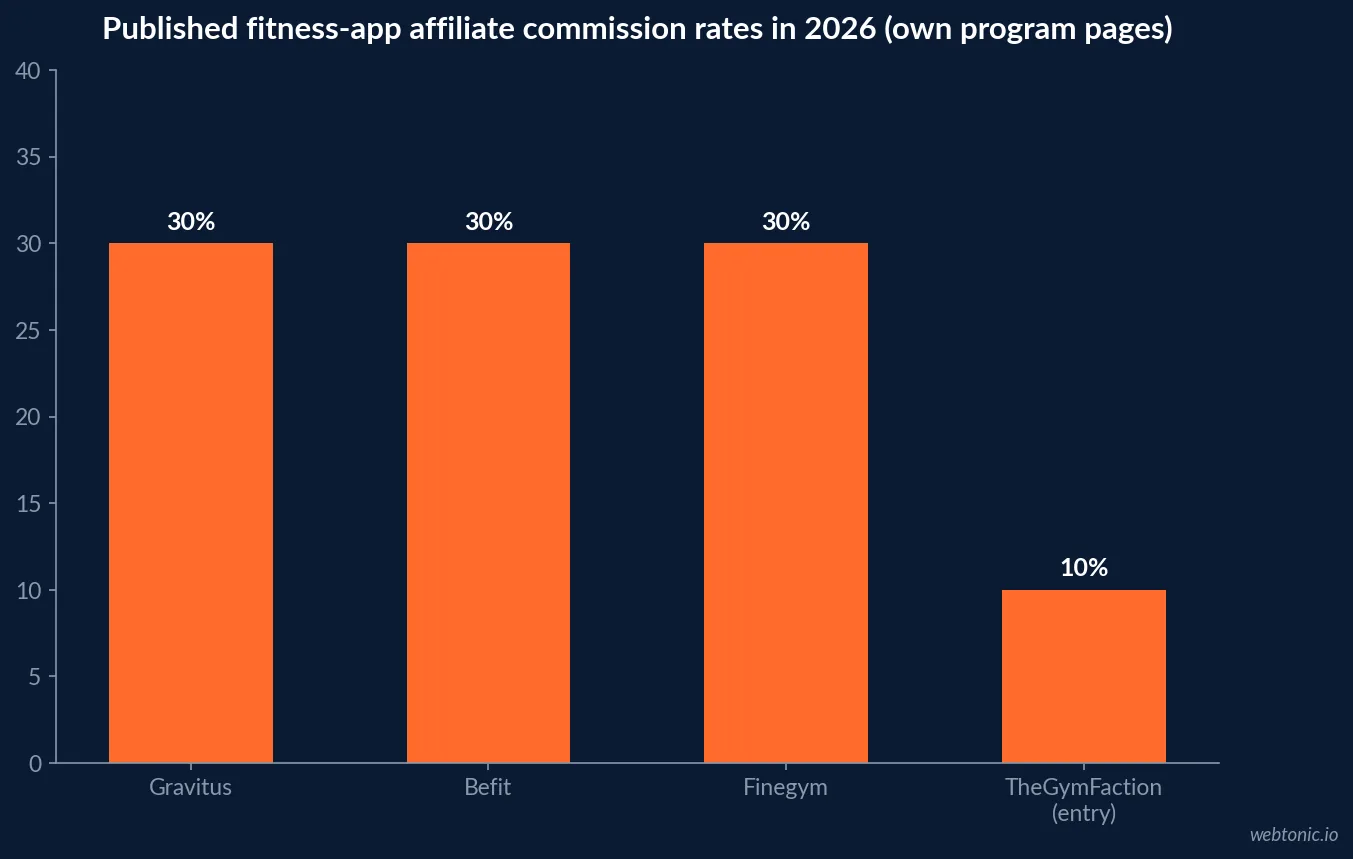
- Gravitus pays a flat 30% commission on every fitness-app subscription referred.
- Befit pays 30% on new subscriptions generated through its affiliate link.
- Finegym pays 30% recurring for 12 months, up to USD 285 per customer a year.
- TheGymFaction starts affiliates at 10%, stepping to 15%, 20% or 25% on volume.
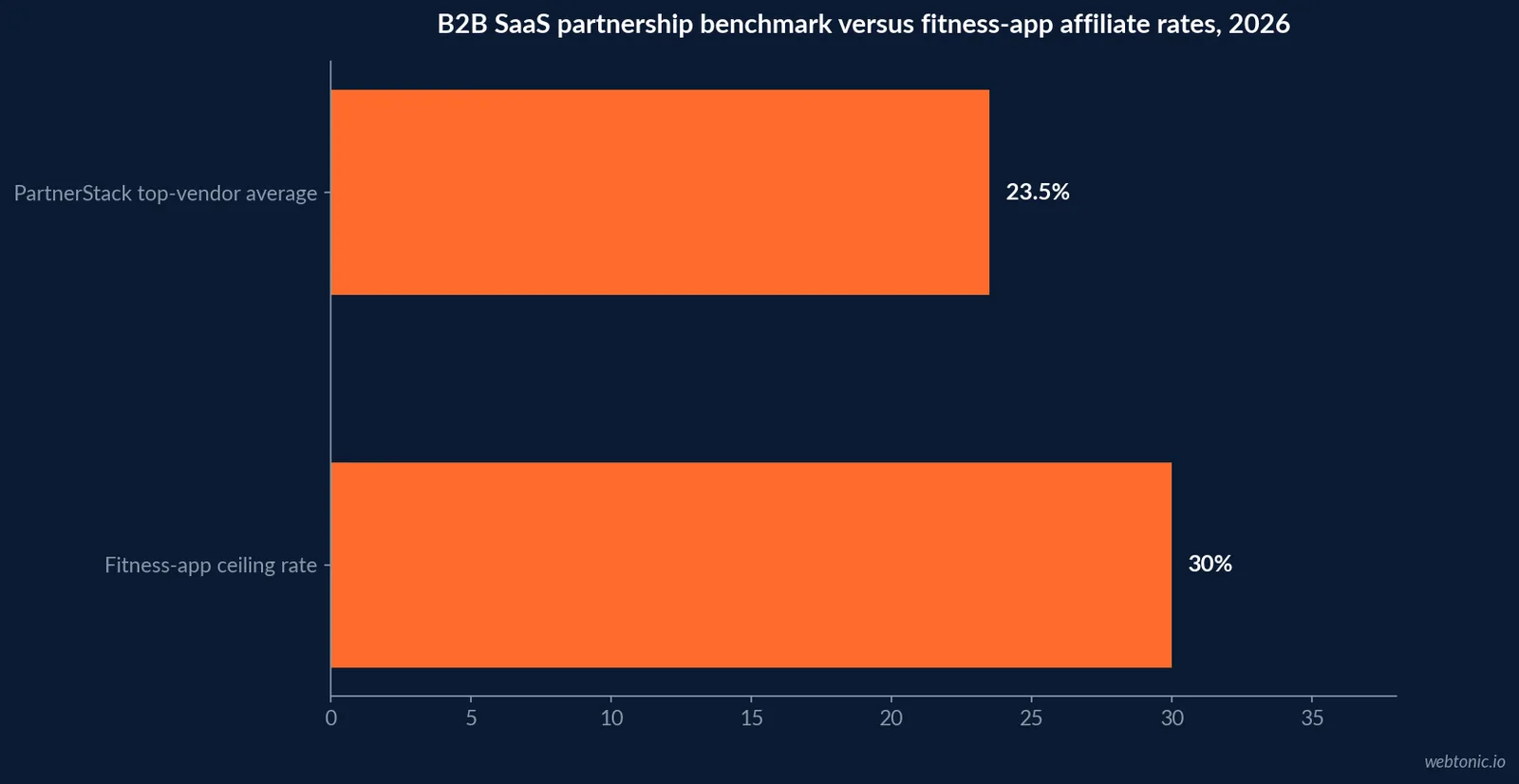
- PartnerStack's top vendors averaged a 23.5% commission across its 2023 network data.
- Top PartnerStack offers cluster at 20%, 25% and 30%, with some SaaS categories to 35%.
- STC Boxing & Fitness discounts 50% off the referrer's next month per successful referral.
- JQ's BFit2 discounts 20% per referral, stacking toward a free membership.
- 43% of advertisers increased affiliate spend over the past year (cross-vertical, IAB Australia).
- 59% plan to increase affiliate spend further next year.
- 34% of advertisers already spend USD 50,000-plus a month gross on the channel.
- CPA remains the dominant payment model, used by 74-86% of advertisers and publishers.
- 51% of advertisers manage programs in-house, 26% via agency, 19% via network.
- 36% of advertisers say affiliate drives over 10% of online revenue.
- 60% of publishers say affiliate is up to 49% of their company's revenue.
Two budgets, not one
"Fitness affiliate marketing" covers two mechanically different programs that get budgeted as if they were one. A subscription fitness app pays a percentage of recurring revenue to a content creator or reviewer through a tracked link - a true affiliate program. A gym or studio pays an existing member a discount for bringing a friend - a referral loyalty mechanic. No published study separates spend on the two, so the honest starting point is each vendor's own published terms, laid out side by side.
What fitness software affiliate programs actually pay
| Program (own page, 2026) | Published commission | Term | Notes |
|---|---|---|---|
| Gravitus | 30% | Every sale | Monthly and yearly plans |
| Befit | 30% | New subscription | Per new subscriber attracted |
| Finegym | 30% recurring | 12 months | Up to USD 285/customer/year |
| TheGymFaction | 10%, stepping to 25% | Ongoing, performance-based | Auto-upgrades on volume |
| PartnerStack network average (context) | 23.5% | 2023 network data | Top-25 vendors by payout |
What a gym membership referral actually pays
Studio-level referral programs do not move cash commission at all - they move service credit against the referrer's own bill. STC Boxing & Fitness gives a 50% discount off the referrer's next month once the referred member completes their first month. JQ's BFit2 runs an unlimited program at 20% off per successful referral, stacking toward a free membership. The Spot Climbing Gym discounts the next month's dues on the same mechanic. None of these three track through a cookie or an affiliate link - they are redeemed manually against an existing account.
| Program (own page, 2026) | Reward structure | Mechanic |
|---|---|---|
| STC Boxing & Fitness | 50% off next month | Manual credit, existing member only |
| JQ's BFit2 | 20% off per referral, stacking | Manual credit, existing member only |
| The Spot Climbing Gym | Discount on next month's dues | Manual credit, existing member only |
Where fitness software sits against the B2B partnership benchmark
PartnerStack's own Research Lab data puts its top-25 vendors' average paid commission at 23.5% in 2023, with the highest-performing offers clustering at 20%, 25% and 30%, and certain recurring-revenue software categories such as ERP reaching 30-35%. Fitness-app programs publishing a flat 30% are pricing themselves at the top of that band rather than the middle, which tracks with a category where subscriber lifetime value is the entire pitch to an affiliate.
How much affiliate spend is actually moving, cross-vertical
No fitness-only spend survey exists, so the honest cross-vertical benchmark is IAB Australia's 2025 Affiliate & Partnership Marketing Industry Review: 43% of advertisers increased spend over the past year, 59% plan to increase it further, and 34% already spend USD 50,000 or more a month gross on the channel. CPA remains the dominant model, used by 74% of advertisers and 86% of publishers in the same survey, ahead of tenancy fees and CPC.
| Cross-vertical benchmark (2025, IAB Australia) | Figure |
|---|---|
| Advertisers who increased spend last year | 43% |
| Advertisers planning further increases | 59% |
| Advertisers spending USD 50,000+/month | 34% |
| Advertisers using CPA payment model | 74% |
| Publishers using CPA payment model | 86% |
| Advertisers where affiliate drives 10%+ of revenue | 36% |
Attribution: a subscription tracks, a gym visit does not
A fitness app's affiliate link tracks the way any SaaS link does - click, trial, paid conversion, cookie window. A gym membership referral does not have that infrastructure by default: STC, JQ's and The Spot all redeem their referral reward manually against a named existing member's account rather than through a tracked link. That is not a technology gap so much as a fit-for-purpose choice - a single-location studio has no need for network-grade tracking when its own front desk can verify who referred whom.
Budgeting the two channels separately
Price a fitness-app affiliate program against subscriber lifetime value and expect to defend a commission near 30% recurring if you want creators competing for it against Gravitus, Befit and Finegym's published rates. Price a studio referral program against one month of dues, not against a customer acquisition cost model built for paid media - the two are apples and oranges, and budgeting them on the same spreadsheet line is how one gets systematically overpaid or underpaid. Our growth marketing practice builds the paid, affiliate and referral mix as three separate budget lines rather than one blended "partnerships" number.
Who should own the program
Per IAB Australia's cross-vertical data, 51% of advertisers keep affiliate program management in-house, ahead of agency (26%) and network (19%) management. For a recurring- commission fitness program, in-house ownership matters because the payout has to reconcile against churn every billing cycle - a job that sits closer to retention than to acquisition. See our affiliate marketing statistics hub for the cross-industry commission benchmarks this page compares fitness against, or talk to us about structuring a fitness partnership program.
Wearables and hardware pay a different scale entirely
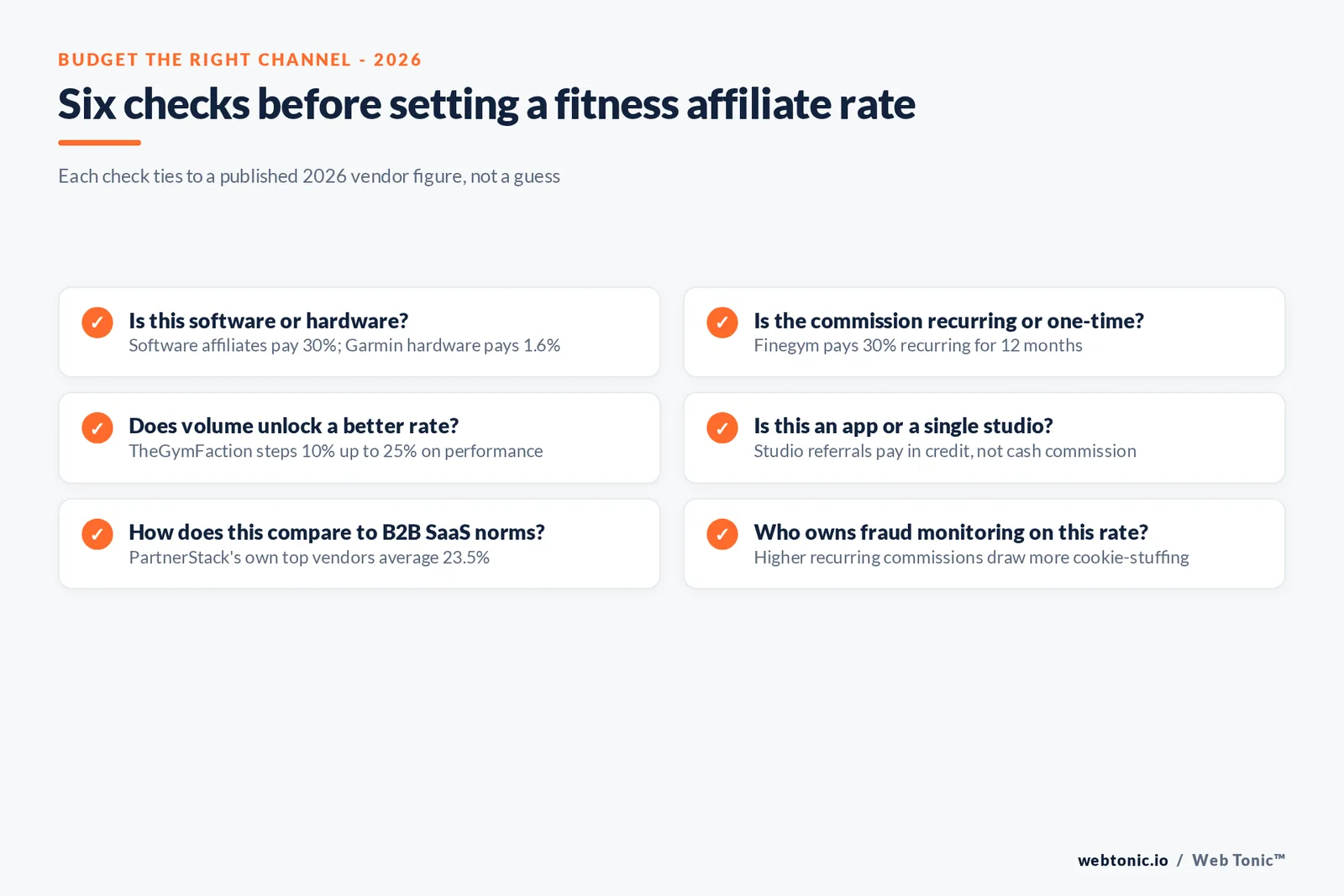
Not every "fitness affiliate" number sits near 30%. Hardware runs far lower: Garmin's own listing on the FlexOffers network pays 1.6% of sales (excluding maps and new products) on a 20-day cookie, and other wearable-hardware programs surveyed on affiliate directories cluster in the 3-8% range. That gap - low single digits for a one-time hardware sale against 30% recurring for a software subscription - is the same logic B2B SaaS uses to justify its own high commissions: software has near-zero marginal cost per additional subscriber, hardware does not.
| Category | Example program | Published commission | Why the rate differs |
|---|---|---|---|
| Fitness software (recurring) | Gravitus / Befit / Finegym | 30% | Near-zero marginal cost per subscriber |
| Fitness software (tiered) | TheGymFaction | 10% rising to 25% | Volume-based tiering |
| Wearable hardware | Garmin (FlexOffers listing) | 1.6% of sales | Physical goods margin, one-time sale |
| Studio membership (loyalty, not affiliate) | STC / JQ's / The Spot | 20-50% one-time credit | Retention mechanic, not acquisition |
Fraud and cookie-stuffing risk in a 30% recurring model
A flat 30% recurring commission is also exactly the structure that attracts the affiliate fraud networks are built to catch - cookie-stuffing, incentivized "free trial" churn, and self-referral through disposable accounts all get more profitable as the commission rate and the recurring window both go up. Programs like Finegym's, paying up to USD 285 per customer across 12 months, carry more fraud-prevention overhead per affiliate than a single-month studio credit ever will, which is a real cost that a flat headline commission rate does not show on its own.
Frequently Asked Questions
What is a normal affiliate commission for a fitness app or brand?
Where fitness software publishes a rate, it lands around 30% of the subscription. Gravitus pays a flat 30% on monthly and yearly plans; Befit pays 30% on new subscriptions; Finegym pays 30% recurring for 12 months, worth up to USD 285 per customer per year on its own numbers. One competitor, TheGymFaction, starts lower at 10% and steps affiliates up to 15%, 20% or 25% based on performance. Treat 30% recurring as the ceiling most fitness-app programs converge on, not a guaranteed floor.
How is a gym membership referral different from an affiliate program?
Mechanically similar, financially different. A studio refer-a-friend program pays in service credit, not cash: STC Boxing & Fitness gives a 50% discount off the referrer's next month, JQ's BFit2 gives 20% off per successful referral (stacking toward a free membership), and The Spot Climbing Gym discounts the next month's dues. None of these move as cash commission or through a tracked affiliate link - they are a loyalty mechanic aimed at existing members, not a paid-media channel aimed at an audience.
What does a typical B2B SaaS partner program pay, for comparison?
PartnerStack's own network data shows its top-performing vendors paid an average commission rate of 23.5% in 2023, with the highest offers clustering at 20%, 25% and 30%, and certain recurring software categories reaching 30-35%. Fitness software commissions sit inside that same band, which suggests fitness apps are pricing partnerships the way B2B SaaS does, not the way a studio's word-of-mouth program does.
Is affiliate spend actually growing across the category this year?
The best available cross-vertical read is IAB Australia's 2025 industry review: 43% of advertisers increased affiliate and partnership spend over the past year and 59% plan further increases next year, while a third (34%) of advertisers already spend USD 50,000-plus a month gross on the channel. No fitness-only study publishes this split, but the direction - more spend, not less - matches what fitness-app programs are doing by holding commissions at 30% rather than cutting them.
Who should manage a fitness affiliate program - in-house or a network?
IAB Australia's 2025 review found 51% of advertisers keep program management in-house, 26% use an agency and 19% use a network. For a subscription fitness brand running a 30% recurring commission, that in-house-lean pattern matters because recurring commission has to be reconciled against churn every month - a mechanic best owned by whoever also owns the retention numbers.
Sources
FlexOffers - Garmin US Affiliate Program listing
Gravitus - Official affiliate program terms
Befit - Official affiliate program terms
Finegym - Official affiliate program terms
TheGymFaction - Official affiliate program terms
PartnerStack - The State of Partnerships in GTM 2026 (with Wynter)
PartnerStack Research Lab - Top vendor average commission rate chart
STC Boxing & Fitness - Referral program terms
JQ's BFit2 - Referral program terms
The Spot Climbing Gym - Referral program terms
IAB Australia - Affiliate & Partnership Marketing Industry Review 2025