Table of contents
Key Takeaways
- X (Twitter) averages a $0.74 CPC and $5.65 CPM, making it one of the cheapest paid social platforms for fertility clinic awareness campaigns.
- 611 million monthly active users make X a massive reach channel, though fertility-specific audiences are niche and require precise targeting.
- 52% of marketers reduced or stopped X ad spend after the Twitter-to-X rebrand, creating lower competition and cheaper inventory for healthcare advertisers.
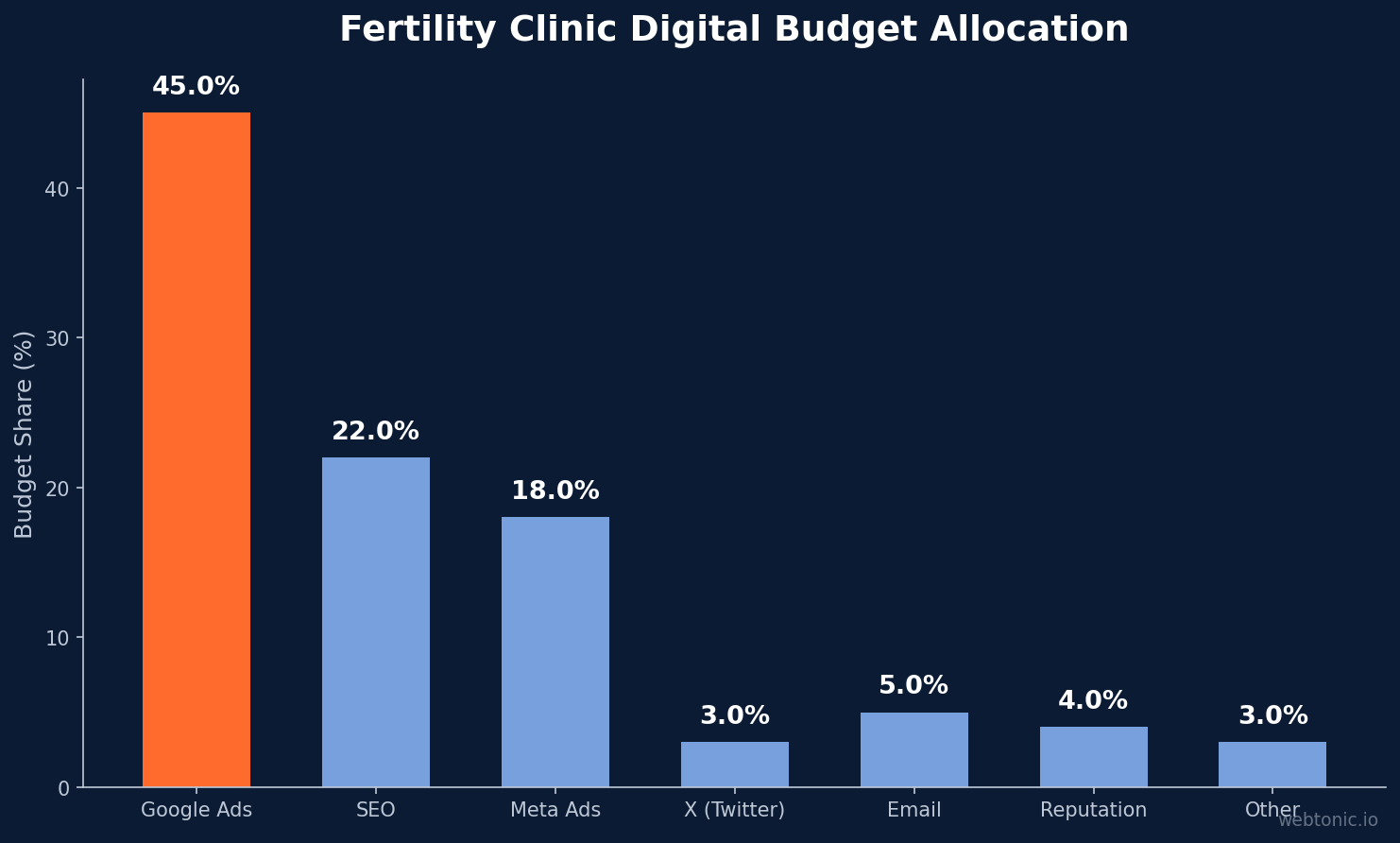
- Fertility clinics allocate only 2–5% of digital budgets to X, with Google Ads taking 40–50% and Meta at 15–20% of total spend.
- X requires pre-authorization for medical product and service ads, with Trend Takeover and Trend Takeover+ now permitting US healthcare promotions with documentation.
- The median engagement rate on X is 0.015% per post, but health-related threads and patient community hashtags drive significantly higher interaction rates.
X (Twitter) Ads Cost Benchmarks for Fertility Clinics
X remains one of the most affordable paid social platforms available to fertility clinic marketers in 2026. While the platform does not publish fertility-specific benchmark tiers, healthcare advertisers benefit from post-rebrand pricing that sits well below Meta and Google Ads. The following table compares verified X ad cost benchmarks against other platforms commonly used by IVF clinics for growth marketing campaigns.
| Metric | X (Twitter) | Meta (Facebook/IG) | |
|---|---|---|---|
| Average CPC | $0.74 | $1.41 | $5.00–$8.00 |
| Average CPM | $5.65 | $7.19 | $33.80 |
| Healthcare CPC Range | $0.26–$0.50 | $1.17–$3.00 | $5.00–$12.00 |
| Cost Per Lead (Avg) | $41.00 | $52.00–$85.00 | $75.00–$150.00 |
| Promoted Trends (US/Day) | $100K–$250K | N/A | N/A |
| Conversion Campaign CPM | $6.46 | $12.00–$25.00 | $45.00+ |
Sources: HeyOz, SearchLab, Scientissimum.

X Platform Reach and Fertility Audience Demographics
X reached 611 million monthly active users worldwide in 2026, with ad reach covering 586.9 million users representing 7.1% of the global population (SocialNexis). While the platform skews younger than LinkedIn, fertility clinic audiences exist within X's 25–44 age bracket, which aligns with the peak IVF treatment demographic where most patients begin their fertility journey.
The median engagement rate across all industries on X is 0.015% per post, but healthcare and patient advocacy threads consistently outperform this baseline. Interactions per post rose 12% year-over-year to 42.71 despite a 5% decline in impressions, suggesting the audience that remains on X is more engaged than before the rebrand (Metricool). Weekly posts per account averaged 17.34 in 2025, up 8% from 15.97 in 2024, indicating growing content activity even as overall reach contracts.
For fertility clinics, X offers unique access to patient community conversations happening organically. The #IVF hashtag generates millions of cumulative views, and fertility journey content draws high-engagement audiences that can be retargeted through promoted posts and conversation targeting. Healthcare advertising is permitted on X with appropriate documentation, and major pharmaceutical companies including Johnson and Johnson and Pfizer maintain active X Ads accounts for healthcare promotion.
Fertility Clinic Digital Marketing Budget Allocation
Most fertility clinics allocate their digital marketing budgets with Google Ads taking 40–50%, SEO at 20–25%, and Meta Ads at 15–20%. Platforms like X, TikTok, and Snapchat share the remaining 5–10% of budget, making X a marginal but potentially high-ROI channel for awareness and community engagement (Tandem Medical Marketing). A typical competitive-metro IVF clinic spends $8,000–$20,000/month on total digital marketing, meaning the X budget rarely exceeds $400–$1,000/month even when included.
| Channel | Budget Share | Primary Use Case | Avg. CPA Range |
|---|---|---|---|
| Google Ads | 40–50% | Intent capture, consultations | $112 |
| SEO | 20–25% | Organic visibility, content | $45–$80 |
| Meta Ads | 15–20% | Awareness, retargeting | $65–$130 |
| X (Twitter) Ads | 2–5% | Community, awareness | $41 (est.) |
| Reputation Mgmt | 5–10% | Reviews, patient trust | Indirect |
| Email Marketing | 5–10% | Patient nurture, retention | $15–$30 |
The fertility marketing budget ranges from $2,000–$6,000/month at the low end to $15,000+ for competitive metros. At an average IVF cycle value of $15,000–$25,000, even a $200–$400 CPA is extremely profitable, making channels like X viable for supplementary patient acquisition if managed correctly (Tandem).
The Post-Rebrand Advertising Opportunity
The Twitter-to-X rebrand created a measurable shift in the advertising landscape. 52% of marketers reduced their X advertising budget or stopped entirely after the rebranding, according to WARC and Reuters advertising surveys cited by SearchLab. For fertility clinics considering a diversified paid media strategy, this advertiser exodus translates directly into lower auction competition and cheaper inventory across healthcare verticals.
Despite the brand controversy, X's active advertiser count grew 60% in Q1 2025 and an additional 28% in Q4 2025, signaling a gradual return of performance-focused advertisers willing to follow the data rather than the headlines. Healthcare and pharmaceutical companies like Johnson and Johnson and Pfizer maintain active X Ads accounts, indicating the platform remains viable for regulated medical advertising (SocialNexis).
The CPC gap between X and Meta is significant: X averages $0.74 CPC versus Meta's $1.41, a 47% cost advantage that compounds over monthly budgets. For a fertility clinic spending $3,000/month on awareness campaigns, switching from Meta to X could yield roughly 90% more clicks at the same spend level. However, this cost advantage must be weighed against Meta's superior targeting precision and higher conversion rates for healthcare lead generation (HeyOz).
X Ads Policy for Healthcare and Fertility Advertising
X imposes specific restrictions on healthcare advertising that fertility clinics must navigate carefully before launching campaigns. Political, health, and financial ads require additional labeling, and misleading health claims — including miracle cures and unverified medical assertions — trigger immediate rejection (AuditSocials).
Medical device advertising follows a tiered system: Class I and II devices may be advertised with supporting documentation, while Class III devices require pre-approval and may only target healthcare professionals. Over-the-counter health products are permitted globally with standard health disclaimer requirements, but unsubstantiated wellness claims such as "boosts immunity" trigger immediate rejection.
Critically, X prohibits creating custom audiences or conversion events based on sensitive health information. Fertility clinics cannot build lookalike audiences from patient lists or retarget based on health-related page visits. This restriction mirrors Meta's Special Ad Category rules but is less widely understood among fertility marketers, creating compliance risk for clinics running campaigns without specialist management.
Trend Takeover and Trend Takeover+ now permit medical products and services in the US with pre-authorization, opening a high-visibility format for IVF awareness campaigns during peak fertility awareness months. National Infertility Awareness Week in April and Fertility Awareness Month provide strategic windows where this premium format may generate significant earned media amplification alongside the paid placement.
X Engagement Patterns for Fertility Content
While X's overall engagement rate is low at a median of 0.015% per post across all industries, fertility and health communities on the platform generate disproportionately high interaction. The platform's real-time conversation format suits the emotional, community-driven nature of fertility journeys that patients share publicly and semi-anonymously.
Metricool's 2025–2026 analysis reveals that weekly posts per account averaged 17.34 in 2025 (up 8% from 2024), while interactions per post grew 12% to 42.71 on average (Metricool). Health-related threads that combine educational content with personal stories tend to generate the highest engagement, particularly when they include IVF success rates, cost transparency breakdowns, or realistic treatment timelines that prospective patients actively seek.
Fertility clinics that position their X presence around educational thought leadership rather than direct promotion see the strongest results. According to cross-platform digital marketing benchmarks, educational healthcare content generates 2–4x the engagement rate of promotional posts, and this pattern holds on X where the algorithmic feed rewards conversation-starting content over broadcast-style advertising. Clinics that respond to questions in fertility community threads build organic trust that paid promotion alone cannot replicate.
X Ads vs. Other Platforms: Fertility Clinic Performance
Comparing X against Meta and Google Ads reveals clear positioning: X excels at cost-efficient awareness, while Google captures high-intent searches and Meta provides the strongest mid-funnel retargeting.
| Factor | X (Twitter) | Meta | Google Ads |
|---|---|---|---|
| Best Use Case | Awareness, community | Retargeting, video | Intent capture |
| Patient Intent Level | Low–Medium | Medium | High |
| Conversion Rate | 1.0–2.5% | 2.8–4.2% | 6.8% |
| Cost Efficiency (CPM) | $5.65 (best) | $7.19 | N/A (CPC model) |
| Targeting Precision | Moderate | High | Very High |
| Policy Restrictions | Moderate | Strict (Special Cat.) | Moderate |
| Audience Health Sensitivity | Custom audience ban | Special category | Keyword-based |
Sources: Benchmarketing, HeyOz, The Global Statistics.
Best Practices for Fertility Clinic X Advertising
- Lead with education, not promotion. Share IVF success rate data, treatment timelines, and cost transparency content. Educational posts generate 2–4x the engagement rate of direct promotional content on X, and algorithm visibility rewards threads that spark genuine conversation.
- Use conversation targeting over interest targeting. X's conversation targeting lets clinics reach users actively discussing fertility topics without relying on sensitive health data lists, keeping campaigns compliant with platform policies and avoiding rejection.
- Budget for awareness, measure downstream. With a $0.74 average CPC, X excels at top-of-funnel awareness. Track assisted conversions in Google Analytics or your attribution platform to measure X's contribution to the full patient acquisition journey rather than judging it on last-click conversions alone.
- Test Trend Takeover during awareness months. National Infertility Awareness Week (April) and World Fertility Day offer high-visibility windows where Trend Takeover's $100K–$250K daily cost may be justified by earned media amplification and brand association with the cause.
- Pre-authorize all healthcare creatives. Submit medical documentation proactively to avoid ad rejection delays. Class I–II medical device ads require documentation; Class III requires pre-approval and may only target healthcare professionals.
Frequently Asked Questions
How much do X (Twitter) Ads cost for fertility clinics?
X Ads average a $0.74 CPC and $5.65 CPM across industries, with healthcare-specific CPCs ranging from $0.26 to $0.50. Fertility clinics can expect costs at the lower end of the healthcare range due to niche targeting and reduced platform competition following the rebrand. The average cost per lead on X is $41, significantly lower than Meta's $52–$85 range for healthcare verticals.
Can fertility clinics legally advertise on X (Twitter)?
Yes, but with restrictions. X requires pre-authorization for medical ads and prohibits building custom audiences from sensitive health data. Fertility clinics must avoid misleading success rate claims and include appropriate disclaimers on treatment-related promotions. Standard educational content about fertility treatments and clinic services is generally permitted without pre-authorization.
Is X (Twitter) effective for IVF patient acquisition?
X is best suited for awareness and community engagement rather than direct patient acquisition. The platform's 0.015% median engagement rate is low compared to Meta, but fertility community hashtags and patient story threads generate higher interaction. Most clinics use X as a supplementary channel alongside Google Ads (40–50% of budget) and Meta (15–20%), allocating just 2–5% of spend to the platform.
How does X advertising compare to Meta for fertility clinics?
X offers a 47% lower CPC ($0.74 vs. $1.41) and 21% lower CPM ($5.65 vs. $7.19) compared to Meta. However, Meta provides stronger targeting precision and higher conversion rates (2.8–4.2% vs. 1.0–2.5%). X excels at cost-efficient awareness; Meta excels at mid-funnel retargeting and video-driven education campaigns.
What percentage of fertility marketing budgets goes to X?
Most fertility clinics allocate 2–5% of their digital marketing budget to X, with Google Ads taking 40–50% and Meta at 15–20%. For a clinic spending $10,000/month total, the X budget typically ranges from $200–$500, used primarily for brand awareness and community engagement rather than direct lead generation.
Sources
socialnexis.com
searchlab.nl
heyoz.com
scientissimum.com
theglobalstatistics.com
metricool.com
tandemmedicalmarketing.com
benchmarketing.org
auditsocials.com
growthscribe.com