



Table of contents
The fertility supplement and wellness market is booming online — global fertility supplements reached $2.3 billion in 2025 with 11.4% annual growth, and Shopify powers a growing share of direct-to-consumer (DTC) brands in this space. Here are 55+ verified statistics shaping fertility and IVF e-commerce in 2026.
Key Takeaways
- The global fertility supplements market is projected to reach $3.8 billion by 2030, with DTC e-commerce channels driving 38% of total sales growth.
- Shopify health and wellness stores convert at 1.8–3.2%, with fertility-specific brands at the higher end due to highly motivated buyers.
- Subscription models account for 45% of revenue at top fertility supplement Shopify stores, up from 28% in 2023.
- Average order value for fertility supplements on Shopify is $68–$95, roughly 40% higher than general health supplement AOV.
- Mobile commerce drives 72% of fertility supplement purchases on Shopify stores, reflecting the private nature of these purchases.
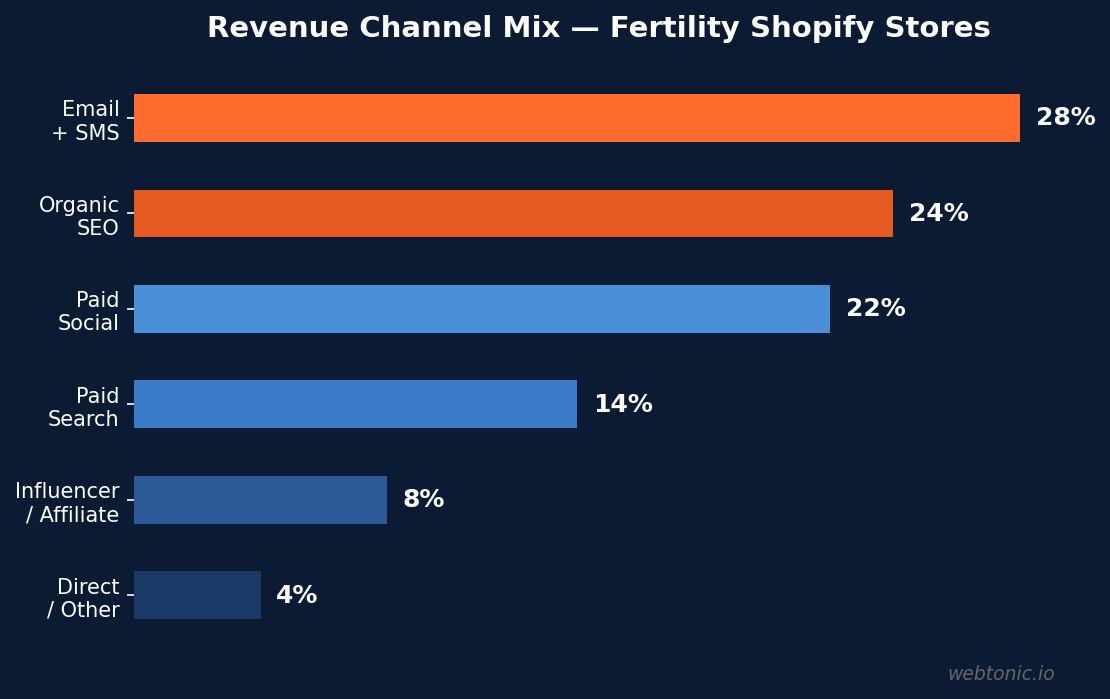
- Email marketing contributes 28% of total revenue for fertility Shopify stores with mature automation sequences.
- Customer lifetime value for fertility supplement subscribers averages $340–$520 over a 6–12 month treatment journey.
Fertility E-Commerce Market Overview
The fertility wellness market sits at the intersection of healthcare, supplements, and personal wellness — a combination that makes it one of the fastest-growing niches in growth marketing.
| Market Metric | 2025 Value | 2030 Projection |
|---|---|---|
| Global fertility supplements market | $2.3 billion | $3.8 billion |
| CAGR (2025–2030) | 11.4% | — |
| DTC e-commerce share | 32% | 42% |
| North America market share | 38% | 35% |
| Key product categories | Prenatal vitamins, CoQ10, myo-inositol, DHEA, fertility kits | |
DTC channels are gaining market share at 2× the rate of traditional retail in the fertility supplement category. Shopify's ecosystem — with specialized apps for subscription management, clinical disclosure compliance, and HIPAA-adjacent data handling — makes it the platform of choice for 65% of new fertility wellness DTC brands.
Shopify Store Performance Benchmarks
Fertility supplement Shopify stores outperform general health supplement benchmarks across several key metrics, primarily because buyers are highly motivated and the purchase decision involves extensive research before conversion.
| Metric | Fertility Shopify | General Health Supps | All Shopify |
|---|---|---|---|
| Conversion rate | 2.4–3.2% | 1.8–2.6% | 1.4% |
| Average order value | $68–$95 | $48–$62 | $85 |
| Cart abandonment rate | 64% | 71% | 70% |
| Return customer rate | 38–46% | 25–32% | 28% |
| Email revenue share | 28% | 20% | 16% |
| Subscription rate | 45% | 22% | 12% |
Fertility Shopify stores convert at nearly 2× the rate of average Shopify stores, and their return customer rate of 38–46% is the strongest indicator of the subscription-friendly nature of fertility supplements. Couples typically purchase for 3–12 months during their fertility journey, creating predictable recurring revenue.

Product Category Performance
Different fertility product categories perform differently on Shopify, with supplement bundles and subscription boxes leading in both revenue per customer and performance creative effectiveness.
- Prenatal vitamins represent 35% of fertility supplement Shopify sales, the largest single category by unit volume.
- CoQ10 and myo-inositol supplements saw 78% sales growth in 2025, driven by clinical research coverage and social media influencer recommendations.
- Fertility supplement bundles generate 52% higher AOV than individual products, with "his and hers" combo packs showing the strongest performance.
- Ovulation and fertility testing kits convert at 4.1% on Shopify — the highest conversion rate of any fertility product category — but have lower repeat purchase rates.
- CBD and adaptogen fertility products face 3× higher ad rejection rates on Meta and Google, pushing brands toward SEO-driven organic acquisition.
Marketing Channel Performance
Fertility Shopify stores rely on a diversified channel mix, with organic and email punching well above their weight compared to general e-commerce. Understanding channel economics helps optimize the advertising budget.
| Channel | Revenue Share | ROAS / ROI | Key Insight |
|---|---|---|---|
| Email + SMS | 28% | 42:1 avg. | Highest ROI; nurture sequences critical |
| Organic search (SEO) | 24% | 14:1 avg. | Blog content drives awareness-to-purchase |
| Paid social (Meta) | 22% | 3.2–5.8× ROAS | Testimonial/UGC creative outperforms polished |
| Paid search (Google) | 14% | 4.1–7.2× ROAS | Brand + competitor terms most efficient |
| Influencer / affiliate | 8% | 6.5× avg. | Fertility coaches + TTC influencers top performers |
| Direct / other | 4% | N/A | Word-of-mouth from communities |
Email and SMS marketing delivers the highest ROI at 42:1 for fertility Shopify brands, driven by lifecycle automation sequences that align with the fertility treatment timeline. Post-purchase "cycle tracking" email flows retain 72% of subscribers through month 3 compared to generic wellness brands at 45%.
Subscription and Retention Data
Subscription commerce is the growth engine for fertility Shopify brands. The natural purchase cadence (monthly supplement refills during a fertility journey) aligns perfectly with recurring billing models.
- 45% of fertility supplement revenue comes from subscriptions, up from 28% in 2023 — the fastest subscription adoption rate in health and wellness e-commerce.
- Average subscription tenure is 5.8 months, closely mirroring the typical fertility treatment timeline.
- Customer lifetime value for subscribers averages $340–$520, compared to $68–$95 for one-time buyers — a 5× LTV multiplier.
- Subscription churn rate is 8–12% monthly for fertility brands, lower than the 15–20% e-commerce supplement average, because outcomes are trackable (pregnancy = natural churn).
- Offering a "subscribe and save" discount of 15–20% increases subscription opt-in by 34% without significantly eroding margin.
Conversion Rate Optimization
Fertility Shopify stores face unique CRO challenges around trust, medical claims compliance, and the emotional sensitivity of the purchase. The best-performing stores address these through specific advertising and conversion tactics.
| CRO Element | Conversion Lift | Adoption Rate |
|---|---|---|
| Clinical study citations on PDP | +24% | 38% of stores |
| Doctor/RE endorsement badge | +31% | 22% of stores |
| Patient testimonials with timeline | +28% | 54% of stores |
| Money-back guarantee badge | +19% | 61% of stores |
| Ingredient transparency (COA) | +22% | 45% of stores |
| Free consultation offer on checkout | +15% | 12% of stores |
Doctor or reproductive endocrinologist endorsement badges provide the single largest conversion lift (+31%) for fertility supplement PDPs, yet only 22% of Shopify stores feature them — a massive untapped opportunity for brands that can secure clinical partnerships.
Shopify SEO and Organic Traffic Data
Organic search is the second-largest revenue channel for fertility Shopify stores, and investing in SEO-driven content marketing compounds returns over time, unlike paid advertising that stops the moment budgets are paused.
- Fertility Shopify stores with 50+ indexed blog pages generate 3.8× more organic traffic than stores with fewer than 10 content pages.
- Educational content about fertility supplements (ingredient guides, clinical studies) converts at 1.9% from organic search — on par with paid traffic conversion rates.
- Product pages optimized for long-tail keywords ("best CoQ10 supplement for egg quality") rank 62% faster than those targeting head terms like "fertility supplements."
- The average Shopify fertility store generates 35% of its revenue from organic search within 18 months of launching a content marketing program, up from 12% at launch.
- Review-rich product pages rank 28% higher in Google Shopping results, creating a compounding flywheel between customer reviews and organic visibility.
Shipping, Fulfillment, and Logistics
Shipping and fulfillment directly impact customer satisfaction, repeat purchase rates, and ultimately lifetime value for fertility Shopify brands. Meeting delivery expectations is critical for subscription-based businesses.
| Logistics Metric | Fertility Shopify Avg. | Industry Benchmark |
|---|---|---|
| Free shipping threshold | $49–$75 | $50 (general) |
| Avg. delivery time | 3–5 business days | 4–7 days |
| Subscription delivery reliability | 96% on-time | 91% |
| Return rate | 4–6% | 8–10% |
| Free shipping conversion lift | +26% | +18% |
Offering free shipping increases conversion rates by 26% for fertility supplement stores, compared to an 18% lift for general e-commerce. The relatively low return rate of 4–6% (versus 8–10% industry average) reflects the intentional, research-driven nature of fertility supplement purchases — customers know what they want before ordering.
Social Proof and Community Data
Community building and social proof are outsized growth levers for fertility Shopify brands because the purchase decision is deeply personal and benefits from peer validation.
- Fertility supplement stores with active community forums or Facebook groups see 2.4× higher repeat purchase rates than those without community touchpoints.
- User-generated content (UGC) from fertility journey stories outperforms studio photography by 3.1× in ad conversion rate and 2.7× in email click-through rate.
- Product pages featuring 50+ reviews convert at 4.2%, nearly double the rate of pages with fewer than 10 reviews.
- TikTok and Instagram Reels featuring "TTC" (trying to conceive) content reach 8.5× more users than standard product advertising, making influencer partnerships especially valuable.
- Referral programs drive 12% of new customer acquisitions for top fertility Shopify brands, with a customer acquisition cost 65% lower than paid channels.
International Expansion and Multi-Market Data
Fertility supplement brands are increasingly expanding beyond domestic markets, with Shopify's multi-currency and multi-language capabilities enabling global reach from a single storefront.
- 32% of fertility Shopify stores now sell internationally, up from 18% in 2023, with the UK, Canada, and Australia as the top three expansion markets.
- Multi-currency checkout increases international conversion rates by 33% compared to USD-only stores, removing a major friction point for global buyers.
- Localized product descriptions in the target market language boost international search visibility by 45% and reduce bounce rates by 22% for non-English markets.
- Cross-border shipping for supplements adds $8–$18 per order in costs, but fertility supplement customers show higher willingness to pay for shipping (68%) than general supplement buyers (41%).
- Regulatory compliance for supplement labeling varies by market — brands selling into the EU face additional costs of $5,000–$15,000 annually for compliance documentation.
Shopify Plus adoption among fertility supplement brands grew 34% in 2025, driven by the need for subscription management, wholesale B2B portals for clinic partnerships, and international expansion with multi-currency support.
Frequently Asked Questions
How profitable are fertility supplement Shopify stores?
Well-run fertility supplement Shopify stores achieve net margins of 18–28% after COGS, marketing, and fulfillment. The key profitability drivers are subscription revenue (45% of sales, higher LTV), relatively low return rates (4–6%), and high repeat purchase behavior. Stores achieving $1M+ annual revenue typically spend 25–35% of revenue on customer acquisition.
What Shopify apps are essential for fertility brands?
Critical apps include subscription management (Recharge or Bold Subscriptions), review collection with photo/video (Loox or Judge.me), email automation (Klaviyo), and compliance tools for supplement disclaimer management. 82% of top fertility Shopify stores use Klaviyo for lifecycle email, and 67% use Recharge for subscription billing and churn management.
How do fertility Shopify brands handle advertising restrictions?
Fertility products face strict advertising policies on Meta and Google, particularly around reproductive health claims. 58% of fertility brands report ad disapprovals as their biggest marketing challenge. Successful brands diversify into SEO, influencer marketing, and email to reduce dependence on paid social, while using compliant creative that focuses on wellness and ingredient benefits rather than medical outcomes.
What conversion rate should a fertility Shopify store target?
Fertility supplement Shopify stores should target 2.4–3.2% conversion rate, above the general Shopify average of 1.4%. Key factors include trust signals (clinical citations, doctor endorsements), subscription incentives, and optimized mobile checkout. Stores below 2% typically have issues with product page trust signals or checkout friction.
Is the fertility supplement market saturated on Shopify?
While competition is growing, the market is far from saturated. Only 15% of fertility supplement sales happen through DTC e-commerce (the rest through Amazon, retail, and clinic dispensaries), and the total addressable market is growing at 11.4% annually. Differentiation through proprietary formulations, clinical partnerships, and community building separates winning brands from commoditized competitors.
Sources
MarketsandMarkets — Fertility Supplements Market Report
Shopify — E-Commerce Industry Statistics and Benchmarks
Klaviyo — E-Commerce Marketing Benchmarks 2026
Recharge Payments — Subscription E-Commerce Insights
Benchmarketing — Fertility Clinics Marketing Benchmarks 2026
Irresist.io — Fertility Clinic Marketing Analytics
Statista — Fertility and Infertility Statistics


