Table of contents
No published study prices family law video production as its own category, so this report builds the budget from 2025-26 cross-industry production-cost data and states every assumption. The constraint that actually shapes a family law video budget isn't cost - it's what a testimonial is allowed to say.
Key Takeaways
- No benchmark prices family law video specifically - this model is built from general 2025-26 production data.
- 89% of businesses use video as a marketing tool, per Wyzowl 2025.
- 93% of marketers report a positive ROI from video.
- 87% of consumers say video convinced them to buy a product or service.
- 98% of consumers have watched an explainer video to learn about a service.
- 37% of non-users don't know where to start; 26% cite time as the barrier.
- 68% of 2025 non-adopters planned to start using video that year.
- Outsourced production runs USD 2,000 to 10,000 for a mid-level short video.
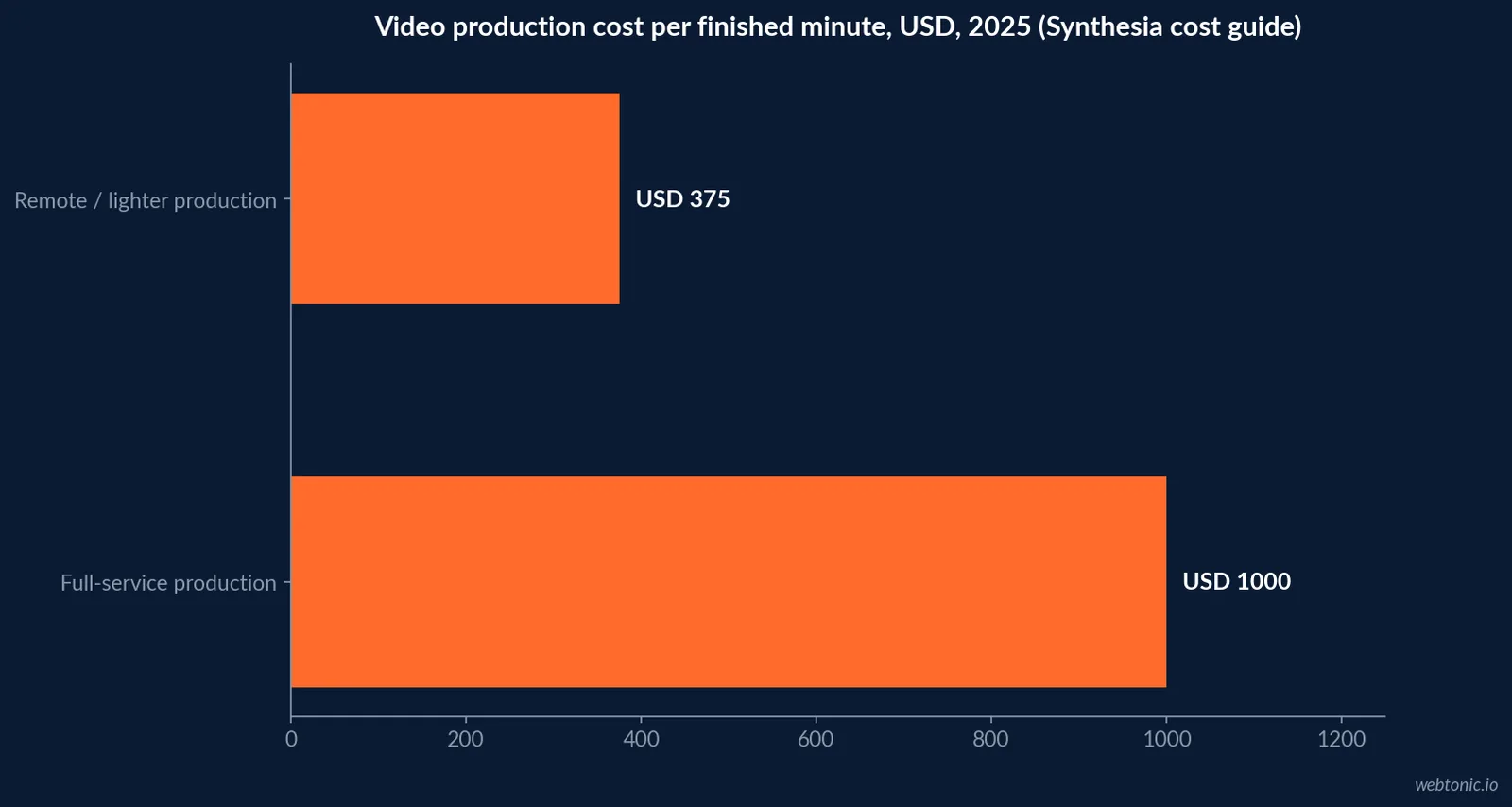
- Full-service production averages about USD 1,000 per finished minute.
- Only ~33% of companies spend USD 5,000+ a year on video, per Wistia.
- 71% of companies now produce video in-house, up from 63% in 2023.
- Nearly 60% plan to invest more in video this year.
- 92% of marketers plan flat-or-higher video spend for 2026.
- 41% have already spent on video ads this year, up from 36%.
- 78% of law firms maintain a LinkedIn presence, a natural distribution channel.
- "Hard" testimonials on case outcomes require a disclaimer under most state rules.
- ABA Model Rule 7.1 bars video claims that create an unjustified result expectation.
Why there is no family law video price list
Video marketing surveys are conducted at the whole-market level - Wistia's 2025 State of Video Report surveyed 1,300+ professionals across every industry, and Wyzowl's 2025 Video Marketing Statistics surveyed 205 marketers and consumers without a legal-vertical breakout. Neither prices family law content specifically. What follows treats the cross-industry data as the rate base and applies it to what a family law firm's video actually needs to do: explain a process, introduce the attorney, and build enough trust to pick up the phone.
| Rate base (2025-26) | Figure | Source |
|---|---|---|
| Outsourced mid-level short video | USD 2,000-10,000 per project | Synthesia 2025 cost guide |
| Full-service production, per finished minute | ~USD 1,000 | Synthesia 2025 cost guide |
| Remote/lighter production, per finished minute | USD 250-500 | Synthesia 2025 cost guide |
| Companies spending USD 5,000+/year on video | ~33% | Wistia 2025 State of Video Report |
| Companies making at least one video a week | 40%+ | Wistia 2025 State of Video Report |
The case for spending it: ROI and consumer behavior
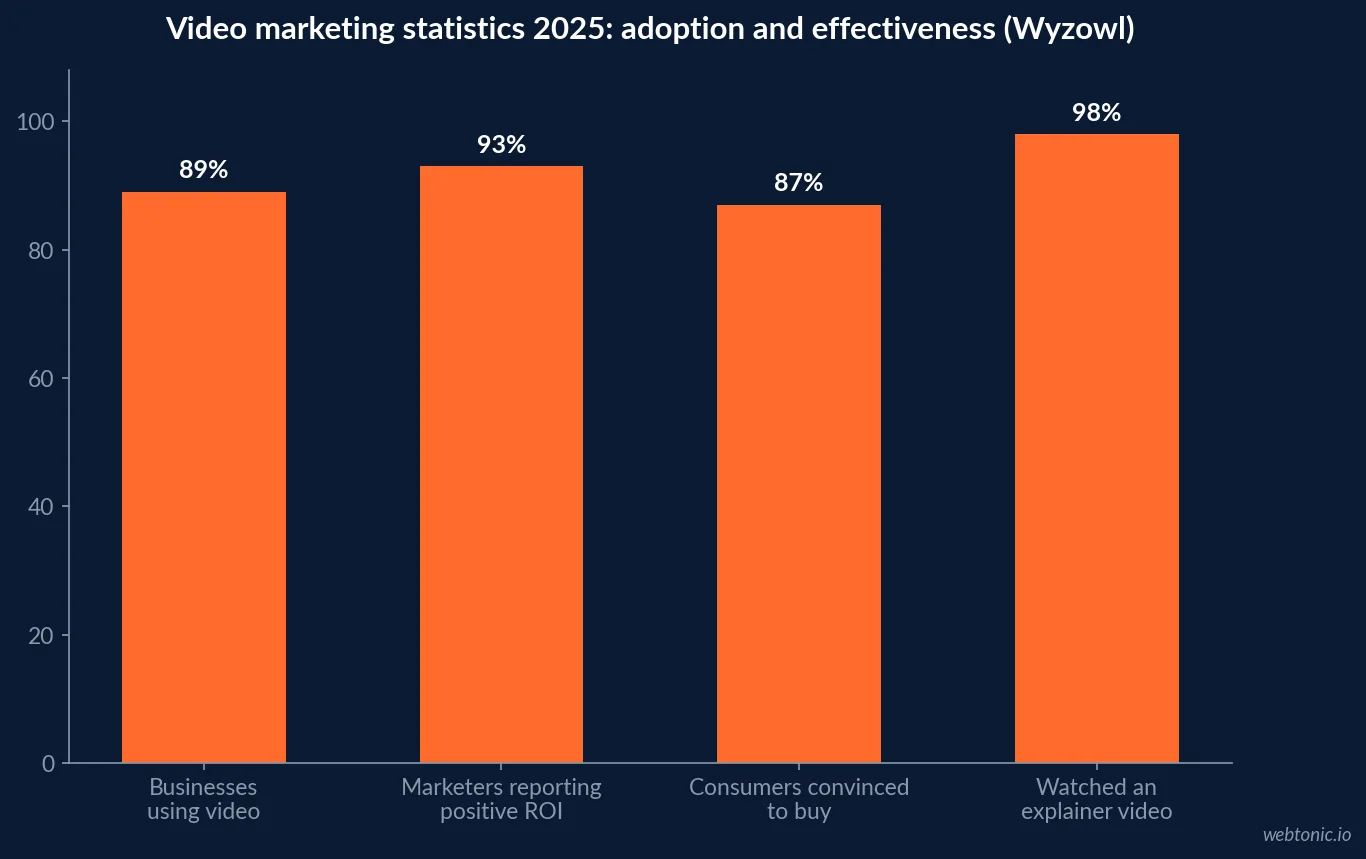
The return data is unusually consistent year over year. Wyzowl's 2025 survey found 93% of marketers who use video report a positive ROI, and on the consumer side, 87% say a video has convinced them to make a purchase while 98% have watched an explainer video specifically to learn about a product or service before buying it. For a family law prospect deciding between three firms found on the same search results page, an explainer video answering "what happens at the first consultation" does exactly the job that statistic describes.
| Video marketing statistic (Wyzowl 2025) | Figure |
|---|---|
| Businesses using video as a marketing tool | 89% |
| Marketers reporting positive ROI | 93% |
| Consumers convinced to buy after watching a video | 87% |
| Consumers who watched an explainer video | 98% |
| Marketers who consider video an integral strategy piece | 95% |
Why adoption still lags the ROI data
If 93% of users report positive ROI, the gap isn't doubt - it's logistics. Wyzowl found 37% of non-adopters simply don't know where to start and 26% cite lack of time, while 68% of that year's non-users planned to adopt video anyway. That pattern matches what production-cost data explains: Wistia found 71% of companies now produce video in-house, up from 63% in 2023, which suggests the barrier firms are actually solving for is process, not budget approval.
| Barrier to starting video (Wyzowl 2025) | Share of non-users |
|---|---|
| Don't know where to start | 37% |
| Lack of time | 26% |
| Planned to adopt within the year anyway | 68% |
Where the budget is actually moving for 2026
Wyzowl's newest data shows the trend continuing rather than plateauing: nearly 60% of companies plan to invest more in video this year, and 92% of marketers plan to spend the same or more on video marketing in 2026. 41% have already spent on video ads this year, up from 36% the year before. At the same time the market is split on whether costs are moving: 38% say video costs are rising while 30% say they're falling, largely a function of AI-assisted editing pulling per-minute costs down even as overall demand for more video content goes up.
The one constraint that isn't about money: what a testimonial can say
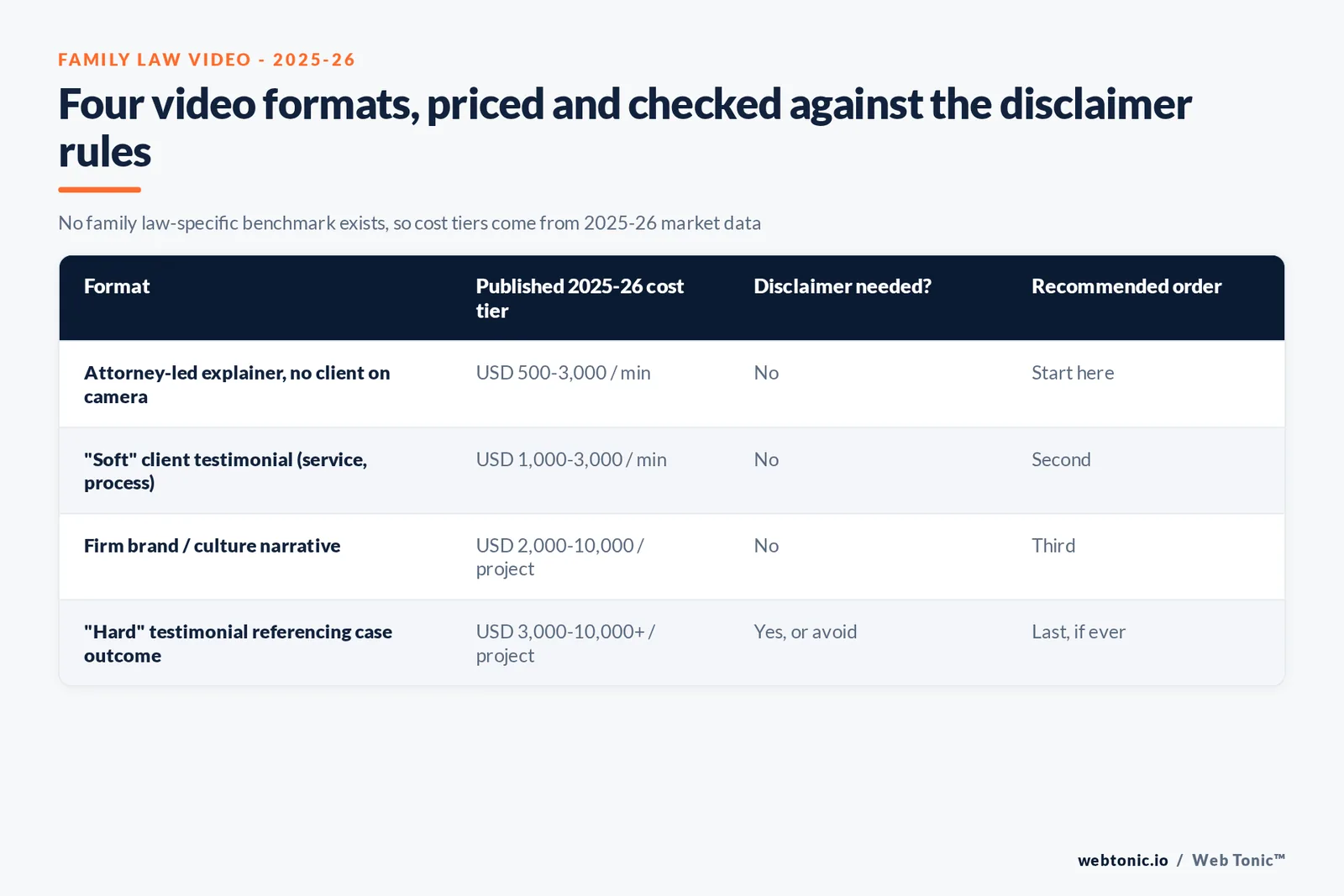
The single biggest risk in a family law video isn't the production budget - it's the script. North Carolina's 2012 Formal Ethics Opinion 1 distinguishes between a "soft" testimonial - a client describing the attorney's professionalism, responsiveness, or how they were treated - which needs no disclaimer, and a "hard" testimonial that references the outcome of the case, which does. California's Rule 7.1 commentary reaches the same conclusion from a different angle: an endorsement "may be misleading if presented so as to lead a reasonable person to form an unjustified expectation that the same results could be obtained." A family law custody or settlement outcome is exactly the kind of fact-specific result this language targets.
Practically: script client-facing video around the intake experience, communication cadence, and how the attorney explained options - never around what the client "won." That also happens to match what the ROI data says works: consumers respond to explainer and process content, not outcome claims.
| Testimonial type | Disclaimer required? | Governing guidance |
|---|---|---|
| "Soft" - describes service, responsiveness, professionalism | No | NC 2012 FEO 1 / CA Rule 7.1 comment |
| "Hard" - references case outcome or result | Yes, or avoid entirely | NC 2012 FEO 1 / ABA Model Rule 7.1 |
| Specific dollar figure quoted by a client | Prohibited outright in several states | NC 2012 FEO 1 |
| Attorney-led explainer, no client on camera | Not applicable | Lowest-risk format |
What marketers are actually budgeting for 2026
HubSpot's 2025 State of Marketing survey found 13.99% of marketers planning to invest more in video channels for the year, with short-form video the single most popular format marketers plan to invest more in at 17.13% of respondents, ahead of live streaming at 13.88%. Lemonlight's 2026 Video Marketing Landscape Report, based on a survey of 300+ marketing professionals, found roughly 20% ranking rising production costs as a top fear for the year - a tension with the AI-driven cost declines Wyzowl and Synthesia both report, and a reminder that budget anxiety and actual per-minute cost are not moving in lockstep.
| 2025-26 video budget signal | Figure | Source |
|---|---|---|
| Marketers planning to invest more in video | 13.99% | HubSpot 2025 State of Marketing |
| Marketers picking short-form as top investment | 17.13% | HubSpot 2025 State of Marketing |
| Marketers naming rising costs a top 2026 fear | ~20% | Lemonlight 2026 Landscape Report |
| Companies planning to spend more on video overall | ~60% | Wistia 2025 State of Video |
Where the finished video should live
Distribution follows where family law firms already have an audience. The American Bar Association's most recent technology survey found 80% of firms maintain a social media presence, with 78% on LinkedIn specifically - the highest of any platform tracked, ahead of Facebook (53%), Instagram (22%), and X (18%). That makes LinkedIn and the firm's own website the two lowest-effort placements for a first explainer video, well ahead of building out a video-first channel from zero. Short-form video is also the top format marketers plan to invest more in for 2025-26, per HubSpot's State of Marketing survey, at 17.13% of respondents choosing it over every other content type.
Our performance creative practice builds video scripts against exactly this disclaimer framework before a single frame is shot, and our guide to whether paid social is worth the investment covers the placement math once the video exists. Firms ready to scope a production budget can talk to us directly.
Frequently Asked Questions
How much does a professional marketing video cost in 2026?
No study prices family law video as its own category, so the honest starting point is the general market. Synthesia's 2025 cost guide puts outsourced production at USD 2,000 to 10,000 for a mid-level short video and up to 50,000 for a longer or more complex one, working out to roughly USD 1,000 per finished minute through a full-service production company. Wistia's 2025 State of Video Report found only about a third of companies spend at least USD 5,000 a year on video in total, so most firms are budgeting per-project, not per-video.
Can a family law firm use client testimonials in a marketing video?
Only carefully. North Carolina's 2012 Formal Ethics Opinion 1 draws a line between "soft" testimonials - about service, professionalism, responsiveness - which need no disclaimer, and "hard" testimonials that reference a case outcome, which do. California's Rule 7.1 comment says the same: an endorsement can be misleading if it leads a reasonable person to expect the same result without knowing the case's specific facts. Script family law testimonials around the client's experience of the process, not the result of the case.
Is video actually worth the production cost for a law firm?
The general marketing data says yes by a wide margin. Wyzowl's 2025 survey found 93% of marketers using video report a positive return on it, and 87% of consumers say a video has convinced them to buy a product or service. The gap is adoption, not effectiveness: Wyzowl found 37% of businesses not yet using video simply don't know where to start, and 26% cite time as the barrier - not cost or doubt about ROI.
What kind of video should a family law firm start with?
Attorney-led explainer content, not testimonials, is the lower-risk starting point. Wyzowl reports that 98% of consumers have watched an explainer video to learn about a product or service, and explainer-style production sits at the lower end of Synthesia's cost tiers - roughly USD 500 to 3,000 for a mid-level result versus several times that for scripted testimonial or brand-narrative pieces that need casting and legal sign-off.
How is video budget trending for 2026?
Up, modestly. Wyzowl's 2026 data shows 92% of marketers planning to spend the same or more on video next year, and 41% have already spent on video ads this year, up from 36% the year before. At the same time, 38% of marketers say production costs are increasing while 30% say they're falling - AI-assisted editing is pulling per-minute costs down even as demand for more video goes up.
Sources
Wyzowl - Video Marketing Statistics 2025
Wistia - 2025 State of Video Report
Synthesia - The Cost of Video Production, 2025
North Carolina State Bar - 2012 Formal Ethics Opinion 1
State Bar of California - Rules of Professional Conduct, Chapter 7
American Bar Association - 2025 Legal Technology Survey Report coverage
HubSpot - 45 Video Marketing Statistics for 2025
Lemonlight - Video Marketing Landscape Report 2026