Table of contents

62% of legal professionals name short-form video the single trend most likely to define legal marketing in 2026, per CallRail's survey of 100 legal marketers, and 59% of law firms added paid social as a brand-new channel in the past year. But social's role in family law lead generation is layered, not universal: platform-level demographic data shows TikTok's core audience skews younger than the typical divorce or custody client, so this page separates what is actually legal-industry data from what is a labeled cross-platform benchmark.
Key Takeaways
- 62% of law firms say short-form video will define 2026 legal marketing, the top-ranked trend, per CallRail.
- 59% of firms added paid social as a new channel in the past year, more than any other channel tracked.
- 36% of firms added organic social as a new channel, and it is a top-three channel firms plan to test further in 2026.
- As a direct new-business driver, paid social sits at 38%, behind SEO (54%), video (50%), and paid search (47%).
- 47% of firms plan to increase paid social spend in 2026, the third-highest growth channel behind email (51%) and influencer marketing (49%).
- 91% of all businesses now use video as a marketing tool, per Wyzowl's 2026 survey, a cross-industry benchmark, not a legal-specific one.
- 67% of non-video marketers plan to start using video in 2026, per Wyzowl.
- TikTok's user base is 35.3% aged 25-34 and 30.7% aged 18-24, together the platform's majority, per Sprout Social, a cross-platform demographic benchmark.
- 68% of law firms now use AI to personalize marketing, including social content, per Clio's 2025 Legal Trends Report.
- Attorneys and Legal Services' Meta ad click-through rate rose 80% year over year in 2025, the largest gain of any tracked industry, per WordStream/LocaliQ.
What law firms are actually doing on social in 2026
CallRail's 2026 Legal Marketing Outlook Report, surveying 100 legal professionals in October 2025, found 59% of firms implemented paid social as a new channel in the past year, more than added email (50%), video (50%), SEO (48%), or GEO/AEO optimization (41%). That makes paid social the single most-adopted new channel among law firms broadly, family law included as part of that surveyed population.
Looking ahead, 36% of firms plan to add organic social as a new tactic in 2026, ranking just behind SMS/text (39%) among channels firms are actively testing, with video close behind at 33%.

| Channel | Share of firms implementing it as new in past year | Source |
|---|---|---|
| Paid social | 59% | CallRail 2026 Legal Marketing Outlook |
| 50% | CallRail 2026 Legal Marketing Outlook | |
| Video | 50% | CallRail 2026 Legal Marketing Outlook |
| SEO | 48% | CallRail 2026 Legal Marketing Outlook |
| GEO/AEO optimization | 41% | CallRail 2026 Legal Marketing Outlook |
Adoption is not the same as attribution
The same CallRail report separately asked firms which channels actually drive new business, a different, more useful question than which ones got budget. There, SEO/organic search led at 54%, followed by video at 50% and paid search at 47%. Paid social landed at 38% and content at 37%. Social is clearly present in the mix, but it is not, by this survey, the leading new-business driver for law firms as a whole.
| Channel | Share of firms naming it a top new-business driver | Source |
|---|---|---|
| SEO / organic search | 54% | CallRail 2026 Legal Marketing Outlook |
| Video | 50% | CallRail 2026 Legal Marketing Outlook |
| Paid search (PPC) | 47% | CallRail 2026 Legal Marketing Outlook |
| Paid social | 38% | CallRail 2026 Legal Marketing Outlook |
| Content | 37% | CallRail 2026 Legal Marketing Outlook |
The trend everyone agrees on: short-form video
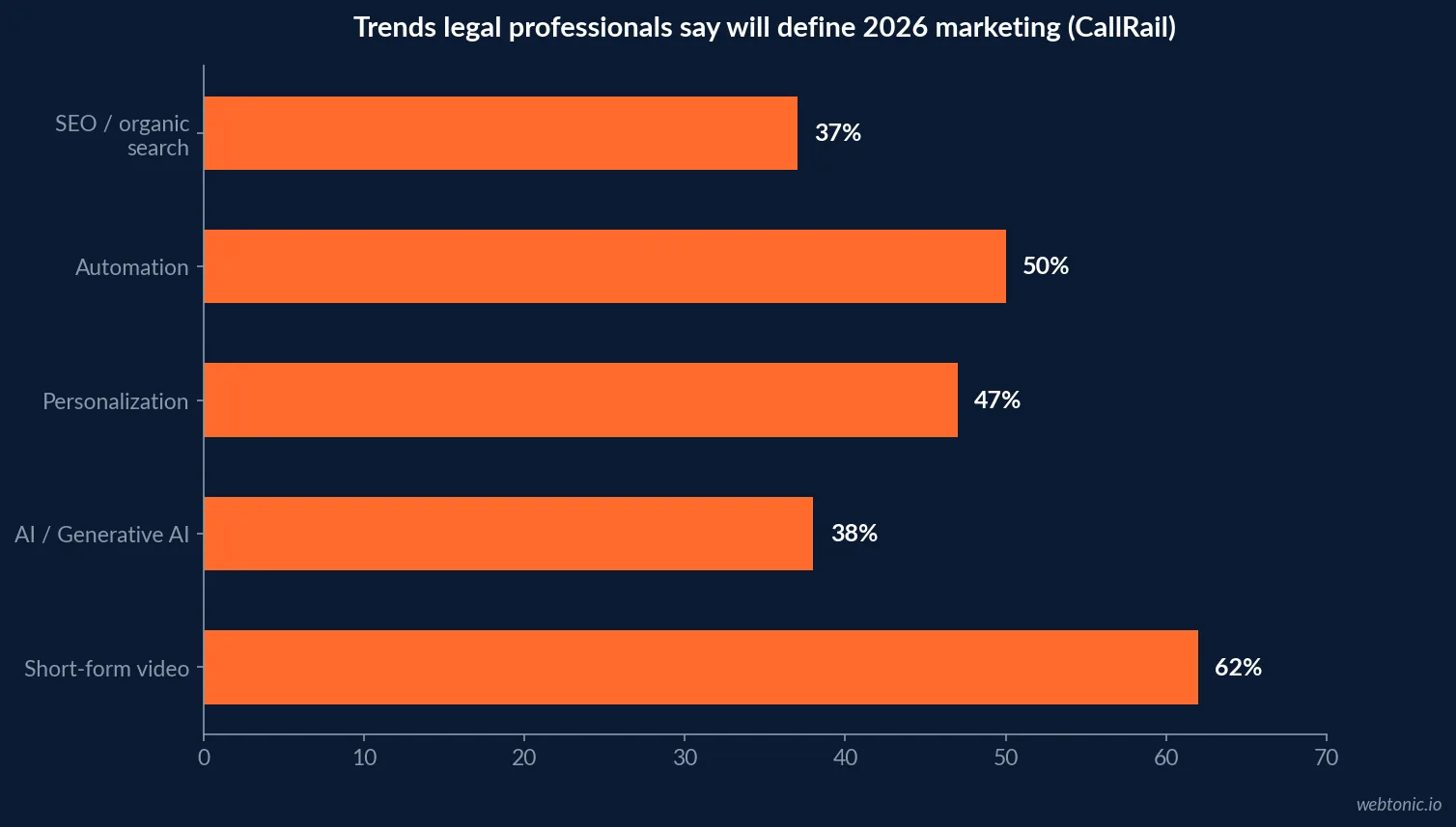
Asked which single trend will define legal marketing in 2026, 62% of firms named short-form video, the highest-ranked answer by a wide margin, ahead of automation (50%), personalization (47%), and generative AI (38%). That legal-industry number lines up with the cross-industry picture: Wyzowl's 2026 video marketing survey of 266 respondents found 91% of businesses now use video as a marketing tool, and 67% of the marketers who don't yet use it plan to start in 2026. Both figures are consistent, one legal-specific and one general, which is a stronger signal than either alone.
| 2026 legal marketing trend | Share of firms naming it | Source |
|---|---|---|
| Short-form video | 62% | CallRail 2026 Legal Marketing Outlook |
| Automation | 50% | CallRail 2026 Legal Marketing Outlook |
| Personalization | 47% | CallRail 2026 Legal Marketing Outlook |
| AI / Generative AI | 38% | CallRail 2026 Legal Marketing Outlook |
| SEO / organic search | 37% | CallRail 2026 Legal Marketing Outlook |
Who is actually on each platform: the honest audience read
No study breaks down family law client demographics by social platform, so this section states its source plainly: Sprout Social's TikTok demographic research puts the platform's age distribution at 18-24: 30.7%, 25-34: 35.3%, 35-44: 16.4%, 45-54: 9.2%, and 55-plus: 8.4%, meaning users under 35 make up roughly two-thirds of the platform. That is a general-population benchmark, not a family-law-client benchmark, and the gap matters: divorce filings concentrate more heavily in the 30s through 50s age range than TikTok's core audience does.
The practical read: TikTok is a reasonable channel for awareness content aimed at younger audiences, cohabitation agreements, pre-nups, "what happens if we break up while renting together" explainer content, but it is a weaker direct-intake channel for a firm's core divorce and custody caseload than Facebook or Instagram, where usage skews closer to the actual client age range, though this page has no platform-level legal-client data to confirm that skew precisely.
| TikTok age group | Share of platform users | Source |
|---|---|---|
| 18-24 | 30.7% | Sprout Social 2026 |
| 25-34 | 35.3% | Sprout Social 2026 |
| 35-44 | 16.4% | Sprout Social 2026 |
| 45-54 | 9.2% | Sprout Social 2026 |
| 55+ | 8.4% | Sprout Social 2026 |
Where Meta fits inside the social mix
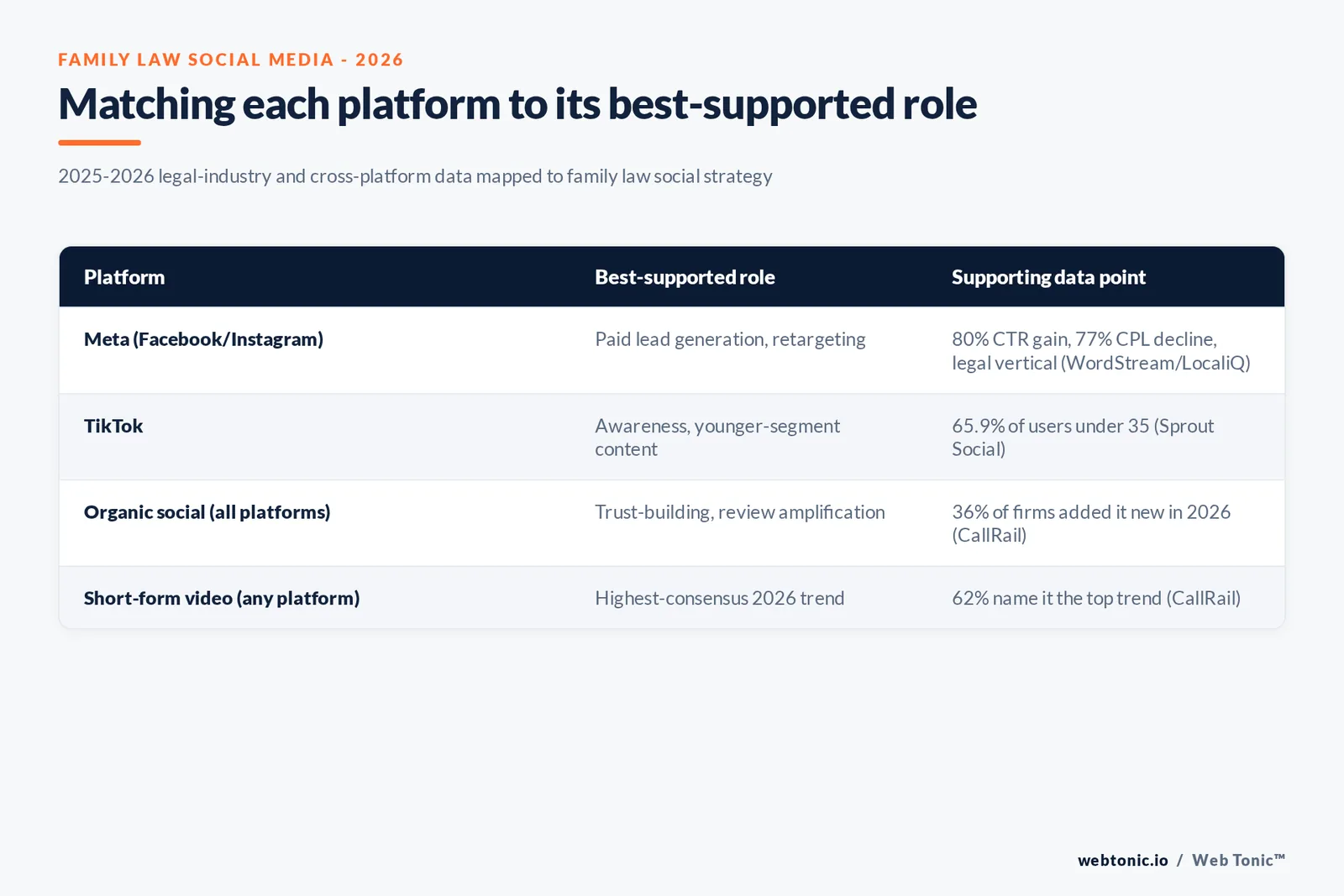
Meta remains the paid-social platform with the clearest legal-vertical data. WordStream/LocaliQ's 2025 Facebook Ads Benchmarks report found Attorneys and Legal Services posted an 80% year-over-year click-through rate gain, the largest of any tracked industry, and a 77% year-over-year cost-per-lead decline, also the steepest drop measured. Read alongside CallRail's 47%-of-firms paid-social spend growth figure, Meta looks like the platform absorbing most of law firms' actual paid-social dollars, with TikTok and organic channels playing a smaller, more awareness-focused role for most firms.
| Platform | Best-supported role for family law | Supporting data point |
|---|---|---|
| Meta (Facebook/Instagram) | Paid lead generation, retargeting | 80% CTR gain, 77% CPL decline (WordStream/LocaliQ 2025) |
| TikTok | Awareness, younger-audience content | 65.9% of users under 35 (Sprout Social) |
| Organic social (all platforms) | Trust-building, review amplification | 36% of firms added it as new in 2026 (CallRail) |
| Short-form video (any platform) | Highest-consensus 2026 trend | 62% name it top trend (CallRail); 91% of businesses use video (Wyzowl) |
A realistic content mix for a family law social program
Given the data above, a defensible allocation leans on Meta for paid lead generation, since it is the only platform with legal-vertical performance data behind it, organic posts across Facebook and Instagram for trust-building content (client-safe testimonials, process explainers, FAQ-style posts), and a smaller, awareness-focused TikTok or Reels presence for shorter-form educational content aimed at a younger segment of the practice, cohabitation and pre-nuptial work in particular. Our creative and performance team builds that mix around each platform's actual, sourced data rather than a one-size-fits-all social calendar, and firms already running Meta campaigns can review our take on choosing a Facebook ads partner before scaling paid social further. Firms weighing the whole channel mix can also compare it against conversion rate benchmarks elsewhere in this series, or talk to our team about a first test budget.
What AI personalization is changing on social
Clio's 2025 Legal Trends Report found 68% of law firms now use AI to personalize marketing, and over half use it for lead scoring (55%) or ROI measurement (53%). For social specifically, that shows up as sharper audience segmentation on Meta's paid tools and faster iteration on which short-form video hooks actually earn a consultation request, rather than just a view. It is also, per the same report, uneven: personal-injury-focused firms lead in using AI for personalization (84% versus 68% overall) but lag in attribution and ROI measurement (36% versus 53% overall), a reminder that adopting a tool and using it to close the attribution loop are two separate steps.
Family law firms following the SEO and email data elsewhere in this series toward a more measured, cross-industry-anchored strategy should apply the same discipline to social: adopt the format (short-form video) where the consensus is strong, but keep the audience assumptions honest about who is actually watching.
Measuring social's real contribution
Because CallRail's data shows social ranks behind SEO and paid search as a direct new-business driver, the most honest KPI for a family law social program is assisted-conversion rate, how often a social touchpoint appears in a client's path before a consultation request, rather than a first-click or last-click lead count. That framing matches how the survey data itself describes social's role: present in almost every firm's channel mix, rarely the sole reason a case comes in the door.
Frequently Asked Questions
Which social platform drives the most new business for law firms?
By CallRail's 2026 survey of 100 legal professionals, paid social is the most commonly adopted new channel, added by 59% of firms in the past year, and organic social ranks among the top three new channels firms plan to test in 2026 at 36%. As a direct new-business driver, though, paid social trails SEO (54%) and video (50%), landing at 38%, which suggests social performs better as a top-of-funnel and retargeting layer than a standalone lead engine.
Is TikTok worth it for a family law firm?
Cautiously, and mostly for brand awareness rather than direct intake. Sprout Social's demographic data shows TikTok's user base skews toward 25-to-34-year-olds (35.3% of users) and 18-to-24-year-olds (30.7%), together nearly two-thirds of the platform. Family law clients, especially in divorce and custody matters, skew somewhat older on average, so TikTok content works best as an awareness or referral-generating layer, not the primary intake channel, unless a firm specifically serves a younger client base (e.g. pre-nuptial agreements, cohabitation agreements).
Should a family law firm invest in short-form video?
The industry consensus says yes. CallRail found 62% of legal professionals name short-form video as the trend most likely to define legal marketing in 2026, the single highest-ranked trend, ahead of automation (50%) and personalization (47%). Wyzowl's broader 2026 survey found 91% of businesses across all sectors now use video as a marketing tool, so family law firms adopting it are following a cross-industry standard, not an unproven experiment.
What's the difference between organic and paid social for family law?
Organic social (unpaid posts, education content, firm updates) was added as a new channel by 36% of firms in 2026 and is one of the top three channels firms plan to test, alongside SMS/text (39%) and video (33%). Paid social was added by a larger 59% of firms and gets more direct new-business credit at 38%, but organic content builds the trust signals, reviews, testimonials, educational posts, that consumer research shows people check before calling any local business.
How does social fit next to SEO and Google Ads for family law marketing?
As a layer, not a replacement. CallRail's new-business-driver ranking puts SEO at 54% and paid search at 47%, both ahead of paid social's 38%, so social generally supports rather than leads a family law acquisition strategy, most effectively as retargeting for people who already visited the firm's site through search, and as a distribution channel for the educational video content driving the 62% short-form-video trend.
Sources
CallRail - 2026 Legal Marketing Outlook Report
Wyzowl - Video Marketing Statistics 2026
Sprout Social - TikTok Statistics 2026
WordStream/LocaliQ - Facebook Ads Benchmarks 2025
Clio - 2025 Legal Trends Report