Table of contents

Attorneys and Legal Services posted the largest Meta Ads click-through rate gain of any industry WordStream tracked in 2025, up 80% year over year, while cost per lead in that same vertical fell 77%. Family law sits inside that legal-services vertical rather than getting its own published line item, so this page reads the benchmark the way a family law buyer actually has to: through the lens of the closest available cohort, with the platform's own targeting limits factored in from the start.
Key Takeaways
- Attorneys and Legal Services Meta CTR rose 80% year over year, the largest gain of any tracked industry.
- Leads-objective CPC for the vertical was $4.10, the second-highest of any industry WordStream measured.
- That $4.10 CPC was still down 44% year over year, the second-largest CPC decline tracked.
- Leads conversion rate hit 10.53% for the vertical, up 31% year over year.
- Cost per lead fell 77% year over year, the steepest CPL decline of any industry in the report.
- The all-industry leads-objective average CPC was $1.92, and average CVR was 7.72%.
- The all-industry average cost per lead was $27.66, up 20% year over year.
- 47% of law firms plan to increase paid social spend in 2026, per CallRail's survey of 100 legal marketers.
- 59% of law firms added paid social as a new channel in the past year.
- 38% of law firm marketing budget increases now flow through paid search and social lines rather than traditional media.
- Meta's Special Ad Category rules restrict targeting for regulated verticals and prohibit implying knowledge of a person's family status in ad copy.
- State bar advertising rules, modeled on ABA-style Rules 7.1 to 7.3, bar misleading claims and unsolicited targeted contact regardless of platform.
- 70% of consumers say they had an easy time finding and hiring a lawyer, per Clio's 2025 Legal Trends Report, which raises the bar for a paid ad to earn the click.
What the vertical actually did on Meta in 2025
WordStream and LocaliQ's 2025 Facebook Ads Benchmarks report, built from 1,180 campaigns running between April 2024 and June 2025, tracks Attorneys and Legal Services as a single vertical, and it is the closest published cohort a family law buyer has. Three numbers stand out against the rest of the report: the vertical's click-through rate improved 80% year over year, the single largest gain of any industry measured; its leads conversion rate reached 10.53%, second only to Restaurants and Food; and its cost per lead fell 77% year over year, the steepest drop tracked.
None of that means Meta got cheap for legal advertisers in absolute terms. The vertical's leads CPC of $4.10 is still the second-highest of any industry in the report, trailing only Dentists and Dental Services at $9.78. What moved is efficiency, not sticker price.
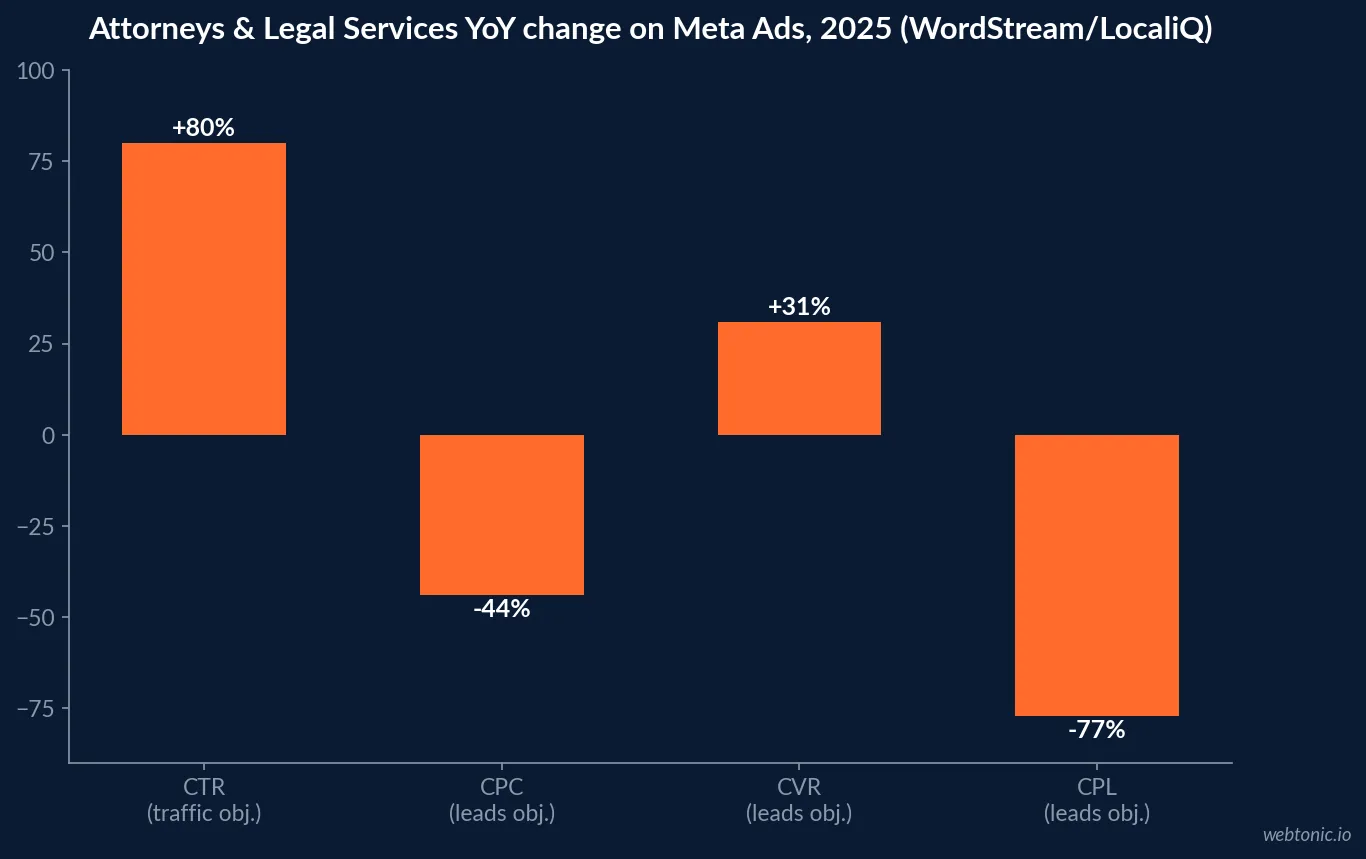
| Metric (leads objective, 2025) | Attorneys & Legal Services | All-industry average | Source |
|---|---|---|---|
| Cost per click | $4.10 | $1.92 | WordStream/LocaliQ 2025 |
| Conversion rate | 10.53% | 7.72% | WordStream/LocaliQ 2025 |
| Cost per lead, YoY change | -77% | +20% | WordStream/LocaliQ 2025 |
| Click-through rate, YoY change (traffic obj.) | +80% | +8% (1.58% to 1.71%) | WordStream/LocaliQ 2025 |
Why the vertical average, not a family law number, is the honest baseline
No publicly available Meta benchmark study breaks Attorneys and Legal Services down into practice areas the way it separates, say, Dentists from Health and Fitness. That is a real gap, and this page states it plainly rather than inventing a family-law-only figure: every Meta CPC, CVR and CPL number above is a legal-services-wide average, and family law campaigns should be benchmarked against it as a cohort, not treated as a stand-in for a number that does not exist.
What that means in practice: if a family law campaign's cost per lead is tracking meaningfully above the vertical's trend, but the account has no way to isolate divorce, custody, or support-modification leads from the rest of a mixed-practice firm's traffic, the fix starts with campaign-level segmentation, not a platform switch.
| Google Ads benchmark (2026, same vertical) | Attorneys & Legal Services | All-industry average | Source |
|---|---|---|---|
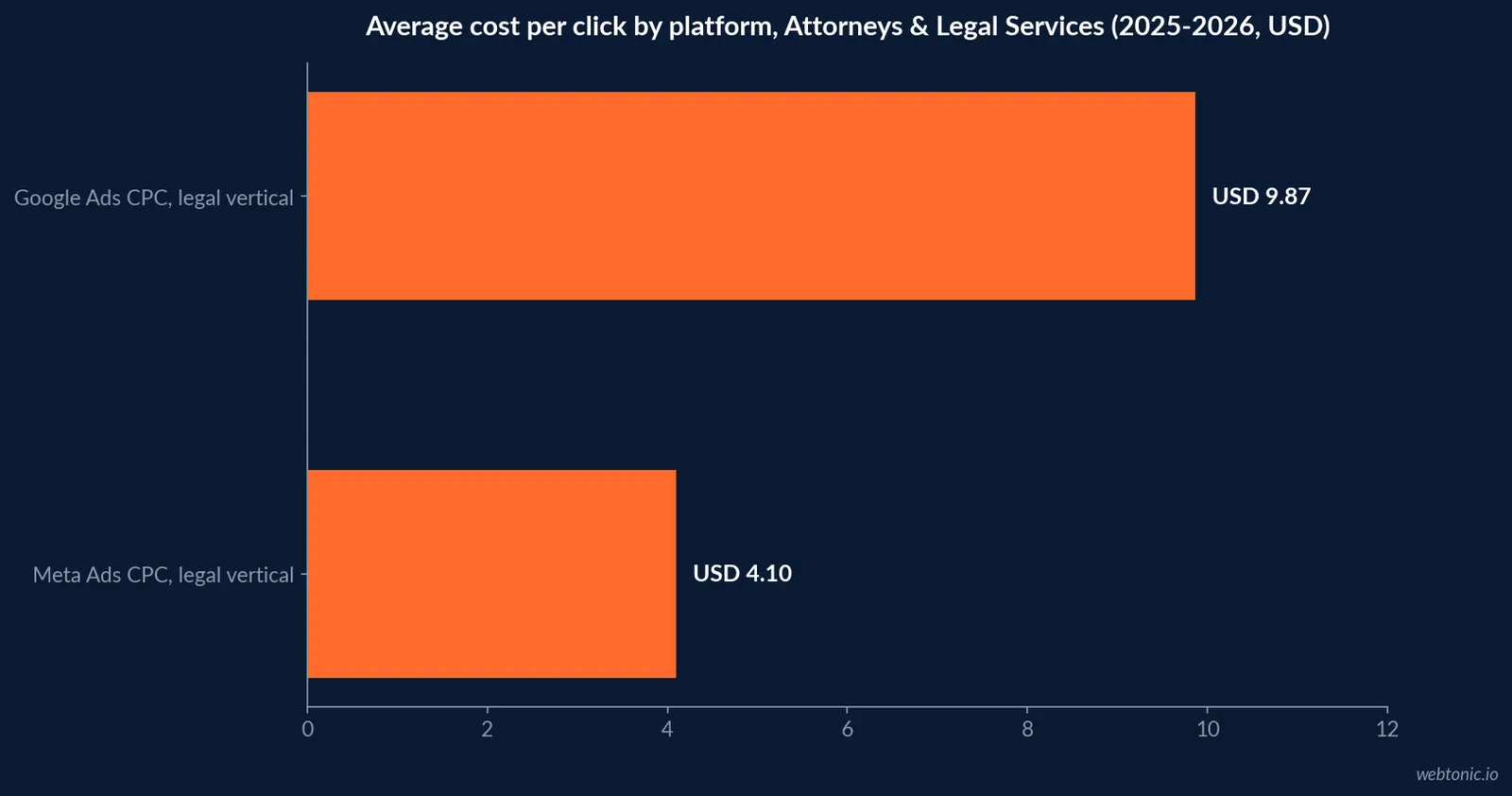
| Average cost per click | $9.87 (highest of any industry) | $5.42 | WordStream/LocaliQ 2026 |
| Average cost per lead | $131.63 (highest of any industry) | $66.69 | WordStream/LocaliQ 2026 |
Meta versus Google: the practical read
Laid side by side, the two platforms tell a consistent story about the legal vertical: it is expensive on both, and cheaper per click on Meta than on Google Ads, where the same vertical posts a $9.87 average CPC and a $131.63 average CPL, both the single highest figures in that report across every tracked industry. Meta's $4.10 leads CPC is roughly 58% lower. That does not make Meta the default channel; it makes it the cheaper acquisition lever to test first while a Google Ads program is still proving out its own cost per lead.
The honest caveat: Google's 2026 report does not publish a like-for-like CPL figure for Meta's leads objective inside the legal vertical, so this is a CPC comparison, not a full cost-per-acquisition comparison across platforms.
Where the marketing budget is actually moving
CallRail's 2026 Legal Marketing Outlook Report, a survey of 100 legal professionals fielded in October 2025, found that only 57% of law firms expect to increase marketing budgets in 2026, down sharply from 86% the year before. Inside that shrinking pool of growth budget, paid social ranks third among channels seeing increased spend at 47%, behind email at 51% and influencer marketing at 49%. Separately, 59% of firms added paid social as a brand-new channel in the past year, more than added email or video.
| Channel | Share of firms increasing 2026 spend | Source |
|---|---|---|
| 51% | CallRail 2026 Legal Marketing Outlook | |
| Influencer marketing | 49% | CallRail 2026 Legal Marketing Outlook |
| Paid social (incl. Meta) | 47% | CallRail 2026 Legal Marketing Outlook |
| SEO | 42% | CallRail 2026 Legal Marketing Outlook |
| Organic social | 35% | CallRail 2026 Legal Marketing Outlook |
The targeting limits that shape every family law campaign
Meta's Special Ad Category framework governs how audiences can be built for regulated verticals, and while family law is not itself a Special Ad Category, the platform's broader ad standards apply to every campaign: an ad cannot assert or imply that the advertiser knows a viewer's personal circumstances, and family status is explicitly listed among the personal attributes ads may not reference. Practically, that rules out copy implying "we know you're going through a divorce" style messaging, however tempting the intent signal.
Layered on top of the platform rule is the legal-industry rule. State bars regulate lawyer advertising in language modeled on the ABA's Model Rules 7.1 through 7.3, which prohibit false or misleading statements about a lawyer's services and restrict solicitation of people known to need legal help for a particular matter. The California Bar's current Rules of Professional Conduct, Chapter 7, spell this out clearly: a lawyer may advertise broadly, but may not pay for referrals outside narrow carve-outs, and every communication must name a responsible lawyer or firm. A compliant Meta campaign for family law leans on message and creative quality, not inferred life-event targeting.
| Constraint | What it means for a family law Meta campaign | Source |
|---|---|---|
| Special Ad Category rules | No inferring divorce/custody status to narrow an audience | Meta developer policy |
| Personal attributes policy | Copy cannot reference a viewer's family status directly | Meta ad standards |
| State bar Rules 7.1-7.3 | No false claims; no paid referrals outside narrow exceptions | California Bar Rules of Professional Conduct |
| Responsible-attorney disclosure | Every ad/communication needs a named lawyer or firm | California Bar Rules of Professional Conduct |
Building a lead form that can hit the vertical's conversion rate
Clio's 2025 Legal Trends Report found that 70% of consumers who recently hired a lawyer say they had an easy time finding and hiring one, largely through referrals and online search. That is a high bar for a cold Meta lead ad to clear: if finding a lawyer already feels easy through existing channels, a paid ad has to offer something referrals and search do not, most often speed of response or a lower-friction first step than a phone call.
The report also found 24% of clients said they would be unlikely to rehire their last lawyer, which points at intake quality, not lead volume, as the leverage point once a Meta campaign is generating clicks. A vertical converting at 10.53% on paid leads is being let down badly by any intake process that cannot answer, qualify, and book inside the first hour.
| Best-practice element | Why it moves the CVR needle | Benchmark reference |
|---|---|---|
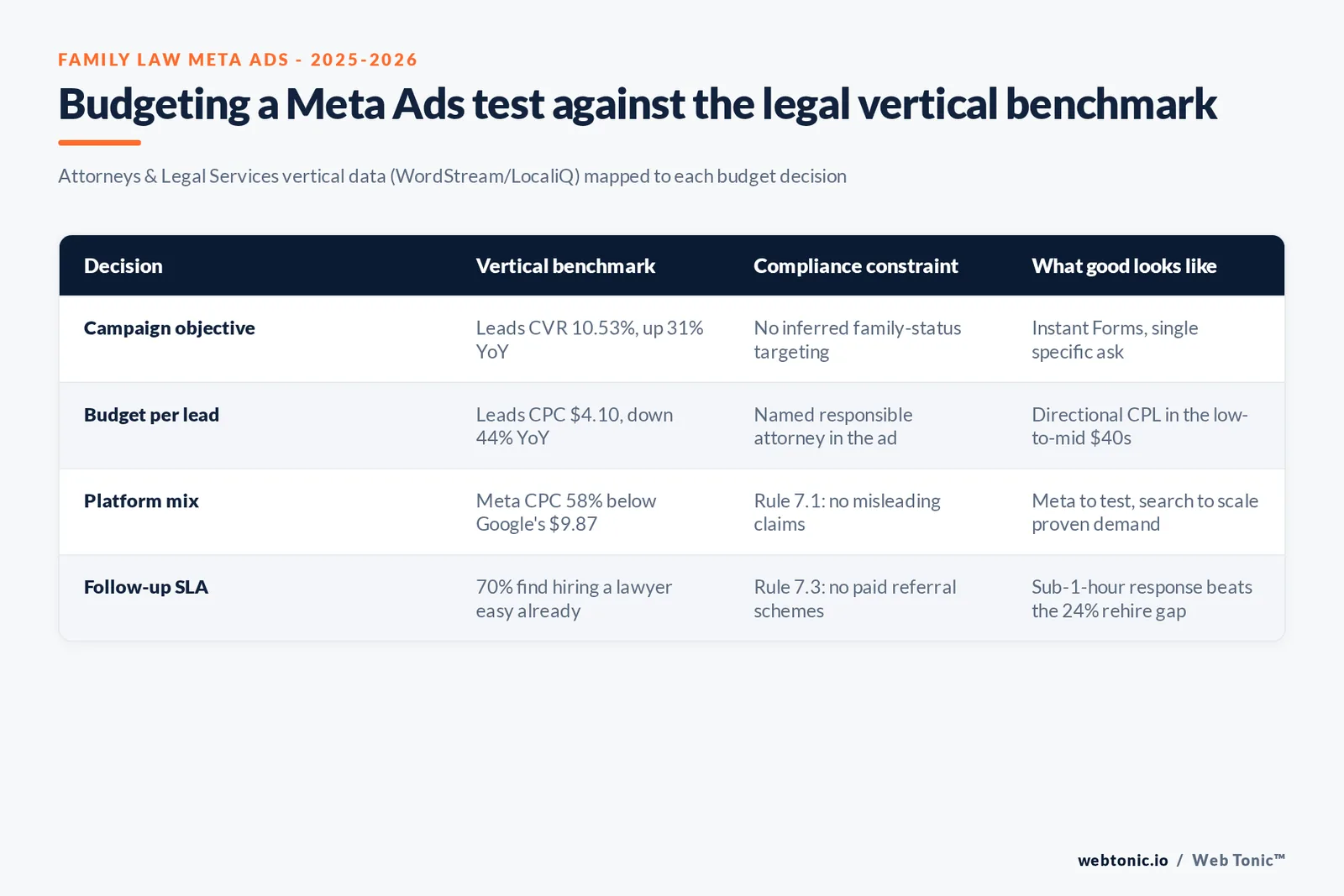
| Instant Forms over off-platform landing pages | Removes a load step from a mobile-first click | WordStream/LocaliQ 2025 |
| Single, specific ask (e.g. custody consult) | Matches the 10.53% vertical CVR ceiling | WordStream/LocaliQ 2025 |
| Sub-1-hour follow-up | Addresses the 24% rehire-reluctance gap directly | Clio 2025 Legal Trends |
| No inferred life-event copy | Keeps the ad inside Meta's personal-attributes policy | Meta ad standards |
The 2026 edition confirms the same vertical is still pricier, not cheaper
LocaliQ's continuously updated Facebook Advertising Benchmarks page, refreshed for 2026, puts the Attorneys and Legal Services traffic-objective click-through rate at 1.77% against an all-industry average that itself climbed to 1.93%, up from 1.71% the year before. Read together with the 2025 PDF's +80% year-over-year CTR gain for the same vertical, the pattern is a legal vertical that started from a low base and is closing the gap with the rest of the market, not one that has overtaken it.
That single data point matters for budgeting: a family law campaign underperforming the 1.93% cross-industry average is not automatically failing, since the vertical itself still sits below that line. The more useful yardstick is the vertical's own year-over-year trend, not a same-year comparison against unrelated industries like Travel or Beauty and Personal Care.
Should video creative carry the family law message?
Meta's Feed and Reels placements reward video, and the broader creative-format data backs that up: Wyzowl's 2026 video marketing survey of 266 respondents found 91% of businesses now use video as a marketing tool, and 67% of marketers who don't yet use video plan to start in 2026. Neither figure is family-law-specific, and this page states that plainly, but they back the same direction CallRail's legal-industry survey points: video was one of the top three new channels law firms planned to test in 2026, alongside SMS/text and organic social.
For a sensitive-topic practice like family law, a short attorney-led video, explaining what a first consultation covers, tends to out-convert a stock-photo static ad, because it answers the trust question a cold click can't: who exactly is on the other end of the form.
Setting a realistic testing budget
Given a $4.10 leads CPC and a 10.53% conversion rate at the vertical average, a firm needs roughly 10 clicks to expect one lead, putting a directional cost per lead in the low-to-mid forty-dollar range before any account-specific optimization, notably higher than the sub-$28 all-industry average, but the direction of travel (a 77% year-over-year CPL decline for the vertical) argues for testing now rather than waiting for the market to get cheaper on its own.
Our Meta Ads management practice builds these campaigns against the vertical benchmark rather than a generic cross-industry target, and can help a firm decide whether Meta or search should carry the first dollar of new paid budget; see how we frame that decision on our page on whether Facebook ads are worth it and what a realistic Facebook ads budget looks like for a service business.
Common mistakes that erase the vertical's CVR advantage
Three patterns show up repeatedly in accounts that convert well below the 10.53% leads-objective benchmark. First, running the traffic objective when the actual goal is a lead, which inflates clicks without the platform's lead-optimization signal working in the campaign's favor. Second, sending clicks to a slow-loading, multi-field website form instead of a native Instant Form, which discards a meaningful share of the mobile audience before it ever reaches the questions. Third, reusing a single ad set across every practice area a firm handles, which dilutes Meta's delivery algorithm and prevents it from learning what a family law searcher specifically responds to.
Fixing all three does not require a bigger budget, only a cleaner campaign structure aligned to the vertical's own benchmark rather than a blended, multi-practice-area account average.
Frequently Asked Questions
Is Meta Ads worth it for a family law firm?
The direction of the data says yes. WordStream/LocaliQ's 2025 Facebook Ads Benchmarks report, built from 1,180 campaigns run between April 2024 and June 2025, found Attorneys and Legal Services posted the single biggest click-through rate gain of any tracked vertical, up 80% year over year, while cost per lead in the same vertical fell further than any other industry, down 77%. That combination, more clicks for less spend per lead, is the strongest directional signal in the whole report.
How much does a Meta lead ad cost for a family law practice?
The Attorneys and Legal Services vertical averaged a $4.10 cost per click on the leads objective in 2025, the second-highest of any industry WordStream tracks, behind only dental. The all-industry average leads CPC was $1.92. Family law sits inside that legal vertical average rather than having its own published number, so budget against the $4.10 figure, not the cross-industry one.
What conversion rate should a family law Meta campaign hit?
Attorneys and Legal Services converted at 10.53% on the leads objective, the second-highest rate WordStream measured and up 31% year over year, against a 7.72% all-industry average. A family law campaign landing meaningfully below 10% on a properly built lead form is underperforming its own vertical, not just the market average.
Can you target people going through a divorce on Meta?
No, not directly. Meta's Special Ad Category framework restricts audience options for regulated verticals, and separately its ad standards prohibit implying knowledge of a person's personal circumstances, family status included. A family law campaign has to earn its clicks on message and placement, not on inferred life-event targeting, which is also consistent with state bar advertising rules that bar solicitation implying special knowledge of a prospect's legal situation.
Does Meta or Google cost less per lead for family law?
On the numbers each platform publishes for the Attorneys and Legal Services vertical, Meta is structurally cheaper per click ($4.10 versus $9.87 on Google Ads in 2026) though Google's benchmark report does not break out a matching Meta-style CPL for the vertical, so the fair comparison is CPC and campaign objective, not a single blended cost figure across platforms.
Sources
WordStream/LocaliQ - Facebook Ads Benchmarks 2025
WordStream/LocaliQ - Search Advertising Benchmarks by Industry 2026
CallRail - 2026 Legal Marketing Outlook Report
Clio - 2025 Legal Trends Report
State Bar of California - Rules of Professional Conduct, Chapter 7
Meta for Developers - Special Ad Category documentation
LocaliQ - Facebook Advertising Benchmarks (2026 edition)
Wyzowl - Video Marketing Statistics 2026