Table of contents

No study benchmarks ad creative for family law specifically, so this page uses the published 'Attorneys & Legal Services' vertical data - cross-practice by definition - and reads it against the state bar rules that actually gate what a family law ad's creative is allowed to claim. Every number below is labeled by the vertical it was measured on.
Key Takeaways
- Legal search CTR rose 12.64% year over year in 2025, the third-highest gain WordStream tracked.
- Legal search CPC sits at USD 8.58, the highest of any category in the same report.
- Legal search cost per lead runs USD 131.63, against a USD 70.11 all-industry average.
- Legal search conversion rate is 5.09%, below the 7.52% all-industry average.
- Legal Facebook traffic-campaign CTR is 1.76%, and CPC is USD 0.86.
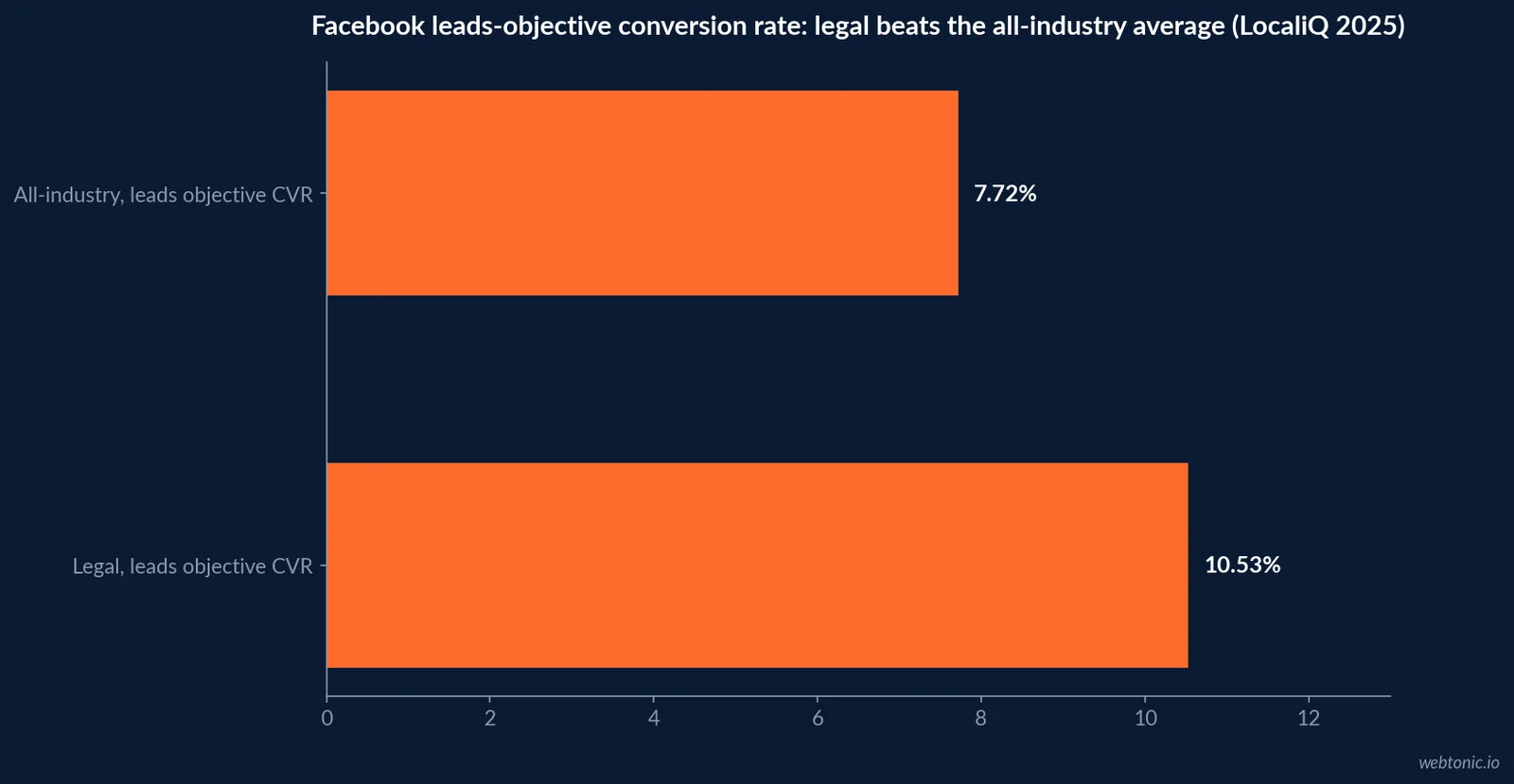
- Legal Facebook leads-campaign conversion rate is 10.53%, well above the 7.72% all-industry average.
- Legal Facebook leads CTR grew 80% year over year, the largest gain of any category tracked.
- Legal Facebook leads cost per lead fell 77% year over year to USD 18.17.
- 91% of businesses across industries now use video as a marketing tool.
- 83% of video marketers say video has directly increased sales.
- 85% say video has helped generate leads.
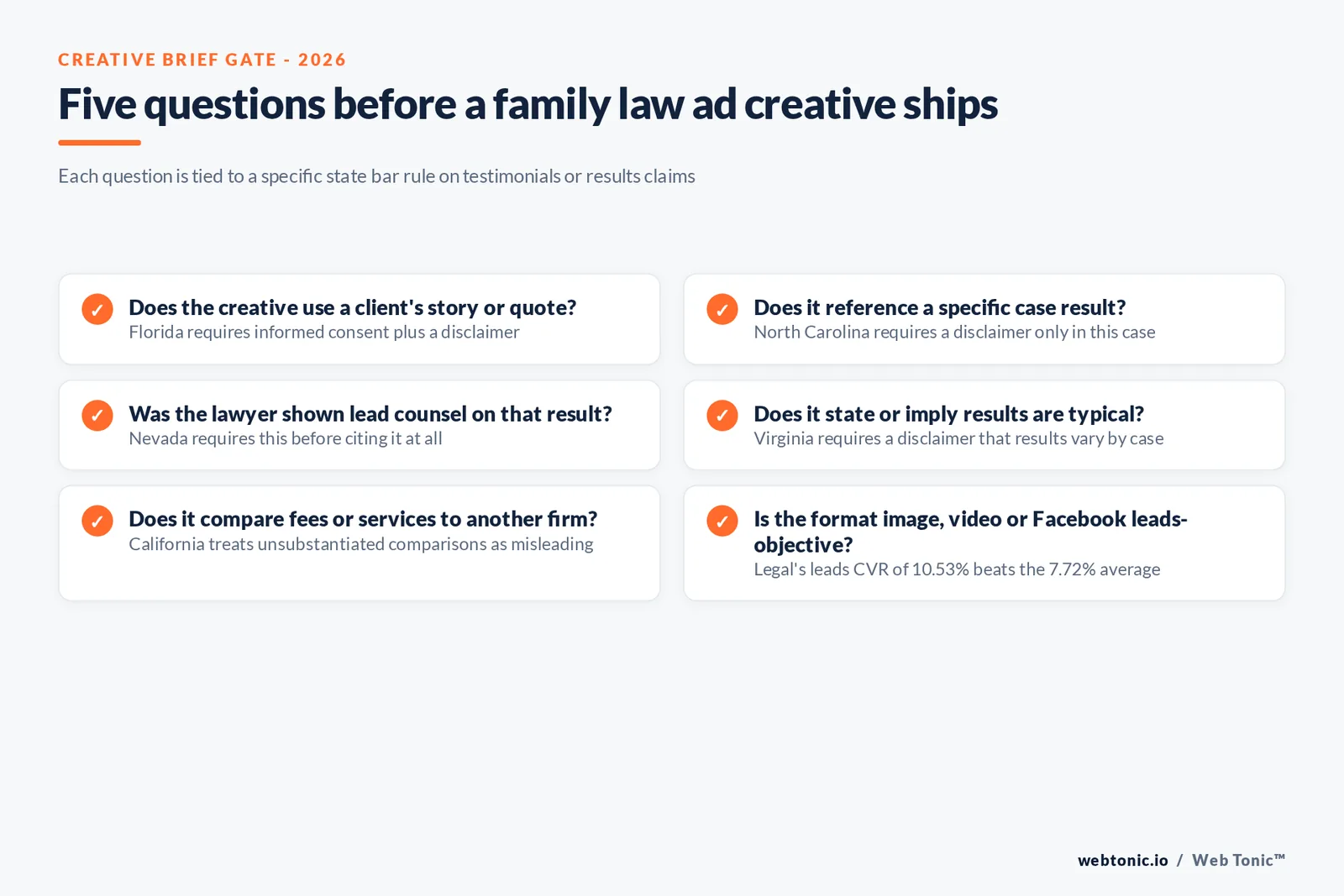
- Florida requires informed consent plus a disclaimer for testimonials tied to a case.
- North Carolina requires a disclaimer only when a testimonial references a specific result.
- Nevada requires the lawyer to have been lead counsel to cite a past result.
- Virginia requires a disclaimer that results depend on each case's own facts.
- Average family law hourly rate is USD 343, the value a single converted lead represents.
Why "legal" data has to stand in for "family law"
No ad platform or benchmark provider publishes creative performance broken out to the practice-area level. What exists is the "Attorneys & Legal Services" category inside WordStream by LocaliQ's 2025 Google Ads Benchmarks report and its companion 2025 Facebook Ads Benchmarks report. Family law sits inside that category alongside criminal defense, personal injury, immigration and every other legal specialty, so a figure that looks strong for "legal" could be dragged up or down by a completely different practice area's ad spend. Every claim on this page keeps that caveat attached.
Search ad creative: legal earns clicks but pays for them
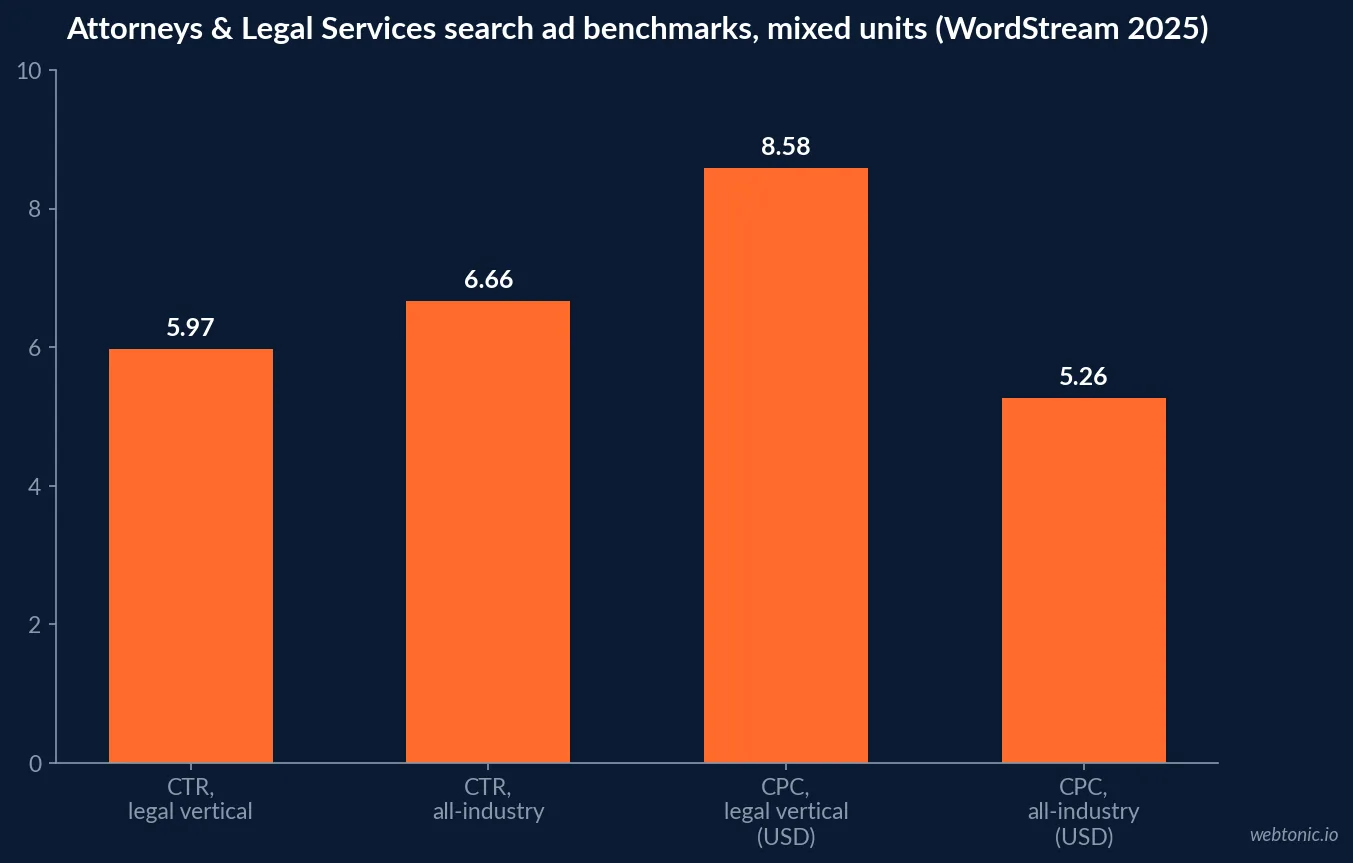
WordStream's 2025 data shows legal search ads pulling a 5.97% click-through rate, below the 6.66% all-industry average, but that CTR still rose 12.64% year over year - the third-largest increase of any category the report tracked, behind only shopping/collectibles/gifts and home improvement. The cost of that click is the highest in the report: USD 8.58, against a USD 5.26 average. Combined with a below-average 5.09% conversion rate, the result is a USD 131.63 cost per lead, nearly double the USD 70.11 all-industry figure.
None of that is a creative problem to fix with better ad copy alone - competition and CPC floors set most of that gap - but it does mean a family law firm's search ad creative has to convert above the legal-vertical average just to hit the all-industry cost-per-lead baseline.
| Metric (Attorneys & Legal Services, 2025) | Legal vertical | All-industry average | Gap |
|---|---|---|---|
| Click-through rate | 5.97% | 6.66% | Below average |
| Click-through rate, YoY change | +12.64% | +3.74% | Growing faster |
| Cost per click | USD 8.58 | USD 5.26 | 63% higher |
| Conversion rate | 5.09% | 7.52% | Below average |
| Cost per lead | USD 131.63 | USD 70.11 | 88% higher |
Facebook creative: the leads objective is where legal wins
LocaliQ's 2025 Facebook Ads Benchmarks splits results by campaign objective, and the split matters for creative planning. On the traffic objective, legal ads run a modest 1.76% click-through rate at USD 0.86 per click, both close to the all-industry average. Switch to the leads objective, though, and legal jumps to a 10.53% conversion rate, comfortably above the 7.72% all-industry average, while its cost per lead of USD 18.17 fell an enormous 77% year over year and its leads CTR grew 80% year over year - the single largest gain across every category in the report.
The practical read: creative built to drive a form fill, not a click, is where legal ad spend on Facebook is currently working best, and that gap has been widening for legal specifically, not shrinking with the rest of the market.
| Facebook ad metric, Attorneys & Legal Services | Traffic objective | Leads objective |
|---|---|---|
| Click-through rate | 1.76% | 2.11% |
| Cost per click | USD 0.86 | USD 4.10 |
| Conversion rate | n/a (traffic objective) | 10.53% |
| Cost per lead | n/a (traffic objective) | USD 18.17 |
| Leads CTR, year-over-year change | n/a | +80% |
| Leads cost per lead, year-over-year change | n/a | -77% |
Video is the format the wider market is betting on
Wyzowl's Video Marketing Statistics 2026 survey, fielded on 266 respondents in late 2025, found 91% of businesses now use video as a marketing tool, and among video marketers, 83% say video has directly increased sales, 85% say it has generated leads, and 82% say it has increased time spent on their website. None of this is a law-firm figure, but paired with legal's outsized Facebook leads performance above, it is a reasonable basis for testing video creative rather than only static image ads in a family law campaign.
| Wyzowl 2026 survey finding (all industries) | Figure |
|---|---|
| Businesses using video as a marketing tool | 91% |
| Video marketers reporting increased sales | 83% |
| Video marketers reporting more leads generated | 85% |
| Video marketers reporting longer site dwell time | 82% |
| Video marketers reporting more traffic | 89% |
The rule that decides what the creative can actually say
Ad creative for family law is gated by state bar advertising rules before it is gated by platform policy. The Florida Bar's 2025 Advertising Handbook requires a lawyer to have the client's informed consent and to attach a clear, conspicuous disclaimer to any testimonial tied to a client's specific matter. North Carolina's 2012 Formal Ethics Opinion 1 takes a lighter touch: general-service testimonials can run without a disclaimer, but any testimonial referencing a specific result still needs one.
Other states go further on results claims specifically. Nevada's Rules of Professional Conduct 7.1-7.5 require that a lawyer citing a past result was lead counsel or primarily responsible for it, and Virginia's Rule 7.1-7.5 requires a disclaimer stating that results depend on the facts of each case. California's Rules 7.1-7.6 separately warn that an unsubstantiated comparison of a lawyer's services or fees to another lawyer's can itself be misleading if stated with enough specificity to seem like a factual claim.
| State bar | What the creative rule requires | What it restricts |
|---|---|---|
| Florida | Informed consent + clear disclaimer for matter-specific testimonials | Result-tied testimonials without consent |
| North Carolina | Disclaimer only for result-specific testimonials | Result claims without context |
| Nevada | Lawyer must have been lead counsel to cite a result | Borrowed or team results as personal claims |
| Virginia | Disclaimer that results depend on case facts | Bare case-result claims |
| California | No unsubstantiated fee/service comparisons stated as fact | Specific comparative claims |
What the underlying case value implies for creative spend
Family law's average lawyer hourly rate is USD 343 per Clio's 2025 Legal Trends Report, among the higher rates the report tracks across practice areas, and the average law firm rate sits at USD 294. That case value is the economic argument behind spending more on creative production than a lower-value category would: a single well-produced ad that lifts conversion rate by even a point or two on a leads campaign already running at 10.53% pays for itself quickly against a case worth several thousand dollars in fees.
It also argues against treating creative as a set-and-forget asset. WordStream's data shows legal CTR and CPC both moving meaningfully year over year - CTR up 12.64%, cost per lead on Facebook's leads objective down 77% - which means creative that was competitive a year ago is being measured against a market that has already shifted underneath it.
| What the case value funds (family law) | Published figure | Creative implication |
|---|---|---|
| Avg. family law lawyer hourly rate | USD 343 (Clio 2025) | Room to fund a real production budget |
| Legal Facebook leads conversion rate | 10.53% (LocaliQ 2025) | A/B testing pays back fast at this rate |
| Legal Facebook leads CPL, YoY change | -77% (LocaliQ 2025) | The channel got cheaper while creative aged |
| Legal search CTR, YoY change | +12.64% (WordStream 2025) | Stale ad copy is losing ground to fresher entrants |
What this means for a creative brief
Put together, the data argues for a specific creative mix: lead-objective Facebook creative (where legal's conversion rate and cost trend both outperform the market), search ad copy that earns its higher CPC through above-average relevance rather than volume, and video tested cautiously given the general-market lift Wyzowl reports. None of that creative can lean on a client story, a settlement number or a "we win custody cases" claim without clearing the specific state bar's disclaimer and consent rules above - which should sit in the creative brief, not get discovered during legal review after the shoot. Our performance creative team builds that compliance check into the brief stage rather than the approval stage.
For the media-buying side of the same funnel, see our breakdown of when Facebook ads are worth the spend, or talk to us about a family-law-specific test plan.
The short version for a creative team building the next batch of assets: lean toward lead-objective formats where the vertical's own data already outperforms the market, price the testing budget against the USD 343 hourly rate a converted lead is worth, and route every testimonial or result claim through the relevant state bar rule before it ever reaches a storyboard, not after the shoot wraps.
Frequently Asked Questions
Is there a family-law-specific ad creative benchmark?
No. The published benchmarks that exist are for the 'Attorneys & Legal Services' vertical as a whole in WordStream/LocaliQ's search and Facebook ads reports, which do not break results out by practice area. This page uses that vertical-level data and states plainly where it is cross-practice rather than presenting it as family-law-specific.
What ad creative format performs best for legal advertisers on Facebook?
LocaliQ's 2025 Facebook Ads Benchmarks report found the leads objective converts far better than the traffic objective for Attorneys & Legal Services - a 10.53% conversion rate against a 1.76% click-through rate on traffic campaigns - and that legal's leads CTR actually grew 80% year over year, the biggest gain of any category the report tracked.
Can a family law ad legally use a past client's story or testimonial?
It depends on the state bar, and most require a disclaimer even when they allow it. Florida's 2025 Advertising Handbook requires informed client consent plus a clear and conspicuous disclaimer for any testimonial tied to a specific matter. North Carolina's bar allows general-service testimonials without a disclaimer but requires one for any testimonial referencing a specific result. Treat every jurisdiction's rule as different until checked.
Do results-focused ad creatives (case outcomes, settlement numbers) need a disclaimer?
In most states tested here, yes. Virginia's Rule 7.1-7.5 requires a disclaimer putting any case result in context and stating that results depend on the facts of each case. Nevada's rule goes further, requiring that any lawyer referencing past results was actually lead counsel or primarily responsible for that outcome. A family law ad claiming 'we win custody cases' without that grounding is a compliance risk before it is a creative choice.
Is video worth the production cost for a family law firm's ad creative?
Wyzowl's 2026 survey (fielded late 2025) found 91% of businesses across industries now use video as a marketing tool, and 83% of video marketers say video has directly increased sales. Neither figure is law-firm-specific, but combined with legal's above-average Facebook lead conversion rate, video is a reasonable creative bet even without a legal-only study to confirm it.
Sources
WordStream by LocaliQ - 2025 Google Ads Benchmarks
LocaliQ - 2025 Facebook Advertising Benchmarks
Wyzowl - Video Marketing Statistics 2026
The Florida Bar - Advertising Handbook, 2025 Edition
North Carolina State Bar - 2012 Formal Ethics Opinion 1
State Bar of Nevada - Rules of Professional Conduct 7.1-7.5
Supreme Court of Virginia - Rules of Professional Conduct 7.1-7.5
The State Bar of California - Rules of Professional Conduct, Chapter 7
Clio - 2025 Legal Trends Report