



Table of contents
Meta Audience Network extends your Facebook and Instagram ad campaigns into thousands of third-party mobile apps. Here is how it works, which ad formats perform best, and how to maximize results.
Key Takeaways
- 37,000+ active developers and publishers currently monetize through the platform worldwide.
- The platform is 100 % bidding-only as of 2024—waterfall setups are no longer supported on iOS or Android.
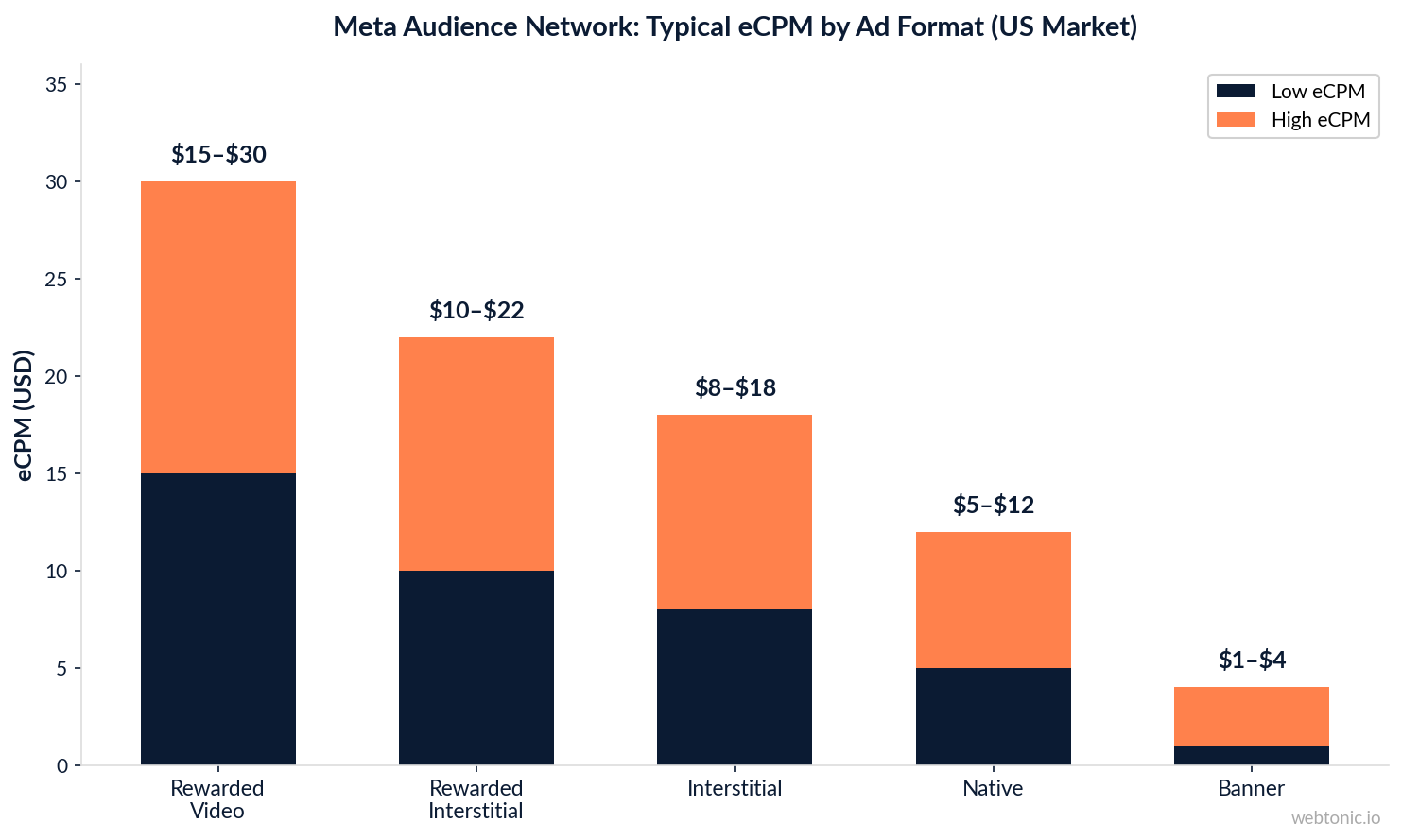
- Rewarded video ads routinely deliver eCPMs of $10–$30 in Tier-1 markets like the U.S. and U.K.
- Advertisers can run placements across Awareness, Traffic, Engagement, App Installs, Conversions, and Catalog Sales objectives.
- Publishers report up to 230 % revenue increases after switching from standalone waterfall to bidding, as shown in industry monetization reports (Polaris Office case study).
What Is Facebook Audience Network?
Facebook Audience Network (FAN)—officially rebranded to Meta Audience Network—is an in-app advertising platform launched in 2014. It lets Meta advertisers extend their campaigns beyond Facebook and Instagram into mobile apps that have integrated the the SDK. For publishers, it provides access to demand from millions of Meta advertisers, monetizing every impression through a real-time bidding auction.
The network operates on the same people-based targeting engine that powers ads on Facebook and Instagram. That means advertisers do not lose any of their audience segmentation, lookalike modeling, or conversion optimization when they extend reach into third-party applications. Measurement, attribution, and billing all remain unified within Ads Manager.
For businesses running growth marketing strategies, Audience Network adds a high-value channel that can reduce overall cost per acquisition by 10–20 % through access to less competitive mobile inventory.
How the Platform Works
From the advertiser side, enabling extended reach is as simple as selecting the option under placements when building a campaign in Ads Manager—or letting Advantage+ Placements allocate budget across all surfaces automatically. The delivery system then bids on ad opportunities inside partner applications in real time.
From the publisher side, the setup involves four steps managed through Monetization Manager:
- Create a business portfolio or sign in with an existing a business account.
- Add your app — provide app details; The team reviews it against Audience Network policies.
- Create placements — choose from rewarded video, interstitial, native, banner, or rewarded interstitial formats, then integrate the Audience Network SDK.
- Earn revenue — once the app is live, ad revenue is deposited monthly into the publisher's bank account.
| Step | Action | Key Requirement |
|---|---|---|
| 1 | Set up Meta Business account | Valid business portfolio |
| 2 | Add app to Monetization Manager | App listed on Google Play or App Store |
| 3 | Create ad placements + integrate SDK | Audience Network SDK (iOS/Android/Unity) |
| 4 | Publish and start earning | App passes Meta review |
Ad Formats Available to Publishers
The platform supports five core ad formats, each designed for different app experiences and monetization goals. Choosing the right format depends on your application type, user flow, and revenue targets.
Rewarded Video Ads
Rewarded video is a player-initiated, full-screen video format that offers an in-app incentive (extra lives, virtual currency, premium content) in exchange for a completed view. Because users opt in, engagement rates are high—completion rates regularly exceed 85 % according to industry benchmarks—and eCPMs often reach $15–$30 in Tier-1 geos.
Interstitial Ads
Full-screen ads that appear during natural pauses—between game levels, after completing a task, or during app transitions. Interstitials support static image, video, carousel, and playable creatives and generate eCPMs of $8–$18 depending on the geo and vertical.
Rewarded Interstitial Ads
A hybrid format combining the interstitial experience with an opt-in reward. These appear at natural transition points and are skippable, making them less intrusive while still offering strong eCPMs.
Native Ads
Native ads let publishers customize every visual element—headline, image, CTA button—to match the app's look and feel. This seamless integration typically yields higher user engagement and lower ad blindness compared to standard display units.
Banner Ads
Small rectangular units placed at the top or bottom of the screen. While they carry the lowest eCPM of all formats, banners provide consistent background revenue and work well as supplementary placements alongside interstitials or rewarded video.
| Format | Best For | Typical eCPM (US) | User Experience |
|---|---|---|---|
| Rewarded Video | Games, utility apps | $15–$30 | Opt-in, high engagement |
| Interstitial | Games, news, social | $8–$18 | Full-screen, natural breaks |
| Rewarded Interstitial | Games | $10–$22 | Skippable with reward |
| Native | Content, utility apps | $5–$12 | Blends with app UI |
| Banner | Any app type | $1–$4 | Persistent, low disruption |
Meta Audience Network vs. Google AdMob
The two dominant mobile ad platforms each bring distinct advantages, as detailed comparison studies consistently show. The former leverages Facebook's people-based targeting for highly relevant ad delivery, while Google AdMob draws on the broader Google Ads ecosystem and integrates tightly with Firebase analytics.
| Criterion | Meta Audience Network | Google AdMob |
|---|---|---|
| Targeting | People-based (Facebook data) | Contextual + Google Signals |
| Auction model | Bidding only (no waterfall) | Bidding + waterfall mediation |
| Revenue share | Not publicly disclosed | 60/40 (publisher/Google) |
| Min payout | $100 | $100 |
| Analytics | Monetization Manager | Firebase + AdMob dashboard |
| SDK platforms | iOS, Android, Unity | iOS, Android, Unity, Flutter |
Many publishers—including over 50 % of the top 100 grossing apps—run both platforms simultaneously through a mediation layer. Meta Audience Network integrates with major mediation partners including Google AdMob Mediation, AppLovin MAX, ironSource, and MoPub successors. Bidding through mediation ensures the highest-paying demand source wins every impression.
App Bidding and Mediation
Since 2024, the platform operates exclusively on a bidding model—waterfall integrations are no longer supported. This shift has driven measurable benefits for publishers:
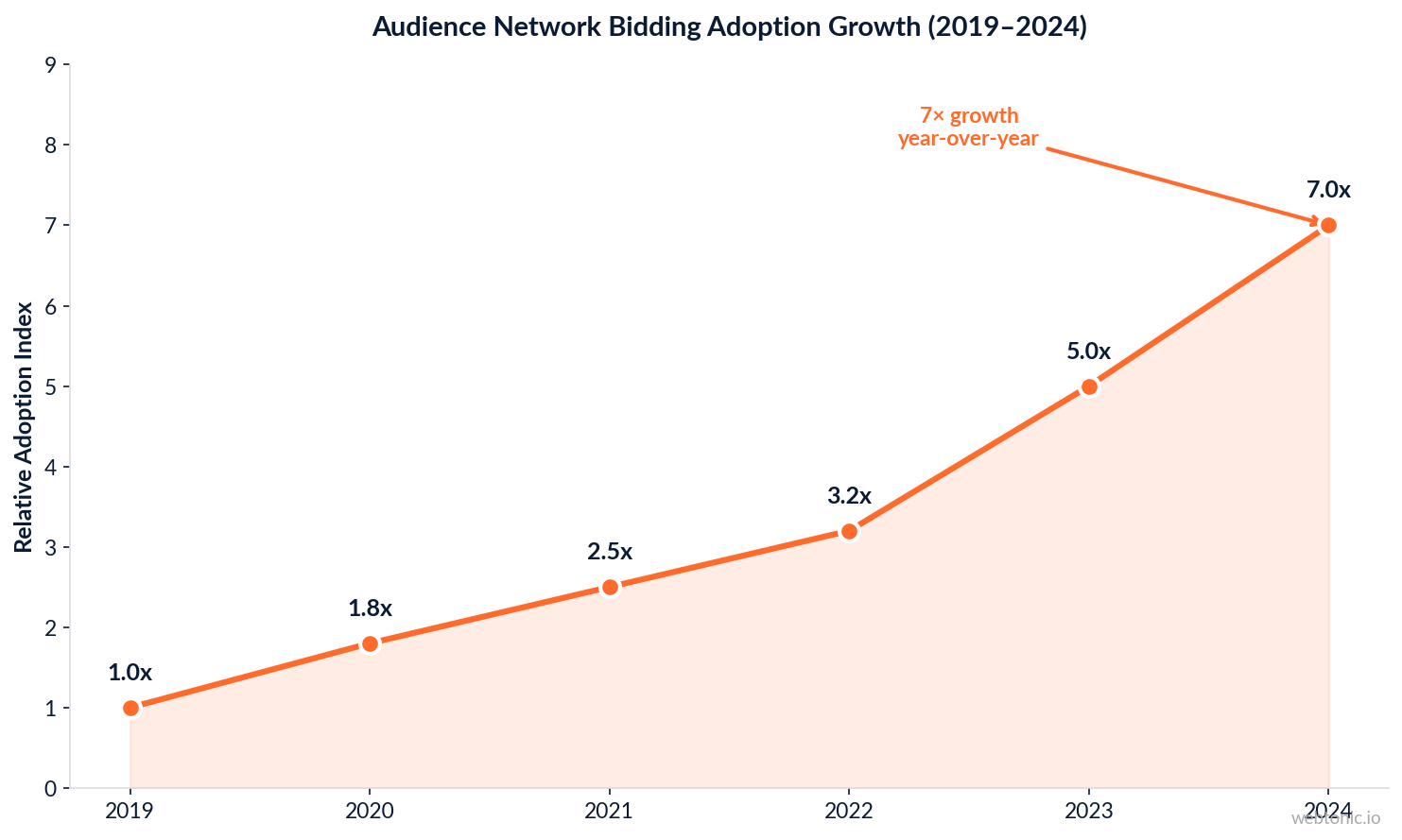
- 7× growth in apps using bidding adoption year-over-year.
- Among the top 10 largest publishers, the majority now earn most of their revenue via bidding.
- Bidding removes the complexity of maintaining manual waterfall priority lists, freeing engineering resources for product development.
Publishers can implement bidding in two ways: through a third-party mediation platform (recommended for most) or via an in-house integration for teams that build their own mediation stack. Either path requires the SDK and a valid bidder token generated through the dashboard.
Optimization Best Practices for Publishers
Maximizing ad revenue requires continuous testing and data-driven decisions. Here are proven strategies used by top-performing publishers:
- Diversify ad formats — Combine rewarded video with interstitials and native ads to capture different user engagement moments without over-saturating any single format.
- A/B test placements — Use the platform's built-in A/B testing to compare placement positions, frequencies, and formats against revenue and retention metrics.
- Control frequency capping — Limit interstitial frequency to avoid user churn. Data analysis should drive the optimal daily cap for your specific audience.
- Monitor ARPDAU — Average Revenue Per Daily Active User is the single most actionable publisher metric. Track it across formats and geos to spot optimization opportunities.
- Use a mobile measurement partner — Integrate with a mobile measurement partner to attribute conversions accurately and understand the true value of each ad placement.
- Keep the SDK updated — Meta regularly releases SDK updates that improve fill rates, bidding performance, and compliance with platform policies.
Extending Reach for Advertisers
Advertisers benefit from this extended reach in two main ways: extended reach and lower cost per result. By enabling these placements, campaigns tap into mobile inventory that Facebook and Instagram feeds alone cannot reach—adding up to 16 % more impressions to a typical campaign. Brands investing in digital marketing can use Audience Network to stretch budgets further across high-intent mobile users.
The following campaign objectives are supported:
- Awareness (video only)
- Traffic
- Engagement (video only)
- App Installs
- Conversions
- Catalog Sales
Supported creative formats include image, video, carousel, playable, and collection ads—though creative and placement eligibility varies by objective. For best results, tailor your creative to mobile-first viewing: vertical or square aspect ratios, concise text overlays, and a clear CTA within the first 3 seconds of video.
SDK Integration Requirements
Integrating the SDK is straightforward for iOS, Android, and Unity projects. Key technical considerations include:
- Hardware-accelerated rendering — Required for video creatives in native ads, interstitials, and rewarded videos. Enable it in the Android manifest for the
AudienceNetworkActivity. - MediaView for native ads — Use Meta's
MediaViewcomponent to display native ad cover images and video assets. This ensures proper pre-caching and autoplay behavior. - ads.txt verification — Add Facebook to your app's ads.txt file (for mobile web) or app-ads.txt (for in-app) to verify inventory ownership and prevent ad fraud.
- Test mode — Use Meta's testing tools to verify SDK integration before going live. Test ads confirm format rendering without affecting live revenue data.
Full implementation guides for each platform are available in the the developer documentation.
Measuring Publisher Performance
This dashboard provides centralized reporting across all apps, placements, and formats. Key metrics to track include:
| Metric | Definition | Why It Matters |
|---|---|---|
| eCPM | Revenue per 1,000 impressions (includes all payment types) | Primary profitability indicator per format |
| Fill Rate | Percentage of ad requests that return a paid ad | Low fill rate signals demand or policy issues |
| ARPDAU | Average revenue per daily active user | Connects ad revenue to user engagement |
| Estimated Revenue | Sum of revenue from all advertisers (may differ slightly from payout) | Real-time revenue tracking across geos and formats |
| Win Rate | Percentage of auctions won by the platform | Indicates competitiveness against other demand partners |
The dashboard also supports country, platform, and placement breakdowns—enabling publishers to identify which geos and formats deliver the highest yield and reallocate placements accordingly.
Related reading
- Facebook Ad Strategies That Actually Drive Conversions in 2026
- Facebook Ad Mistakes: 8 Costly Errors Draining Your Budget
- Facebook Retargeting: How to Build Remarketing Funnels That Actually Convert
- Meta Ads Agency services at Web Tonic
FAQ
What is the difference between Facebook Audience Network and Meta Audience Network?
They are the same product. FAN was rebranded as part of Meta's company-wide renaming in 2021. All features, SDKs, and tools remain identical.
Does Meta Audience Network still support waterfall mediation?
No. As of 2024, the platform is bidding-only on both iOS and Android. Publishers must migrate from waterfall to bidding to continue monetizing.
How much can publishers earn from Meta Audience Network?
Earnings depend on application category, user geography, and ad format. Rewarded video in Tier-1 markets can reach $15–$30 eCPM, while banners in emerging markets may yield under $1 eCPM. Top publishers using optimized bidding setups report revenue increases of 50–230 % compared to waterfall.
Can I run both AdMob and Meta Audience Network in the same app?
Yes. Most publishers use a mediation platform (like Google AdMob Mediation, AppLovin MAX, or ironSource) to run both networks simultaneously. The mediator holds a real-time auction for each impression, and the highest-paying network wins.
What targeting options do advertisers get?
The platform uses the same targeting as Facebook and Instagram ads—including custom audiences, lookalike audiences, interest targeting, demographic filters, and behavioral segments. All targeting is configured in Meta Ads Manager and automatically extends to extended placements.
Sources
Meta Audience Network – Official Homepage
Ad Formats Overview
Monetize Your Mobile Game
App Bidding Updates from Audience Network
Comparing Major Ad Networks for Rewarded Video – Applixir
Polaris Office Case Study – Audience Network
App Bidding Updates – Platform Blog


