Table of contents
Webflow powers 1.2% of the global CMS market and has become the fastest-growing platform among digital agencies, yet most electrical contractors still run bloated WordPress installs that score below 50 on Google PageSpeed. Below we compile the 2026 benchmarks that show how website platform choice directly impacts lead conversion, page speed, and long-term maintenance cost for electrical service businesses. Whether you are weighing a rebuild or benchmarking your current site, these numbers provide the evidence base for a platform decision.
Key Takeaways
- Webflow sites achieve a 68.9% Core Web Vitals pass rate, versus 49.3% for WordPress, giving electrical businesses a built-in speed advantage (PageSpeedMatters).
- Webflow out-of-the-box PageSpeed scores land between 85–95, while the average electrician site scores just 54/100 on mobile (Borah Labs, OnwardCraft).
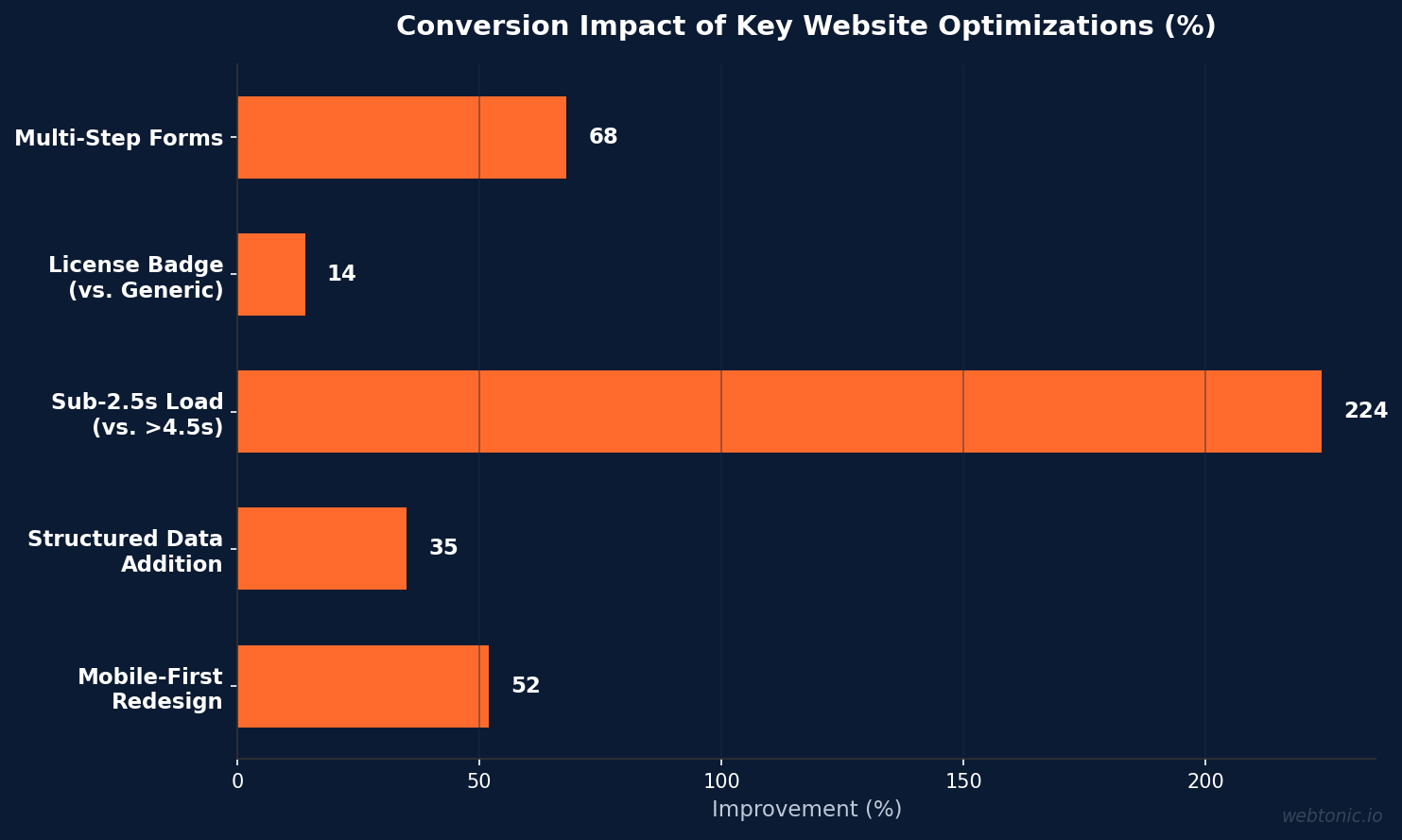
- Electrician websites that load under 2.5 seconds convert at 6.8%, compared to 2.1% for sites over 4.5 seconds — a 3.2× gap (OnwardCraft).
- 24.6% of digital agencies now choose Webflow over WordPress, up from 6.8% in 2022, nearly quadrupling in four years (Visionary Marketing).
- Multi-step web forms lift form completion rates by up to 68% on electrical contractor sites (DecentUI Studio).
- Webflow reached roughly 500,000 active websites and $213 M revenue in 2024, with 66% year-over-year growth (Enricher.io, Sales-Hacking).
- Britain Electric's Webflow rebuild produced a 2,515% organic traffic increase alongside a 116% jump in Google Search clicks within 30 days (Contra, Crowns Web Design).
Webflow vs. WordPress: Electrical Services Benchmarks at a Glance
| Metric | Webflow | WordPress (Typical Contractor Site) | Source |
|---|---|---|---|
| CMS Market Share | 1.2% | 62.5% | W3Techs |
| Website Builder Share | 14.5% | N/A (self-hosted CMS) | WMTips |
| Out-of-Box PageSpeed (Mobile) | 85–95 | 30–50 (avg. electrician = 54) | OnwardCraft / Borah Labs |
| Core Web Vitals Pass Rate | 68.9% | 49.3% | PageSpeedMatters |
| Good TTFB Rate | 55.5% | 24.8% | PageSpeedMatters |
| Agency Adoption (2026) | 24.6% | Legacy majority | Visionary Marketing |
| Avg. Conversion (<2.5s Load) | 6.8% | 2.1% (>4.5s Load) | OnwardCraft |
Webflow's Market Position in 2026
Webflow holds a 1.2% share of the overall CMS landscape tracked by W3Techs, powering roughly 500,000 active websites worldwide. Within the website-builder category specifically, Webflow commands 14.5% market share, trailing only Wix and Squarespace among no-code platforms (WMTips). Revenue growth confirms the trajectory: Webflow posted $213 million in 2024, a 66% year-over-year jump from roughly $128 million in 2023 (Enricher.io).
Among agencies, the shift is even more pronounced. 24.6% of digital agencies chose Webflow over WordPress in 2026, up from just 6.8% in 2022. Personal portfolio adoption climbed from 8.4% to 22.4% over the same period (Visionary Marketing). For electrical service businesses seeking a growth marketing partner, the implication is clear: the agency building your next site is increasingly likely to use Webflow.
Site Speed and Core Web Vitals for Electrical Websites
Speed is the single largest controllable conversion lever for electrical contractors. The average electrician website takes 8.84 seconds to render its main content on mobile and scores just 54/100 on Google PageSpeed (Borah Labs). Only 1.9% of electrician sites score above 80, and 95% lack structured-data markup (Electrician Audit).
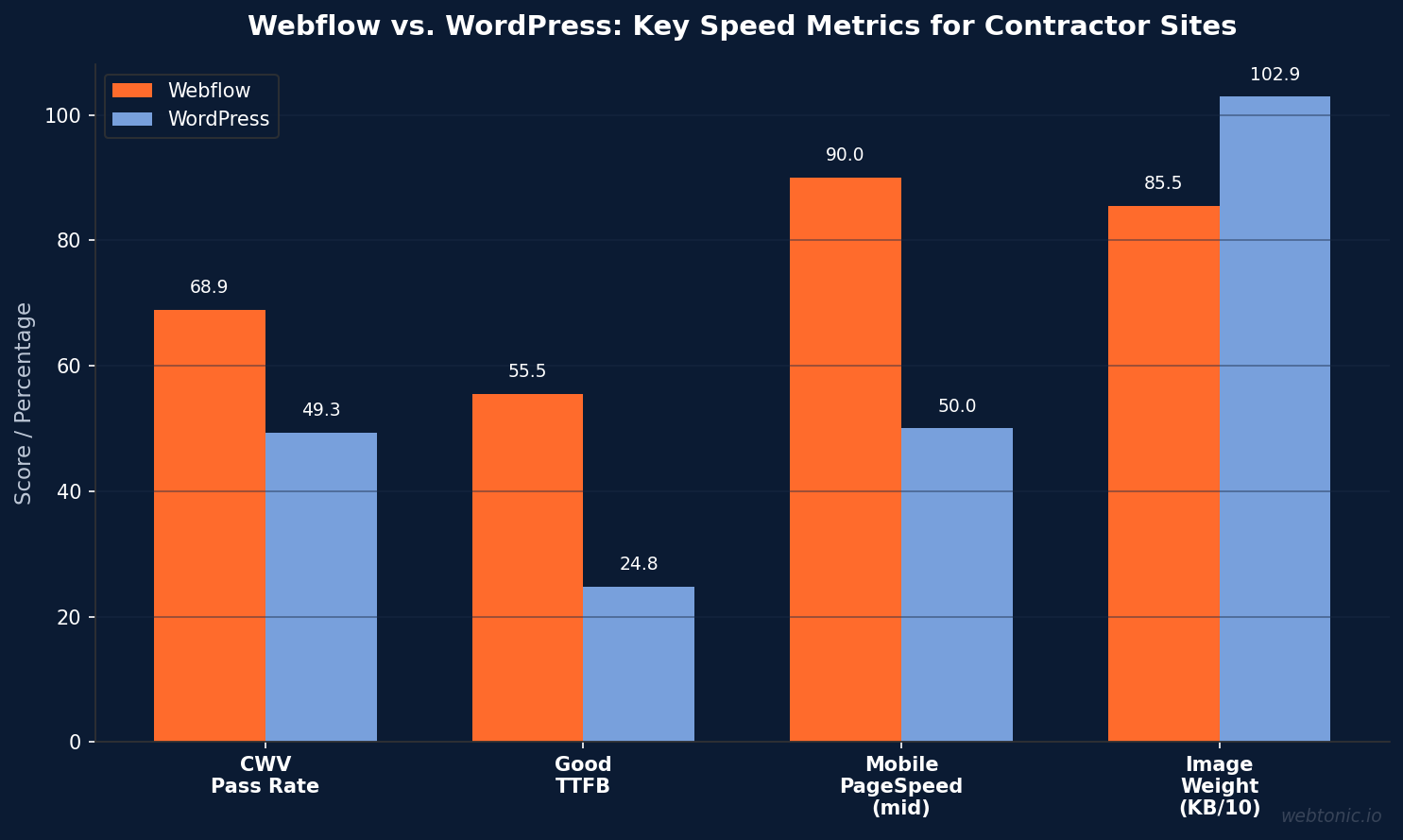
Webflow delivers a dramatically different baseline. A 2026 field study found Webflow achieves a 68.9% Core Web Vitals pass rate versus WordPress's 49.3%, with a 55.5% good TTFB rate compared to WordPress's 24.8% (PageSpeedMatters).
Why it matters: contractor sites loading in under 2.5 seconds averaged a 6.8% conversion rate, while sites exceeding 4.5 seconds dropped to 2.1% — a 3.2× difference (OnwardCraft). For an electrical business generating 1,000 monthly visitors, that gap means roughly 47 additional leads per month simply from faster load times. Google has confirmed Core Web Vitals as a ranking signal, so speed affects both conversion and organic visibility.
Core Web Vitals Breakdown by Platform
| Metric | Webflow | WordPress | Squarespace |
|---|---|---|---|
| CWV Pass Rate | 68.9% | 49.3% | 53.0% |
| Good TTFB | 55.5% | 24.8% | 78.5% |
| Median JavaScript | 918 KB | 692 KB | 1,350 KB |
| Median Image Weight | 855 KB | 1,029 KB | 1,089 KB |
| Mobile PageSpeed (Out-of-Box) | 85–95 | 65–85 (variable) | 70–80 |
Website Conversion Benchmarks for Electrical Contractors
The median contractor website converts 2–4% of visitors into a call or form submission, while the top 6% reach 8–12% on the same traffic volume (PipelineOn). Electrical services specifically fall in the 6–10% range for optimized sites, driven by a mix of emergency no-power calls and planned panel upgrades.
Multi-step forms are a proven lever. Splitting an 8-field contact block into a 3-step sequence lifts completion rates by up to 68% (DecentUI Studio). TVR Electrical Services saw contact leads increase 52% and quote submissions jump 50% after a conversion-rate optimization overhaul. Displaying a "Licensed Master Electrician" badge outperformed a generic "Licensed & Insured" label by 14% in split testing (OnwardCraft). Combined with Webflow's sub-2-second native load times, these trust signals create a compounding speed-plus-credibility effect that fuels sustainable lead generation.
Electrical Contractor Website Redesign Case Studies
Real-world results confirm the platform advantage. Britain Electric's full Webflow rebuild delivered a 2,515% increase in organic traffic, with Google Search clicks jumping 116% (69 vs. 32) and impressions growing 26% within the first 30 days. Click-through rate rose from 2.2% to 3.8%, and organic sessions increased 77% compared to the previous period.
W3 Electric's website optimization and AI-powered automation campaign generated 33 new leads at a 1,400% ROI (ServiceLine Pro). Armstrong Air & Electric followed a similar path, producing 52 new leads and a 160% ROI through site-level changes alone. These gains are not Webflow-exclusive — any fast, well-structured site can perform — but Webflow's out-of-the-box performance floor means electrical contractors reach competitive baselines without extensive developer intervention or plugin stacking.
| Business | Approach | Key Result |
|---|---|---|
| Britain Electric | Full Webflow rebuild + SEO | +2,515% organic traffic, +116% search clicks |
| W3 Electric | Site optimization + AI automation | 33 leads, 1,400% ROI |
| Armstrong Air & Electric | Site optimization | 52 leads, 160% ROI |
| TVR Electrical Services | CRO overhaul | +52% contact leads, +50% quote submissions |
Agency Adoption Trends and Cost Considerations
The typical contractor WordPress install costs $20–$60/month for hosting plus $400–$900/year in theme and plugin fees. Webflow plans start at $24/month with hosting, SSL, and CDN bundled. For multi-location electrical firms, the CMS plan scales without per-plugin conflicts or security-patch cycles. The trade-off: Webflow's median JavaScript payload is 918 KB versus WordPress's 692 KB, though this is offset by Webflow's superior TTFB and image optimization pipeline.
Total cost of ownership matters more than sticker price. A WordPress site scoring 30–50 on PageSpeed out of the box may need $2,000–$5,000 in speed optimization work to match what Webflow delivers natively. Understanding these trade-offs is central to managing your Google Ads cost, since landing page speed directly affects Quality Score and CPC. Slow pages waste ad spend; fast pages compound returns through lower cost per click and higher conversion rates.
The maintenance equation also favors Webflow for small electrical shops without dedicated IT staff. WordPress sites require regular core updates, plugin updates, and security patches — a neglected WordPress install can become a security liability within months. Webflow handles infrastructure updates automatically, letting the electrician focus on running service calls rather than patching a CMS. For businesses managing multiple location pages or service-area listings, Webflow's CMS collections enable programmatic content generation at scale, a capability that typically requires custom WordPress development costing $5,000 or more to replicate.
Best Practices for Electrical Service Websites on Webflow
- Keep PageSpeed above 85 on mobile. Webflow delivers this natively — avoid heavy third-party scripts that erode the speed advantage.
- Use multi-step forms. Segment contact forms into 2–3 steps to capture up to 68% more completions (DecentUI Studio).
- Display license badges prominently. "Licensed Master Electrician" converts 14% better than generic trust badges in A/B testing (OnwardCraft).
- Add structured data from day one. 95% of electrician sites lack schema markup — adding LocalBusiness and Service schema improves rich-result eligibility.
- Optimize for mobile-first. Over 70% of electrical service searches start on a mobile device. Webflow's responsive breakpoints simplify this. Build your performance creative assets with mobile viewports in mind.
- Publish case studies and project galleries. Visual proof of work drives higher trust signals and longer session durations, which in turn support organic rankings.
- Connect analytics immediately. Only 25% of contractors track customer acquisition cost. Proper data intelligence setup unlocks budget reallocation that often delivers more leads without raising spend.
Webflow Feature Fit for Electrical Service Businesses
| Webflow Feature | Use Case | Impact |
|---|---|---|
| Visual CMS | Service pages, project galleries, team bios | No developer needed for routine content updates |
| Native CDN & SSL | Fast load from any U.S. region | 85–95 PageSpeed vs. 30–50 without optimization |
| Responsive Breakpoints | Mobile-first design for 70%+ mobile users | Higher mobile conversion, lower bounce rate |
| Custom Code Embed | Schema markup, tracking scripts, chat widgets | Rich results + attribution without plugin conflicts |
| CMS API | Dynamic service-area pages at scale | Programmatic generation of 50+ location pages |
| Form Logic | Multi-step forms with conditional fields | Up to 68% lift in form completion rates |
Frequently Asked Questions
Is Webflow better than WordPress for electrician websites?
For most electrical contractors, Webflow delivers faster out-of-the-box speeds (85–95 PageSpeed vs. 30–50), a 68.9% Core Web Vitals pass rate, and zero plugin maintenance. WordPress offers a higher SEO ceiling with tools like Rank Math but requires ongoing developer investment. The right choice depends on whether the business has in-house technical resources or prefers a managed, low-maintenance platform.
What is a good conversion rate for an electrical services website?
The median contractor website converts 2–4% of visitors. Optimized electrical service sites reach 6–10%, and the top 6% across all trades hit 8–12%. Speed, trust badges like license credentials, and multi-step forms are the most impactful levers for improvement.
How much does a Webflow website cost for an electrical contractor?
Webflow plans start at $24/month with hosting, SSL, and CDN included. A professional agency build typically runs $3,000–$10,000 depending on scope and customization. WordPress total ownership — hosting, themes, plugins, and security patches — often matches or exceeds this over a two-year period.
Does Webflow support structured data for local electrical businesses?
Yes. Webflow allows custom code embeds where you can add LocalBusiness, Service, and FAQPage JSON-LD schema directly into page settings. Since 95% of electrician sites lack structured data, adding it provides an immediate competitive advantage in local search results and Google rich snippets.
How does website speed affect electrical service lead generation?
Sites loading under 2.5 seconds convert at 6.8%, while sites over 4.5 seconds convert at just 2.1% — a 3.2× difference. For an electrical contractor generating 1,000 monthly visitors, that gap represents roughly 47 additional leads per month. Investing in speed through platforms like Webflow or performance optimization pays for itself quickly. Learn more about how we approach this at Web Tonic.
Sources
W3Techs — Webflow Usage Statistics
PageSpeedMatters — WordPress vs Webflow vs Squarespace Speed
Borah Labs — Electrician Website Benchmarks
Electrician Audit — 1,222 Sites Analyzed
OnwardCraft — Contractor Website Conversion Study
PipelineOn — Contractor Website Conversion Rates
Visionary Marketing — CMS Market Share 2026
Enricher.io — Webflow Market Share Statistics
DecentUI Studio — Frictionless Electrician Web Forms
ServiceLine Pro — W3 Electric Case Study