Table of contents
Snapchat's e-commerce advertising ecosystem has matured into a genuine performance channel, with Dynamic Product Ad revenue growing more than 30% year-over-year and total Q1 2026 revenue reaching $1.53 billion (up 12% YoY). Below is a comprehensive statistical breakdown of how online retailers are spending, converting, and scaling on the platform in 2026.
Key Takeaways
- Snap Q1 2026 revenue hit $1.53 billion, a 12% year-over-year increase, with 483 million daily active users globally.
- E-commerce CPMs on Snapchat range from $6 to $10 for most DTC categories, significantly lower than equivalent Meta inventory.
- Median DTC e-commerce CPA is $23.40 for first-time purchasers, with top-quartile advertisers achieving CPAs below $14.
- Dynamic Product Ads adoption among SMBs more than doubled in Q1 2026, with DPA revenue growing 30%+ YoY.
- AR shopping lenses drive a 94% increase in conversion rates and a 66% reduction in product return rates.
- Total active advertisers on Snapchat grew 60% YoY in Q1 2025, and 28% YoY in Q4 2025, showing accelerating adoption.
- Snapchat's projected 2026 ad revenue is approximately $5.9 billion, reflecting sustained double-digit growth.
E-Commerce Snapchat Ads Benchmarks at a Glance
| Metric | E-Commerce Benchmark | Source |
|---|---|---|
| CPM (DTC) | $6–$10 | Billo / AdLiftr |
| CPC (median) | $0.62–$0.94 | Coinis / AdSkull |
| CPA (first purchase) | $23.40 median ($14 top quartile) | AdLiftr |
| CTR | 0.86%–0.94% | AdSkull / Market.biz |
| ROAS | 2.4× (median case study) | Coinis |
| Minimum Daily Budget | $5 (recommended $50–$100) | DMA Singapore |
| Active Advertisers Growth | +60% YoY (Q1 2025) | SocialPilot / Snap |
| DPA Revenue Growth | +30% YoY | Snap Q1 2026 |

Snapchat Advertising Revenue and Platform Growth
Snap Inc. reported total Q1 2026 revenue of $1.529 billion, an increase of 12% year-over-year, with advertising revenue specifically at $1.24 billion (up 3% YoY). The company's daily active users returned to global growth at 483 million, with adjusted EBITDA reaching $233 million — demonstrating healthy monetization efficiency.
Full-year 2026 advertising revenue is projected at approximately $5.9 billion, according to industry forecasts. The growth is being driven primarily by direct response advertising improvements, with 38% of PPC marketers worldwide now increasing their Snapchat budgets. The platform's ad-eligible user base of 46.4 million Gen Z users in the U.S. alone positions it as a critical reach channel for youth-oriented e-commerce brands.
Snap's AI-powered ad platform improvements have delivered a 55% reduction in cost-per-action for low-conversion segments (7-zero-conversion cohorts) and a 45% reduction in CPA for 1-zero-conversion segments, directly benefiting e-commerce advertisers with thinner margins.
Snapchat Ads Cost Benchmarks for E-Commerce
E-commerce advertisers on Snapchat enjoy cost structures that compare favorably to Meta, particularly for brands entering the platform for the first time. According to AdLiftr's 2026 benchmark report, the median DTC e-commerce CPA sits at $23.40 for first-time purchasers, while the top quartile of advertisers achieves CPAs below $14. The performance gap is overwhelmingly explained by creative quality rather than platform limitations.
| Cost Metric | Low End | Median | High End |
|---|---|---|---|
| CPM | $5.10 | $6.00–$8.00 | $10.00+ |
| CPC | $0.62 | $0.80–$0.94 | $1.50+ |
| CPA (DTC first purchase) | < $14 | $23.40 | $48+ |
| Cost per Swipe-Up | $0.30 | $0.50–$0.70 | $1.20+ |
A Coinis case study found that an e-commerce campaign with $18,400 in spend achieved a $5.10 CPM, $0.62 CPC, and 2.4× ROAS, generating 521 purchases at a $35.32 CPA. This illustrates the platform's potential for brands willing to invest in native vertical video creative.
Dynamic Product Ads and Catalog-Driven Commerce
Snap's Dynamic Product Ads (DPA) have emerged as a cornerstone of its e-commerce strategy. DPA revenue grew more than 30% year-over-year in Q1 2026, while adoption among small and medium-sized customers more than doubled. The company's AI improvements — including targeted ranking, format optimization, and delivery enhancements — have contributed to a 55% reduction in CPA for key conversion cohorts.
Catalog-powered Shopping Lenses extend this capability by enabling product-level creative that users can interact with through augmented reality. According to Snap's internal data, these catalog-powered AR experiences drive improvements across all key purchase metrics, including purchase rate, cost per purchase, and return on ad spend.
For e-commerce brands already running Meta DPA campaigns, Snapchat's Dynamic Ads offer a parallel channel with lower auction density and less creative fatigue — a combination that Sagum describes as an arbitrage opportunity driven by TikTok regulatory uncertainty pushing brands to diversify.
AR Shopping and Try-On Experiences
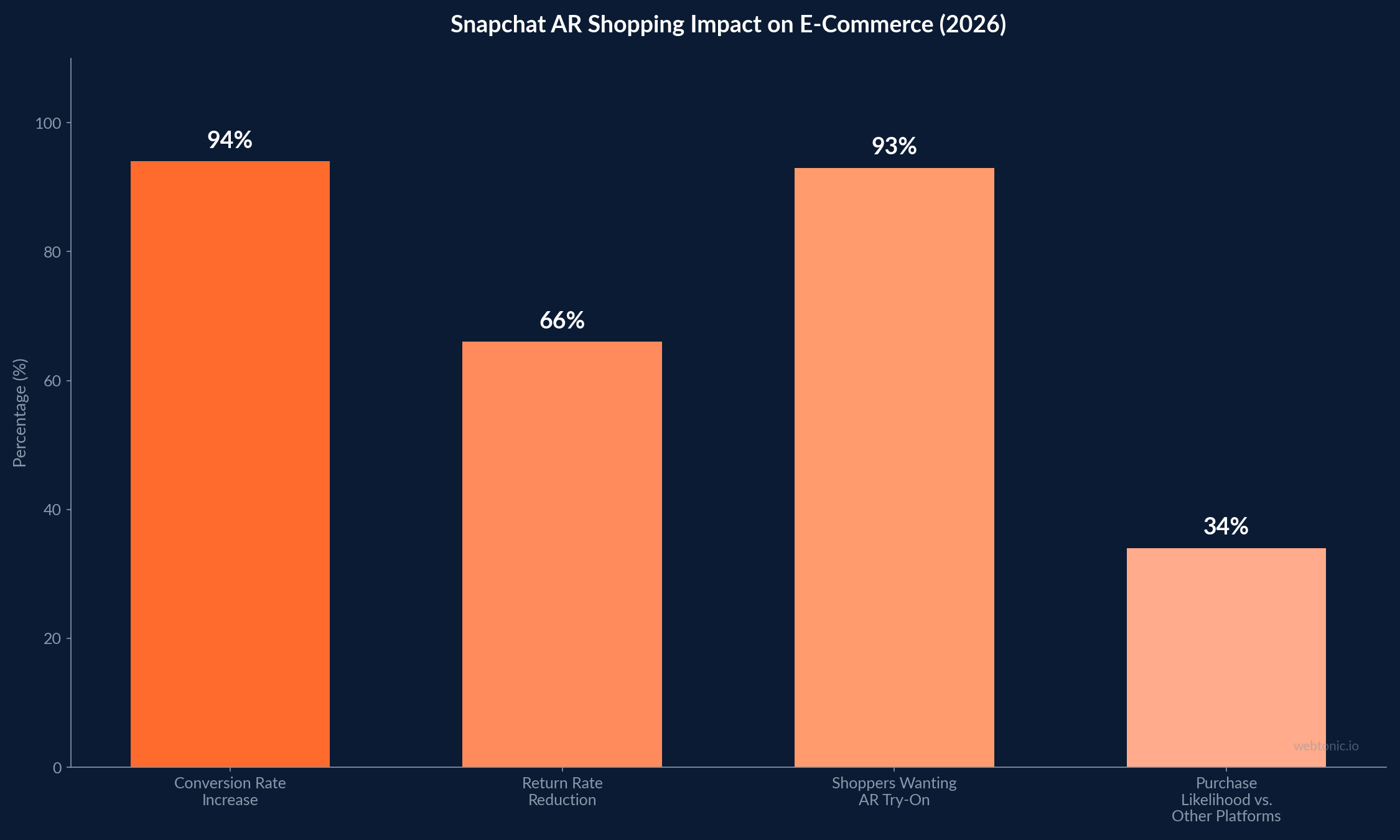
Snapchat's augmented reality capabilities represent a unique competitive advantage for e-commerce advertisers. The platform reports 250 million+ shopping users per month, with 2.4× higher conversion rates when AR try-on is integrated into the shopping experience. Additionally, 93% of shoppers want AR for product evaluation (Snap × Ipsos), and AR-enabled product listings show 25% fewer returns (Snap × Shopify study).
The conversion impact is substantial: brands running AR try-on lenses for apparel and beauty categories report a 94% increase in conversion rates compared to static product ad benchmarks, according to The Drum's reporting on Snap's ray-tracing technology. This is complemented by a 66% reduction in return rates when consumers preview products through AR before purchasing.
These AR capabilities make Snapchat particularly effective for visually driven product categories — beauty, eyewear, footwear, and home décor — where "try before you buy" reduces purchase friction and increases average order value.
Snapchat Ads Performance by E-Commerce Campaign Objective
Snapchat offers distinct campaign objectives for e-commerce advertisers, each with significantly different cost profiles and optimization behavior. Understanding these differences is critical for allocating ad spend effectively across the purchase funnel.
| Campaign Objective | Typical CPM | Typical CPC | Best E-Commerce Use Case |
|---|---|---|---|
| Awareness | $2.50–$5.00 | N/A | New product launches, brand building |
| Traffic (Swipe-Up) | $5.00–$8.00 | $0.30–$0.70 | Driving shoppers to product pages |
| Conversions | $8.00–$15.00 | $1.00–$2.50 | Direct purchase optimization |
| Catalog Sales (DPA) | $6.00–$10.00 | $0.62–$0.94 | Retargeting, product-level ads |
Conversion campaigns require a minimum of $50–$100 per day to exit the learning phase, according to the Digital Marketing Agency Singapore playbook. While the platform technically allows $5/day budgets, e-commerce advertisers consistently report that campaigns below $50/day fail to generate enough conversion data for Snap's algorithm to optimize effectively.
The catalog sales objective — powered by Dynamic Product Ads — offers the best balance of cost efficiency and purchase intent for e-commerce brands with an existing product feed. Brands that sync their Shopify or WooCommerce catalogs directly to Snapchat Ads Manager can launch DPA campaigns within minutes, leveraging the same product feed already running on Meta.
Creative Format Performance on Snapchat for Online Retailers
Creative format selection directly impacts e-commerce ad performance on Snapchat. The platform's native full-screen vertical video format delivers the strongest engagement, but several ad formats serve different stages of the purchase journey.
Single Video Ads remain the workhorse format, with median CTRs of 0.86%–0.94% for e-commerce. However, Collection Ads — which display a hero video above a row of tappable product thumbnails — consistently outperform single-image formats for catalog-driven retailers by enabling immediate product browsing without leaving the Snapchat app.
Story Ads (branded tiles in the Discover section) offer premium placement at higher CPMs but deliver stronger brand recall and consideration metrics. For e-commerce brands focused on new customer acquisition rather than direct response, Story Ads provide a middle ground between awareness and conversion objectives.
The emerging winner for 2026 is AR-enhanced Shopping Lenses, which combine product catalog data with interactive 3D try-on experiences. Brands leveraging these formats report not only the 94% conversion lift noted above but also 2–3× longer engagement times per session compared to static or video-only formats, creating more opportunities for product discovery and upselling.
Snapchat E-Commerce Audience Demographics
Snapchat's audience composition gives e-commerce brands access to a high-spending younger demographic that is increasingly difficult to reach on other platforms. The platform reached 483 million daily active users globally in Q1 2026, with 46.4 million Gen Z users in the U.S. alone. Snapchatters are 34% more likely to buy products through Snapchat Ads compared to the same ad on competing platforms, per Snap's first-party data.
| Audience Metric | Value | Implication for E-Commerce |
|---|---|---|
| Global DAUs (Q1 2026) | 483 million | Broad reach for international DTC brands |
| US Gen Z Users | 46.4 million | High-value youth market access |
| Purchase Likelihood vs. Other Platforms | +34% | Stronger purchase intent in-feed |
| AR Shopping Users / Month | 250M+ | Built-in product discovery channel |
| Advertiser Growth (Q1 2025 YoY) | +60% | Lower competition vs. Meta |
Millennials — the cohort that now controls the highest share of online spending power — are also disproportionately represented on Snapchat, and the platform's privacy-first approach (ephemeral messaging, limited public data scraping) is increasingly attractive to privacy-conscious consumers. According to Triple Whale's e-commerce attribution data, Snapchat currently captures approximately 2–3% of the median DTC ad budget, suggesting significant headroom for growth as more brands discover the platform's cost efficiency and audience quality.
Best Practices for Snapchat E-Commerce Campaigns
Based on the 2026 benchmarks and case study data, here are the top strategies for maximizing e-commerce performance on Snapchat:
- Start with $50–$100/day per ad set to exit the learning phase quickly — the $5/day platform minimum is insufficient for conversion optimization.
- Invest in vertical video creative quality — the gap between top-quartile ($14 CPA) and bottom-quartile ($48+ CPA) advertisers is almost entirely explained by creative, not targeting.
- Deploy Dynamic Product Ads early — with SMB adoption more than doubling and DPA revenue up 30%+ YoY, catalog-connected campaigns are the platform's fastest-growing format.
- Integrate AR try-on for visual product categories — the 94% conversion lift and 66% return reduction justify the development investment for beauty, fashion, and accessories brands.
- Leverage the arbitrage window — TikTok uncertainty is driving budget diversification; Snapchat's lower CPMs ($6–$10 vs. $12–$18 on Meta) offer a cost advantage that may narrow as adoption grows.
- Complete conversion tracking setup and sync audiences before scaling — Billo notes that Snapchat's cost structure rewards advertisers who handle measurement infrastructure properly.
- Test Collection Ads for catalog-driven brands — the multi-product tile format enables product browsing without leaving the app, reducing friction in the purchase journey and improving add-to-cart rates.
Snapchat vs. Other Platforms for E-Commerce Advertising
| Platform | Avg. CPM (E-Commerce) | Avg. CPC | Typical ROAS | Key E-Commerce Advantage |
|---|---|---|---|---|
| Snapchat | $6–$10 | $0.62–$0.94 | 2.0–2.5× | AR try-on, lowest CPM, Gen Z reach |
| Meta (Facebook/IG) | $12–$18 | $1.20–$1.80 | 2.5–4.0× | Mature optimization, broadest targeting |
| TikTok | $9–$14 | $1.00–$2.00 | 2.0–3.0× | TikTok Shop, viral discovery |
| Google Ads (Shopping) | N/A (CPC model) | $0.50–$1.50 | 3.0–8.0× | High-intent search, product feeds |
Snapchat occupies a distinct position in the e-commerce advertising stack: it delivers the lowest CPMs among major social platforms, strong AR-driven engagement, and access to an underserved younger audience segment. While its ROAS ceiling is currently lower than Meta's, the lower entry cost makes it an effective prospecting and awareness channel that complements higher-funnel paid strategies.
The platform's cost advantage is most pronounced in the awareness and traffic tiers, where Snapchat CPMs regularly undercut Meta by 40–60%. For direct-response e-commerce campaigns, the gap narrows but remains meaningful, particularly for brands targeting the 18–34 age bracket where Snapchat's audience density exceeds all competitors except TikTok. Brands running multi-platform strategies typically allocate 10–15% of their social ad budget to Snapchat as a diversification play that hedges against Meta CPM inflation and TikTok regulatory risk.
Frequently Asked Questions
What is the average CPC for e-commerce Snapchat ads in 2026?
The average cost per click for e-commerce campaigns on Snapchat ranges from $0.62 to $0.94, depending on the ad format, targeting precision, and creative quality. This is significantly lower than Meta's typical $1.20–$1.80 CPC for comparable e-commerce campaigns. The cost advantage stems from Snapchat's lower auction density — fewer advertisers competing per impression — which translates to cheaper clicks for brands willing to produce platform-native vertical video content.
How does Snapchat's ROAS compare to Meta for online stores?
Snapchat e-commerce campaigns typically achieve a 2.0–2.5× ROAS, while Meta campaigns average 2.5–4.0×. However, Snapchat's lower CPMs mean the cost to acquire initial data and reach is substantially cheaper, making it effective as a top-of-funnel acquisition channel.
Are Snapchat Dynamic Product Ads effective for e-commerce?
Yes. DPA revenue grew 30%+ year-over-year in Q1 2026, and SMB adoption more than doubled. Snap's AI improvements have reduced CPA by 45–55% for key advertiser segments, making catalog-connected campaigns increasingly viable for smaller online retailers.
What role does AR play in Snapchat e-commerce advertising?
Snapchat's AR try-on lenses deliver a 94% increase in conversion rates and a 66% reduction in product returns. With 250 million+ monthly shopping users and 93% of shoppers wanting AR for product evaluation, AR is Snapchat's primary competitive moat in e-commerce.
What budget should e-commerce brands allocate to Snapchat ads?
While the platform minimum is $5/day, $50–$100 per day per ad set is the realistic minimum for conversion campaigns. E-commerce brands testing Snapchat should plan for a $300/day total budget across 3–5 ad sets during the initial learning phase. Brands scaling beyond the test phase should expect to spend $500–$1,500/day to maintain consistent conversion volume and keep campaigns out of the learning phase. The key metric to monitor is cost-per-action relative to the top-quartile benchmark of $14 — if your CPA exceeds $48, creative quality is almost certainly the bottleneck, not budget level.
Sources
ppc.land — Snap Q1 2026 Earnings
adliftr.com — Snapchat Ads Cost Benchmarks 2026
searchlab.nl — Snapchat Statistics 2026
socialpilot.co — Snapchat Statistics 2026
billo.app — Snapchat Ads for E-Commerce
coinis.com — Snapchat Ads Benchmarks
pymnts.com — Snap AI Ad Platform
sagum.com — Snapchat E-Commerce Arbitrage
cnbc.com — Snap Q1 2026 Earnings