Table of contents
ABM in e-commerce means targeting named wholesale and retail-partner accounts, not running personalized ads at individual shoppers. This page separates that B2B/wholesale budget question from consumer marketing and sizes it against Shopify's own B2B commerce data, ITSMA's ABM benchmarks and Forrester's buying-group research. The distinction matters because the two motions compete for the same marketing budget line in most e-commerce companies, and conflating them leads to underfunding whichever one has the smaller, louder internal advocate.
Key Takeaways
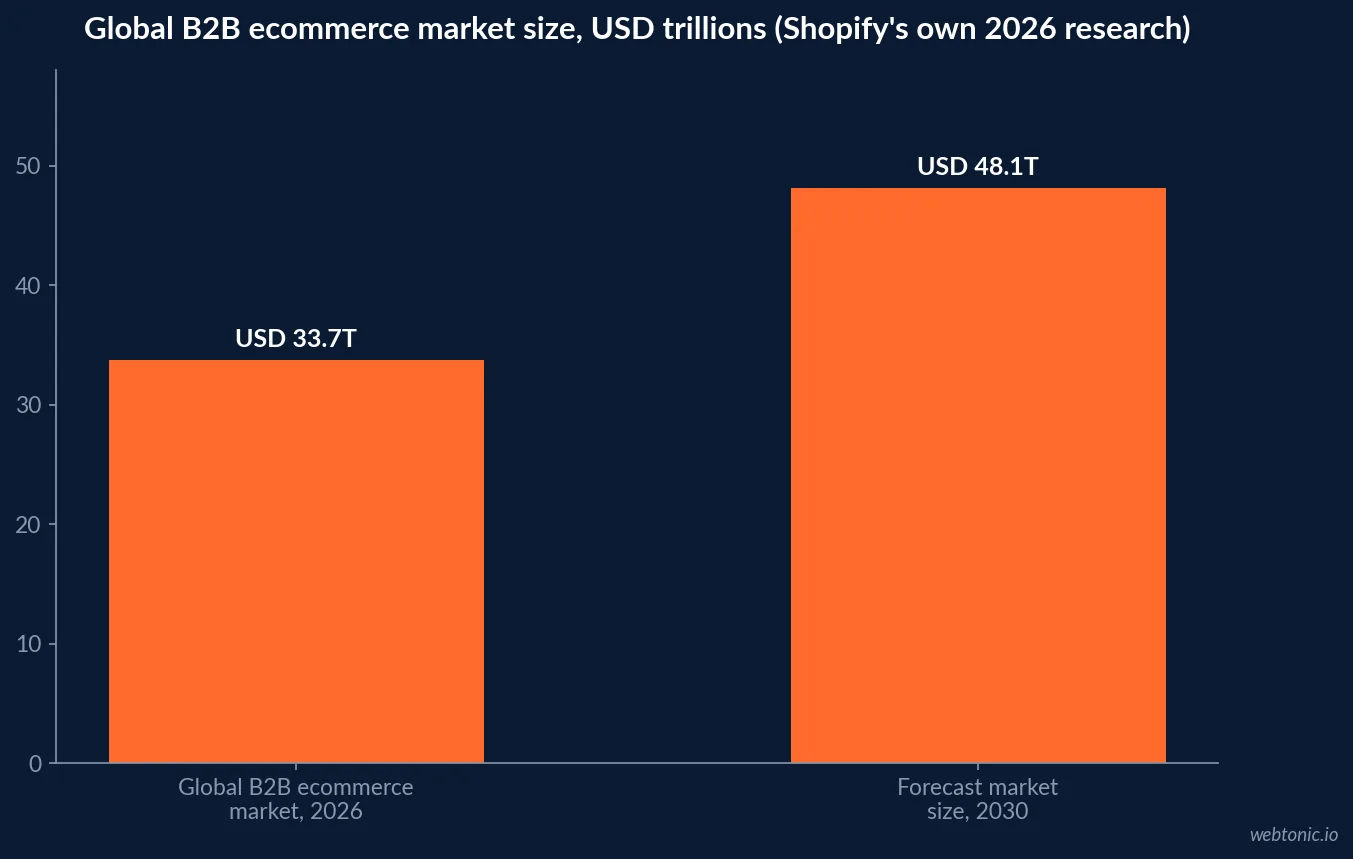
- The global B2B ecommerce market is valued at $33.7 trillion in 2026, per Shopify's own research.
- That market is forecast to exceed $48.1 trillion by 2030.
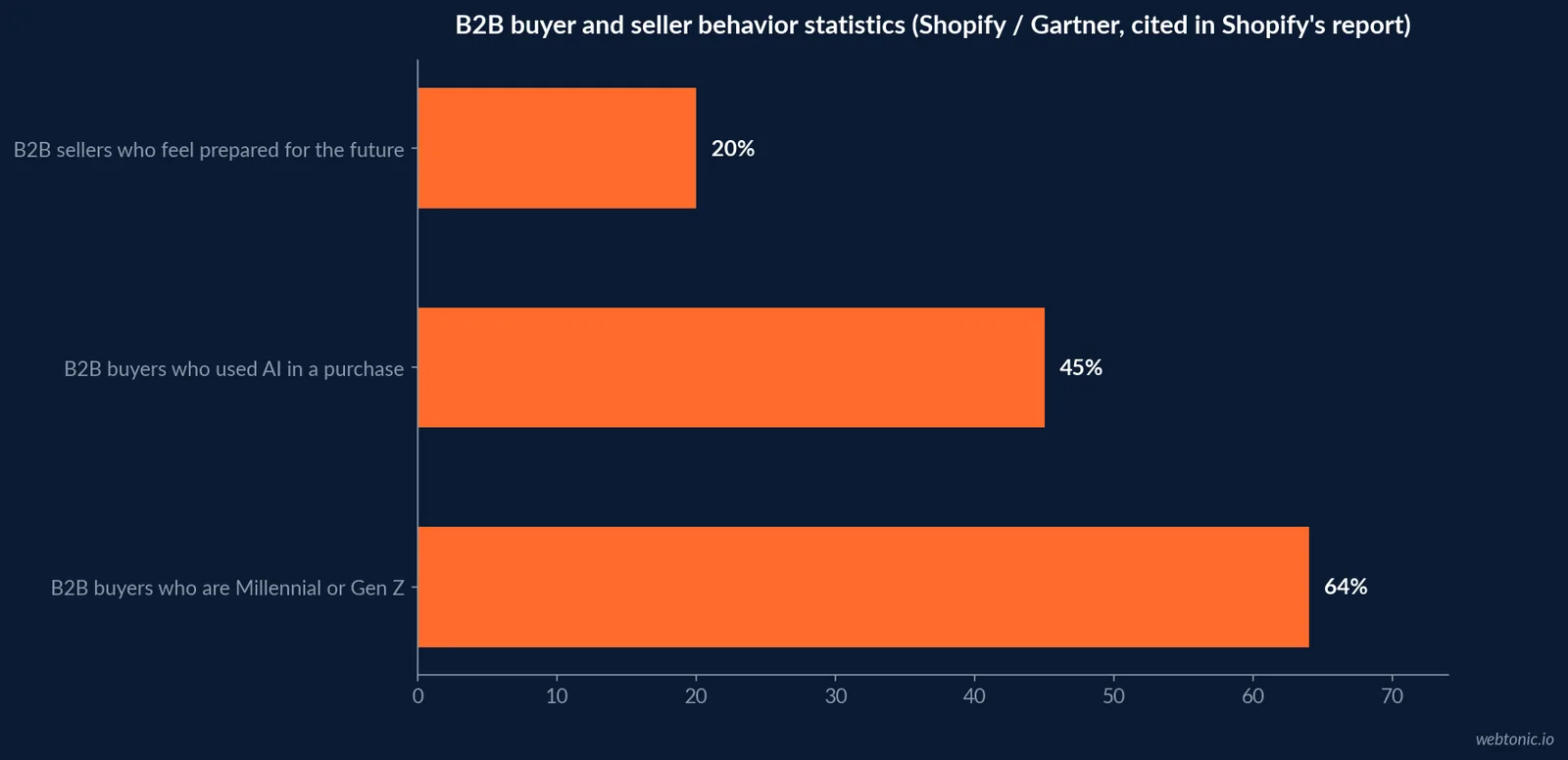
- 64% of B2B buyers are now Millennials or Gen Z, per the same Shopify report.
- Only 20% of B2B sellers feel prepared for the future of the channel.
- 45% of B2B buyers used AI during a recent purchase, per a Gartner survey cited in that report.
- The average B2B purchase now spans 10 sales channels, per a McKinsey finding in the same research.
- 94% of B2B organizations sell to buying groups of three or more, per Forrester.
- 84% of purchases over $5,000 are decided by that size of group.
- Mature ABM programs dedicate 30% of the marketing budget to the practice, per ITSMA.
- 66% of those programs plan to increase ABM spend.
- 78% report improved pipeline growth attributable to ABM.
- 81% rate ABM's ROI as equal to or better than traditional marketing.
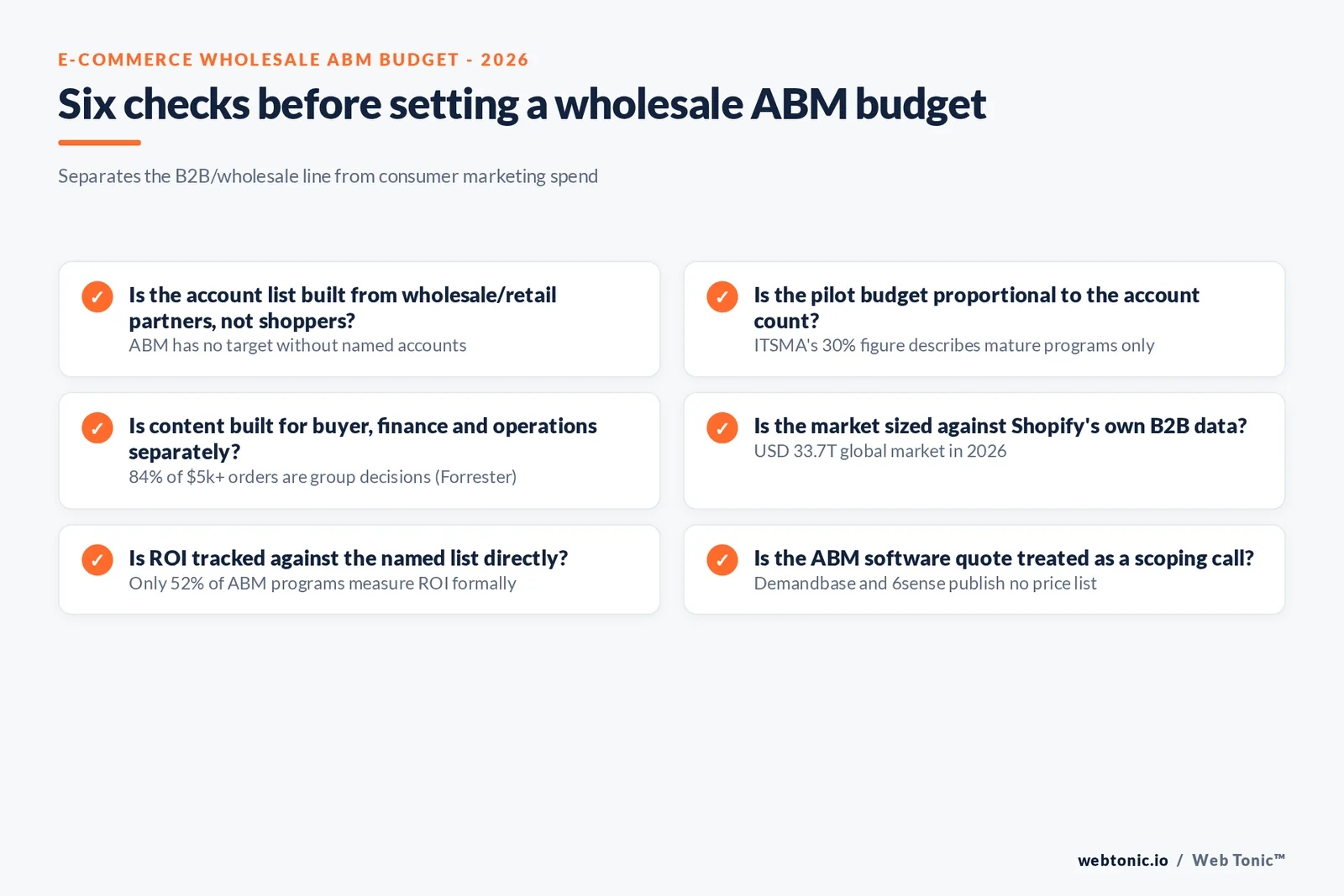
- Only 52% formally measure that ROI.
- ABM platform pricing is unpublished across Demandbase and 6sense.
- The average enterprise B2B buying group spans 5 to 11 stakeholders, per Gartner's own research, reinforcing why a wholesale account needs more than one contact.
| Market metric | Figure | Source |
|---|---|---|
| Global B2B ecommerce market size, 2026 | $33.7 trillion | Shopify, B2B Ecommerce Trends 2026 |
| Forecast market size by 2030 | $48.1 trillion | Shopify, B2B Ecommerce Trends 2026 |
| Share of B2B buyers who are Millennial/Gen Z | 64% | Shopify, B2B Ecommerce Trends 2026 |
| B2B sellers who feel prepared for the future | 20% | Shopify / B2B Online / Deloitte Digital |
| B2B buyers who used AI in a recent purchase | 45% | Gartner, cited in Shopify's report |
| Sales channels spanned by an average B2B purchase | 10 | McKinsey, cited in Shopify's report |
Why this is a B2B budget question, not a DTC one
ABM has no application to an anonymous shopper - it is built around named accounts a sales or partnerships team can actually list. For an e-commerce business, that means the wholesale buyers, retail chains, distributors and bulk-order corporate clients who place recurring purchase orders, not the consumers checking out on the storefront. Shopify's own 2026 research puts that B2B side of the business at a $33.7 trillion global market, forecast to clear $48.1 trillion by 2030 - large enough that most brands selling both DTC and wholesale now run the wholesale side as its own budget line with its own ABM plan. That report was produced with B2B Online and Deloitte Digital, and found that companies with high digital-commerce maturity beat their annual sales goals by a 110% greater margin than low-maturity peers, which is one reason the wholesale motion increasingly gets a dedicated budget rather than leftover DTC spend.
Who is on a wholesale buying committee
Forrester's revenue-operations research found 94% of B2B organizations report selling to groups of three or more, and for any purchase over $5,000 - which covers most opening wholesale orders - 84% of buyers confirm a group that size decided it. For a retail or wholesale account, that typically means a category or merchandising buyer, a finance approver who signs the purchase order, and an operations contact who owns fulfillment and return terms. An ABM plan built around one buyer contact is missing at least two of the three people who can say no.
| Buying-committee role (wholesale account) | What they decide | Content they need |
|---|---|---|
| Category / merchandising buyer | Product fit, assortment, margin | Sell-through data, margin math, comps |
| Finance / procurement approver | Payment terms, credit, PO value | Pricing tiers, terms, volume discounts |
| Operations / logistics contact | Fulfillment, lead time, returns | Shipping SLAs, EDI/integration readiness |
Sizing the ABM budget against ITSMA's benchmarks
The Momentum ITSMA and ABM Leadership Alliance benchmark study, surveying marketers already running ABM, found those programs dedicate an average of 30% of the 2023 marketing budget to the practice, with 66% planning to increase that spend. That describes a mature program several years into ABM - a wholesale e-commerce team piloting its first named-account list should size a proportional test budget against a handful of retail partners or distributors, not carve out three-tenths of total marketing spend on day one. Put in perspective against the market itself: even a modest pilot budget is a rounding error against a $33.7 trillion global B2B ecommerce category, which means the constraint is internal discipline about scope, not a shortage of addressable opportunity.
| ABM program outcome (N=111-208) | % reporting improvement | Source |
|---|---|---|
| Active engagement with selected accounts | 85% | Momentum ITSMA / ABM Leadership Alliance |
| Pipeline growth | 78% | Momentum ITSMA / ABM Leadership Alliance |
| Revenue growth | 74% | Momentum ITSMA / ABM Leadership Alliance |
| ROI equal to or better than traditional marketing | 81% | Momentum ITSMA / ABM Leadership Alliance |
| Programs formally measuring that ROI | 52% | Momentum ITSMA / ABM Leadership Alliance |
Who else already has data on this buyer
BigCommerce's own Global B2B Buyer Behavior survey of 1,006 B2B buyers across the US, UK and Australia found 74% now use online platforms to purchase, 65% use search engines as their main discovery method and 42% use online marketplaces like Amazon Business. That behavior shift is exactly why a named-account plan matters for wholesale sellers: a buyer who already researches and prices online before a rep ever calls needs account-specific content ready at each of those touchpoints, not a single generic catalog.
The hidden buyer inside a wholesale committee
Not every voice in the three-person wholesale committee is equally visible. LinkedIn's B2B Institute research on buyer groups, run with Bain & Company and NewtonX, found that "hidden buyers" carry almost equal decision-making weight to product-focused "target buyers" - 49% versus 51%. For a wholesale order, the hidden buyer is usually the finance approver signing the purchase order, not the merchandising buyer who first responds to outreach - a pitch aimed only at the merchandiser misses roughly half the real influence on whether the order gets placed.
| Buying-group research | Figure | Source |
|---|---|---|
| Average enterprise buying-group size | 5-11 stakeholders | Gartner B2B Buying Report |
| B2B buyers using online platforms to purchase | 74% | BigCommerce Global B2B Buyer Survey |
| B2B buyers using search engines to discover suppliers | 65% | BigCommerce Global B2B Buyer Survey |
| B2B buyers using online marketplaces | 42% | BigCommerce Global B2B Buyer Survey |
| Decision weight held by "hidden buyers" | 49% (vs. 51% for target buyers) | LinkedIn B2B Institute |
What ABM tooling costs a wholesale team
No platform in this category publishes a price list, which matters when budgeting. Demandbase's own pricing page states the model - a platform fee plus a flat fee per user - without listing numbers, and 6sense's own site follows the same pattern. A wholesale e-commerce team should expect the quote to move with the size of the named-account list and any ad-spend commitment bundled into the platform, and should treat the first conversation with any vendor as a scoping call, not a price check.
Building the budget, in order
- Separate the wholesale/B2B line from the DTC marketing budget before setting an ABM figure - they serve different buyers entirely.
- Name the accounts first - the retail chains, distributors and bulk-order clients that already buy or could buy at volume - before allocating spend.
- Build content for all three committee roles (buyer, finance, operations), not just the merchandising contact who first replies, and assume the finance approver is the harder-to-reach "hidden buyer" in the room.
- Match content to how these buyers already shop - 74% research and purchase on online platforms and 65% start at a search engine, per BigCommerce's own data, so the account-specific landing experience matters as much as the outreach.
- Pilot at a fraction of ITSMA's 30% mature-program benchmark and grow the share only once pipeline data from the named list supports it.
- Budget a scoping call, not a subscription price, when evaluating Demandbase or 6sense for the account list in play.
Frequently Asked Questions
Does ABM apply to a direct-to-consumer e-commerce brand?
Not in the way it applies to B2B software - ABM targets named commercial accounts: wholesale buyers, retail chains carrying the product, distributors and corporate-gifting or bulk-order clients. A DTC brand with no wholesale or bulk channel has no accounts to target with ABM; the budget question in this article is specifically for the B2B/wholesale side of an e-commerce business, which Shopify's own research puts at a $33.7 trillion global market in 2026.
How much of the marketing budget should a wholesale ABM program get?
Momentum ITSMA and the ABM Leadership Alliance's benchmark study of companies already running ABM found those programs dedicate an average of 30% of the marketing budget to the practice, with 66% planning to increase spend the following year. That is a mature B2B benchmark, not an e-commerce-specific one - a wholesale team should size its first pilot against a named account list, then grow the share once pipeline data from that list justifies it.
Who is actually on the buying committee for a wholesale order?
Forrester's revenue-operations research found 94% of B2B organizations report selling to groups of three or more, and 84% of purchases over $5,000 are decided by a group that size. For a wholesale buyer, that group typically includes a merchandising or category buyer, a finance approver and an operations or logistics contact who signs off on fulfillment terms - three separate people an ABM plan needs separate content for, not one buyer persona.
Does ABM improve pipeline for B2B e-commerce sellers?
ITSMA's benchmark data, from 111 companies already running ABM, found 78% saw pipeline growth improve and 74% saw revenue growth improve, with 81% rating ABM's ROI as equal to or better than traditional marketing. Only 52% formally measure that ROI, so the figures describe self-reported outcomes from companies that kept the program running - directional evidence, not a guaranteed multiplier on a wholesale pipeline.
What does ABM software cost for a wholesale/B2B e-commerce team?
No major platform publishes a price list. Demandbase's own pricing page states the model - a platform fee plus a flat per-user fee - without numbers, and 6sense follows the same custom-quote pattern. A wholesale team should expect the quote to move with account-list size and ad-spend commitment, and should budget a scoping call before a number, the same as any other B2B buyer of ABM tooling.
Sources
Shopify, B2B Ecommerce Trends 2026
Forrester, Your Buyer Is A Group, Not A Person
Momentum ITSMA / ABM Leadership Alliance, Rethinking ABM 2023 Benchmark Study
Demandbase, Pricing & Packaging
See the cross-industry ABM statistics hub for the platform-wide figures referenced above, or explore Growth Marketing services and get in touch to scope a wholesale ABM pilot.