Table of contents
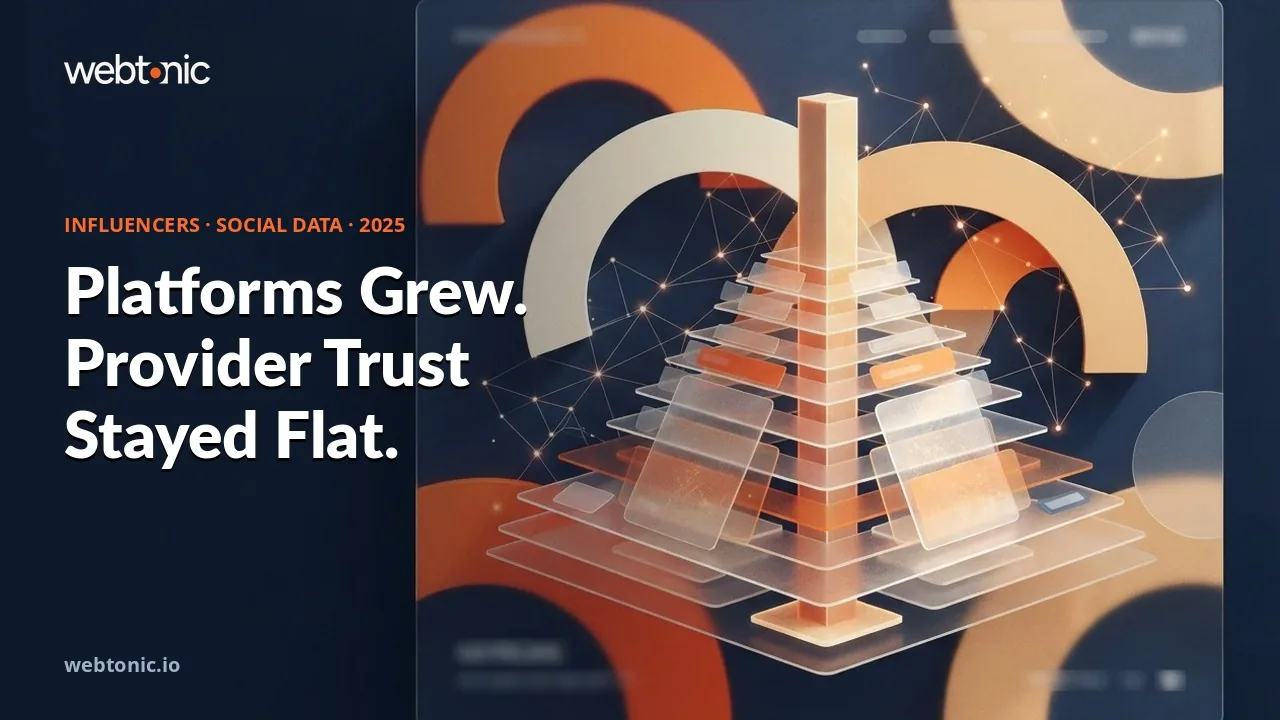
Social media's influence on cosmetic decisions has held roughly flat since 2021, not grown the way platform usage has. What has stayed constant across three ASDS survey waves is who gets credit for that influence: the provider, not an influencer or a platform. This report tracks that trend and pairs it with Pew's platform-by-age data to show where dermatology and plastic surgery content should actually run.
Key Takeaways
- 78% of patients followed their provider's social media in 2021, per ASDS.
- That figure was 74% in 2025 - essentially flat, not growing with platform usage.
- 52% said a provider's social presence influenced scheduling in 2021, per ASDS.
- Roughly half say the same in 2025, per the same survey series.
- Dermatologists are named the top influencer in 12 of 15 categories in the 2025 wave.
- 83% said rate and review sites impacted their decision in 2021.
- 94% use rating and review sites in 2025, a related but differently worded figure.
- Roughly six in ten teens use TikTok and Instagram, per Pew's 2024 survey.
- 55% of teens use Snapchat, per the same Pew data.
- 16% of teens report being on TikTok almost constantly.
- 70% of ASDS survey respondents are considering a cosmetic procedure in 2025.
- Facial plastic surgery volume is projected up 19% for 2025, per AAFPRS.
- Non-invasive treatments make up 80% of AAFPRS-member procedures.
- 473 respondents were surveyed in ASPS's own social media patient-empowerment study.
- 70% of that study's respondents had undergone plastic or reconstructive surgery.
The trend line: flat influence, growing platforms
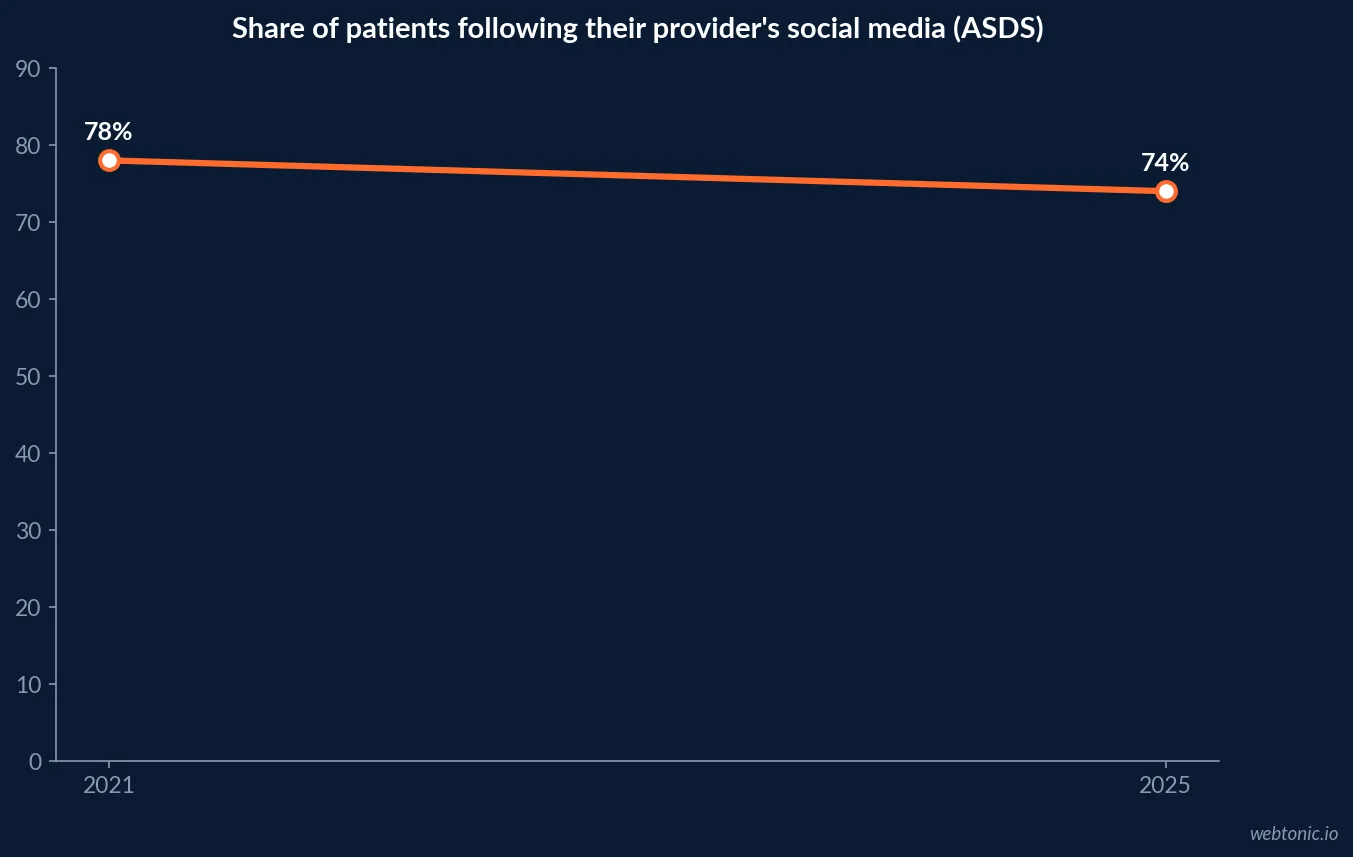
ASDS has fielded its Consumer Survey on Cosmetic Dermatologic Procedures across multiple years, giving a rare same-methodology comparison. The 2021 wave, based on 3,527 consumers, found 78% of patients followed their current or potential provider's social media, and 52% said a provider's social media presence influenced their decision to schedule. The 2025 wave found 74% follow their provider and roughly half say the same about scheduling influence - both essentially flat, with a slight dip in the follow rate despite four more years of platform growth.
| Influence measure | 2021 (ASDS) | 2025 (ASDS) | Direction |
|---|---|---|---|
| Follow provider's social media | 78% | 74% | Slight decline |
| Provider's social presence influences scheduling | 52% | ~50% | Roughly flat |
| Rate/review site impact on decision | 83% impacted by them | 94% use them | Different wording, both high |
| Top influencer for the decision | Dermatologist | Dermatologist (12 of 15 categories) | Unchanged |
What TikTok's role actually looks like in the published research
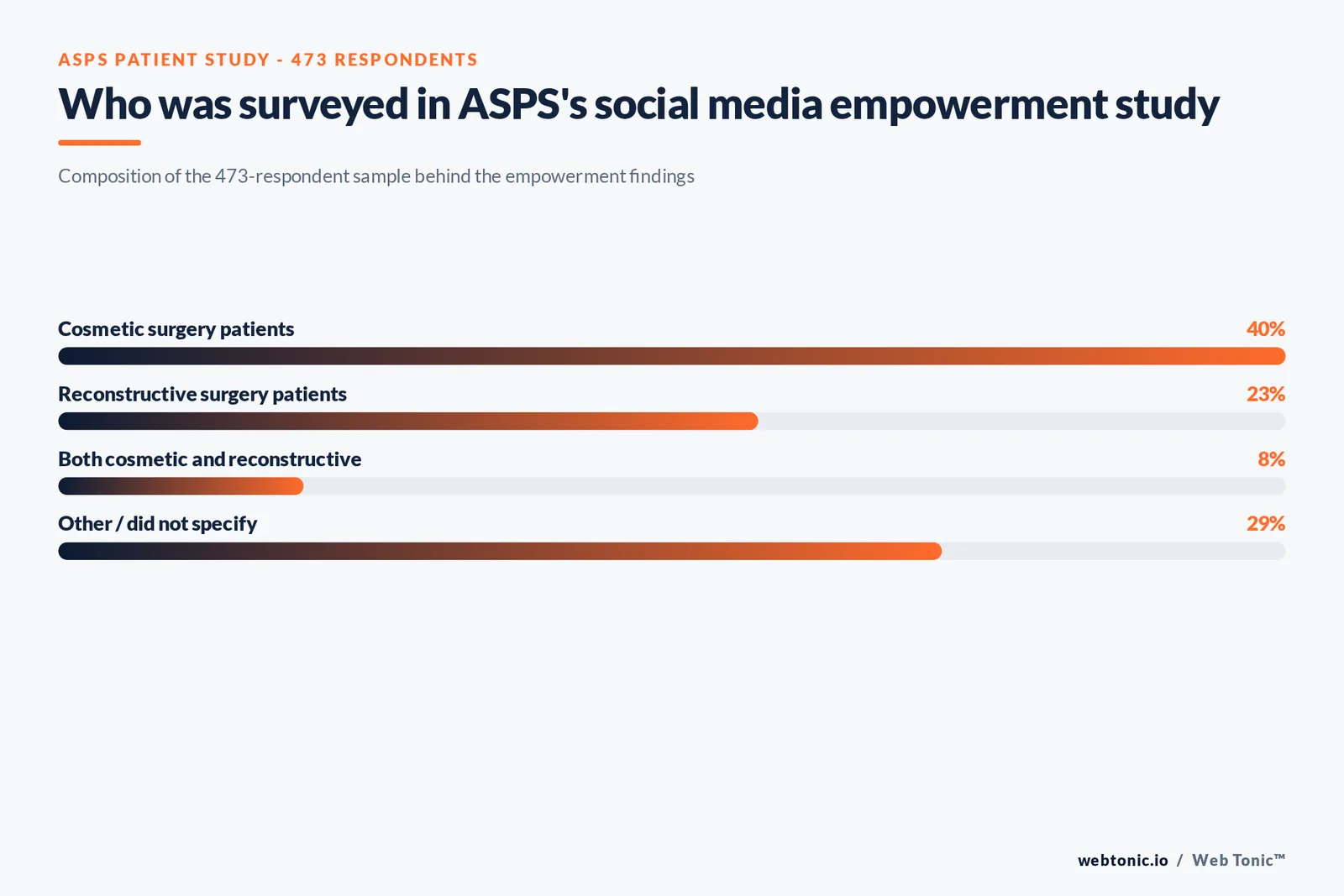
ASPS has published direct commentary on this. Its article on "The prevalence of TikTok and its impact on plastic surgery procedures" argues the platform is normalizing procedures and reducing stigma, shifting who considers surgery in the first place. Separately, ASPS's own social media patient-empowerment study, surveying 473 respondents (70% had undergone plastic or reconstructive surgery: 40% cosmetic, 23% reconstructive, 8% both), found social media use associated with patients feeling more informed and decision-confident going into a procedure. Neither study assigns a specific booking percentage to TikTok itself - the honest summary is that the qualitative effect is documented and the platform-attributed booking volume is not.
| ASPS social media study detail | Figure | What it shows | What it does not show |
|---|---|---|---|
| Total respondents | 473 | Patients reporting on their own social media use | Not a random population sample |
| Had undergone plastic/reconstructive surgery | 70% | Cosmetic 40%, reconstructive 23%, both 8% | Causal link to TikTok specifically |
| Reported feeling more empowered/informed | Majority (qualitative CIDES scale result) | Social media use correlates with confidence | A booking-rate or revenue figure |
Where the age split actually sends the budget
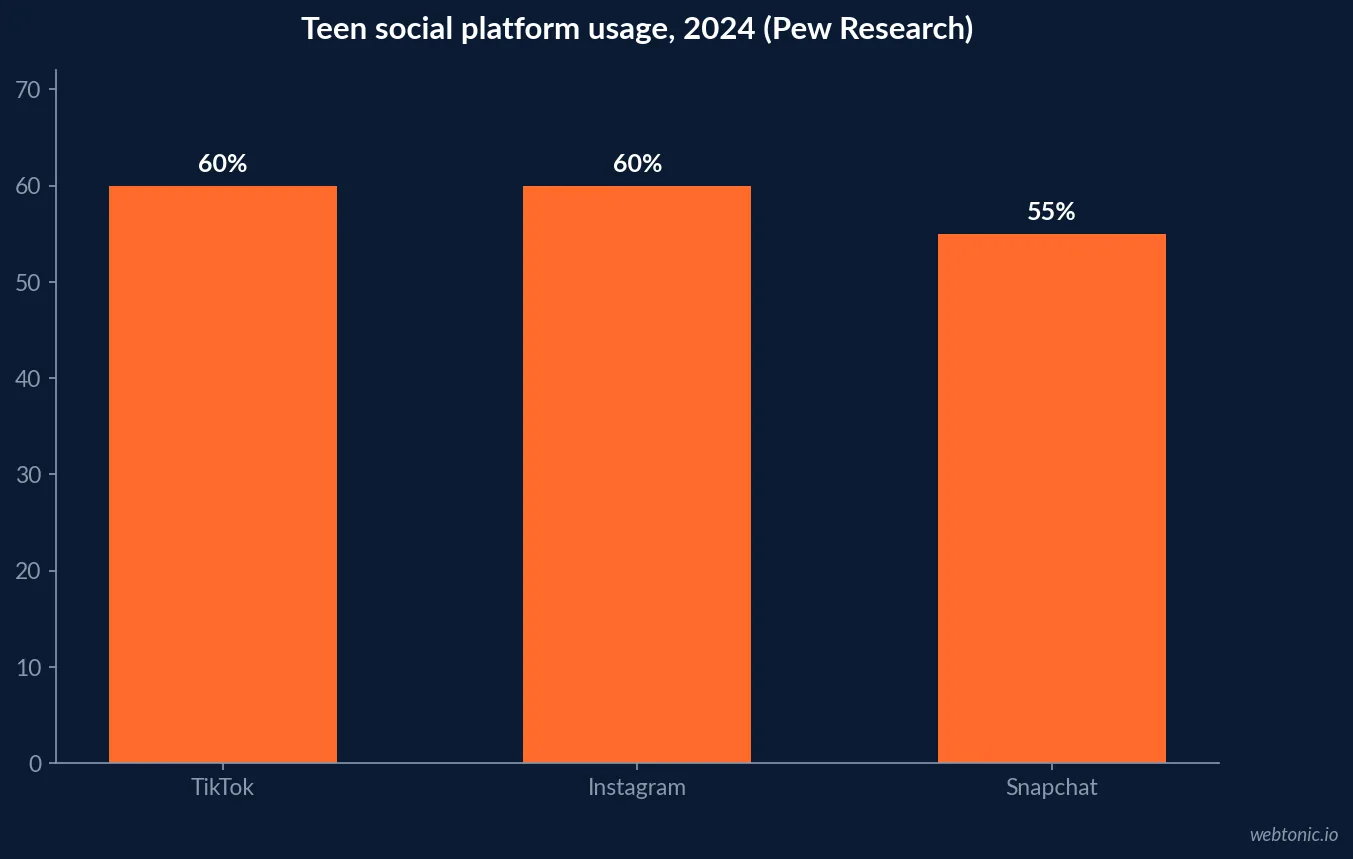
Dermatology treats a much younger average patient than plastic surgery, particularly for acne, which makes teen platform data directly relevant in a way it usually isn't for other medical categories. Pew Research's 2024 Teens, Social Media and Technology survey found roughly six in ten teens use TikTok and Instagram, 55% use Snapchat, and 16% report being on TikTok almost constantly. Plastic surgery skews toward an older, typically higher-income adult audience, where the ASDS and ASPS data above - provider following, review sites, dermatologist trust - carries more direct weight than a platform's teen usage figures.
| Platform (Pew, 2024) | Teen usage | Relevance to derm/plastic surgery content |
|---|---|---|
| TikTok | ~60%, 16% almost constantly | Acne/skincare content for a dermatology audience |
| ~60% | Provider-led before/after and education content | |
| Snapchat | 55% | Lower priority for most clinical content |
Why owned content matters more as review-reading habits shift
BrightLocal's 2025 Local Consumer Review Survey found a clear shift over time from consumers who "always" read reviews before choosing a business toward those who only read them "occasionally" - a general softening in review-reading discipline across categories. That makes a provider's own social content, which doesn't rely on a consumer choosing to seek out a review, a more dependable touchpoint than hoping a researcher works through a full review page before booking.
What the reconstructive-surgery audience needs differently
ASPS's own social media patient-empowerment study surveyed a mixed population - 40% cosmetic patients, 23% reconstructive, 8% both - and reconstructive patients are a meaningfully different content audience than cosmetic ones. Reconstructive content (post-mastectomy reconstruction, trauma repair, congenital conditions) has to prioritize sensitivity and informational clarity over the aspirational tone that works for elective cosmetic content, and mixing the two tones on one account risks alienating one audience or the other.
The global growth behind the content demand
Content volume isn't rising in isolation - procedure demand is. The International Society of Aesthetic Plastic Surgery's 2024 Global Survey counted close to 38 million surgical and non-surgical aesthetic procedures worldwide, up 40% since 2020, with eyelid surgery overtaking liposuction as the most common surgical procedure for the first time. A social content calendar built two years ago around liposuction as the flagship procedure is now behind where global procedure mix actually sits.
| Global procedure signal (ISAPS 2024) | Figure | Content implication |
|---|---|---|
| Total procedures worldwide, 2024 | ~38 million | Category-wide audience is still expanding |
| Growth since 2020 | +40% | Older content calendars are under-built for current demand |
| Most common surgical procedure, 2024 | Eyelid surgery (new leader) | Shift content emphasis away from liposuction-first |
| Botulinum toxin procedures worldwide | 7.8 million | Injectable content still has the largest addressable audience |
What a content calendar should weight, by format
Combining the ASDS influence data with AAFPRS's procedure-mix shift points to a specific content split: frequent, low-production injectable and skincare content for the volume business, occasional higher-production surgical content for the credibility business, and provider-led format across both given three straight ASDS survey waves naming the dermatologist as the top influence.
| Content type | Recommended cadence | Primary platform | What data supports it |
|---|---|---|---|
| Provider-led education (injectables, skincare) | Weekly or more | Instagram, TikTok | 80% of AAFPRS-member procedures are non-invasive |
| Before/after (consented, compliant) | 2-4x per month | 94% use review/rating sites; visual proof matters | |
| Teen-relevant acne/skincare content | Weekly | TikTok, Instagram | ~60% of teens use each platform per Pew |
| Surgical procedure deep-dives | Monthly or less | Provider's owned channels | Rarer, higher-consideration decision |
| Patient testimonial (FTC-compliant) | Occasional | Instagram, website | Dermatologist named top influence in 12 of 15 categories |
What's changing on the practice side
AAFPRS's 2026 annual survey projects facial plastic surgery volume up 19% for 2025, with non-invasive treatments like neurotoxins and fillers now 80% of AAFPRS-member procedures - a volume shift that favors frequent, lower-cost content formats (a filler touch-up video) over the occasional big-procedure showcase. Combined with ASDS's finding that 70% of consumers are already considering a cosmetic procedure, the content opportunity is less about creating demand from nothing and more about capturing an audience that has already decided to research.
The compliance layer for influencer and testimonial content
Any endorsement-style content - a patient testimonial, a paid influencer post, or a provider demonstrating a result - falls under the FTC's endorsement guides: the endorsement has to reflect the endorser's honest opinion, any payment or free treatment has to be disclosed, and the claim can't imply a typical result the treatment doesn't reliably produce. That standard, covered in the same FTC Health Products Compliance Guidance referenced above, applies equally to an organic TikTok post and a paid partnership.
How to prioritize a limited content budget
Lead with the provider on camera, since three ASDS survey waves in a row name the dermatologist as the top influence, ahead of platforms or influencers. Split platform investment by service line: teen acne and general skincare content toward TikTok and Instagram per Pew's usage data, and adult cosmetic-procedure content toward the provider's owned channels and review-site presence, where ASDS and ASPS both point the actual influence. Weigh reach against the reconstructive-versus-cosmetic split ASPS documented in its own sample, and report engagement against appointment volume rather than follower count, since none of the studies cited here tie a follower number directly to a booking. If you want a content plan built against your own service mix, our performance creative team can map it, see how paid social complements this in our analysis of when paid social is worth the spend, or talk to us about building the calendar itself.
Frequently Asked Questions
Has social media's influence on cosmetic decisions grown or shrunk since 2021?
It has held roughly steady, not grown as fast as the platforms themselves. ASDS's Consumer Survey on Cosmetic Dermatologic Procedures found 78% of patients followed their provider's social media in 2021, against 74% in 2025 - essentially flat, with a slight dip. The share whose decision to schedule an appointment was influenced by a provider's social media presence moved from 52% in 2021 to roughly half in 2025. The constant across both years: dermatologists themselves, not influencers or platforms, are named the top influence on the decision.
Which platform matters most for a dermatology or plastic surgery practice's social strategy?
It depends on which service and which patient. Pew Research's 2024 teen survey found roughly six in ten teens use TikTok and Instagram and 55% use Snapchat - relevant for acne-focused dermatology content aimed at a teen audience. Plastic surgery skews toward an adult, often higher-income audience where ASDS and ASPS both point to the provider's own feed and review sites, not a specific platform's demographics, as the influence that actually moves a booking.
Is TikTok actually driving plastic surgery procedure volume?
ASPS has published qualitative research on the mechanism - its own commentary on TikTok's prevalence notes that visibility is normalizing procedures and shifting who considers them, and its 2024 patient-empowerment study found social media use correlated with patients feeling more informed before a procedure. Neither study puts a percentage on TikTok-attributed bookings specifically, so treat the platform's role as documented but not yet quantified - a fair distinction to make in any content built from this data.
Should a practice use influencer partnerships or provider-led content?
The consistent finding across three ASDS survey waves (2019, 2021, 2025) is that dermatologists are named the top influencer, not lifestyle influencers or celebrities - true in 12 of 15 tracked procedure categories in the 2025 wave. That argues for prioritizing the provider's own voice on camera over a paid influencer placement, though influencer content isn't ruled out by this data, just not shown as the primary driver.
What compliance rule applies specifically to influencer or testimonial content?
The FTC's endorsement rules require that any endorsement - paid or unpaid, from an influencer or a real patient - reflect the endorser's honest opinion, disclose a material connection such as payment or free treatment, and not imply results the treatment cannot reliably produce. That applies to a boosted Instagram post the same way it applies to a TV ad.
Sources
ASDS - 2021 Consumer Survey on Cosmetic Dermatologic Procedures (infographic)
ASDS - Consumer Survey on Cosmetic Dermatologic Procedures (2025)
ASPS - The Prevalence of TikTok and Its Impact on Plastic Surgery Procedures
ASPS - Social Media Use May Help to Empower Plastic Surgery Patients
BrightLocal - Local Consumer Review Survey 2025
Pew Research Center - Teens, Social Media and Technology 2024
ISAPS - 2024 Global Survey on Aesthetic/Cosmetic Procedures
AAFPRS - New Trends in Facial Plastic Surgery (2026 Annual Survey)
AAFPRS - 2026 Annual Survey, Trends Defining Facial Plastic Surgery
FTC - Health Products Compliance Guidance