Table of contents

No vendor currently publishes a dermatology or plastic surgery-specific email benchmark, and the metric most practices still lead with - open rate - has been quietly unreliable since 2021. This page builds the real picture from what is published: cross-industry benchmarks, Apple's tracking-pixel change, and the consent rules that decide who a practice can legally email in the first place.
Key Takeaways
- No major vendor breaks out a dermatology or plastic surgery email benchmark as of 2026.
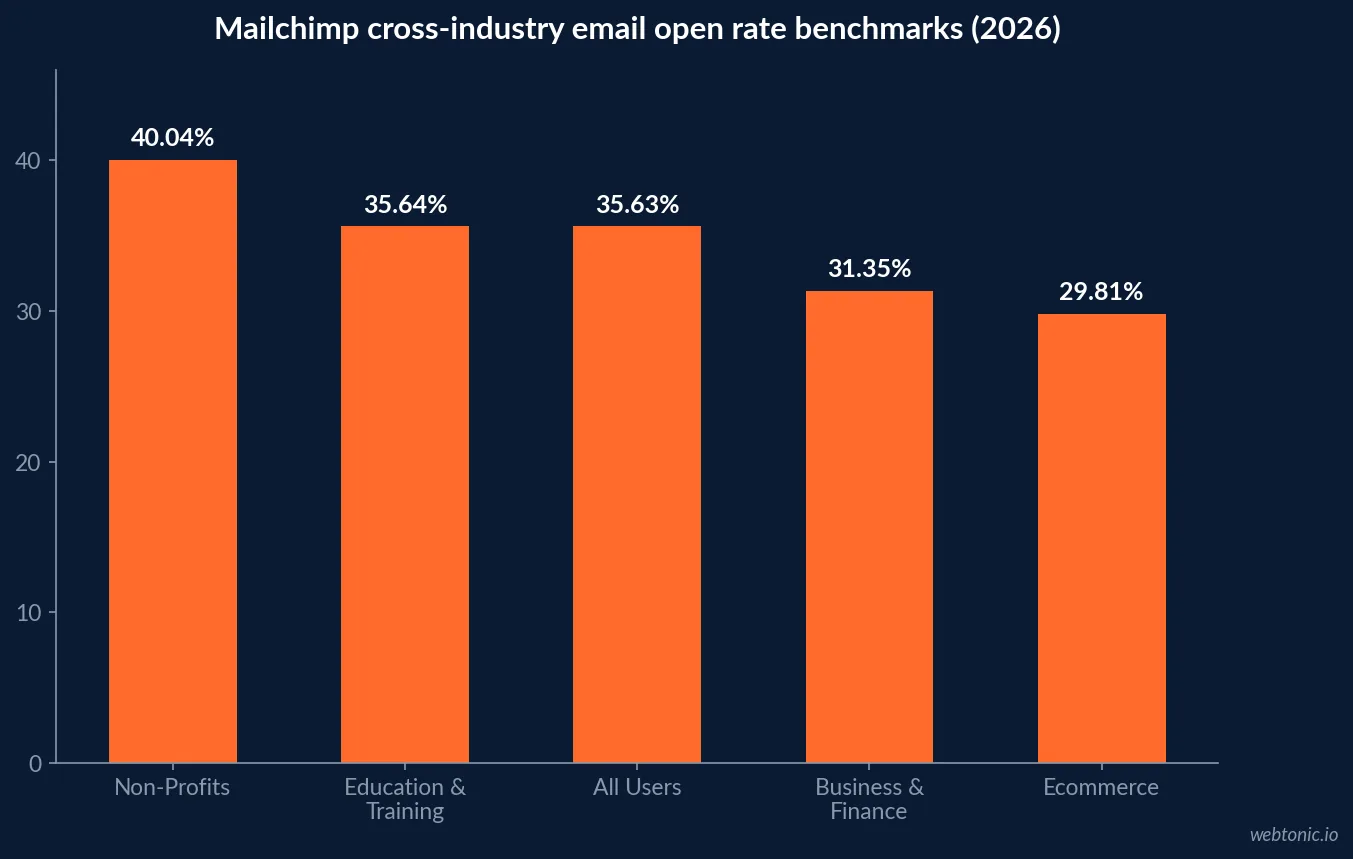
- Mailchimp's cross-industry open rate average is 35.63%, the nearest public floor.
- Non-Profits post the highest tracked open rate at 40.04% in Mailchimp's public table.
- Ecommerce posts the lowest at 29.81% among Mailchimp's published categories.
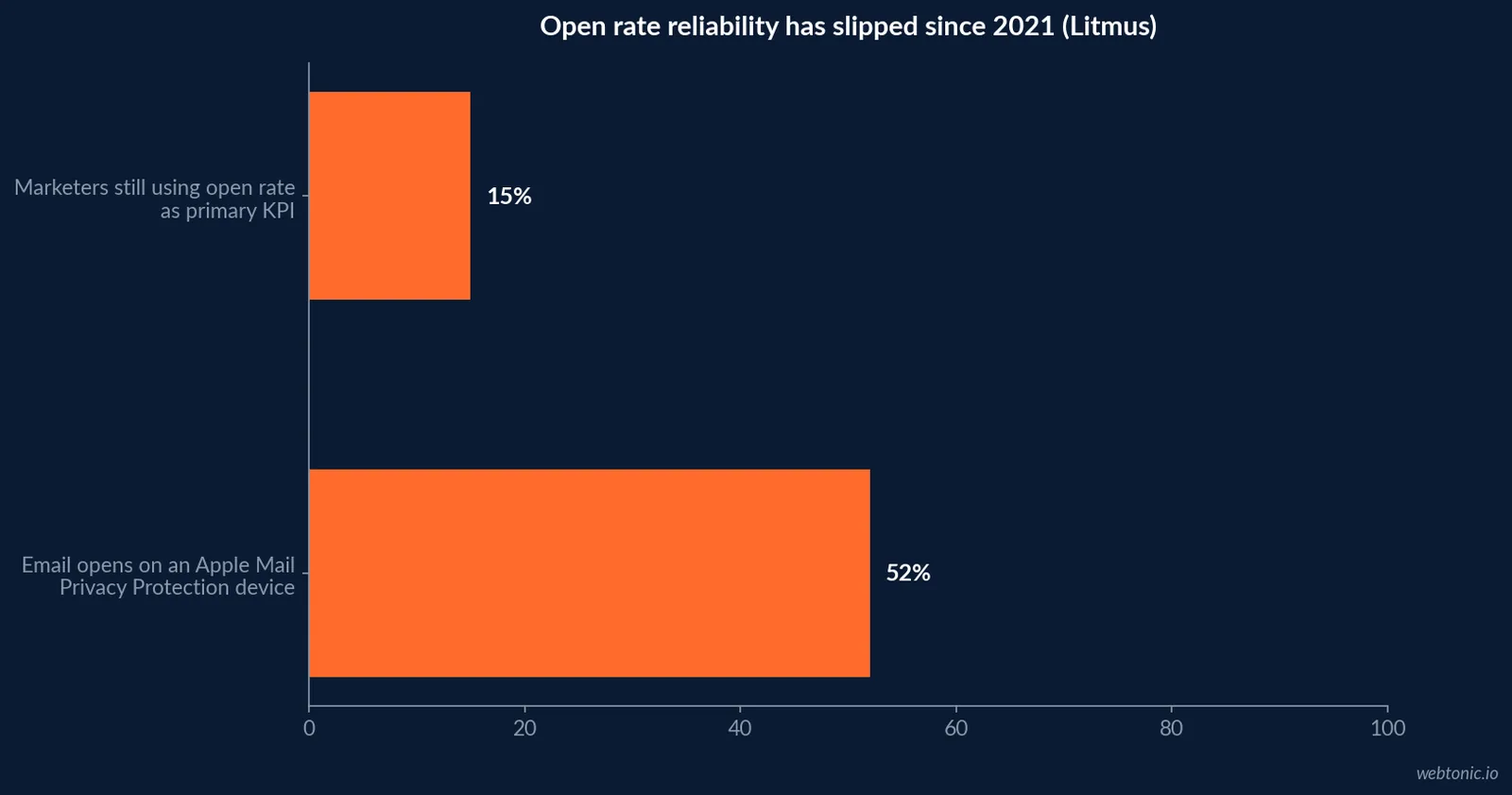
- More than half of all email opens happen on an Apple Mail Privacy Protection device, per Litmus.
- That has counted as an "open" since 2021 whether or not anyone read the email.
- Only 15% of marketers still treat open rate as their primary metric, per Litmus's State of Email research.
- CAN-SPAM requires an opt-out and accurate headers, not opt-in consent, for commercial email.
- HIPAA requires written authorization before protected health information drives a marketing email.
- Refill and treatment-related reminders are generally exempt from that authorization requirement.
- 70% of consumers say they are considering a cosmetic procedure, per ASDS 2025 - a nurture-list opportunity.
- More than half of AAFPRS member surgeons report rising virtual consultation and follow-up use in 2026.
- Mailchimp's cross-industry click rate average is 2.62%.
- Its cross-industry unsubscribe rate average is 0.22%.
Why there is no dermatology or plastic surgery row to cite
Mailchimp's own published benchmark table - one of the largest available panels, built from hundreds of millions of sends - currently lists five categories: Business + Finance, Non-Profits, Education + Training, Ecommerce, and an All Users average. Medical, dermatology and aesthetics categories are not among them. That is a genuine data gap, not an oversight in this article - any number claiming to be "the dermatology email open rate" that isn't sourced to a named, current study should be treated as invented.
| Category (Mailchimp, current) | Avg. open rate | Avg. click rate | Avg. unsubscribe rate |
|---|---|---|---|
| Non-Profits | 40.04% | 3.27% | 0.18% |
| Education + Training | 35.64% | 3.02% | 0.18% |
| All Users (cross-industry) | 35.63% | 2.62% | 0.22% |
| Business + Finance | 31.35% | 2.78% | 0.15% |
| Ecommerce | 29.81% | 1.74% | 0.19% |
The unsubscribe rate tells a steadier story than the open rate
Unsubscribe rate, unlike open rate, still requires an active decision by the recipient, which makes it one of the more trustworthy numbers in Mailchimp's table even without a healthcare-specific row. Business + Finance posts the lowest unsubscribe rate at 0.15%, and All Users average 0.22% - both figures a dermatology or plastic surgery list, built from patients who opted in during an actual visit, should be able to beat, since a warmer list than a blended cross-industry average should churn less.
Use the 35.63% All Users figure as a cross-industry floor for a dermatology or plastic surgery list, not a target - a practice's audience is smaller, warmer and typically opted in through an in-office visit, which argues for outperforming a blended cross-industry average rather than matching it.
The metric changed underneath the benchmark
Even where a benchmark exists, "open rate" has meant something different since 2021. Apple's Mail Privacy Protection pre-loads the tracking pixel in every email a user opens in Apple Mail, which logs an open regardless of whether the recipient reads past the subject line. Litmus's own email client research finds that more than 50% of all email opens now happen on a device with Mail Privacy Protection active. Litmus's State of Email Report found that only 15% of marketers still treat open rate as their primary success metric - a sign the industry itself has already discounted the number that most practice dashboards still lead with.
| What changed | When | Effect on reported open rate | Source |
|---|---|---|---|
| Apple Mail Privacy Protection launches | 2021 | Pre-fetches images, logs opens with no read | Litmus |
| Share of opens on an MPP-active device | Current | More than 50% of all opens | Litmus |
| Marketers still using open rate as primary KPI | Current | Only 15%, down from a majority | Litmus State of Email |
What that means for a practice comparing itself to a 2019 baseline
A practice that tracked a 28% open rate in 2019 and a 34% open rate today has not necessarily improved engagement - it may be measuring a population that is now roughly half Apple Mail users whose "opens" are partly automatic. The honest fix is to weight click rate, reply rate and booked-appointment attribution over open rate, since those actions still require a human decision that a pre-fetch cannot fake.
| Metric | Still reliable after MPP? | Why | What to track instead if not |
|---|---|---|---|
| Open rate | No - inflated by automatic pre-fetch | Apple Mail loads images without a human action | Click rate, replies, bookings |
| Click rate | Yes | Still requires an active click from a person | n/a |
| Unsubscribe rate | Yes | Still requires an active opt-out | n/a |
| Reply rate | Yes | Cannot be triggered automatically | n/a |
| Booked-appointment attribution | Yes, if tracked in the CRM | Requires the recipient to act outside the inbox | n/a |
The consent layer: two different rules, easy to conflate
The FTC's CAN-SPAM Act Compliance Guide governs commercial email broadly: accurate header and "from" information, no deceptive subject lines, a working opt-out honored within 10 business days, and no requirement for opt-in consent before the first message. That is the low bar every commercial sender clears.
HIPAA sits above it for health data specifically. Under 42 U.S.C. SS 17936 and the HIPAA Privacy Rule's marketing definition, using protected health information to decide who receives a marketing communication - or what it says - generally requires the patient's written authorization, with exceptions for face-to-face communication and for the patient's own treatment. The authorization mechanics are set out directly in 45 CFR § 164.508, which requires that authorization name the specific use and be signed before protected health information drives a marketing send; because state privacy statutes can add stricter consent rules on top of this federal floor, a national practice group should still confirm state-level requirements before building a segmented campaign.
| Rule | Governs | Consent standard | Practical effect on a practice's list |
|---|---|---|---|
| CAN-SPAM Act (FTC) | Any commercial email | Opt-out honored, accurate headers | Baseline compliance, low bar |
| HIPAA Privacy Rule marketing definition | Email built from patient health data | Written authorization, with exceptions | Segmenting by diagnosis or procedure needs sign-off |
| Treatment/refill exception | Ongoing-care communications | No separate authorization needed | Appointment and refill reminders are generally clear |
| State-level opt-in add-ons | Varies by state | Some states require opt-in beyond HIPAA | Check state rules before a national send |
Send frequency and timing, absent a specialty benchmark
With no dermatology or plastic surgery send-frequency study published, the safer default is conservative: a monthly or twice-monthly cadence for general education content, reserving higher-frequency sends for the authorized, segmented nurture sequence described below. Since All Users unsubscribe at 0.22% on Mailchimp's blended average and this list should run warmer than that baseline, an unsubscribe rate climbing toward or past that figure is the clearest signal that frequency, not content quality, is the problem.
What a compliant nurture sequence actually looks like
The 70% of consumers already considering a procedure are the right target for a nurture sequence, but the sequence has to be built so consent covers what it will contain before the first send. A general "you expressed interest in our practice" opt-in, collected at intake or through a website form, supports broad educational content. Anything that segments by a specific diagnosis, procedure or health condition pulled from the patient's chart crosses into HIPAA's marketing-authorization requirement and needs its own written sign-off naming that use.
| Sequence step | Content type | Consent needed | Compliance note |
|---|---|---|---|
| Welcome email after intake | General practice introduction | General marketing opt-in | Low risk, broad consent covers it |
| Educational follow-up | Procedure overview, FAQs | General marketing opt-in | Avoid pulling from chart data to personalize |
| Segmented offer by interest expressed on a form | Service-specific content | General marketing opt-in, if self-reported | Self-reported interest is not the same as chart data |
| Segmented offer by diagnosis or procedure history | Service-specific content | Written HIPAA marketing authorization | Requires separate, specific sign-off |
| Appointment or refill reminder | Care-related, not promotional | No separate authorization | Falls under the treatment exception |
Benchmarking the program against itself, not a borrowed number
Because no vendor publishes a dermatology or plastic surgery row and open rate itself is compromised, the most defensible benchmark is the practice's own trend in click rate and booked-appointment attribution, tracked monthly against its own baseline. AAFPRS's 2026 annual survey, covering member facial plastic surgeons, found more than half reporting rising use of digital follow-up tools generally - a sign the specialty is already moving benchmarking toward outcomes it can track directly rather than industry averages that don't exist for it yet.
Where the list-building opportunity actually is
The 2025 ASDS Consumer Survey on Cosmetic Dermatologic Procedures found 70% of respondents are considering a cosmetic procedure - a large population sitting well before a booking decision, which is exactly the audience an authorized, well-timed email nurture sequence is built for. Capturing that consideration stage in-office, with clear consent language covering what will be sent, converts a HIPAA compliance requirement into the list-building step rather than a blocker.
Email is one channel in a broader shift, not the whole story
AAFPRS's 2026 annual survey found that more than half of member surgeons report rising use of virtual consultations and digital follow-up tools - patient communication is moving into channels a traditional email platform doesn't measure at all. The practical implication for an email program: benchmark it against its own click-through and appointment data over time, not against a stale open-rate number, and expect a growing share of pre- and post-visit contact to move to channels this report can't yet benchmark either.
If you want a compliant nurture sequence built around your own consent language and CRM data, our growth marketing team can set it up, read our breakdown of general email marketing benchmarks for the cross-industry context behind the numbers above, or talk to us about auditing your current program's consent language.
Frequently Asked Questions
What is a good email open rate for a dermatology or plastic surgery practice?
No major vendor currently publishes a dermatology or plastic surgery-specific row - Mailchimp's public benchmark table lists Business + Finance, Non-Profits, Education + Training, Ecommerce and an All Users average of 35.63%, with no medical or aesthetics category broken out. Treat that 35.63% as a cross-industry floor to compare against, not a target built for this specialty, and weight click rate and booked appointments over open rate for the reason in the next answer.
Why has email open rate become a less reliable metric?
Apple's Mail Privacy Protection, live since 2021, pre-fetches images in every email opened in Apple Mail, which registers as an open whether or not a person actually reads the message. Litmus's own email client research puts more than half of all email opens on a device with Mail Privacy Protection active, which means an open-rate number reported today is measuring a different thing than the same number reported in 2020. Litmus's State of Email research also found that only 15% of marketers still treat open rate as their primary success metric, down from a majority position a few years earlier.
What does a patient need to agree to before a practice can email them marketing content?
Two layers apply, and they are not the same law. The CAN-SPAM Act, enforced by the FTC, requires an opt-out mechanism, accurate header information and honest subject lines for any commercial email - it does not require opt-in consent for general marketing. HIPAA is the stricter layer for anything that uses protected health information to select who receives an email or what it says: with limited exceptions, the HIPAA Privacy Rule requires the patient's written authorization before protected health information is used for marketing communications.
Are appointment reminders or refill emails treated as marketing under HIPAA?
Generally no. HHS's refill-reminder guidance and the treatment/health-care-operations exceptions in the HIPAA marketing definition carve out communications about a drug or treatment currently prescribed to the patient, and communications made face-to-face or as part of ongoing care. A newsletter promoting a new injectable service to your full patient list is a different category and needs authorization; a reminder that a patient's existing prescription needs a refill generally does not.
How is patient communication technology evolving beyond email?
Faster than email benchmarks are being republished. AAFPRS's 2026 annual survey found that more than half of its member surgeons report rising use of virtual consultations and digital follow-up tools, extending the same nurture-and-retain job email used to do alone into pre-visit and post-visit touchpoints that sit outside a traditional email platform's reporting entirely.
Sources
Mailchimp - Email Marketing Benchmarks & Industry Statistics
Litmus - Apple Mail Privacy Protection Knowledge Center
Litmus - The Top Email Marketing Trends (State of Email Report)
FTC - CAN-SPAM Act: A Compliance Guide for Business
eCFR - 45 CFR § 164.508, Uses and Disclosures for Which an Authorization Is Required
U.S. Code - 42 U.S.C. SS 17936, Conditions on Certain Contacts
ASDS - Consumer Survey on Cosmetic Dermatologic Procedures (2025)
AAFPRS - New Trends in Facial Plastic Surgery (2026 Annual Survey)
AAFPRS - 2026 Annual Survey, Trends Defining Facial Plastic Surgery