Table of contents
Weave's own pricing page starts a dental communication plan at USD 199 a month; its 2026 survey of healthcare practices found 39% report fewer no-shows after automating in 2025. This page prices the tooling from vendors' own pages and sets it against what the same vendors' research says automation is actually changing for patient bookings.
Key Takeaways
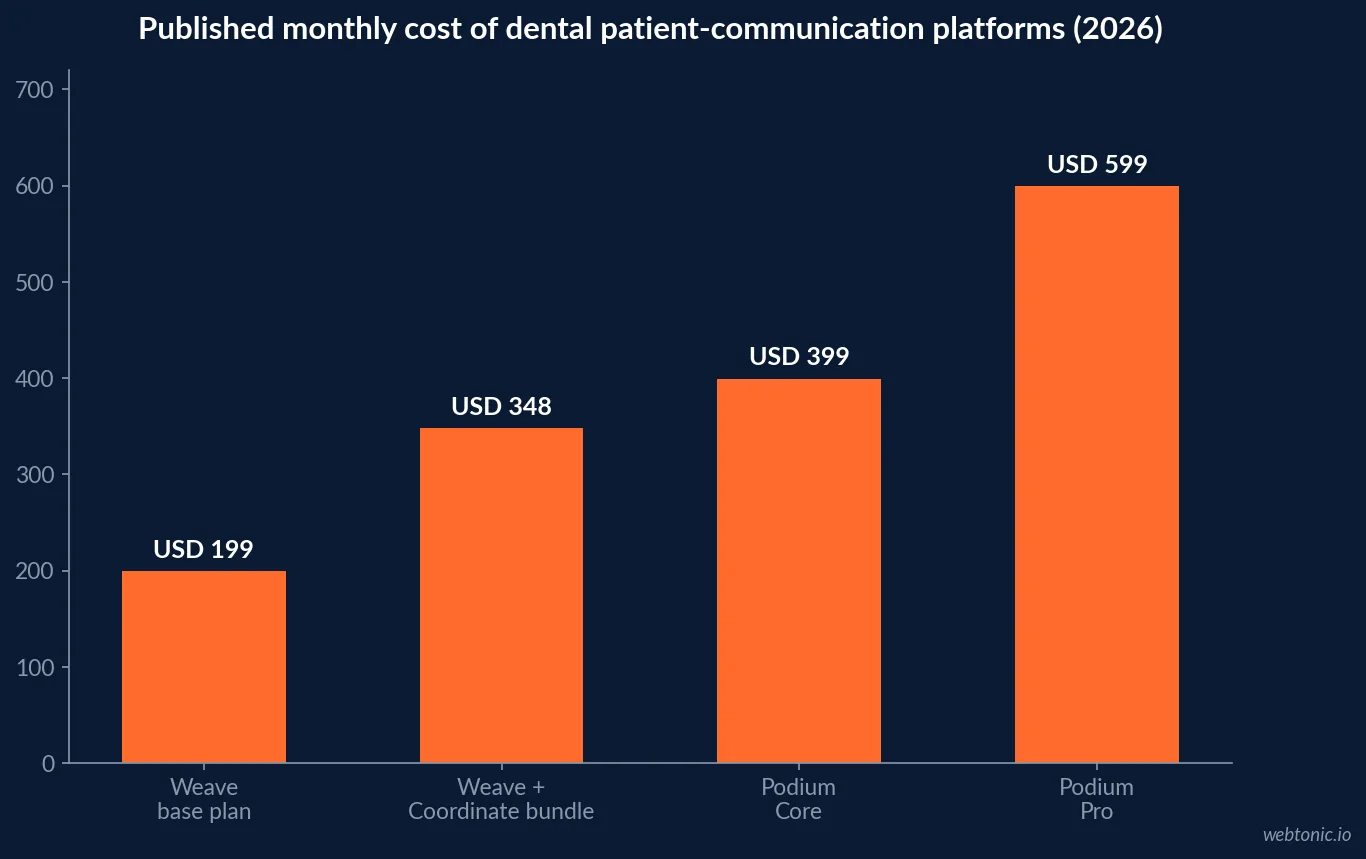
- Weave's base patient-communication plan starts at USD 199 a month.
- A recall-and-reminder bundle adds USD 149 a month on top of that base.
- Podium's own pricing page lists Core at USD 399 a month and Pro at USD 599.
- Podium's top Signature tier is quote-only, not published.
- 61% of practices report improved patient communication after automating in 2025.
- 41% report improved team productivity and efficiency.
- 39% report fewer no-shows and last-minute cancellations.
- 60% cite HIPAA and data-privacy concerns as the top automation risk.
- 51% cite concern about AI producing low-quality work.
- 35% cite regulatory uncertainty as a barrier.
- HubSpot's Marketing Hub Professional runs USD 890 a month billed monthly.
- Or USD 800 a month billed annually, saving USD 1,080 a year.
- Professional-tier onboarding is a one-time USD 3,000 fee.
- Enterprise-tier onboarding runs USD 7,000.
- Klaviyo's free tier caps out at 250 profiles and 500 emails a month.
- The same free tier includes USD 5 of mobile messaging a month.
- Any business texting U.S. patients at scale must register under A2P 10DLC.
- HIPAA's Part 164 governs whether a reminder counts as protected health information.
What the tooling itself costs
Vendor pricing pages, opened directly rather than pulled from a round-up, give the honest floor. Weave's own pricing page lists a base plan starting at USD 199 a month, and Weave's plan builder prices its Coordinate bundle - online scheduling, digital forms, reminders and follow-ups, and recall and reactivation - at an additional USD 149 a month. Podium's own pricing page publishes two tiers directly: Core at USD 399 a month and Pro at USD 599 a month, with its top Signature tier reserved for a custom sales conversation.
| Vendor (own pricing page) | Published tier | Monthly cost | What it covers |
|---|---|---|---|
| Weave | Base plan | USD 199 | Calling, texting, core platform |
| Weave | Coordinate bundle (add-on) | USD 149 | Recall, reminders, confirmations |
| Podium | Core | USD 399 | Review requests, unified inbox, texting |
| Podium | Pro | USD 599 | Everything in Core plus AI concierge, automations |
| Podium | Signature | Custom quote | Multi-location, advanced automation |
What automation is reported to change
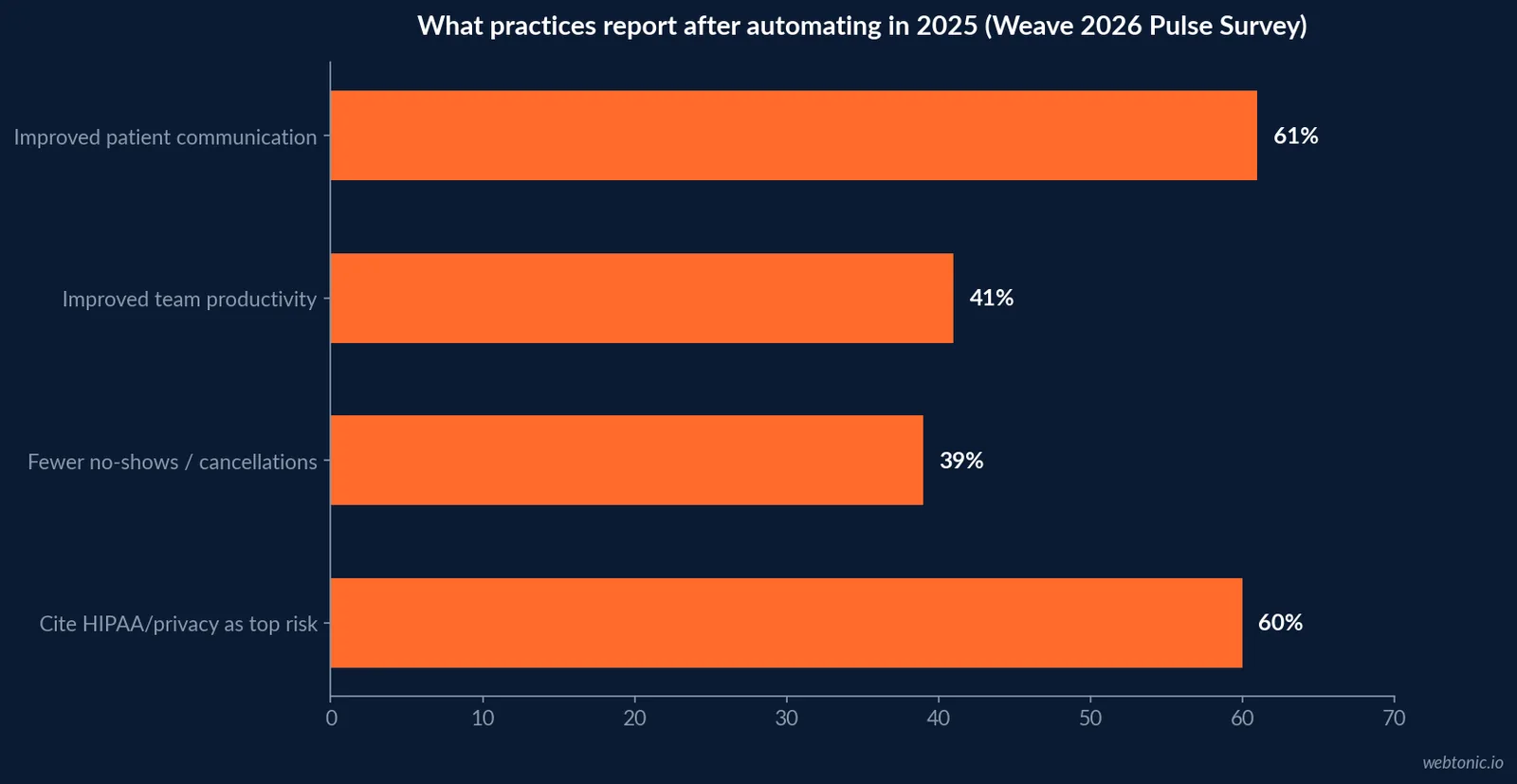
Weave's 2026 Pulse Survey asked healthcare practices, including dental offices, what changed after they operationalized automation in 2025. 61% report improved patient communication and responsiveness, 41% report improved team productivity and efficiency, and 39% report fewer no-shows and last-minute cancellations. The survey reports these as outcomes correlating with automation adoption broadly; it does not isolate which specific workflow, such as recall texts versus online scheduling, drove each number.
| Reported outcome after 2025 automation | Share of practices | Source |
|---|---|---|
| Improved patient communication and responsiveness | 61% | Weave 2026 Pulse Survey |
| Improved team productivity and efficiency | 41% | Weave 2026 Pulse Survey |
| Fewer no-shows and last-minute cancellations | 39% | Weave 2026 Pulse Survey |
What is holding the rest back
The same survey found adoption is gated by trust in the data pipeline, not by doubt about the payoff. 60% of respondents cite HIPAA and data-privacy concerns as their top risk factor, ahead of 51% who cite concern about AI producing low-quality work and 35% who cite regulatory uncertainty generally. For a category handling appointment details tied to a named patient, that ordering tracks with how the compliance rules below are actually written.
The compliance layer specific to patient texting
Three separate rule sets apply before a reminder text goes out. The Telephone Consumer Protection Act, which the FCC continues to interpret and amend, governs consent for automated calls and texts to a mobile number. Separately, Twilio's own compliance documentation confirms that any business sending application-to-person SMS from a U.S. long code must register under the carrier-run A2P 10DLC framework or risk filtering. On top of both, HIPAA's 45 CFR Part 164 governs whether the content of a reminder - naming a procedure, for instance, rather than just a time - counts as protected health information requiring extra safeguards.
| Compliance layer | What it governs | Who enforces it | Source |
|---|---|---|---|
| TCPA consent rules | Automated calls/texts to a mobile number | FCC | fcc.gov order docket |
| A2P 10DLC registration | Application-to-person SMS delivery at scale | Wireless carriers via Twilio/CTIA | Twilio compliance docs |
| HIPAA Privacy and Security Rules | Whether reminder content is protected health information | HHS Office for Civil Rights | 45 CFR Part 164, ecfr.gov |
A cheaper email-first alternative, and its limits
Not every practice needs a healthcare-specific platform on day one. Mailchimp's own pricing page starts its Standard email and SMS plan at USD 20 a month for 500 contacts, well under Weave's USD 199 base and Podium's USD 399 Core tier. The trade-off is the same one general platforms carry throughout this page: Mailchimp prices email and SMS marketing broadly, not HIPAA-aware appointment reminders or two-way patient texting synced to a scheduling system, so it fits as a newsletter or promotional layer rather than a replacement for recall automation.
Where a general marketing platform fits, and where it doesn't
General-purpose marketing automation is priced differently and is not HIPAA-aware by default. HubSpot's own pricing guide puts Marketing Hub Professional at USD 890 a month billed monthly, or USD 800 a month billed annually - a USD 1,080 annual saving - plus a one-time USD 3,000 onboarding fee for that tier and USD 7,000 for Enterprise. Klaviyo's own pricing page caps its free tier at 250 profiles, 500 emails a month and USD 5 of mobile messaging a month, well below what a multi-thousand-patient practice needs before it starts paying per message.
| General platform (own pricing page) | Published price point | What it does not include |
|---|---|---|
| HubSpot Marketing Hub Professional | USD 890/mo monthly, USD 800/mo annual | HIPAA-aware appointment workflows |
| HubSpot onboarding (Professional) | USD 3,000 one-time | Practice-management system integration |
| Klaviyo free tier | USD 0, capped at 250 profiles / 500 emails | SMS at meaningful patient-list volume |
A scheduling-automation data point from a different vendor
Weave and Podium are not the only vertical players pricing this workflow. NexHealth, which sells real-time online scheduling synced to a practice's calendar, reports on its own resource pages that practices using its platform bring in 15 to 45 new patients a month through web, social and text/email scheduling embedded directly in those channels. That is vendor-reported customer data, not an independent study, and it measures new-patient volume rather than the recall and reactivation workflows priced above.
| Vendor claim (self-reported) | Figure | What it measures | Source |
|---|---|---|---|
| New patients per month via online scheduling | 15-45 | Acquisition, not recall | NexHealth resource page |
What a HIPAA-labelled reminder actually has to avoid
The compliance risk practices name most (60%, above) is specific: a reminder that references a diagnosis or a named procedure carries more privacy exposure than one that only confirms a date and time. 45 CFR Part 164 treats health information tied to an identified patient as protected regardless of the channel it travels through, which is why vendor platforms built for healthcare, rather than general marketing tools, default their reminder templates to date-and-time language and keep treatment detail inside a secure patient portal instead of the text body itself.
Sequencing the decision
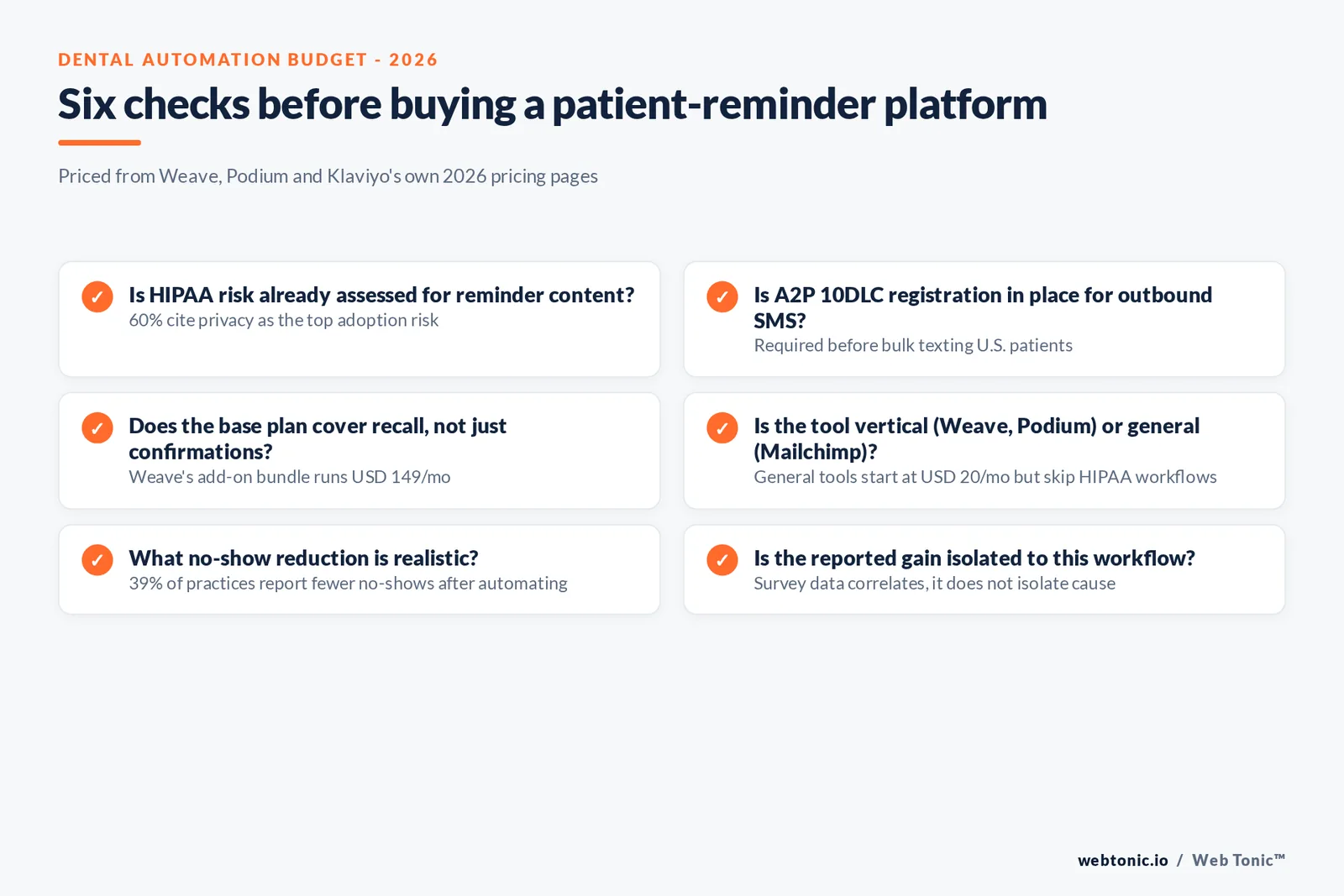
The honest order, from the data above: confirm the compliance layer first (TCPA consent language, A2P 10DLC registration, and a HIPAA risk assessment on the reminder content itself), then price a vertical tool built for the compliance layer (Weave, Podium) against what a general platform (HubSpot, Klaviyo) would need bolted onto it to reach the same coverage. A practice that skips the compliance step and buys tooling first is buying the wrong thing at either price point.
Our data and analytics practice maps automation spend against practice-management data before a tool is chosen, and our marketing automation statistics page covers the cross-industry adoption numbers behind the same platforms named here.
What this does not prove
None of the figures above show that automation alone, independent of staffing and scheduling discipline, produces the 39% no-show reduction Weave reports. The finding correlates automation adoption with better outcomes across a survey sample; it does not isolate a single workflow as the cause. Read the pricing tables as a cost floor and the survey figures as directional evidence, not as a guaranteed return for any one practice. A practice comparing Weave's USD 199 base plan against Podium's USD 399 Core tier, or against a Mailchimp-plus-manual-workflow combination at USD 20 a month, is really comparing how much of the HIPAA and scheduling-sync work it wants a vendor to handle versus how much it is willing to build itself. See contact us if you want that return modelled against your own booking data.
Where the ROI math has to stay honest
None of the figures above isolate a single automated workflow as the cause of a specific booking outcome. Weave's 39% no-show figure correlates with automation adoption across a survey sample that likely also changed staffing and confirmation processes in the same period; NexHealth's 15-to-45 range is a self-reported customer range, not a controlled comparison. Treat both as directional evidence for what a tool category can do, priced against what it costs above, rather than as a guaranteed return for a specific practice.
Frequently Asked Questions
What does patient-reminder automation cost for a dental practice?
Vendor pricing pages, not round-ups, give the clearest floor. Weave's own pricing page starts a base communication plan at USD 199 a month, with a dedicated Coordinate bundle for reminders, recall and confirmations priced at an additional USD 149 a month. Podium's own pricing page lists two published tiers, Core at USD 399 a month and Pro at USD 599 a month, with its top Signature tier quoted only on request. None of these figures is a Web Tonic price; each is the vendor's own published rate.
Does automated texting actually reduce no-shows?
Weave's 2026 Pulse Survey of healthcare practices found that among those who operationalized automation in 2025, 39% report fewer no-shows and last-minute cancellations, alongside 61% who report improved patient communication. The survey does not isolate reminders from the rest of a practice's automation stack, so read the 39% as correlating with automation adoption broadly, not proof that reminders alone caused it.
What compliance rules apply before a dental office can text patients?
Two separate layers. The Telephone Consumer Protection Act, enforced by the FCC, governs consent for automated calls and texts to a patient's mobile number. Separately, any business sending application-to-person SMS in the U.S. must register under the wireless industry's A2P 10DLC framework, per Twilio's own compliance documentation, or its messages get filtered or blocked by carriers. Dental offices layer HIPAA on top of both, since appointment reminders about specific treatment can be protected health information under 45 CFR Part 164.
What is holding practices back from automating further?
Privacy, not skepticism about the payoff. Weave's 2026 survey found 60% of respondents cite HIPAA and data-privacy concerns as their top risk factor in adopting automated patient communication, ahead of concern about AI producing low-quality work at 51% and regulatory uncertainty at 35%. That ordering suggests vendor compliance documentation, not feature lists, is what closes deals in this category.
Is a general marketing automation platform (HubSpot, ActiveCampaign, Klaviyo) a fit for a dental office?
Only as a layer on top of a dedicated patient-communication tool. HubSpot's own pricing lists Marketing Hub Professional at USD 890 a month billed monthly (USD 800 annually) plus a one-time USD 3,000 onboarding fee, and Klaviyo's own pricing page caps its free tier at 250 profiles and 500 emails a month. Those tools handle email and SMS marketing broadly but do not natively carry HIPAA-aware appointment workflows the way a vertical platform like Weave does.
Sources
Weave - Pricing page
Weave - Plan builder
Weave - 2026 Pulse Survey press release
Podium - Pricing page
HubSpot - Marketing Hub pricing guide
Klaviyo - Pricing page
Twilio - A2P 10DLC compliance documentation
Federal Communications Commission - TCPA rulemaking docket
eCFR - Title 45, Part 164 (HIPAA)
NexHealth - Patient acquisition resource page
Mailchimp - Pricing page