Table of contents
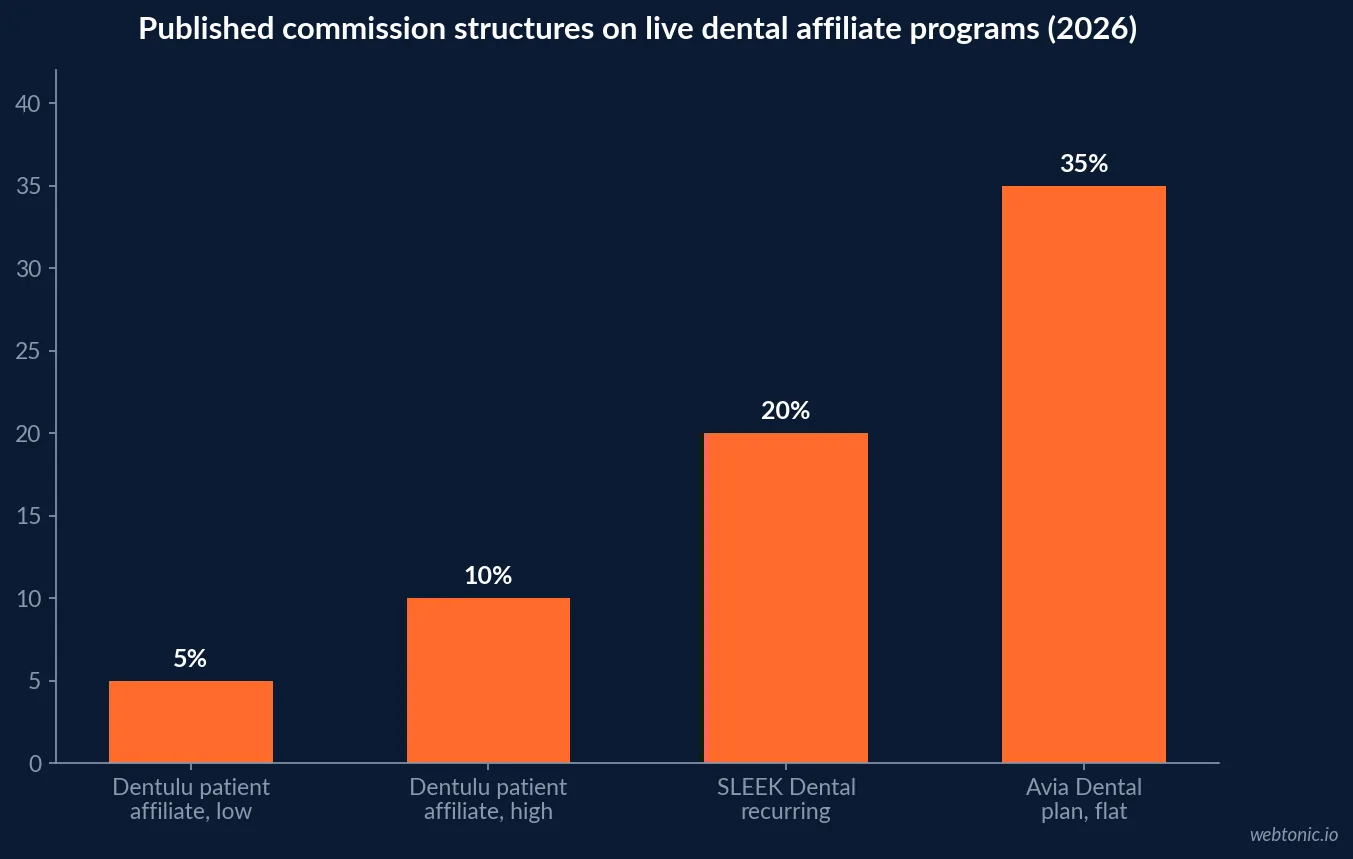
Live 2026 dental affiliate programs pay 5% to 35% commission on a product or membership sale, but the channel that actually moves patients between clinicians runs on a different, mostly cashless mechanism because of the federal Anti-Kickback Statute. This page separates the two and prices what is published for each.
Key Takeaways
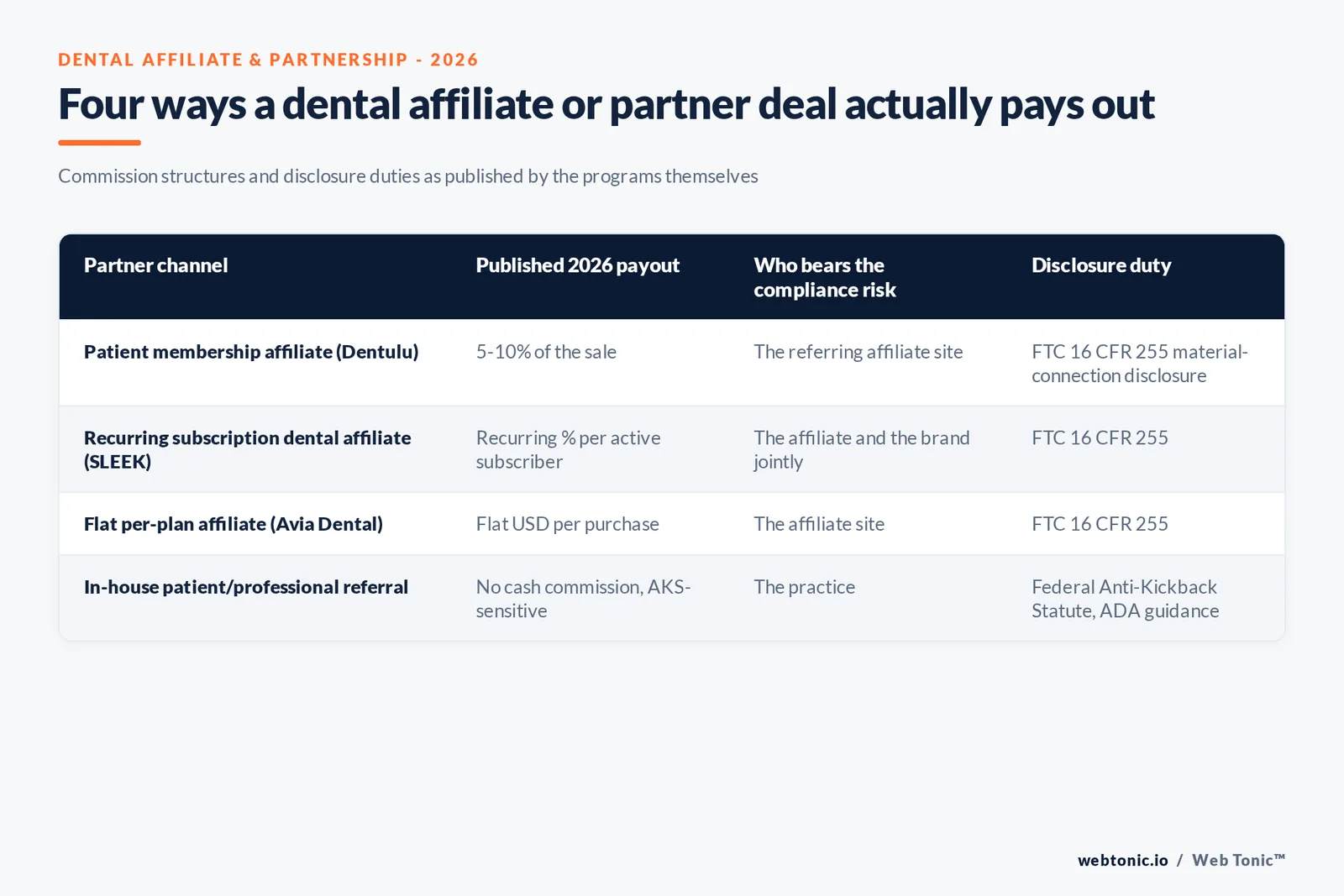
- Dentulu's patient affiliate program pays 5% to 10% per sale.
- Avia Dental pays a flat USD 35 per plan purchase.
- SLEEK Dental Club pays a recurring commission per active subscriber.
- Uniqa Dental's tiered rate starts at 3% and reaches 10% at USD 30,000 in sales.
- The Federal Anti-Kickback Statute bars paid referrals tied to federal program billing.
- FTC 16 CFR 255 requires disclosure of any paid or free-product connection.
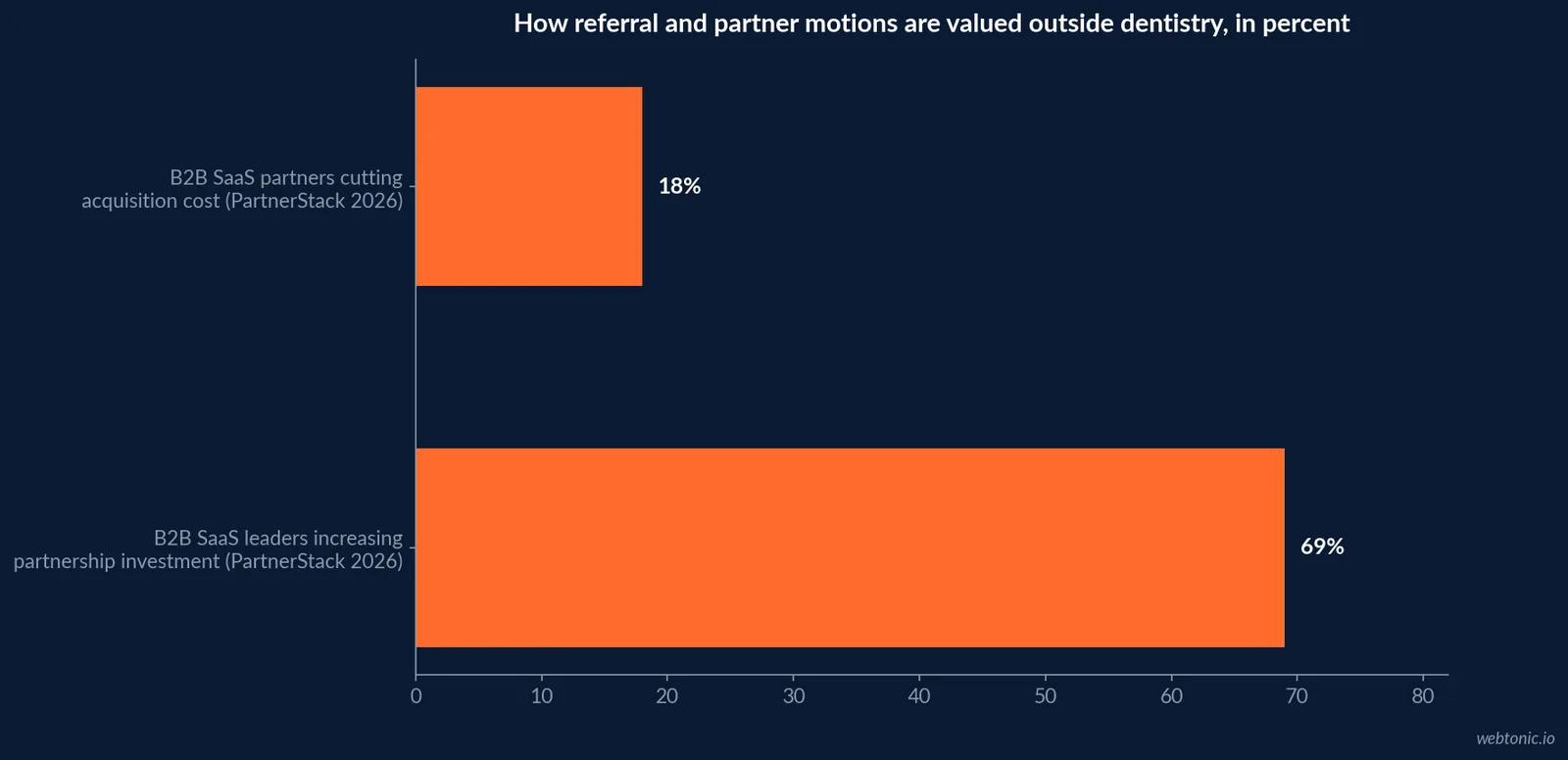
- 69% of B2B companies outside dentistry are increasing partnership investment in 2026.
- Only 18% of those companies credit partners as the primary lead-gen and referral source.
- LegalMatch-style commercial lead marketplaces are a purchase of advertising, not a referral fee.
- There are roughly 178,000 to 202,000 active dental practice locations in the US.
- The US has close to 200,000 practicing dentists (ADA workforce data).
- A 30-day cookie window is the retail-affiliate default applied to one-time product sales.
- HHS OIG safe harbors can protect a referral-service fee that meets strict conditions.
- No dental-specific commission benchmark study exists, so this page builds from live program pages.
- Coupon and discount programs can still trigger AKS scrutiny per ADA's own compliance guidance.
The two channels dentistry actually runs, and why they pay differently
"Affiliate and partnership marketing" for a general business usually means one thing: a publisher earns a commission for sending a buyer. Dentistry runs two separate versions of that idea, and mixing them up is the single most common compliance mistake in this niche.
The first is a consumer product or membership affiliate program - a whitening kit, a discount membership plan, a smile-simulation platform - sold the same way any e-commerce affiliate program is sold, disclosed under the same FTC rule. The second is a patient or professional referral between dental providers, which is where the Anti-Kickback Statute narrows what cash can legally change hands.
What live dental affiliate programs actually pay (2026)
These are current, own-site published rates, not aggregator estimates. Dentulu's patient affiliate program pays 5% to 10% of the resulting sale. SLEEK Dental Club pays a recurring monthly commission for every active subscription an affiliate refers. Avia Dental pays a flat USD 35 per plan purchase, with no signup fee for the affiliate.
| Program | Published 2026 rate | Payout mechanism | What is being sold |
|---|---|---|---|
| Dentulu Patient Affiliates | 5%-10% per sale | One-time, per transaction | Discount dental services membership |
| SLEEK Dental Club | Recurring monthly % | Recurring, per active subscriber | Sonic toothbrush + dental coverage subscription |
| Avia Dental Plan | Flat USD 35 | One-time, per plan purchase | Dental discount plan |
| Dentulu Professional Affiliates | Custom, performance-based | Negotiated per professional referred | Practice sign-ups to Dentulu's platform |
The rate that actually scales: tiered commission
Some programs reward volume the same way any SaaS affiliate program does. Xadia's dental simulation-platform partner program advertises up to 30% commission for 12 months on every referred practice. That is a professional-to-business affiliate deal, not a patient referral, and it is structured, disclosed, and priced exactly like a software affiliate program because it is one.
The honest read: where the transaction is a product or software sale to a consumer or a practice, dentistry's affiliate economics look like any other vertical's. Where the transaction is a patient moving between two clinicians, the economics are legally constrained on purpose.
| Rate tier | Published example | Ceiling | Duration of the elevated rate |
|---|---|---|---|
| Entry tier | Uniqa Dental, starts at 3% | 5% at USD 12,000 in sales | Ongoing, tier-based |
| Volume tier | Uniqa Dental, mid tier | 10% at USD 30,000 in sales | Ongoing, tier-based |
| Software partner tier | Xadia partner program | 30% commission | First 12 months per referral |
| Recurring subscriber tier | SLEEK Dental Club | Undisclosed %, recurring | For the life of the subscription |
Why the patient-referral side of the channel is not priced the same way
The HHS Office of Inspector General has issued advisory opinions specifically on referral-service fee arrangements, and the pattern across them is consistent: a fee tied to referral volume is scrutinized, while a fee protected by the personal-services or referral-service safe harbor at 42 C.F.R. 1001.952(f) can clear. The ADA's own compliance guidance extends the same caution to promotional discount and coupon programs, which can be read as inducement even when no explicit "referral fee" line exists in the contract.
In practice this means the safest partnership structure between two dental providers is a no-cash cross-referral relationship, documented and reciprocal, not a percentage-of-fee arrangement.
In-house vs outsourced: the management question
Outside dentistry, PartnerStack's State of Partnerships in GTM 2026 report found 69% of B2B companies increasing investment in partnerships, yet only 18% credit partners as the primary channel for lead generation and referrals. That gap between rising investment and modest primary-channel credit is the same gap a solo or small-group dental practice faces: running an affiliate network account, chasing FTC-compliant disclosure language, and reconciling monthly payouts is real operating overhead against a channel that is rarely the biggest lead source.
A DSO with dozens of locations can justify an in-house partnerships hire. A single practice almost always gets more for its time from joining an existing marketplace or hiring an agency that already runs compliant affiliate creative and disclosure language across multiple accounts.
| Structure | Who manages disclosure/compliance | Best fit | Real 2026 reference point |
|---|---|---|---|
| In-house affiliate program | The practice or DSO marketing team | Multi-location DSOs with a marketing hire | PartnerStack: 69% raising investment |
| Joined existing marketplace (e.g. Dentulu partner network) | The marketplace operator | Solo and small-group practices | Dentulu professional affiliate terms |
| Agency-managed affiliate program | The agency, under contract | Practices wanting a hands-off channel | Standard affiliate-management retainer |
| No-cash cross-referral network | Both referring parties, documented | Clinician-to-clinician referral | HHS OIG safe harbor, 42 CFR 1001.952(f) |
Disclosure: the rule that applies regardless of structure
Every consumer-facing affiliate link, whether it pays 5% or 35%, is a "material connection" under FTC 16 CFR Part 255. The rule does not care whether the affiliate is a dental hygiene blogger, a patient influencer, or a professional referral platform pushing consumer sign-ups: if money, free product, or another benefit changes hands for the endorsement, it has to be disclosed clearly and conspicuously, next to the claim, not buried in a bio or a footer.
That single rule is also the cheapest compliance win on this list. Unlike the Anti-Kickback Statute's fact-specific safe harbors, 16 CFR 255 compliance is a copy fix: state the connection in plain language, every time.
Attribution and fraud: what applies, what does not
Dentistry has no published, dentistry-specific cookie-window or fraud-rate study. The broader affiliate industry's default for a one-time retail-style purchase (which is what a membership-plan or product affiliate sale is) is a 30-day attribution window, extended for subscription products with a longer consideration cycle. Fraud monitoring on a small dental affiliate program is realistically limited to what the host network already screens for; a solo practice running its own tracking link has neither the volume nor the tooling to build fraud detection that a network like Impact or Awin runs by default for its enterprise merchants.
The practical takeaway: joining an established network gets a small dental brand fraud screening it could not build itself, on top of the commission-tracking infrastructure. Our broader look at affiliate marketing statistics across industries covers the same fraud and attribution question at general-market scale.
| Risk area | Dentistry-specific data | Applicable general standard | Practical action |
|---|---|---|---|
| Attribution window | Not published | 30 days, retail default | Set 30 days unless subscription-length justifies more |
| Fraud/invalid clicks | Not published | Varies by network tier | Use an established network's built-in screening |
| Disclosure | ADA flags coupon/discount risk | FTC 16 CFR 255, all connections | Disclose every paid or free-product link |
| Referral-fee exposure | ADA anti-kickback FAQ | 42 CFR 1001.952(f) safe harbor | Avoid cash tied to referral volume between clinicians |
Sizing the addressable market
The practice count that any affiliate or partnership program is ultimately selling into: the ADA's own workforce report puts the US dentist population near 200,000, spread across roughly 178,000 to 202,000 active practice locations depending on how DSO-affiliated sites are counted. That is a large enough base for product-affiliate programs to run at real scale, and small enough per-location that a single practice's affiliate program will never carry meaningful volume without joining a network.
Our growth marketing practice treats this the same way: channel-fit before channel-scale. A partnership channel that cannot reach enough of a ~200,000-provider market on its own is a channel to join, not to build from zero.
Commercial lead marketplaces as the affiliate-free alternative
Where a practice wants predictable, scalable patient volume without any of the affiliate or referral-fee questions above, commercial lead marketplaces sell placement and delivery as advertising, the same mechanism a paid search campaign uses. 1-800-DENTIST has run a pay-per-call program for dental practices for nearly four decades, and general home-services marketplaces such as Angi Pro operate on the same delivered-lead model, charging per shared or exclusive lead rather than a percentage of the resulting treatment revenue. That structural difference - fee for delivery, not a cut of the outcome - is what keeps a marketplace purchase outside kickback-style scrutiny even when the dollar amounts are larger than any affiliate commission on this page.
The trade-off is cost predictability against margin: a marketplace lead costs a fixed amount whether or not the patient books, while an affiliate commission only pays out on a completed sale.
| Model | Payment trigger | Typical structure | Where it sits legally |
|---|---|---|---|
| Product/membership affiliate (Dentulu, SLEEK, Avia) | Completed consumer sale | 5%-35% commission or flat fee | FTC 16 CFR 255 disclosure |
| Commercial lead marketplace (1-800-DENTIST style) | Lead delivered, regardless of booking | Fixed per-lead or subscription fee | Ordinary advertising purchase |
| Professional cross-referral (no cash) | Never - relationship-based | No payment changes hands | AKS-safe by design |
| Bar-adjacent referral service equivalent (rare in dentistry) | Fee-based remittance | Percentage of resulting revenue | Would require an AKS safe harbor |
What a program actually costs to run in-house
Beyond the commission itself, an in-house affiliate program carries three recurring costs a practice rarely budgets for up front: network or tracking software fees, the staff time to review disclosure language on every new affiliate's page, and monthly reconciliation of who gets paid what. None of these show up in a program's advertised commission rate, which is exactly why PartnerStack's broader 2026 data on partnership investment - 69% of companies increasing spend while only 18% credit partners as the primary lead source - reads as a caution about overhead outpacing return, not an endorsement to build bigger.
A DSO running affiliate programs across dozens of locations can absorb that overhead against a correspondingly larger commission pool. A single practice usually cannot.
What this means for a practice deciding today
Run consumer product or membership affiliate offers like any retail vertical: disclose under 16 CFR 255, price commission against the 5-35% published range, and expect a 30-day attribution default. Keep clinician-to-clinician referral relationships cash-free and documented, because that is what the Anti-Kickback Statute and the ADA's own guidance are steering every dental practice toward. And unless the practice is part of a DSO large enough to justify a dedicated partnerships hire, join an existing marketplace before building an in-house program from scratch, and revisit our wider agency benchmark roundup when weighing whether to run the program in-house at all.
Frequently Asked Questions
Is affiliate marketing even legal for a dental practice?
For products and memberships, yes, provided the affiliate discloses the paid connection under FTC 16 CFR 255. What is restricted is cash-for-patient-referral between the practice and a referring party: the federal Anti-Kickback Statute bars remuneration to induce referrals of services billable to a federal health care program, and the American Dental Association's own guidance treats most paid coupon or referral-fee arrangements as exposed under that statute unless a safe harbor applies.
What commission rates do live dental affiliate programs actually pay?
Published, own-site rates in 2026 run from a flat USD 35 per plan purchase (Avia Dental) to 5-10% per sale on a patient membership affiliate program (Dentulu) to a tiered 3-10% recurring rate that climbs with sales volume (Uniqa Dental). None of these are patient-referral fees between clinicians; they pay for driving a consumer to a retail purchase, which is the legally cleaner side of the channel.
How is this different from a referral-partner or lead-marketplace channel?
A referral-partner deal (a hygienist school, an orthodontist's front desk sending overflow to a general practice) usually pays nothing in cash precisely because cash payment risks the Anti-Kickback Statute. A commercial lead marketplace, by contrast, charges the practice a fee for a lead delivered, which is an ordinary purchase of advertising, not a referral fee, and sits outside the kickback analysis entirely.
Who manages the program: the practice, an affiliate network, or an agency?
PartnerStack's 2026 GTM survey, run outside dentistry but instructive on management cost, found 69% of B2B companies increasing partnership investment and only 18% crediting partners as the primary source of qualified leads and referrals. For a single-location practice, running an affiliate network account in-house rarely pencils out against outsourcing to an agency or joining an existing marketplace.
What attribution window should a dental affiliate program use?
There is no dentistry-specific published standard, but the broader affiliate industry defaults to a 30-day cookie window for retail-style, one-time purchases (the category a dental membership or product affiliate sale falls into), with the option to extend where the sales cycle runs longer, such as an insurance-linked membership plan with a multi-visit decision cycle.
Sources
Dentulu - Patient affiliate program terms
SLEEK Dental Club - Affiliate program
Avia Dental - Affiliate program
American Dental Association - Anti-Kickback Statute FAQ
HHS OIG - Advisory Opinion 26-18
eCFR - 16 CFR Part 255, Endorsement Guides
PartnerStack and Wynter - The State of Partnerships in GTM 2026
American Dental Association - US Dentist Workforce, 2025 update