Table of contents

No benchmark study reports a Meta Ads cost per lead specific to criminal DUI defense firms. The closest verified figure is WordStream's 2025 Facebook Ads Benchmarks for the broader Attorneys and Legal Services category, which this page pairs with NHTSA and MADD data on when impaired-driving incidents actually happen, so the spend decisions below rest on published numbers rather than a DUI-specific number that does not exist yet.
Key Takeaways
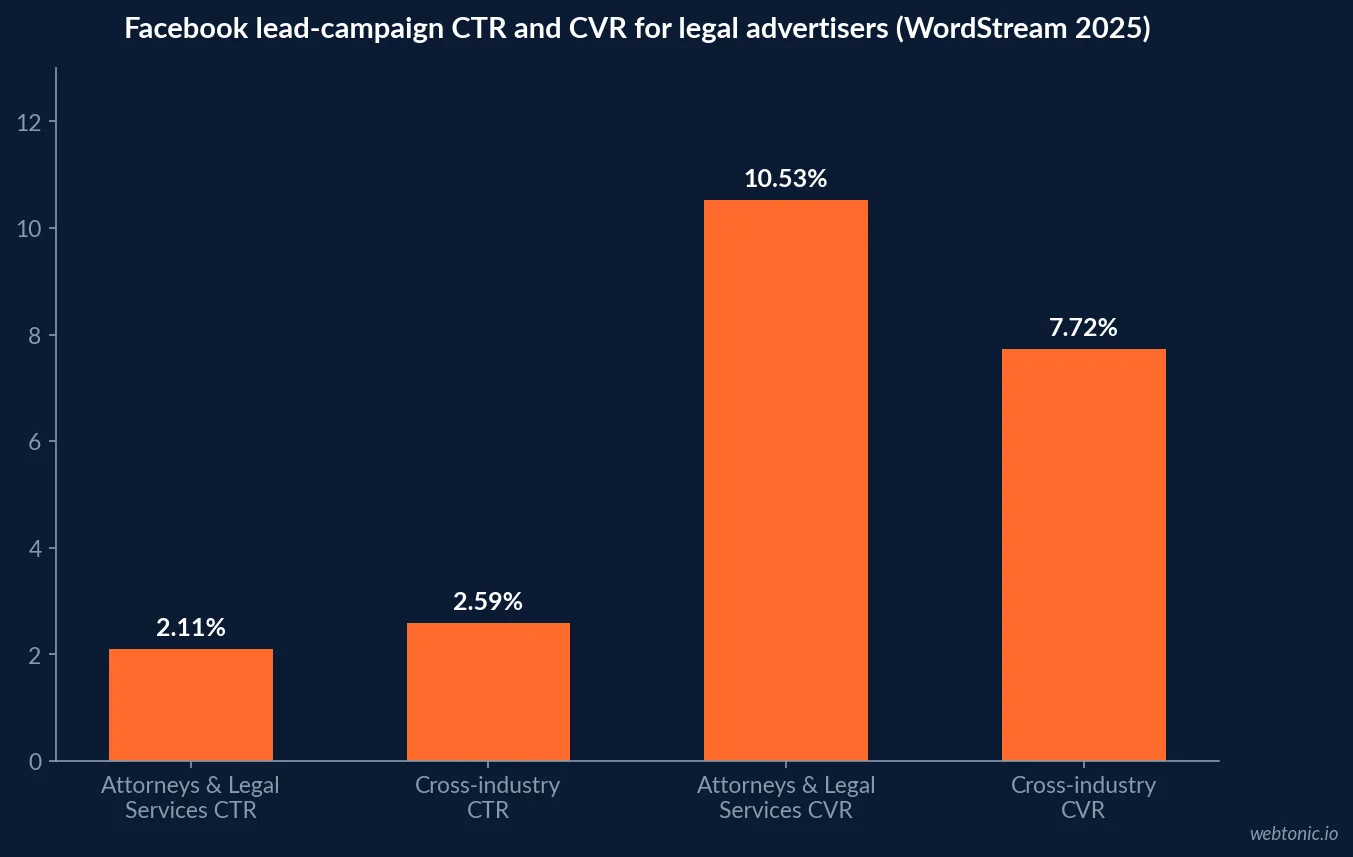
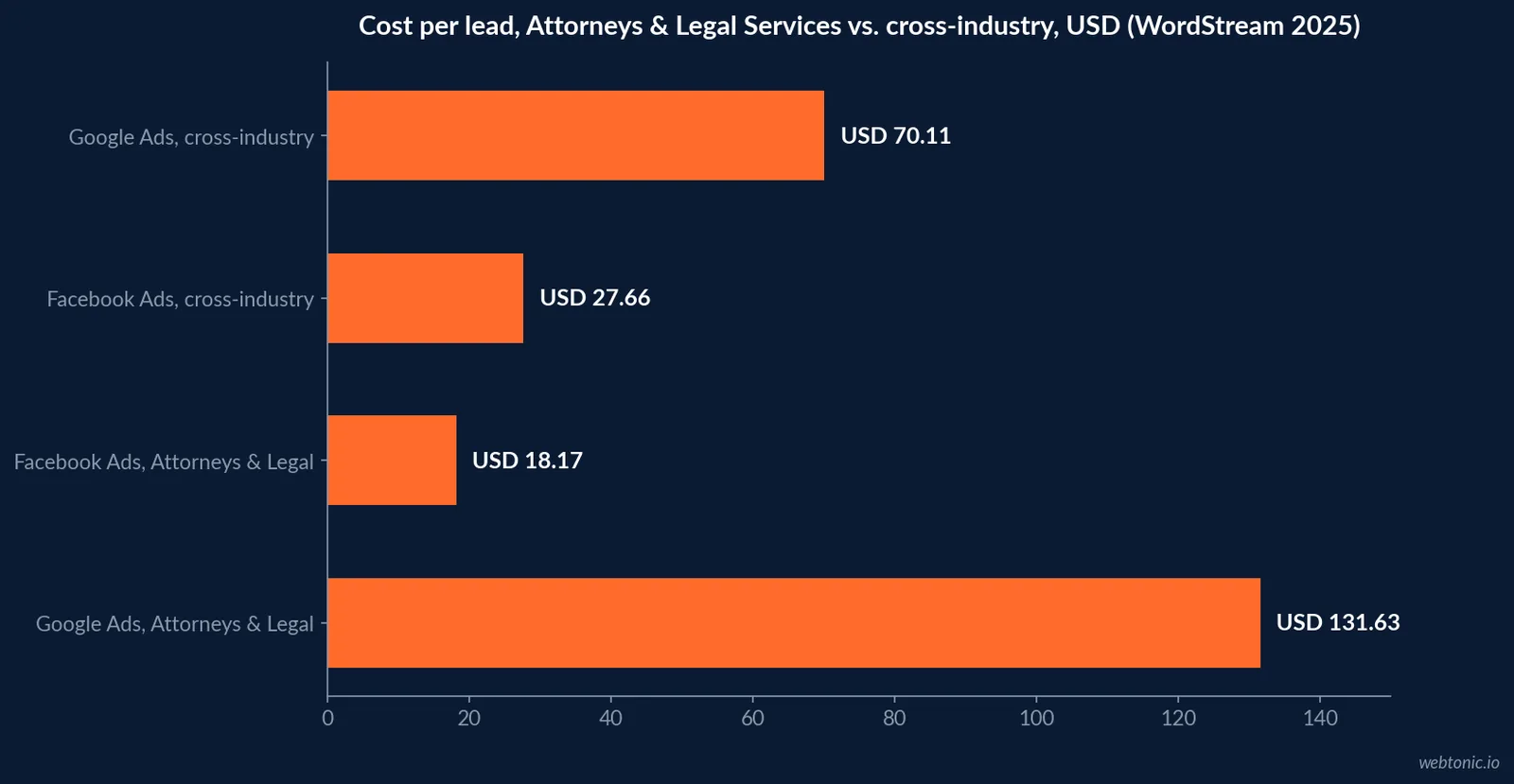
- Facebook lead-campaign cost per lead for legal advertisers is $18.17 in 2025.
- That is down 77% year over year, the steepest drop WordStream tracked.
- Cross-industry Facebook lead cost is $27.66 by comparison.
- Google Ads cost per lead for the same category is $131.63.
- Legal cost per click on Google is $8.58, the highest of any industry tracked.
- Facebook lead-campaign CTR for legal advertisers is 2.11%.
- Facebook lead-campaign CVR for legal advertisers is 10.53%, up 31% year over year.
- Legal Facebook traffic-campaign CTR rose 80% year over year to 1.76%.
- 36% of alcohol-impaired fatal crashes happen at night versus 26% by day.
- 29% of alcohol-impaired fatal crashes cluster on weekends.
- Impaired-driving incidents spike as much as 40% over Labor Day weekend.
- 12,429 people died in alcohol-impaired crashes in 2023, one every 42 minutes.
- Only 40% of law firms answer a test phone call, Clio's secret shopper found.
- Just 33% respond to a test email in that same test.
- 80% of law firms keep some social media presence, ABA's 2025 survey found.
- 78% of those firms are on LinkedIn, 53% on Facebook.
- 59% of solo and small firms name referrals their top lead source, not paid social.
- ABA Rule 7.1 bars unsubstantiated result claims in any ad, on any platform.
Why "DUI Meta Ads" has no benchmark of its own
Meta's ad platform, and the third-party firms that benchmark it, report performance by broad business category, not by legal sub-practice. WordStream's 2025 Facebook Ads Benchmarks, published by LocaliQ in September 2025 from a sample of thousands of active US campaigns, groups every attorney together under "Attorneys and Legal Services." A criminal DUI defense firm's ad account sits in the same bucket as a personal injury or estate-planning practice.
That means every figure on this page is a category-level number, applied honestly rather than dressed up as DUI-specific. Where the category number and the DUI reality diverge - mainly on timing, covered below - this page says so plainly.
| Metric, lead campaigns (2025) | Attorneys & Legal Services | Cross-industry average | Source |
|---|---|---|---|
| Click-through rate | 2.11% | 2.59% | WordStream 2025 |
| Cost per click | $4.10 | $1.92 | WordStream 2025 |
| Conversion rate | 10.53% | 7.72% | WordStream 2025 |
| Cost per lead | $18.17 | $27.66 | WordStream 2025 |
Meta is the cheaper channel for this category, on paper
The gap between Meta and Google for legal advertisers is unusually wide. WordStream's 2025 Google Ads Benchmarks puts Attorneys and Legal Services at a $8.58 cost per click - the single highest of any industry in the report - and a $131.63 cost per lead, more than seven times the Facebook figure for the same broad category. Optmyzr's Navah Hopkins, quoted in that same report, called out attorney and legal services specifically as the industry where "even when clicks are reasonably priced, competition for meaningful conversions can drive lead costs significantly higher."
The honest caveat: Google Ads intent (someone actively searching "DUI lawyer near me") and Meta intent (someone scrolling a feed) are not interchangeable. A DUI arrest creates urgent, high-intent search behavior that search ads are built to catch; Meta's cheaper cost per lead reflects a colder, earlier-stage audience, which is why most firms that run both channels use them for different jobs rather than picking one.
| Channel, Attorneys & Legal Services (2025) | CTR | Cost per click | Cost per lead |
|---|---|---|---|
| Facebook Ads, lead campaigns | 2.11% | $4.10 | $18.17 |
| Facebook Ads, traffic campaigns | 1.76% | $0.86 | not applicable |
| Google Ads, search | 5.97% | $8.58 | $131.63 |
| Google Ads, cross-industry average | 6.66% | $5.26 | $70.11 |
What actually drives the search: the arrest, not the ad
A DUI defense inquiry is triggered by an arrest, and arrests cluster in predictable windows. NHTSA's 2023 Alcohol-Impaired Driving data shows alcohol-impaired fatal crashes run 36% at night against 26% during the day, and 29% cluster on weekends against the weekday rate. MADD's 2025 Labor Day release, citing NHTSA, put the spike in impaired-driving incidents at up to 40% over that one holiday weekend alone.
MADD's own tracker reports 11,904 drunk-driving deaths in 2024, or one every 44 minutes; NHTSA's separate 2023 count was 12,429 fatalities, or one every 42 minutes that year. Both point the same way: the underlying event that creates DUI search demand is not evenly spread across the calendar, and a Meta ad account that spends at a flat daily rate is missing the nights and weekends when the people it needs to reach are actually being booked.
| Timing signal (NHTSA 2023 / MADD) | Share or figure | Marketing implication |
|---|---|---|
| Alcohol-impaired fatal crashes, nighttime | 36% | Weight evening dayparting higher |
| Alcohol-impaired fatal crashes, daytime | 26% | Baseline, not a priority window |
| Alcohol-impaired fatal crashes, weekend | 29% | Add weekend budget, not just weekday |
| Labor Day weekend impaired-driving spike | up to 40% | Pre-fund a holiday-weekend flight |
| 2023 alcohol-impaired fatalities | 12,429 | One every 42 minutes, per NHTSA |
The compliance ceiling Meta ads can't shop around
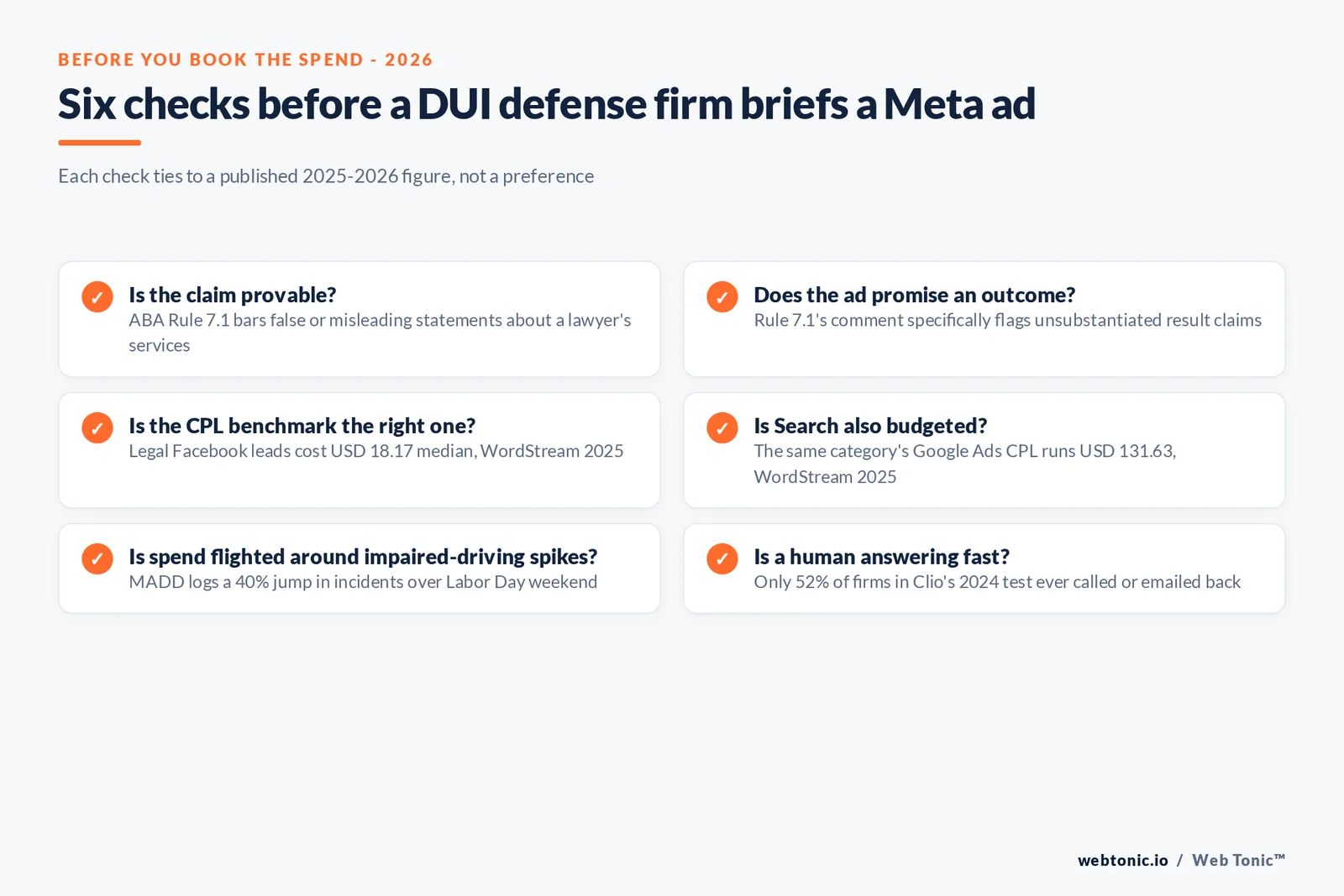
Whatever the platform, the claim inside the ad answers to the bar, not to Meta's own ad review. ABA Model Rule 7.1 requires that every communication about a lawyer's services be truthful and not misleading, and its comment specifically flags claims about results a lawyer cannot substantiate. Rule 7.3 adds limits on direct solicitation of people the lawyer knows are in need of legal services in a particular matter - relevant for any Meta custom-audience strategy built around court-record or booking data.
Meta's own ad review checks for policy violations, not state bar rules, so passing Meta's approval is not the same as being compliant. The firm, not the platform, carries that risk.
Who is actually running these ads, and what beats them
ABA's 2025 legal technology survey found 80% of law firms maintain some social media presence, led by LinkedIn at 78% and Facebook at 53%; only 22% run Instagram and 18% run X. Yet Clio's 2025 Legal Trends Report found 59% of solo and small firms still name referrals, not any paid channel, as their single biggest source of new leads.
The two facts sit together comfortably: most firms have a Meta presence, but referrals still out-produce it, which is why the honest use of the cost-per-lead numbers above is to size a paid channel that supplements intake, not one that is expected to replace it.
| Channel presence, law firms (ABA 2025) | Share of firms | Note |
|---|---|---|
| Any social media presence | 80% | ABA 2025 survey |
| 78% | Most common platform | |
| 53% | Where most Meta ad spend runs | |
| 22% | Growing but still a minority | |
| X (formerly Twitter) | 18% | Falling among large firms since 2023 |
How to size a first Meta budget for this practice area
Start from the category benchmark, not a guess: a $18.17 median cost per lead against a $27.66 cross-industry median gives a range to test against, with the caveat that a specific market's competitive intensity for DUI defense keywords and audiences can push either number higher. Pair the spend with the timing data above rather than an even daily pace, and route every lead into answered calls and same-day follow-up - the Clio secret-shopper number below is the real ceiling on how much a lower cost per lead can help.
If Meta's cheaper lead cost is funding volume that a front desk can't return, that gap is worth fixing before the ad spend increases. Our performance creative team builds and tests legal-vertical Meta creative against these exact benchmarks, and our breakdown of when Facebook ads are worth the investment covers the ROI math in more depth.
| Intake reality check (Clio 2024 secret shopper) | Result | What it means for Meta spend |
|---|---|---|
| Firms that answered a test phone call | 40% | 6 in 10 leads may hit voicemail |
| Firms that responded to a test email | 33% | Email follow-up is not a safe default |
| Firms that responded by either channel | 52% | Just under half go fully unanswered |
| Consumers expecting a same-day reply | 79% | Clio's client-expectation research |
What to test next
Run lead-form ads against a landing page, not just an in-platform form, so response-time tracking is possible end to end. Test dayparting weighted toward nights and weekends against a flat schedule, and measure cost per answered call, not just cost per lead, since the Clio numbers above make clear those are two different metrics. Compare the resulting number against the same firm's Google Ads cost per lead before deciding how the budget should split between the two channels, and review a channel plan with our team if the split is unclear.
Frequently Asked Questions
How much does a Facebook lead cost for a DUI defense firm?
No study splits DUI defense out from the rest of the legal category, so the honest number is the Attorneys and Legal Services average: WordStream's 2025 Facebook Ads Benchmarks put the median cost per lead for that category at $18.17 on lead-objective campaigns, against a $27.66 cross-industry median. That figure fell 77% year over year, the steepest drop of any industry WordStream tracked.
Is Meta cheaper than Google Ads for this kind of legal work?
On cost per lead, yes, by a wide margin. WordStream's 2025 data puts the same Attorneys and Legal Services category at $131.63 per lead on Google Ads search campaigns, more than seven times the Facebook figure. Google's click-through rate for the category is also lower at 5.97% against Meta's 2.11% on lead campaigns, though the two channels are not capturing the same intent.
What can a Meta ad for a DUI defense firm actually claim?
Only what can be proven. ABA Model Rule 7.1 bars false or misleading statements about a lawyer's services, and its official comment specifically calls out unsubstantiated claims about results. A headline like 'we win every DUI case' or 'guaranteed dismissal' is the kind of claim state bars flag first, regardless of the platform it runs on.
When should DUI defense ad spend actually run?
Around when arrests happen, not around a flat weekly budget. NHTSA's 2023 data shows 36% of alcohol-impaired fatal crashes occurred at night against 26% by day, and MADD has logged impaired-driving incidents spiking as much as 40% over the Labor Day weekend. A firm that flights extra budget into weekend and holiday nights is matching spend to when the search demand is created.
Does a bigger ad budget matter if no one answers the phone?
Not much. Clio's 2024 Legal Trends Report ran a secret-shopper test on law firms and found only 40% answered a test call and 33% responded to a test email, for a combined 52% response rate. Every dollar spent on Meta traffic that reaches an unanswered line or inbox is a wasted cost per lead, no matter how low that cost per lead looks in a benchmarks report.
Sources
WordStream - Facebook Ads Benchmarks 2025
WordStream - Google Ads Benchmarks 2025
NHTSA - Traffic Safety Facts, 2023 Data: Alcohol-Impaired Driving
MADD - Drunk Driving Statistics
MADD - Labor Day impaired-driving spike, 2025
American Bar Association - Model Rule 7.1, Comment
American Bar Association - Model Rule 7.3
American Bar Association - 2025 legal technology survey
Clio - 2025 Legal Trends for Solo and Small Law Firms