Table of contents
Meta's own 2026 benchmark report has no lead-conversion figure for attorneys at all - the category is CTR-only. So the honest answer to "what DUI ad creative converts best" has to come from where legal ads are actually measured to conversion: Google Ads, plus the trust-signal research on how legal consumers decide.
Key Takeaways
- Attorneys & Legal Services appear in Meta's 2026 traffic-objective tables only.
- The category is excluded from Meta's 14-industry leads-objective tables entirely.
- Legal's Meta traffic click-through rate is 1.77% in 2026.
- Legal's Meta traffic cost per click is USD 0.69 in 2026.
- On Google Ads, legal's click-through rate is 5.87%, below the 6.64% cross-industry average.
- Legal's Google Ads cost per click is USD 9.87, the highest of any tracked category.
- That is nearly double the USD 5.42 all-industry average cost per click.
- Legal's Google Ads conversion rate is 5.55%, versus an 8.18% average.
- Legal's cost per lead is USD 131.63, versus a USD 66.69 average.
- Nearly 70% of legal consumers call reviews the most helpful decision factor.
- Pricing and fees follow at 61.6%, responsiveness at 58%.
- Overall reputation is cited by 53% of legal consumers.
- 92.4% of legal consumers research before contacting an attorney at all.
- Law firms plan the biggest 2026 creative investment in video, at 50% of firms.
- Short-form video is the top format at 62% among firms adding new formats.
- Lawyers now face a 30-day window to complete Google's LSA identity verification.
Meta has no lead-conversion number for legal, full stop
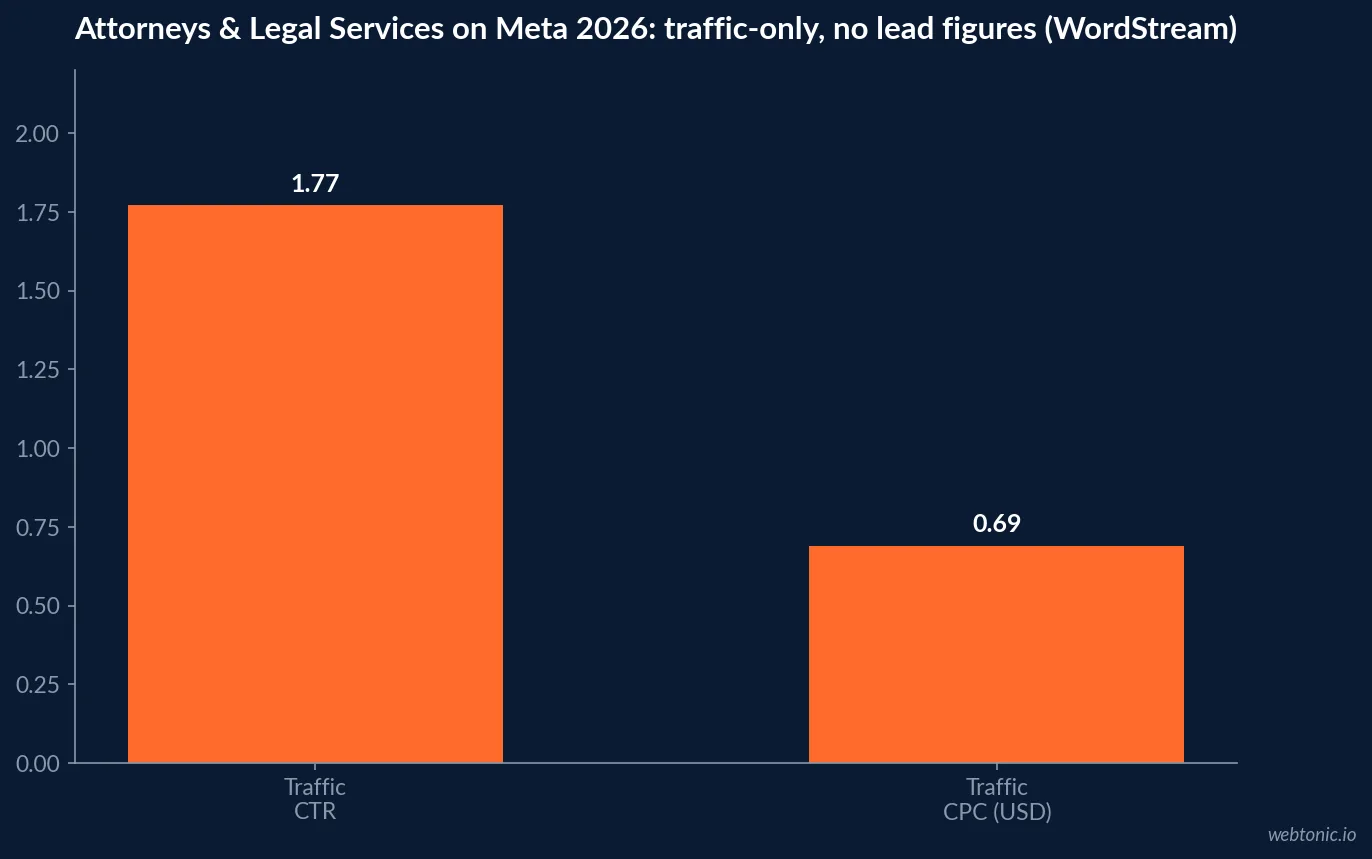
WordStream by LocaliQ's 2026 Facebook Ads Benchmarks report, built from almost 1,800 US campaigns, tracks four metrics - click-through rate, cost per click, conversion rate, and cost per lead - split across a traffic-objective table (22 industries) and a leads-objective table (14 industries). Attorneys & Legal Services appears only in the traffic table, alongside Business Services, Animals & Pets, Apparel, Restaurants & Food, Shopping, and Travel - categories the report states didn't meet its minimum sample size for the leads-objective breakout.
That is the single most important fact for anyone buying DUI ad creative on Meta: there is no published, sourced Meta lead-conversion or cost-per-lead benchmark for legal to test creative against. Any number claiming otherwise is not from this report and needs its own citation before you trust it.
| Metric (Meta 2026) | Attorneys & Legal Services | Where it sits in the report |
|---|---|---|
| Traffic click-through rate | 1.77% | Published, traffic-objective table |
| Traffic cost per click | USD 0.69 | Published, traffic-objective table |
| Leads conversion rate | Not published | Category excluded from the 14-industry leads table |
| Cost per lead | Not published | Category excluded from the 14-industry leads table |
Where legal ad creative IS measured to conversion: Google Ads
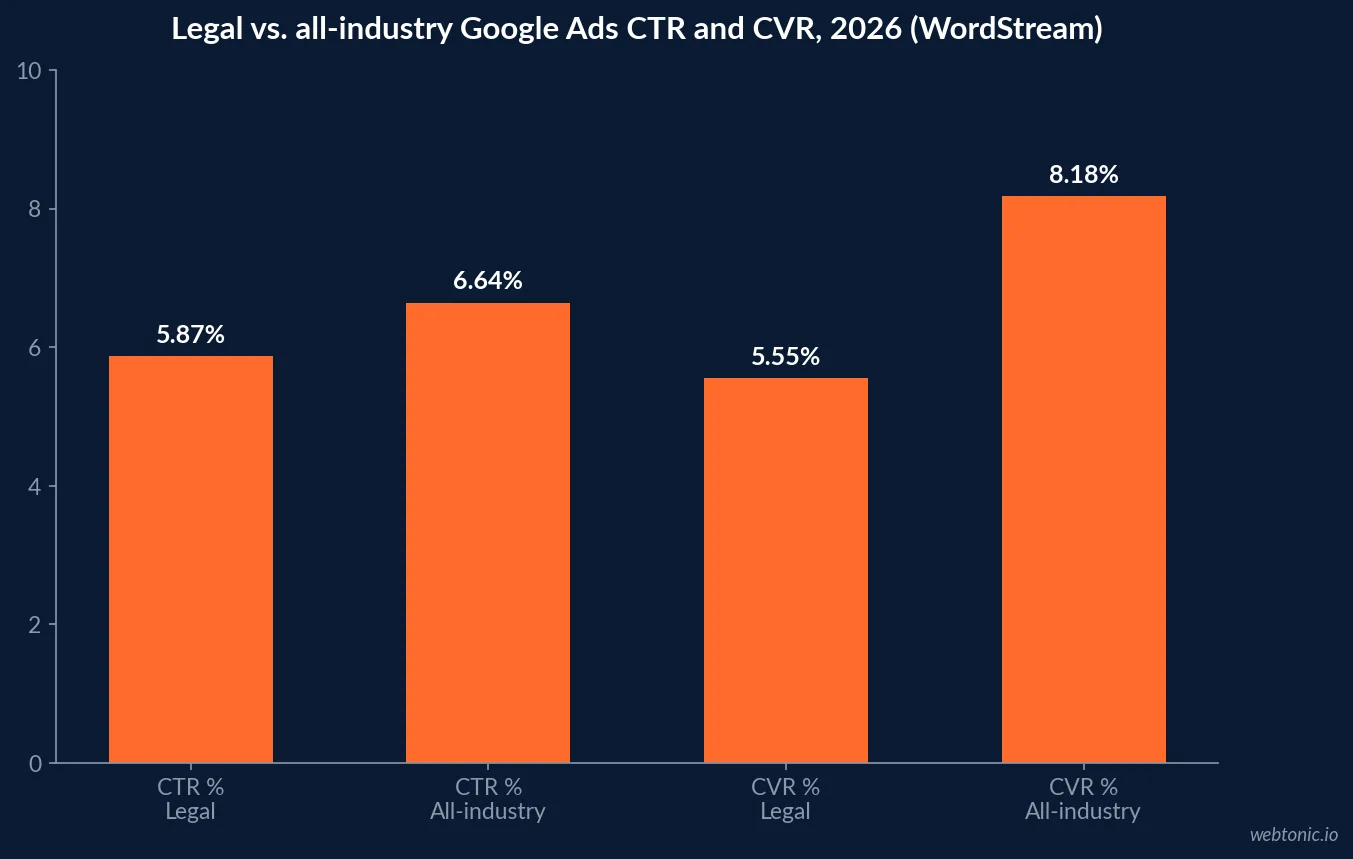
The same publisher's 2026 Google Ads Benchmarks report does track Attorneys & Legal Services to conversion, and the picture is a harder one than most creative teams assume. Legal's click-through rate, 5.87%, sits below the 6.64% all-industry average - meaning legal ad creative is being clicked on at a below-average rate despite carrying the highest cost per click of any tracked category, at USD 9.87, nearly double the USD 5.42 all-industry average. Conversion rate lands at 5.55% against an 8.18% average, and cost per lead reaches USD 131.63 against a USD 66.69 average.
| Metric (Google Ads 2026) | Attorneys & Legal Services | All-industry average | Gap |
|---|---|---|---|
| Click-through rate | 5.87% | 6.64% | -0.77 pts |
| Cost per click | USD 9.87 | USD 5.42 | +82% |
| Conversion rate | 5.55% | 8.18% | -2.63 pts |
| Cost per lead | USD 131.63 | USD 66.69 | +97% |
What actually decides the click, per the legal-consumer research
Since no study isolates DUI-specific creative performance, the next-best evidence is what legal consumers themselves say moves them. Martindale-Avvo's State of the Legal Consumer 2026 report, drawing on its 2024 consumer survey, found reviews cited by nearly 70% of respondents as the most helpful factor in choosing an attorney, ahead of pricing and fees (61.6%), responsiveness (58%), and overall reputation (53%). Separately, 92.4% of legal consumers say they research an issue before contacting an attorney at all - the ad's job is to survive that research phase, not just earn the first click.
| Decision factor | Share citing it | Source |
|---|---|---|
| Client reviews | ~70% | Martindale-Avvo 2024 legal consumer survey |
| Pricing and fees | 61.6% | Martindale-Avvo 2024 legal consumer survey |
| Responsiveness | 58% | Martindale-Avvo 2024 legal consumer survey |
| Overall reputation | 53% | Martindale-Avvo 2024 legal consumer survey |
| Research before contacting an attorney | 92.4% | Martindale-Avvo 2024 legal consumer survey |
The format law firms are actually shifting toward
The 2026 CallRail Legal Marketing Outlook Report, surveying 100 US law firms, found video is the second-largest planned 2026 budget increase at 50% of firms, behind email. Among firms adding new formats this year, short-form video leads at 62%, ahead of automation (50%) and personalization (47%). That is a cross-industry legal-marketing signal, not a DUI-specific creative test, but it lines up with the response-time and trust-signal data above: short, fast, credibility-forward creative matches what the underlying consumer research says people are actually screening for.
| Creative/channel signal | Figure | Source |
|---|---|---|
| Firms increasing video budget in 2026 | 50% | CallRail 2026 Legal Marketing Outlook |
| Short-form video adoption among new formats | 62% | CallRail 2026 Legal Marketing Outlook |
| Automation adoption among new formats | 50% | CallRail 2026 Legal Marketing Outlook |
| Personalization adoption among new formats | 47% | CallRail 2026 Legal Marketing Outlook |
Building the creative brief from evidence, not habit
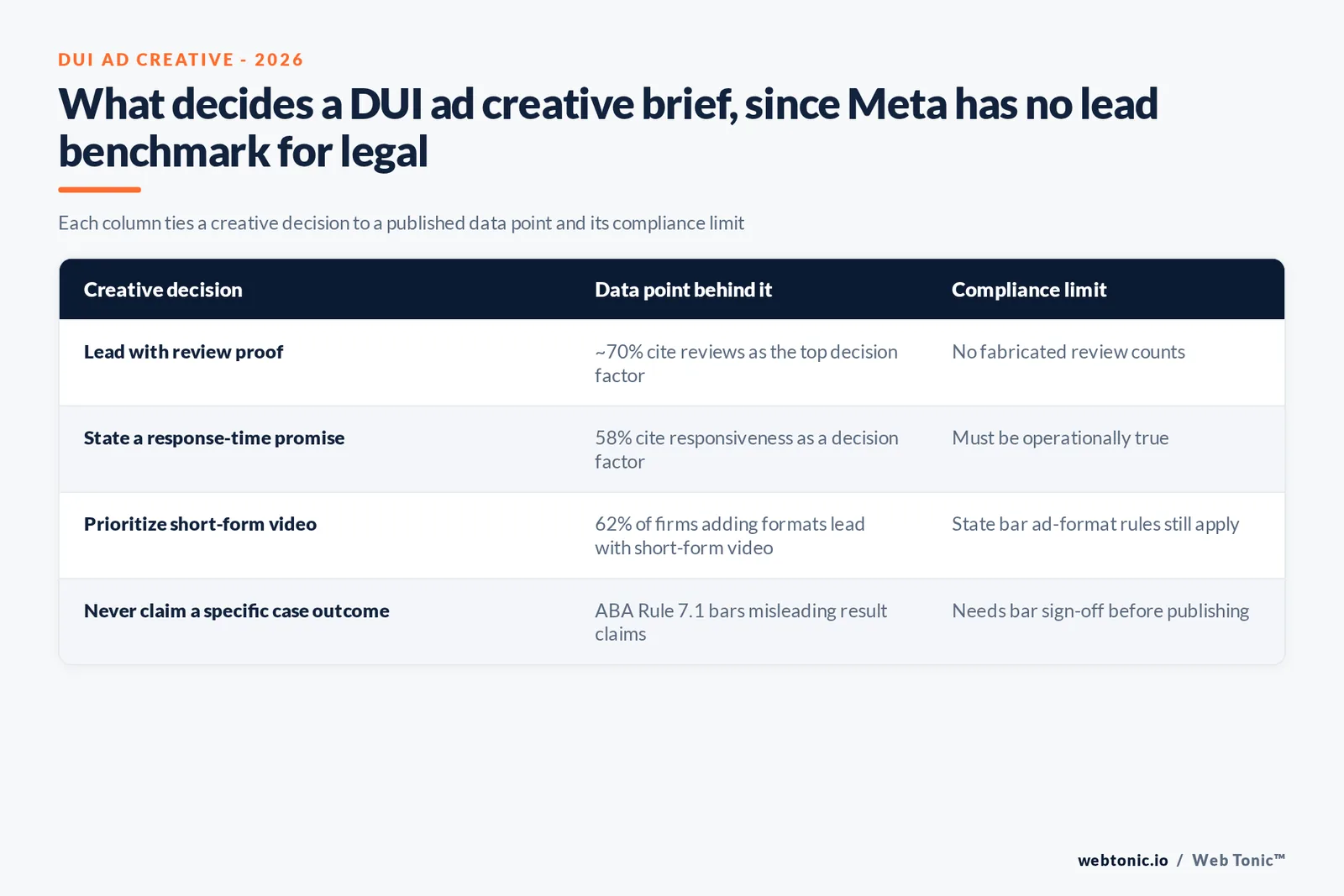
A defensible DUI ad-creative brief pulls from three places at once: the Google Ads cost structure above (creative has to work harder than average per click, since clicks cost more and convert less), the trust-signal research (lead with review proof and a stated response-time promise, since those are the two most-cited decision factors after reviews), and the format data (short-form video first, since that is where the category is actually moving budget). None of that requires - or should use - a DUI-specific outcome claim.
Because Meta's own report leaves legal without a lead-conversion benchmark, the safest testing approach is to treat Meta as a top-of-funnel channel that feeds a search or landing-page conversion point you CAN measure, rather than optimizing Meta creative toward a cost-per-lead target that no published source has actually validated for this category. That distinction alone changes how a media buyer should structure a DUI campaign's budget split between platforms.
What a first DUI ad creative test should actually include
Given the data above, a first test slate reasonably includes: one short-form video creative leading with a review count or star rating, one static or carousel creative leading with a stated response-time promise ("we answer 24/7" or similar, if operationally true), and one creative variant naming the specific jurisdiction or court the firm practices in, since local specificity is a documented trust signal in legal-consumer research even where it hasn't been isolated for ad creative specifically. Test against click-through rate and, wherever the account allows it, phone-call or form-fill conversions tracked through the firm's own CRM - not a platform-reported "lead" that, per the data above, isn't even benchmarked for this category on Meta.
The compliance line every DUI ad has to hold
ABA Model Rule 7.1 requires that lawyer communications, including ads, not be false or misleading - which the rule's own comment extends to a technically accurate statement presented in a way that creates unjustified expectations about a result. Rule 7.2 governs the specific mechanics of paid advertising, and Rule 7.3 covers direct solicitation. States layer their own restrictions on top, particularly around testimonials and stated case outcomes, so a DUI ad claiming a specific result needs sign-off from whoever handles bar compliance before it runs, not after.
On the platform side, Google requires lawyers running Local Services Ads to complete license and identity verification, and tightened that process through its partner Evident in 2024, giving affected lawyers a 30-day window to comply or lose LSA eligibility - a separate track from standard Search and Display verification.
Want the creative brief built against your own account's cost-per-lead, not the category average? Talk to us, or see how we scope paid creative work in our performance creative practice. We also cover the channel-cost side of this in our guide to whether Facebook ads are worth it for a service business weighing Meta against search.
Frequently Asked Questions
Is there a published conversion rate for DUI ads on Facebook?
Not from the primary source. WordStream by LocaliQ's 2026 Facebook Ads Benchmarks report tracks Attorneys and Legal Services only in its traffic-objective tables (CTR 1.77%, CPC USD 0.69) and explicitly excludes the category from its 14-industry leads-objective tables, alongside Business Services and a handful of others. Any 'legal conversion rate on Facebook' figure you see quoted elsewhere is not sourced to that report and should be treated as unverified.
What does convert, then, on paid search for DUI ads?
The category-wide benchmark, not a DUI-specific one. WordStream's 2026 Google Ads Benchmarks put Attorneys and Legal Services at a 5.55% conversion rate and USD 131.63 cost per lead, both against an all-industry average of 8.18% and USD 66.69. That means legal ad creative on search is being measured against a harder-to-convert, more expensive category than most, which raises the bar for what the ad itself has to do before the click even happens.
What should the creative say, since we don't have a DUI-specific benchmark?
Address the two things the legal-consumer research says decide a hire, since no ad-creative study isolates DUI specifically. Martindale-Avvo, Avvo and FindLaw's 2026 State of the Legal Consumer report found reviews are the single most-cited factor in choosing an attorney, at nearly 70% in their 2024 survey, ahead of pricing and fees (61.6%) and responsiveness (58%). Creative that leads with a credible review count or a specific response-time promise is answering a documented decision factor, not a guess.
Can a DUI ad legally show past case results or testimonials?
Only within what the ABA Model Rules and each state bar allow, and states differ meaningfully here. ABA Model Rule 7.1 bars any communication that is false or misleading, including an accurate statement presented in a way that creates unjustified expectations. Some states additionally restrict or require disclaimers on testimonials and past-result claims. Never publish a DUI-specific outcome claim in ad creative without state-bar sign-off, and never imply a guaranteed result.
Does Google require lawyers to get verified before running ads?
Yes, for Local Services Ads specifically. Google's Local Services and Advanced Verification policies require license checks, and Google tightened lawyer identity verification through its partner Evident in 2024, giving lawyers a 30-day window to complete it or lose LSA eligibility. That verification layer sits outside standard Search and Display campaigns, so a DUI-defense firm running both LSA and search ads is managing two separate compliance tracks, not one.
Sources
WordStream by LocaliQ - Facebook Ads Benchmarks 2026
WordStream by LocaliQ - Google Ads Benchmarks 2026
Martindale-Avvo, Avvo & FindLaw - The State of the Legal Consumer 2026
CallRail - 2026 Legal Marketing Outlook Report
American Bar Association - Model Rules of Professional Conduct 7.1-7.5
Google - How providers qualify for Local Services Ads
Search Engine Land - Google tightens lawyer LSA verification