



Table of contents
Shopify now powers 5.6 million active merchants worldwide, and countertop retailers are increasingly turning to the platform to sell surfaces, samples, and accessories online. Here are the Shopify and e-commerce statistics that matter for countertop businesses in 2026.
Key Takeaways
- 5.6 million active merchants operate on Shopify worldwide in 2026 (KaspianFuad).
- Shopify merchants cleared $100 billion in Q1 2026 GMV with 34% year-over-year revenue growth (Shopify).
- Online countertop sales reached 22% of total market revenue in 2023, up from 12% in 2020 (Zipdo).
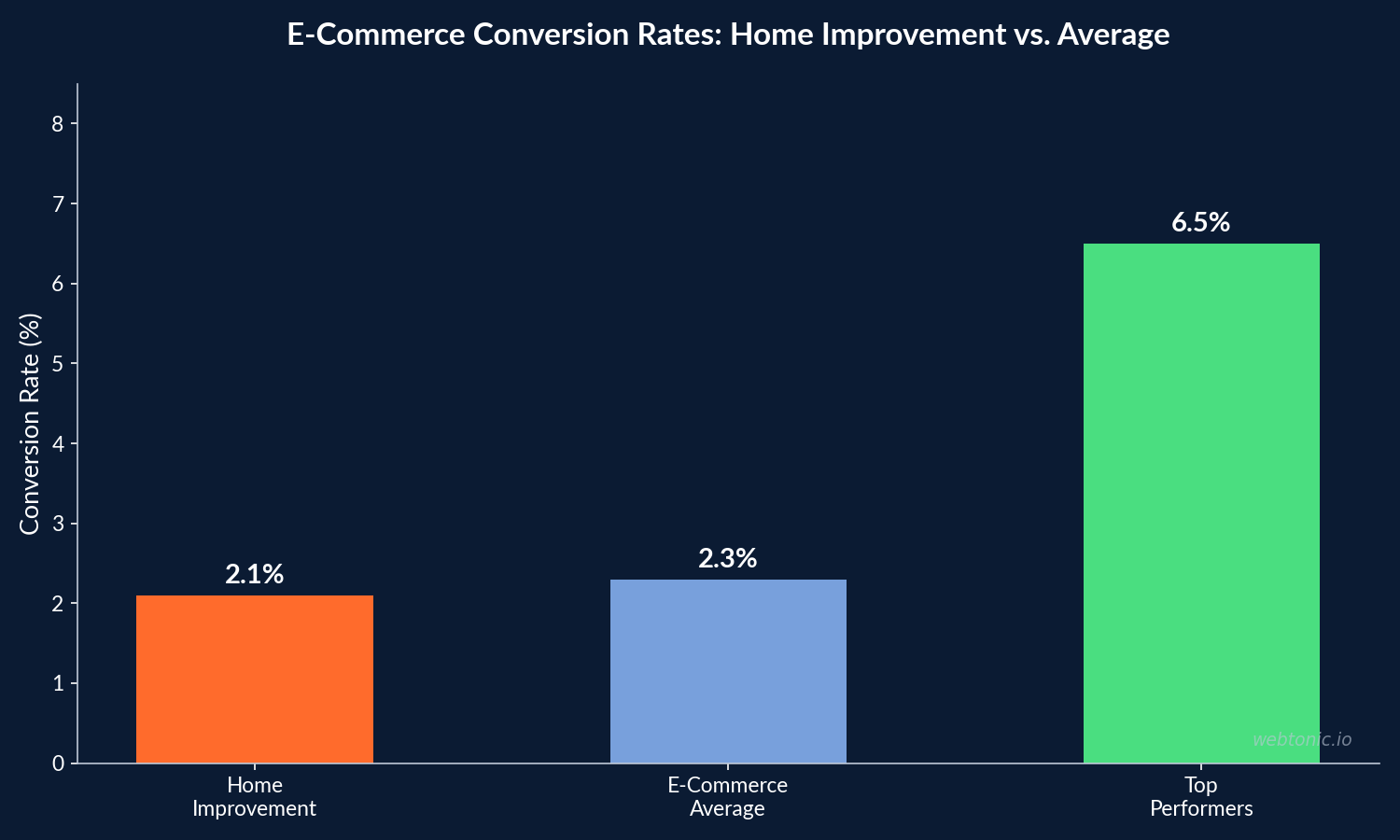
- Home improvement e-commerce conversion rate averages 2.1%, slightly below the 2.3% e-commerce average (WisePIM).
- Average order value in home improvement is $135, compared to the $143 e-commerce average (WisePIM).
- 45% of Shopify stores pass all Core Web Vitals, above the web-wide average of ~40% (Thunder).
- Shopify is the fastest major e-commerce platform with an average load time of 1.2 seconds (Thunder).
- Shopify achieved 15% free cash flow margins in Q1 2026 (Shopify).
Shopify E-Commerce Benchmarks for Countertops
| Metric | Home Improvement | E-Commerce Avg. |
|---|---|---|
| Conversion rate | 2.1% | 2.3% |
| Average order value | $135 | $143 |
| Cart abandonment rate | 72% | 70% |
| Mobile traffic share | 68% | 73% |
| Desktop conversion premium | +45% vs. mobile | +35% vs. mobile |
| Online sales share (countertops) | 22% (2023) | Varies by category |
Shopify Platform Growth and Market Position
Shopify's Q1 2026 financial results demonstrate the platform's accelerating growth trajectory, which is attracting more home improvement retailers including countertop businesses. Key platform metrics include:
- $100+ billion in Gross Merchandise Volume (GMV) processed in Q1 2026 alone.
- 34% year-over-year revenue growth, maintaining its position as the fastest-growing major e-commerce platform.
- 15% free cash flow margins, signaling long-term platform stability and ongoing investment in merchant tools.
- 5.6 million active merchants globally, up from 4.8 million in early 2025 (KaspianFuad).
For countertop businesses evaluating e-commerce platforms, Shopify's scale means a mature ecosystem of marketing integrations, payment processors, and fulfillment tools that reduce the technical barriers to selling surfaces online.
Countertop E-Commerce Market Trends

The countertop industry's shift toward online sales has been dramatic. Zipdo's Countertops Industry Statistics report documents that online sales climbed to 22% of countertop market revenue in 2023, nearly doubling from 12% in 2020. This growth is driven by several converging trends:
- Sample-first purchasing: countertop retailers sell material samples online (quartz, granite, marble swatches) to homeowners who then book in-home measurements for full slab orders.
- Accessory and care product sales: sealers, cleaners, edge profile kits, and undermount sink accessories lend themselves to standard e-commerce fulfillment.
- Remnant and discount slab marketplaces: smaller fabricators use Shopify to sell off-cuts and remnant pieces at reduced prices, reaching budget-conscious renovators.
- B2B ordering portals: wholesalers and distributors increasingly use Shopify Plus for builder and contractor bulk ordering with custom pricing tiers.
The WisePIM Home Improvement E-Commerce Benchmarks report highlights an important conversion pattern: while 68% of home improvement traffic comes from mobile devices, desktop visitors convert at a 45% higher rate. This suggests that countertop shoppers browse on mobile but complete purchases—especially high-value orders—on desktop where product details and comparison are easier.
Core Web Vitals and Shopify Performance
| Performance Metric | Shopify | Industry Comparison |
|---|---|---|
| Average load time | 1.2 seconds | WooCommerce: 2.2s, Magento: 2.9s |
| Core Web Vitals pass rate | 45% | Web-wide avg: ~40% |
| Speed advantage | 1.8–2.4× faster | vs. WooCommerce, Magento, BigCommerce |
| LCP (Largest Contentful Paint) | Best-in-class | Critical for image-heavy countertop stores |
| CLS (Cumulative Layout Shift) | Strong | Important for product gallery stability |
Thunder's State of Shopify Speed 2026 report confirms that Shopify is the fastest major e-commerce platform with an average load time of 1.2 seconds—1.8 to 2.4× faster than WooCommerce, Magento, and BigCommerce. For countertop stores that rely on high-resolution product imagery—slab photos, edge profile close-ups, installed kitchen galleries—this speed advantage directly impacts both search rankings and user experience.
However, 55% of Shopify stores still fail at least one Core Web Vital. For countertop businesses, the most common culprits are uncompressed slab images exceeding 2MB, third-party apps adding render-blocking scripts, and unoptimized theme code. Addressing these issues through image compression, lazy loading, and careful app selection can push a countertop Shopify store into the top-performing 45% that pass all Core Web Vitals.
Shopify Theme and App Ecosystem for Countertops
The Shopify App Store offers over 10,000 third-party apps (KaspianFuad), and countertop retailers typically leverage several key categories for their stores:
- Product visualization tools: apps like virtual kitchen visualizers that let customers see how a countertop material looks in their space before ordering samples.
- Sample ordering and swatching: specialized apps that manage sample kits, track sample-to-purchase conversion, and automate follow-up sequences.
- Inventory management: Shopify POS integrates physical showroom inventory with online availability—critical for countertop retailers managing unique slabs.
- Structured data for products: apps that automatically generate Product schema markup to improve search visibility and enable rich results with pricing and availability.
Free themes remain popular on Shopify—KaspianFuad reports that a significant share of stores use free themes—though premium themes with advanced product filtering, gallery features, and custom design capabilities typically deliver better conversion rates for high-consideration products like countertops.
Checkout, Payments, and Total Cost of Ownership
Shopify's checkout experience is among the highest-converting in e-commerce, which matters for countertop businesses where average order values are substantial. The Thunder speed report confirms that Shopify's checkout loads faster than competitors, reducing abandonment at the final step.
For countertop businesses evaluating total cost of ownership, key considerations include:
- Platform fees: Shopify Basic at $39/month to Shopify Plus for enterprise-tier countertop distributors, with transaction fees of 2.4–2.9% + 30¢ per sale.
- Theme costs: premium themes range from $180–$400, while free themes provide a functional starting point.
- App costs: most countertop stores spend $50–$200/month on essential apps (reviews, SEO, email marketing, inventory sync).
- Shopify POS: bridges physical showroom and online store, with unified inventory tracking—a key differentiator for countertop retailers with physical locations.
Privacy, Compliance, and International Selling
For countertop businesses selling across state or international borders, Shopify provides built-in compliance tools. KaspianFuad's 2026 statistics note that Shopify supports merchants in 175+ countries, with tools like Shopify Translate & Adapt for multilingual stores and built-in tax calculation for domestic and international orders.
California Consumer Privacy Act (CCPA) compliance is particularly relevant for countertop businesses collecting customer data through analytics and measurement. Shopify's built-in privacy controls help merchants manage cookie consent, data collection disclosures, and customer data deletion requests without requiring custom development.
Mobile Commerce and Countertop Shopping Behavior
Mobile commerce patterns in the countertop industry differ significantly from typical e-commerce categories. While 68% of home improvement traffic comes from mobile devices (WisePIM), the research-heavy and high-consideration nature of countertop purchases creates a distinctive browsing-to-buying funnel. Most countertop shoppers use mobile devices to browse material options, compare prices, and read reviews, then switch to desktop to complete sample orders or request quotes.
This cross-device behavior means countertop Shopify stores must deliver an excellent mobile browsing experience while ensuring the desktop checkout flow is equally optimized. Key mobile optimization priorities for countertop stores include:
- Image gallery performance: slab and surface photos must load quickly on mobile without sacrificing visual quality—potential customers need to see veining, texture, and color accuracy.
- Touch-friendly product filters: allow mobile visitors to filter by material (quartz, granite, marble, porcelain), color family, price range, and edge profile without cumbersome dropdown menus.
- Sticky add-to-cart and sample request buttons: keep the primary call-to-action visible during mobile scrolling to reduce friction between browsing and conversion.
- Progressive Web App (PWA) capabilities: Shopify supports PWA features that enable app-like mobile experiences including offline access to product galleries and faster page transitions.
SEO and Marketing Integration on Shopify
Shopify's SEO capabilities are a critical consideration for countertop businesses aiming to capture organic search traffic alongside paid marketing. KaspianFuad's 2026 data shows that Shopify stores benefit from built-in search engine optimization features including customizable title tags and meta descriptions, automatic sitemap generation, canonical URL handling, and clean URL structures.
For countertop retailers, the most impactful Shopify SEO strategies include creating detailed product descriptions with material specifications and care instructions, building collection pages organized by material type and color family, publishing blog content targeting buyer research queries (e.g., "how to choose kitchen countertops"), and implementing structured data markup for Product and Review schema to enable rich results in search. CuFinder's benchmarks show that organic search drives 52.5% of countertop website traffic, making SEO a primary growth lever for Shopify-based countertop stores.
Marketing integrations further strengthen Shopify's value for countertop businesses. Native integrations with Meta Ads, Google Shopping, email marketing platforms, and CRM tools enable multi-channel customer acquisition and retention campaigns. The Shopify ecosystem supports abandoned cart recovery sequences—essential given the 72% cart abandonment rate in home improvement e-commerce—and post-purchase review solicitation that builds the social proof critical for high-consideration purchases. For countertop businesses selling samples, automated follow-up sequences that check whether the customer is ready to order a full slab can convert browsing shoppers into high-value installation projects over a multi-week nurture cycle.
Related reading
- How Shopify Performs for Locksmith E-Commerce: 2026 Data & Benchmarks
- Manufacturing Shopify Statistics: 2026 B2B Ecommerce Benchmarks
- 38+ Statistics Shaping Shopify in the Mold Removal Industry (2026)
- Custom Web Development services at Web Tonic
FAQ
Is Shopify a good platform for selling countertops?
Shopify is well-suited for countertop businesses, especially for selling samples, accessories, care products, and remnant slabs. With 5.6 million active merchants and the fastest load time (1.2 seconds) among major e-commerce platforms, Shopify offers the speed and reliability that image-heavy countertop stores need. Its POS system also bridges physical showroom inventory with online sales.
What is the average conversion rate for home improvement Shopify stores?
Home improvement e-commerce stores—including countertop retailers—average a 2.1% conversion rate according to WisePIM's 2026 benchmarks. This is slightly below the overall e-commerce average of 2.3%. Desktop visitors convert at a 45% higher rate than mobile visitors, reflecting the research-heavy nature of countertop purchases.
How fast are Shopify stores compared to other platforms?
Shopify stores load in an average of 1.2 seconds, making them 1.8 to 2.4× faster than WooCommerce, Magento, and BigCommerce stores. Additionally, 45% of Shopify stores pass all Core Web Vitals, above the web-wide average of approximately 40%. This speed advantage is critical for countertop stores with large product image galleries.
What percentage of countertop sales happen online?
Online sales accounted for 22% of countertop market revenue in 2023, nearly doubling from 12% in 2020 according to Zipdo. This includes sample orders, accessory sales, remnant slab purchases, and B2B wholesale orders. The trend toward online purchasing continues to accelerate as more fabricators and retailers launch e-commerce operations.
What does it cost to run a countertop store on Shopify?
Total monthly cost for a countertop Shopify store typically ranges from $89 to $350+, including Shopify plan fees ($39–$399/month), essential apps ($50–$200/month), and optional premium theme costs ($180–$400 one-time). Transaction fees of 2.4–2.9% + 30¢ per sale apply. Shopify Plus starts at $2,300/month for enterprise-tier distributors requiring custom checkout and B2B features.
Sources
https://kaspianfuad.com/tools/shopify-statistics-2026/
https://www.shopify.com/news/shopify-q1-2026-financial-results
https://wisepim.com/ecommerce-industry-insights/home-improvement
https://www.thunderpagespeed.com/research/shopify-speed-report-2026/
https://zipdo.co/countertops-industry-statistics/
https://cufinder.io/blog/benchmarks/countertop-manufacturing/


