Table of contents

Webflow commands 0.8% of the global CMS market yet delivers a 67% Core Web Vitals pass rate for contractor sites — nearly double the 35% WordPress achieves in the same vertical. For construction materials companies competing on lead gen and e-commerce, the platform choice directly shapes conversion outcomes.
Key Takeaways
- Webflow holds 0.8% CMS market share globally, powering roughly 493,000 active sites and growing 425x from 2020 to 2025 (Popupsmart).
- 394 UK construction firms already use Webflow as of June 2026 (Firmbase).
- Webflow sites pass Core Web Vitals at 79% on desktop, compared to WordPress at 50% (The Stacc).
- Construction sites loading under 2.5 seconds average a 6.8% conversion rate — 3.2x higher than sites over 4.5 seconds (OnwardCraft).
- Every 1-second mobile delay drops contractor conversions by roughly 7% (PipelineOn).
- The average building materials website converts at 2.8%, with top performers reaching 9.5% on lead-gen forms (Cufinder).
- 58.4% of construction website traffic is mobile, yet desktop drives 62% of conversions (Cufinder).
- 3-year total site cost on Webflow runs $3,500 to $5,000 vs. $5,000 to $10,000 on WordPress for comparable contractor sites (OnwardCraft).
Construction Materials Webflow Benchmarks at a Glance
The table below aggregates the most critical performance and cost benchmarks for construction materials companies evaluating or already using Webflow as their website and growth platform.
| Metric | Value | Context |
|---|---|---|
| Webflow Global CMS Share | 0.8% of all websites | ~493,000 active sites |
| UK Construction Firms on Webflow | 394 | As of June 2026 |
| Webflow Desktop CWV Pass Rate | 79% | vs. WordPress at 50% |
| Contractor Webflow CWV Pass Rate | 67% | vs. WordPress at 35% |
| Construction Website CVR (Average) | 2.8% | Industry standard |
| Lead-Gen CVR (Top Performers) | 9.5% | Quote request forms |
| Mobile Traffic Share | 58.4% | Field workers browse on phones |
| Desktop Conversion Share | 62% | Procurement desktop-heavy |
| Speed Under 2.5s CVR | 6.8% | 3.2x faster-site premium |
| Speed Over 4.5s CVR | 2.1% | Plugin-heavy sites struggle |
| 3-Year Cost (Webflow) | $3,500 to $5,000 | Hosting included |
| 3-Year Cost (WordPress) | $5,000 to $10,000 | Plugins + maintenance extra |
Webflow Market Position and Growth Trajectory
Webflow has grown from 48 active domains in July 2020 to over 20,400 tracked enterprise domains by early 2025 — a staggering 425x increase (Popupsmart). Revenue reached $213 million annually, and the platform now powers roughly 493,000 active sites across all industries.
Within the broader CMS landscape, Webflow holds 1.2% of the CMS market among known-CMS sites and 0.8% of all websites globally (CMSConf). While that is a fraction of WordPress's 41.2%, Webflow's year-over-year growth rate far outpaces legacy platforms. The platform's tracked site count grew 26% in just two months in mid-2026, signaling accelerating adoption among industries like construction materials that prioritize visual design quality, mobile responsiveness, and low maintenance overhead.
For the Business and Industrial category specifically, there are 2,566 live Webflow e-commerce stores, including 53 in the Industrial Materials and Equipment sub-sector. In the UK alone, 394 construction companies actively run their websites on Webflow as of June 2026 (Firmbase). This adoption is concentrated among mid-market firms that need design sophistication without the overhead of custom development or ongoing WordPress plugin management.
Core Web Vitals: CMS Platform Performance Comparison
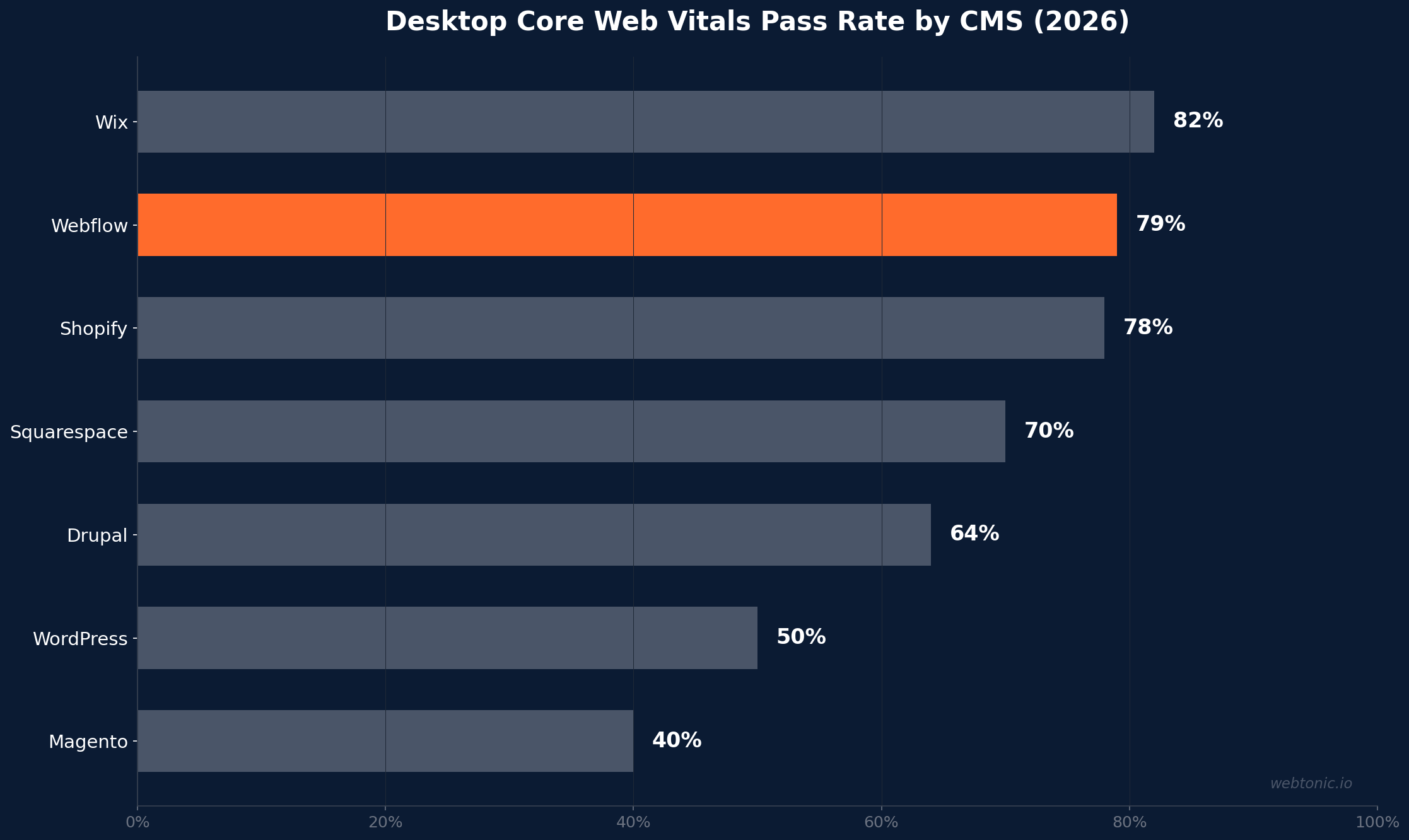
Speed is revenue for construction materials sites. According to The Stacc's 2026 analysis of HTTP Archive CrUX data, Webflow delivers a 79% desktop Core Web Vitals pass rate — ahead of Shopify at 78%, Squarespace at 70%, and well clear of WordPress at 50%. WordPress's low score reflects the plugin-heavy architecture common in many contractor and building materials sites.
| CMS Platform | Desktop CWV Pass Rate | Good TTFB Share |
|---|---|---|
| Wix | 82% | 65% |
| Webflow | 79% | 71% |
| Shopify | 78% | 95% |
| Squarespace | 70% | 94% |
| Drupal | 64% | 58% |
| WordPress | 50% | 32% |
| Magento | 40% | 19% |
When narrowed to contractor sites, Webflow sites pass CWV at 67% versus just 35% for WordPress (OnwardCraft). The gap is driven primarily by WordPress's reliance on third-party plugins for forms, analytics, and sliders — each adding render-blocking requests that inflate Largest Contentful Paint and Interaction to Next Paint scores. For building materials companies running paid search campaigns, a fast landing page directly affects Quality Score and cost per click.
Website Speed and Conversion Impact in Construction
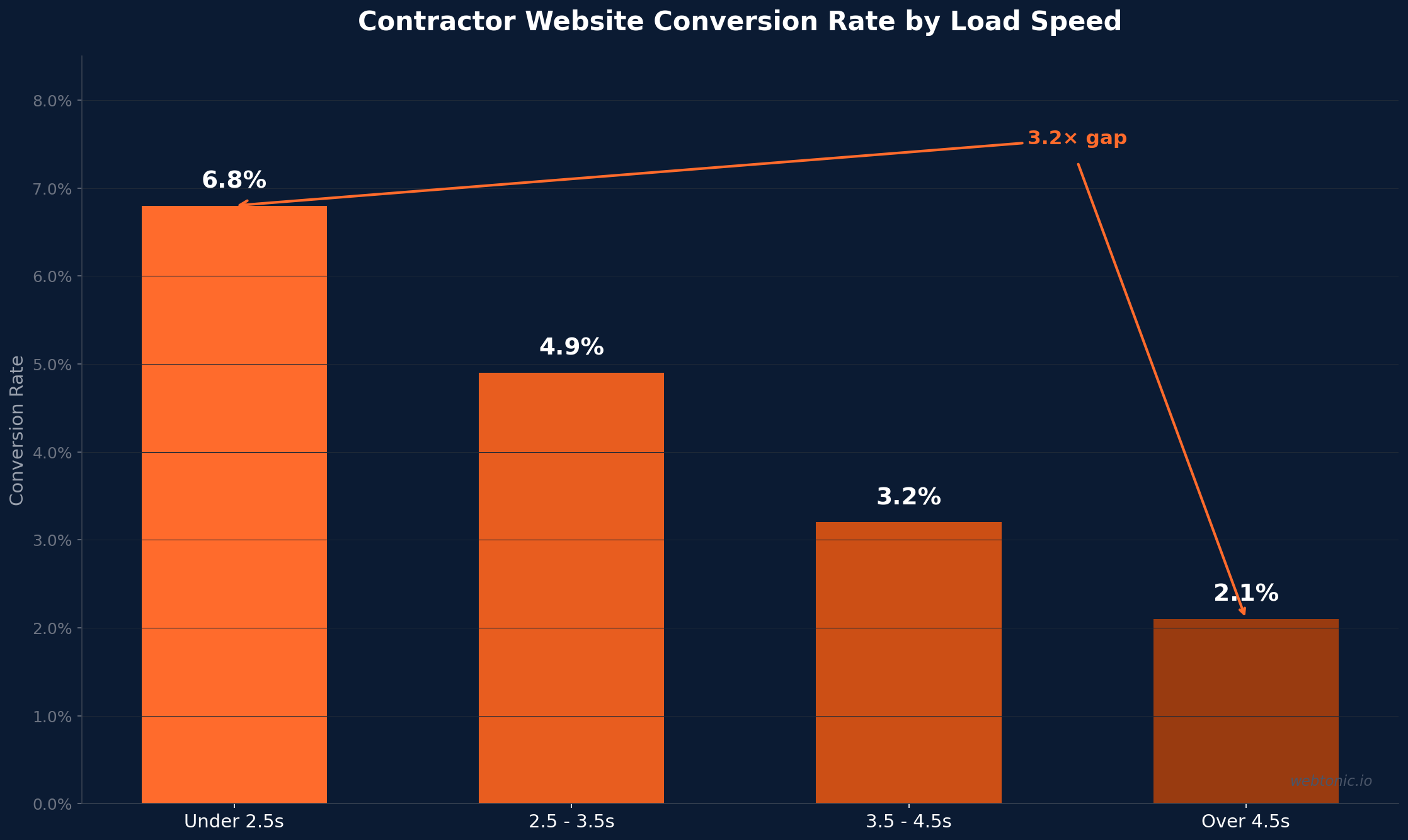
A 200-site contractor study by OnwardCraft found that sites loading in under 2.5 seconds averaged a 6.8% conversion rate, while those exceeding 4.5 seconds dropped to 2.1% — a 3.2x gap. Every additional second of mobile load time costs roughly 7% of conversions (PipelineOn).
The current state of the industry is alarming. General contractors average an 11.0-second mobile LCP — 8.5 seconds over Google's 2.5-second threshold (Borah Labs). Remodeling firms fare slightly better at 10.16 seconds but remain far from passing. For building materials companies, these slow speeds translate directly into lost leads and abandoned product catalog sessions.
Webflow's architecture — CDN-first hosting, no server-side rendering overhead, automatic image optimization — gives construction materials companies a structural speed advantage. Pages loading in 1 second convert 3x higher than those loading in 5 seconds, while bounce rates spike 90% at the 5-second mark. A site that moves from a 5-second load to a 2-second load can expect to roughly double its lead volume from the same traffic.
The Mobile vs. Desktop Conversion Gap
Construction materials websites face a persistent device mismatch. 58.4% of traffic arrives on mobile, yet desktop still drives 62% of conversions and mobile converts at just 1.8% compared to desktop at 3.5% among top performers (Cufinder). Mobile represents 78% of all contractor traffic in 2026, making this gap a major revenue leak for firms not optimizing mobile experiences.
Webflow's visual breakpoint editor lets design teams build truly responsive layouts rather than relying on generic mobile plugins. Construction materials firms that invest in mobile-first Webflow design can close the conversion gap by ensuring product catalogs, quote request forms, and spec sheets render cleanly at every screen width. Sites that bounce 60% of phone visitors — the current contractor average — are leaving projects on the table.
The procurement workflow in construction materials adds complexity. Field workers browse on mobile to find products, but purchasing decisions often shift to desktop for RFQ submissions and spec comparisons. Webflow's ability to build device-adaptive user journeys — mobile-optimized discovery pages that smoothly hand off to desktop-friendly specification sheets — directly addresses this split behavior pattern.
Website Build and Ownership Costs
Budget allocation matters heavily for construction materials companies weighing platform choices. A 2026 pricing analysis breaks down initial build costs across company sizes:
| Company Size | Freelancer Cost | Agency Cost |
|---|---|---|
| Solo Contractor | $1,500 to $3,500 | $3,500 to $6,000 |
| Mid-Size Contractor | $3,500 to $9,000 | $8,000 to $18,000 |
| Commercial GC / Materials Co. | $9,000 to $18,000 | $12,000 to $45,000 |
Over a 3-year window, Webflow sites cost $3,500 to $5,000 total for a complex contractor site versus $5,000 to $10,000 for WordPress — a savings driven by eliminated plugin licensing, reduced maintenance hours, and built-in hosting (OnwardCraft). For building materials distributors managing multiple product lines, the lower ongoing cost frees budget for performance analytics and conversion optimization initiatives.
Construction Materials Digital Adoption Landscape
The construction materials e-commerce sector is scaling rapidly. The global construction material marketplace platform market is projected to reach $23.95 billion by 2034 at a 12.8% CAGR. This surge means building materials companies need websites that function as both brand showcases and transactional platforms.
MKM Building Supplies, a major UK distributor, achieved an 82% increase in online revenue alongside a 75% improvement in average page load speed after a digital platform overhaul. While MKM chose a dedicated e-commerce platform for deep transactional needs, Webflow serves construction materials firms that prioritize lead generation over direct sales — where the 4.2% average lead-gen conversion rate and 9.5% top-performer benchmark demand clean, fast landing pages.
The organic search channel remains the highest-ROI investment for construction materials marketing. SEO delivers 681% ROI for construction companies, with organic search driving 45 to 60% of high-value leads (Siana Marketing). Webflow's clean semantic HTML output and built-in technical SEO features — automatic sitemaps, meta tag management, canonical URLs, and structured data support — give construction materials sites a strong foundation for capturing that organic traffic.
Construction technology investment also signals the direction of the industry. Supply chain technologies captured 34% of invested construction tech capital in the first half of 2026, reflecting a broader shift toward digital-first procurement and supplier discovery workflows. For construction materials manufacturers and distributors, this means that websites are no longer optional marketing assets — they are central to how buyers find, evaluate, and request quotes from suppliers.
Companies that pair Webflow's design and performance advantages with proper agency support consistently outperform those relying on template-based WordPress setups. The data shows that construction websites with authoritative technical content generate 3 to 5 times more qualified leads than sites with generic landing pages, making the investment in a well-built Webflow site a measurable growth lever rather than a cost center.
Webflow Best Practices for Construction Materials Companies
Building materials firms get the most from Webflow by applying these data-backed strategies:
- Prioritize mobile-first design. With 58.4% mobile traffic and 78% of contractor visits on phones, every layout decision should start at the smallest screen. Test product catalogs and RFQ forms on 4G connections to simulate field conditions.
- Target sub-2.5-second LCP. The 6.8% conversion rate for fast sites is 3.2x the slow-site rate. Use Webflow's native lazy loading, WebP auto-conversion, and responsive images to hit the threshold.
- Build dedicated landing pages per product line. Construction materials firms with authoritative technical content see 3 to 5x more qualified leads than those with generic pages (Authority Specialist).
- Implement SEO from launch day. Organic search drives 45 to 60% of high-value construction leads and delivers 681% ROI — the highest of any channel. Webflow's clean semantic code and built-in technical SEO baseline outperform plugin-dependent CMS setups.
- Use CMS Collections for specs and product data. Webflow's CMS powers dynamic pages at scale — ideal for construction materials catalogs with hundreds of SKUs, each needing individual specs, images, and structured data.
- Budget for a 3-year horizon. Webflow's $3,500 to $5,000 total 3-year cost beats WordPress's $5,000 to $10,000, and the gap widens as plugin update cycles and security patches compound over time.
Webflow vs. WordPress for Construction Materials Sites
The platform decision shapes long-term performance. Here is how the two compare across metrics that matter most for building materials marketing teams:
| Factor | Webflow | WordPress |
|---|---|---|
| CWV Pass Rate (Contractor) | 67% | 35% |
| Technical SEO Baseline | Built-in, clean code | Requires plugin setup |
| 3-Year Total Cost (Complex) | $3,500 to $5,000 | $5,000 to $10,000 |
| Security Maintenance | Managed by platform | Owner responsibility |
| Design Flexibility | Visual, code-level control | Theme + plugin dependent |
| E-commerce Depth | Limited native cart | Full via WooCommerce |
| Plugin Ecosystem | ~250 integrations | 60,000+ plugins |
Webflow wins on performance, maintenance burden, and design quality. WordPress wins on deep e-commerce and plugin extensibility. For construction materials companies whose primary goal is lead generation and brand presence rather than full transactional e-commerce, Webflow offers the stronger ROI path. Teams running paid social and search campaigns particularly benefit from Webflow's fast landing pages, which directly improve ad platform quality scores and lower cost per acquisition.
Frequently Asked Questions
Is Webflow a good choice for construction materials companies?
Yes — particularly for firms focused on lead generation and brand visibility. Webflow delivers a 67% CWV pass rate for contractor sites versus 35% on WordPress, which directly impacts search rankings and conversion rates. The platform's visual editor lets teams create product-specific landing pages without developer dependencies, and its managed hosting eliminates the plugin-bloat that slows most construction WordPress sites.
How does website speed affect construction materials lead generation?
Speed is the single biggest technical lever. Sites loading in under 2.5 seconds convert at 6.8% versus 2.1% for sites over 4.5 seconds — a 3.2x difference. Each additional second of mobile load time costs roughly 7% of conversions. With the average general contractor site running an 11-second LCP, there is massive upside for firms that prioritize speed through platforms like Webflow.
What does a construction materials Webflow site cost?
Initial build costs range from $3,500 to $9,000 with a freelancer to $8,000 to $18,000 with an agency for mid-size firms. Over 3 years, Webflow's total cost of ownership runs $3,500 to $5,000 compared to $5,000 to $10,000 for WordPress, driven by lower maintenance requirements and built-in hosting.
Can Webflow handle large product catalogs for building materials?
Webflow's CMS Collections support up to 10,000 items per collection, which covers most building materials catalogs. For distributors with larger inventories or requiring complex cart, tax, and shipping logic, a headless CMS or dedicated e-commerce platform may complement a Webflow marketing site.
How many construction companies currently use Webflow?
At least 394 UK construction companies actively use Webflow as of June 2026, and there are 2,566 live Webflow stores in the Business and Industrial category globally. The number is growing rapidly as firms migrate from WordPress to capture Webflow's performance and maintenance advantages.
Sources
Popupsmart — Webflow Statistics
Firmbase — Construction Companies Using Webflow UK
The Stacc — Core Web Vitals Statistics 2026
OnwardCraft — Contractor Website Conversion Study
OnwardCraft — WordPress vs Webflow for Contractors
Cufinder — Building Materials Marketing Benchmarks
PipelineOn — Contractor Website Speed
Borah Labs — General Contractors Website Benchmarks
Siana Marketing — Construction Marketing ROI 2026
Authority Specialist — Construction SEO Benchmarks
Project Cost Estimator — Construction Website Cost 2026
CMSConf — CMS Market Share 2026