Table of contents

The construction materials industry is rapidly shifting toward e-commerce, and Shopify is emerging as a key platform for distributors, suppliers, and building material retailers looking to sell online. With only 7% of the industry's sales currently conducted online, the runway for digital growth is enormous. Below, we break down the data that shapes this sector in 2026.
Key Takeaways
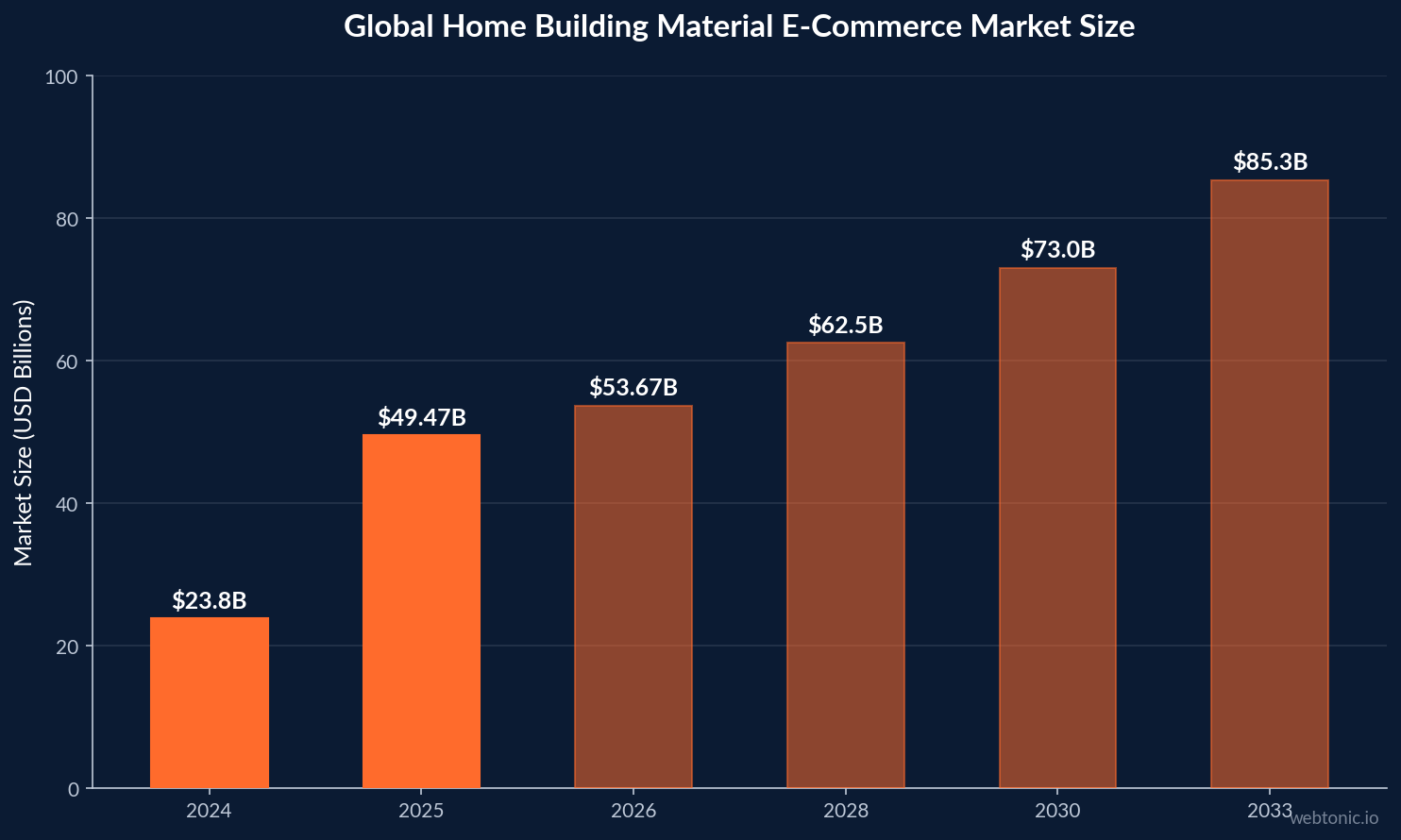
- The global home building material e-commerce market is valued at $49.47 billion in 2025 and is projected to reach $85.3 billion by 2033 at a 6.9% CAGR (Verified Market Research).
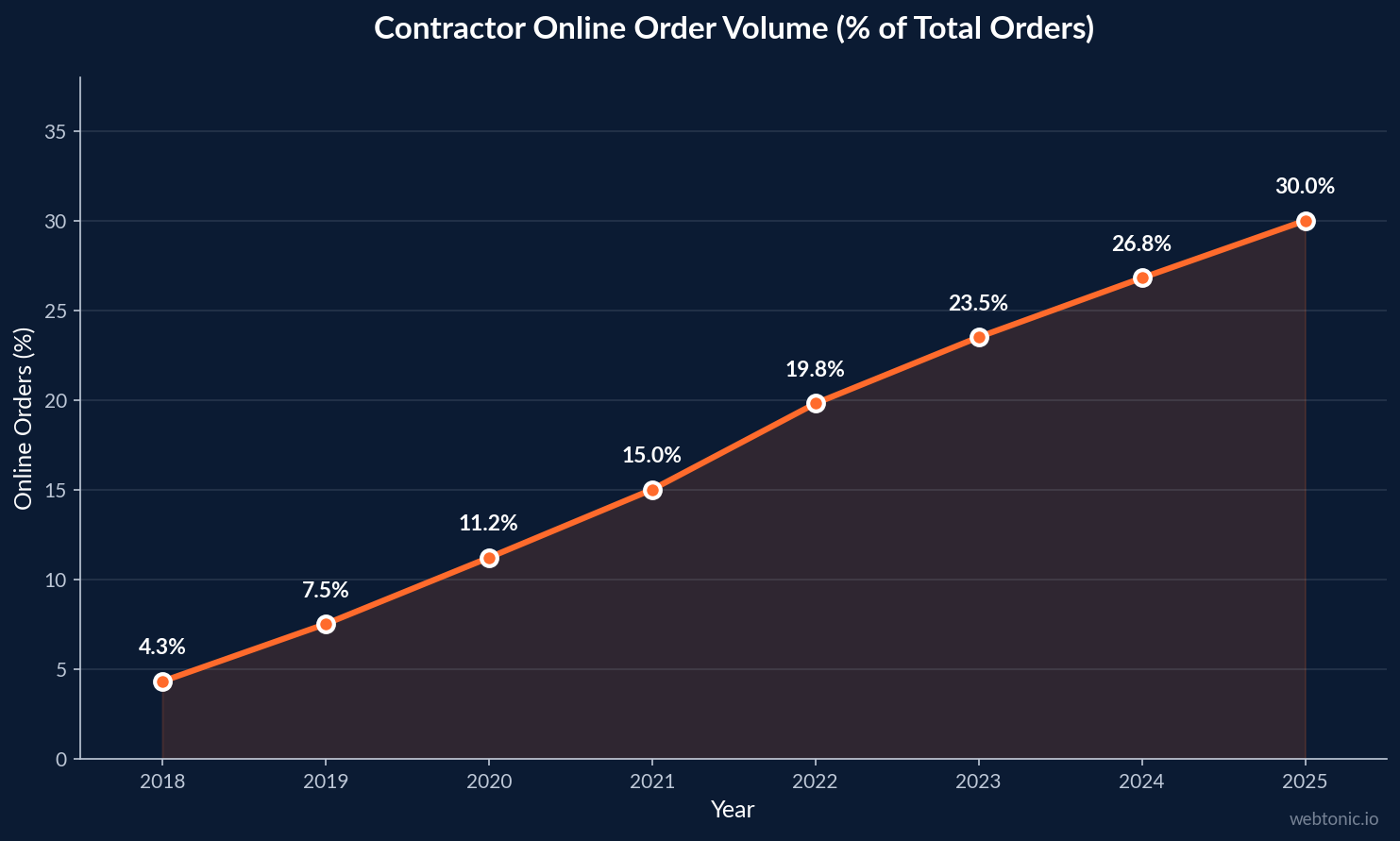
- Online purchases rose from 4.3% of contractor order volume in 2018 to 30% in 2025 — a 702% increase (BigCommerce Industrial Buyer Report).
- There are 12,752 active Shopify stores in the Home Improvement segment, with an average product catalog of 1,310 items per store (Bootleads).
- B2B platforms command 52% of the building material e-commerce market revenue, reflecting strong demand for bulk ordering and negotiated pricing (Verified Market Research).
- 67% of B2B buyers now make at least half of their purchases online, and 83% expect that share to grow (BigCommerce / MDM 2025).
- 40% of building material wholesalers already use e-commerce channels for sales, up from 12% in 2021 (World Metrics).
- The North American lumber and building materials market is valued at roughly $620 billion, with the top 150 dealers generating $412 billion in revenue (555 Capital Advisors).
- Shopify reported 31% revenue growth in Q4 2025 and 30% for the full year, expanding its position in B2B commerce (Shopify).
Construction Materials E-Commerce Market at a Glance
| Metric | Value | Source |
|---|---|---|
| Global Market Size (2025) | $49.47 billion | Verified Market Research |
| Projected Market Size (2033) | $85.3 billion | Verified Market Research |
| CAGR (2027–2033) | 6.9% | Verified Market Research |
| North America Share (2025) | 38% (~$16.82B) | Verified Market Research |
| NA Lumber & Building Market | ~$620 billion | 555 Capital / Webb Analytics |
| Online Share of Contractor Orders | 30% (up from 4.3% in 2018) | BigCommerce |
| B2B Platform Revenue Share | 52% | Verified Market Research |
| Global B2B E-Commerce (2026) | $36 trillion | Intl. Trade Administration |
Shopify's Role in the Construction Supply Chain
Shopify has positioned itself as a serious B2B commerce platform, and the construction materials sector is one of its fastest-growing verticals. According to Bootleads, 12,752 active Shopify stores operate in the Home Improvement segment as of mid-2026, with 431 new stores added in the last 30 days alone — a 3% monthly growth rate.
These stores carry significantly larger catalogs than the Shopify average. The typical construction-adjacent Shopify store lists 1,310 products, compared to the platform-wide average of just 409. Average listed prices sit at $341 per item, nearly 57% above the Shopify average of $217, reflecting the higher-value nature of building materials and hardware.
Shopify's overall momentum reinforces the trend. The company reported 31% year-over-year revenue growth in Q4 2025, with a 19% free cash flow margin. Its B2B product suite — including custom pricing tiers, trade accounts, and ERP integrations — continues to attract distributors and manufacturers seeking a unified commerce platform.
Buyer Behavior Is Driving Rapid Digital Adoption
The shift to online purchasing in construction materials is no longer speculative — it is measurable. According to the 2025 Industrial Buyer Report from BigCommerce, online orders grew from 4.3% of total contractor volume in 2018 to 30% by 2025, representing a staggering 702% increase over seven years.
MDM's 2025 B2B buyer research supports this acceleration: 67% of construction buyers now place at least half of their orders online, and 83% expect their online purchasing to increase further. Perhaps most tellingly, over 58% of purchases now occur outside traditional distributor relationships, pushing established players to invest in their own digital storefronts or risk losing market share to platform-first competitors.
This behavioral shift extends to product research as well. 73% of construction firms now allocate dedicated budgets to digital tools, with online material sourcing identified as the fastest-growing category (MarketIntelo). Contractors increasingly demand real-time inventory tracking, digital quoting, and job-site delivery scheduling — features that platforms like Shopify Plus, BigCommerce, and vertical-specific marketplaces are racing to deliver.
Wholesale and Distribution E-Commerce Benchmarks
| Metric | 2021 | 2023 | 2025–2026 |
|---|---|---|---|
| Wholesalers Using E-Commerce | 12% | 40% | Est. 50%+ |
| Online Share of Total Sales | 8% | 12% | Est. 18–22% |
| Average B2B Order Value (US) | $2,200 | $2,500 | $2,500–$2,800 |
| YoY E-Commerce Growth | 18% | 25% | Est. 15–20% |
| Lead Gen Conversion Rate | — | — | 4.2% |
| E-Commerce Direct Sale CVR | — | — | 1.8% |
Source: World Metrics, CuFinder 2026 Benchmarks
The data reveals a clear trajectory: e-commerce adoption among building material wholesalers has more than tripled since 2021. The average B2B order value of $2,500 signals that these are not small consumer purchases — contractors and developers are using Shopify and comparable platforms for significant procurement transactions. The 4.2% lead generation conversion rate for quote requests outperforms many B2B verticals, highlighting the high intent of construction material buyers searching online.
Market Size and Growth Projections
Multiple research firms agree on the upward trajectory of construction material e-commerce, though estimates vary depending on scope and methodology:
- Verified Market Research values the global home building material e-commerce market at $49.47 billion in 2025, growing to $85.3 billion by 2033 at a 6.9% CAGR.
- MarketIntelo estimates the broader online building marketplace at $42.3 billion in 2025, projected to reach $153.8 billion by 2034 at a 14.2% CAGR — the higher figure reflecting marketplace transaction volumes.
- 555 Capital Advisors pegs the global building materials distribution market at $800+ billion, with forecasts calling for 4–5% annual growth toward $1.0–$1.1 trillion over the next decade.
The construction materials vertical sits at an inflection point. Material costs have risen more than 40% above pre-pandemic levels and, after a brief decline, began climbing again in late 2025. Tariffs on construction goods reached a 40-year high of roughly 25–30% in 2025 (BigCommerce / Deloitte). These cost pressures are pushing distributors and buyers alike toward digital platforms that offer transparent pricing, real-time inventory visibility, and automated reordering — capabilities that Shopify Plus and similar solutions now provide out of the box.
Platform and Digital Traffic Benchmarks for Construction Materials
| Channel / Metric | 2026 Benchmark |
|---|---|
| Mobile Traffic Share | 58% |
| Desktop Traffic Share | 38% |
| Organic Search Traffic (Global) | 42% |
| Paid Search Traffic (US) | 18.5% |
| Social Traffic | 6% |
| Google Ads CPC | $2.85–$3.50 |
| Google Ads CVR | 3.4% |
| Google Shopping ROAS | 4.5:1 |
| Avg. Session Duration | 2 min 45 sec |
| Pages Per Session | 3.2 |
Source: CuFinder Building & Construction Materials Benchmarks 2026
For Shopify stores in this space, the 58% mobile traffic share underscores the importance of mobile-optimized storefronts. However, 62% of conversions still occur on desktop — procurement managers and project estimators prefer desktop when placing large orders. The Google Shopping ROAS of 4.5:1 is particularly strong for Shopify merchants leveraging product feeds, making paid shopping campaigns one of the most efficient acquisition channels for building material retailers.
Key Challenges and Opportunities for Shopify Merchants
Despite the growth trajectory, construction material e-commerce faces unique challenges that distinguish it from traditional retail:
- Complex product catalogs: The average Shopify construction store lists 1,310 products — three times the platform average — requiring robust filtering, search, and variant management.
- High average order values: At $341 average listed price per item and bulk orders exceeding $2,500, data-driven pricing strategies and trade credit integrations are critical for conversion.
- B2B-specific requirements: 52% of construction material e-commerce revenue flows through B2B platforms that support volume discounts, PO-based ordering, and multi-location delivery — capabilities that Shopify Plus now offers natively.
- Material cost volatility: With prices 40%+ above pre-pandemic levels and tariffs at a 40-year high, buyers demand real-time pricing and instant quote functionality.
- Omnichannel expectations: Harvard JCHS projects homeowner renovation spending at ~$524 billion in early 2026, creating demand from both professional contractors and DIY homeowners who expect seamless online-to-store experiences.
How Building Material Distributors Win with E-Commerce
The data points to a clear playbook for construction material companies building or scaling their Shopify presence:
- Invest in B2B features first. With 67% of buyers already purchasing online and 83% planning to increase, growth marketing strategies that prioritize trade account portals, custom pricing, and ERP sync will outperform consumer-first approaches.
- Optimize Google Shopping feeds. The 4.5:1 ROAS benchmark for construction materials makes Google Ads a high-priority channel. Ensure product data feeds include detailed specifications, certifications, and regional availability.
- Reduce contractor friction. Distributors that expanded their digital footprint in 2024 grew revenue 1.6%, while those that didn't saw revenue fall 2.4% (555 Capital). Digital ordering, job planning tools, and fulfillment visibility are becoming table stakes.
- Mobile-first, desktop-close. While 58% of traffic is mobile, 62% of conversions happen on desktop. Ensure product discovery works seamlessly on mobile, then provide an optimized checkout for desktop procurement teams.
- Track repeat purchase rate. The 45% repeat purchase rate and 65% customer retention rate in this vertical mean lifetime value calculations should drive acquisition budgets, not just cost-per-click metrics.
Shopify App Store and International Adoption in Construction
The Shopify App Store plays a critical role in enabling construction material merchants to customize their e-commerce operations. With over 13,000 apps available on the Shopify app store, building material retailers can integrate specialized tools for B2B pricing, inventory management, and quote-request workflows without custom development. Popular apps for construction merchants include product configurators for custom material dimensions, automated freight calculators, and ERP connectors that sync with distributor management systems.
Internationally, Shopify's construction materials adoption mirrors global building activity patterns. The United States leads with the highest concentration of construction Shopify stores, followed by the United Kingdom, Canada, and Australia. In Canada, the residential construction boom has pushed more building material suppliers onto Shopify, particularly for lumber, insulation, and roofing products. Australia's construction sector — valued at over AUD $230 billion — is similarly driving Shopify adoption among hardware wholesalers and specialty material suppliers, with India and Germany emerging as high-growth markets.
The global B2B e-commerce market is projected to reach $36 trillion by 2026, growing at a 14.5% CAGR according to the International Trade Administration. Within this massive addressable market, construction material merchants on Shopify benefit from the platform's expanding B2B capabilities: customer-specific catalogs, net payment terms, and multi-location inventory management. The revenue growth statistics confirm Shopify's momentum — the platform processed an estimated $286 billion in GMV across North America in 2025, with B2B representing a small but rapidly growing share. Amazon and Google Shopping integrations further extend the reach of Shopify-based construction material stores, enabling multi-channel distribution through established marketplaces. For merchants weighing platform options, the top consideration remains total cost of ownership balanced against conversion rates and order management flexibility.
Related reading
- Construction Materials Webflow Statistics: Performance, Costs & Adoption Data
- Construction Materials WordPress Statistics: CMS Adoption, Performance & Trends
- 2026 Construction Materials Landing Pages & CRO Report: Trends, Stats & Performance Data
- Custom Web Development services at Web Tonic
Frequently Asked Questions
How big is the construction materials e-commerce market?
The global home building material e-commerce platform market was valued at $49.47 billion in 2025 and is projected to grow to $85.3 billion by 2033 at a 6.9% CAGR, according to Verified Market Research. North America holds the largest share at approximately 38%, driven by high contractor adoption of digital procurement tools and mature logistics infrastructure.
How many Shopify stores sell construction materials?
As of mid-2026, 12,752 active Shopify stores operate in the Home Improvement segment, which includes construction materials, hardware, and building supplies. Roughly 431 new stores are added each month, representing a 3% monthly growth rate. These stores carry an average of 1,310 products each, well above the Shopify platform average.
What percentage of construction material sales happen online?
Online sales currently represent an estimated 7–30% of total construction material sales, depending on the segment. While Shopify's enterprise data cites just 7% for the broader industry, the 2025 Industrial Buyer Report found that 30% of contractor order volume now occurs online. The gap reflects varying adoption rates between large distributors and smaller independent dealers.
Is Shopify suitable for B2B building material sales?
Yes. Shopify Plus now offers native B2B functionality including custom price lists, company accounts with multiple buyers, net payment terms, and volume-based discounting. Platforms like Uncap specialize in building Shopify B2B solutions specifically for construction supply companies, integrating fitment data, dealer pricing, and ERP synchronization.
What is the average order value for building materials sold online?
The average order value for U.S. wholesale building materials purchased online is approximately $2,500, according to World Metrics. For Shopify stores in the Home Improvement segment, the average listed product price is $341 — significantly higher than the platform-wide average of $217 — reflecting the premium nature of construction materials and hardware components.
Sources
Verified Market Research — Home Building Material E-Commerce Platform Market
BigCommerce — Building & Construction Materials Ecommerce (2026)
Bootleads — Shopify Home Improvement Stores (2026)
World Metrics — Wholesale Building Materials Industry Statistics
555 Capital Advisors — Building Material Distribution 2026 Market Update
Shopify — Q4 2025 Financial Results
Shopify Enterprise — Construction Ecommerce Guide
MarketIntelo — Online Building Materials Market Report
Uncap — B2B Ecommerce Statistics (2026)
CuFinder — Building & Construction Materials Marketing Benchmarks 2026