Table of contents

Construction materials companies spend an average of $252 per lead, yet most lack the attribution infrastructure to determine which marketing channels actually drive revenue. With sales cycles averaging 2–6 months, 5+ decision-makers per deal, and 60–70 % of leads originating from phone calls rather than trackable digital clicks, proper marketing attribution is the difference between scaling the right channels and wasting budget on vanity metrics. Below are 65+ verified statistics on marketing attribution, analytics, CRM integration, and ROI measurement for the construction materials industry in 2026.
Key Takeaways
- The building materials industry spends an average of $252 per lead, making accurate attribution essential for controlling customer acquisition costs (Point to Point).
- Contractors with clean attribution report 20–35 % higher marketing ROI than those relying on last-click tracking alone (PipelineOn).
- Phone calls still drive 60–70 % of home service and construction leads, making offline conversion tracking mandatory for accurate measurement (PipelineOn).
- SEO delivers 681 % ROI and referral marketing 480–520 % ROI — the two highest-return channels when properly attributed (Siana Marketing).
- Construction materials sales cycles average 2–6 months, with project-based work extending to 18 months, demanding multi-touch attribution models (First Sales).
- Cutting quote-request form fields from 12 to 5 boosted conversion rates by 40 %, illustrating how analytics-driven UX optimization compounds marketing ROI (CuFinder).
- ABM with attribution cut ad spend 75 % while increasing qualified leads 2.5× for a global construction materials manufacturer (Vehnta).
- Weighted multi-touch attribution models that value early specification touches and late commercial touches outperform last-click for building materials sales (AI for Manufacturers).
Marketing Channel ROI for Construction Materials
When attribution is properly configured, the performance gap between channels becomes stark. Growth marketing strategies anchored by SEO and referral programs consistently outperform paid channels on pure ROI for construction companies, but only when measurement spans the full sales cycle from first touch to closed contract.
| Channel | Avg ROI / ROAS | Avg CPA | Attribution Note | Source |
|---|---|---|---|---|
| SEO | 681 % | — | Longest attribution window: 6–12 months | Siana Marketing |
| Referral Marketing | 480–520 % | — | Offline tracking required for accuracy | Siana Marketing |
| Google Shopping | 450 % (4.5:1 ROAS) | $1.10 CPC | Last-click biased; under-attributes display | CuFinder |
| Google Ads (Search) | — | $85–$110 CPA | Highest-intent digital channel | CuFinder |
| Display Ads | — | $65 CPA | View-through attribution needed | CuFinder |
| Facebook Ads | — | $0.95–$1.65 CPC | Upper-funnel; often under-attributed | CuFinder |
| Email Marketing | — | — | 22.8 % open, 2.9 % CTR | CuFinder |
The 681 % SEO ROI reported by Siana Marketing carries an important caveat: it requires 6–12 months of attribution window to capture the full value of organic traffic, since construction materials purchasers often visit a site multiple times before initiating contact. Companies using 30-day attribution windows systematically under-credit SEO and over-credit bottom-funnel paid channels.

Attribution Models Compared for Construction Materials Marketing
The construction materials buying journey involves specification by architects, quoting by contractors, negotiation by project managers, and procurement by purchasing departments — each handled by different stakeholders often using different devices and communication channels. Single-touch attribution models consistently mis-credit the converting channel and starve the upper-funnel activities that actually initiate sales.
| Attribution Model | How It Works | Construction Pros | Construction Cons | Best Use Case |
|---|---|---|---|---|
| Last Click | Credits the final touchpoint before conversion | Simple, easy to implement | Ignores specification and awareness stages | Quick reporting baseline |
| First Touch | Credits the initial discovery touchpoint | Shows which channels drive awareness | Ignores nurture and closing activities | Awareness campaign evaluation |
| Linear | Distributes equal credit to all touchpoints | Fair representation across long cycles | Over-credits low-impact intermediate touches | Multi-channel balanced view |
| Weighted Multi-Touch (AI) | Spec-to-sale weighting of touchpoints | Matches the construction buying journey | Requires robust CRM integration | Project-based complex sales |
| Time Decay | Assigns more credit to recent touchpoints | Favors closing-stage activities | Under-credits the specification stage | Short-cycle repeat product sales |
The AI-powered spec-to-sale attribution model is emerging as the gold standard for construction materials manufacturers. These models assign higher weights to specification-stage touches (architect engagement, technical download, CPD attendance) and commercial-stage touches (quote request, purchase order), while assigning less weight to passive mid-journey interactions like email opens and social impressions (AI for Manufacturers).
Offline Conversion Tracking and CRM Attribution
With 60–70 % of construction leads originating from phone calls, offline conversion tracking is not optional — it is the foundation of meaningful marketing analytics. CRM integration connects the marketing-sourced lead to the closed deal, often months after the initial engagement, enabling true revenue attribution rather than proxy metrics like form fills or phone call volume.
- Dynamic Number Insertion (DNI) and offline conversion imports are mandatory for construction marketers — without them, 60–70 % of lead sources remain invisible and budget allocation decisions rely on incomplete data (PipelineOn).
- CRM-based attribution connects ad clicks to closed construction jobs through offline conversion uploads, UTM-tagged lead capture, and monthly revenue reconciliation (Click Track Marketing).
- MKM Building Supplies used Google shop-visit tracking plus in-branch feedback signals to link digital advertising campaigns to real-world purchasing outcomes, driving measurable local impact at scale across multiple branches (Green Ginger Digital).
- AI-powered attribution models generate daily pipeline reports showing which campaigns, channels, and sequences drive pipeline value — with drill-down capability to individual projects so marketers can trace the exact path from first specification touch to signed contract (Revenue Institute).
- Importing closed-won revenue data back into Google and Microsoft Ads enables true ROAS optimization and allows smart bidding algorithms to optimize for actual job value rather than form fills or phone calls (Click Track Marketing).
Lead Cost and Conversion Benchmarks for Construction Materials
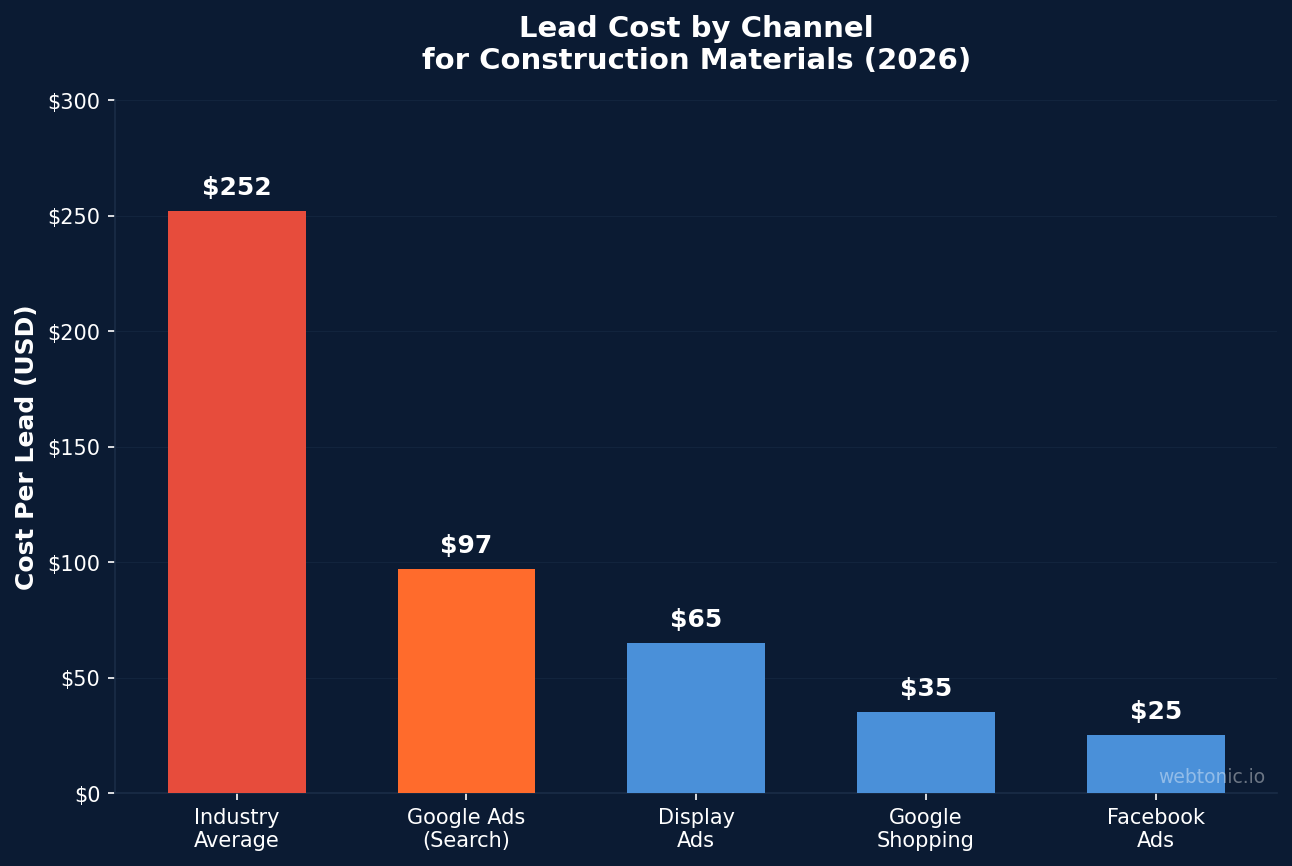
Understanding the true cost per lead and conversion rate by channel enables construction materials marketers to allocate budgets accurately and identify optimization opportunities. The gap between paid search costs and organic channel performance is significant — but only visible with proper attribution infrastructure in place.
| Metric | Value | Context | Source |
|---|---|---|---|
| Avg cost per lead (building materials) | $252 | Industry-wide BPM manufacturer study | Point to Point |
| Google Ads CPA (search) | $85–$110 | Construction materials vertical | CuFinder |
| Google Ads CPA (display) | $65 | Construction materials vertical | CuFinder |
| Quote form conversion rate | 4.2 % | Top performers reach 9.5 % | CuFinder |
| Customer retention rate | 65 % | Top-tier brands exceed 75 % | CuFinder |
| Repeat purchase rate | 45 % | Building materials average | CuFinder |
| Churn rate (top tier) | < 8 % | Building materials brands | CuFinder |
| Sales cycle length | 2–6 months | Project work extends to 18 months | First Sales |
| Decision-makers per deal | 5+ | Architects, GCs, owners, purchasing | Inveo |
The $252 average CPL masks enormous variance: companies with proper attribution discovered that their best channels generated leads at under $80 while their worst exceeded $400. Without attribution, budget allocation defaults to equal distribution or gut feel — leaving significant efficiency gains on the table.
Data-Driven Marketing Maturity in Construction Materials
Most construction materials brands still operate at a reporting-only level of analytics maturity — collecting data without using it to drive decisions. The gap between data collection and data-driven decision-making represents the largest untapped ROI opportunity in the vertical, with early adopters gaining compounding advantages over competitors still relying on quarterly review spreadsheets.
- Data-driven marketing is no longer a competitive edge — it is operational discipline for building product manufacturers in 2026. Companies without attribution infrastructure are making blind budget decisions with hundreds of thousands of dollars at stake (Draper DNA).
- Revenue-aligned KPIs and executive dashboard reporting are prerequisites for attribution maturity — vanity metrics like impressions and click-through rates obscure actual ROI and lead to misallocation (Draper DNA).
- 67 % of construction companies increased marketing budgets in recent years due to competitive bidding pressures, making attribution critical for proving ROI and retaining budget allocation from leadership.
- Building materials decision chains involve 5+ stakeholders — architects, general contractors, owners, and purchasing managers — requiring attribution models that track influence across roles, not just the final purchaser (Inveo).
- Specification intelligence and market forecasting tools like ConstructConnect help manufacturers move from raw data collection to predictive decision-making by linking project activity, contractor behavior, and marketing channels into a unified view of pipeline value.
Attribution Best Practices for Construction Materials Marketers
- Implement offline conversion tracking first. Since 60–70 % of construction leads come via phone, Dynamic Number Insertion (DNI) and CRM-to-ad-platform sync represent the single highest-ROI attribution investment a construction materials company can make (PipelineOn).
- Adopt weighted multi-touch attribution. Models that assign higher weights to specification-stage and commercial-stage touches match the construction buying journey far better than last-click, which consistently over-credits bottom-funnel search campaigns (AI for Manufacturers).
- Connect your CRM to ad platforms. Import closed-won revenue data back into Google and Meta Ads to enable true ROAS optimization and smart bidding based on actual project and job values rather than lead form submissions.
- Simplify lead capture forms to improve both conversion and attribution. Reducing form fields from 12 to 5 boosted conversion rates by 40 % — and every unnecessary field is a point where attribution data can be lost or corrupted (CuFinder).
- Measure by revenue and contract value, not lead volume. The $252 average CPL hides massive variance — proper attribution reveals which channels produce $50K commercial projects versus $500 retail material orders, enabling budget allocation that maximizes total revenue rather than lead count (Point to Point).
FAQ
What is marketing attribution for construction materials companies?
Marketing attribution is the process of connecting marketing touchpoints — ads, emails, website visits, phone calls, trade show interactions — to actual revenue. For construction materials companies with 2–6 month sales cycles and 5+ decision-makers per deal, attribution reveals which channels drive specification, quoting, and purchasing decisions so marketing budgets can be allocated based on evidence rather than assumptions.
Why is last-click attribution insufficient for construction materials?
Construction materials buying involves specification by architects, approval by general contractors, and procurement by purchasing managers — a multi-stakeholder journey where the converting click rarely reflects the channel that actually influenced the decision. Last-click ignores 60–70 % of phone-sourced leads and all upper-funnel specification activity that initiates the sales process.
How much does the average construction materials lead cost?
The building materials industry averages $252 per lead according to a BPM manufacturer study. However, this varies dramatically by channel — Google Ads search CPA runs $85–$110, display runs $65, and organic channels like SEO and referral marketing deliver significantly lower costs per acquisition when measured over the full attribution window.
What is the best attribution model for construction materials?
Weighted multi-touch attribution that assigns higher credit to early specification touches and late commercial touches is recommended for project-based construction sales. AI-powered spec-to-sale models automate this scoring and provide daily pipeline reports showing which campaigns drive the most valuable outcomes.
How can construction companies track offline conversions?
Implement Dynamic Number Insertion (DNI) for phone call tracking, connect your CRM to Google and Meta ad platforms via offline conversion uploads, and use Google shop-visit tracking for branch and showroom locations. This infrastructure captures the 60–70 % of leads that occur offline and enables true revenue-based ROI measurement across all marketing channels.
Sources
Point to Point — Building Materials Lead Cost Study
PipelineOn — Data Source Attribution for Contractors
Siana Marketing — Construction Marketing ROI 2026
CuFinder — Building Materials Benchmarks
AI for Manufacturers — Spec-to-Sale Attribution
Click Track Marketing — Outdoor Build ROI Tracking
Green Ginger Digital — MKM Building Supplies
Revenue Institute — AI Multi-Touch Attribution
Inveo — RevOps for Building Materials
Draper DNA — Data-Driven Marketing in Building Products