Table of contents

No published study prices video marketing for cleaning companies specifically. This page builds a working budget model from Wyzowl's 2026 cross-industry video marketing survey and the IAB's 2026 digital video ad spend data, and states every place the evidence is general-market rather than cleaning-specific.
Key Takeaways
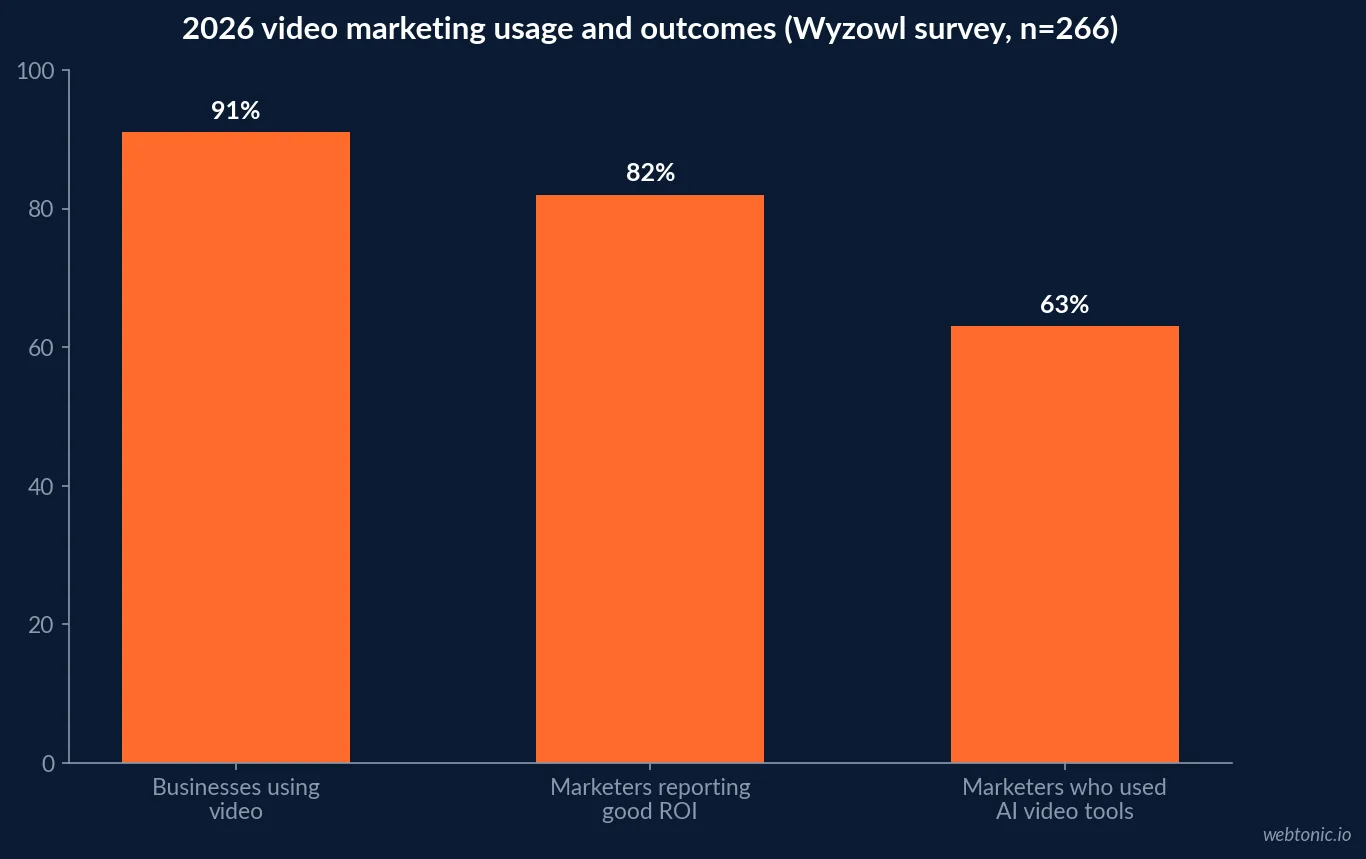
- 91% of businesses now use video as a marketing tool (Wyzowl, 2026).
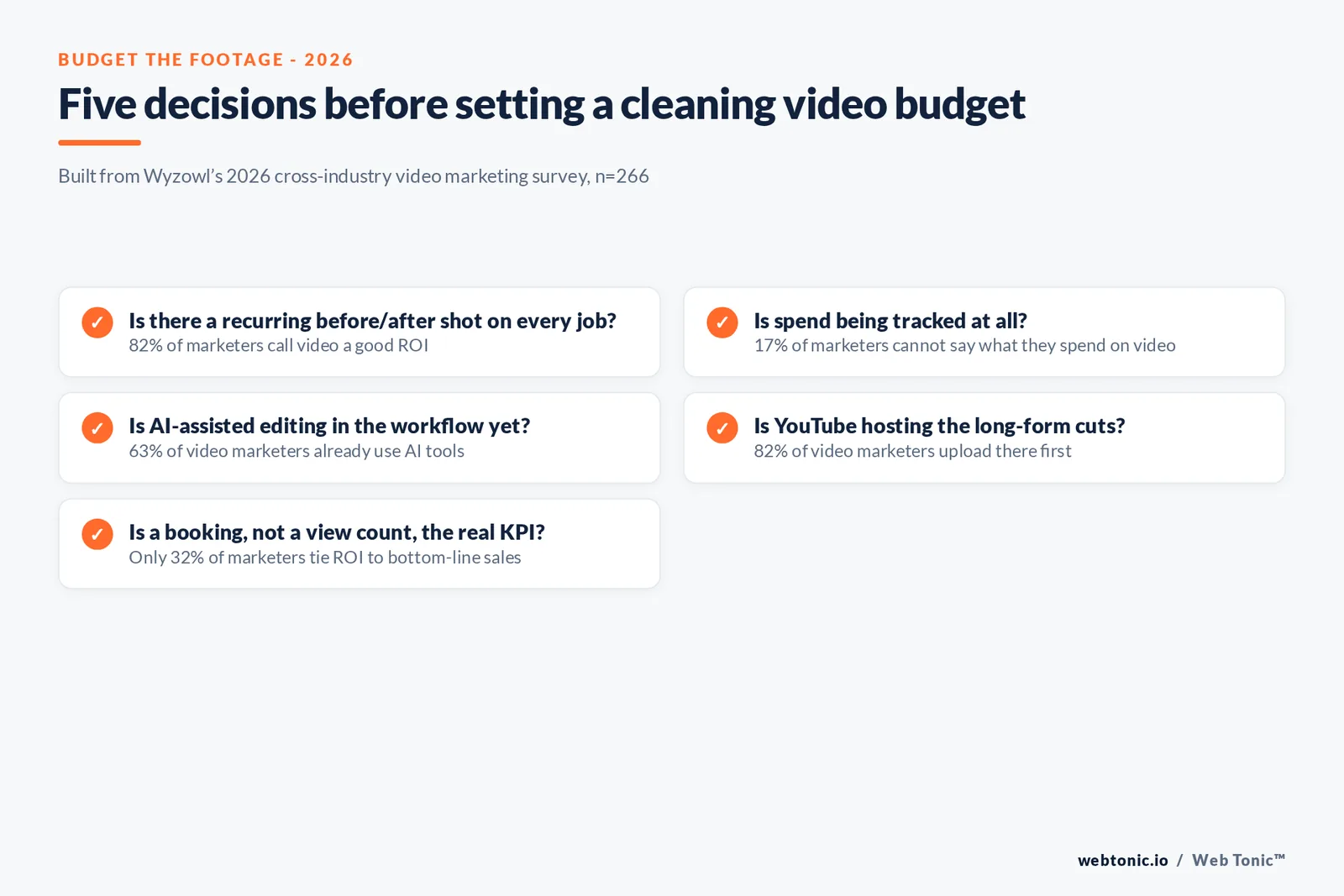
- 82% of marketers who use video call it good ROI, down from last year's high.
- 46% of marketers allocate a third of budget or less to video content.
- 17% of marketers do not track their video spend at all.
- 92% plan to spend the same or more on video in 2026.
- 63% of video marketers have used AI video tools, up from 51% a year earlier.
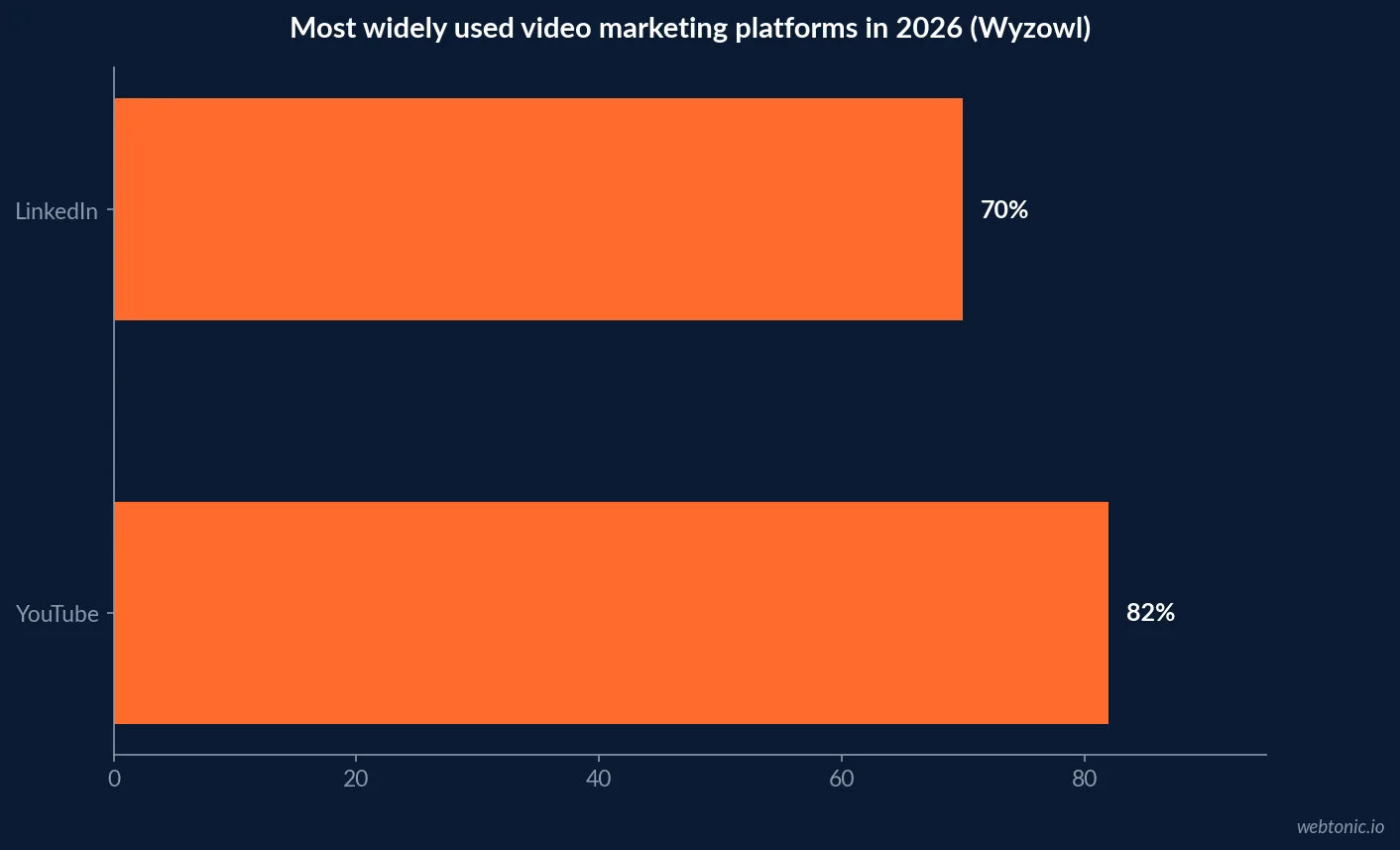
- 82% of video marketers upload to YouTube, the most widely used platform.
- 70% of video marketers also use LinkedIn for video.
- 67% measure ROI through video views, the most common single method.
- 63% measure ROI through engagement such as likes, shares and reposts.
- Only 32% measure ROI through bottom-line sales directly.
- 89% of consumers say video quality affects brand trust.
- Digital video ad spend will exceed USD 80 billion in 2026 (IAB), doubling in five years.
- #CleanTok-tagged videos on TikTok have logged roughly 2.4 billion views organically.
- The top reason marketers skip video is time, not budget or skill.
Why this page is a model, not a cleaning-specific benchmark
Video marketing surveys are conducted across marketer populations, not by service category. The best available 2026 data is Wyzowl's Video Marketing Statistics report, based on 266 marketers and consumers surveyed in late 2025, with 12 years of trend history behind it. It does not break results out by home services or cleaning. Treat every figure below as a cross-industry rate applied to a specific, highly visual service category, not a quote.
What makes this transferable at all is that cleaning is one of the most naturally video-friendly service categories that exists - a before/after shot or a walkthrough clip requires no script, no studio and no actor, which lowers the real-world cost of acting on this data well below the survey's implied average.
| Video marketing fact (Wyzowl 2026, n=266) | Figure | What it means for a cleaning business |
|---|---|---|
| Businesses using video as a marketing tool | 91% | Not using video is now the outlier position |
| Marketers reporting good ROI from video | 82% | The category-agnostic case is strong |
| Marketers who used AI video tools | 63% | Editing cost has dropped since 2025 (51%) |
| Marketers unsure how much they spend on video | 17% | Budget tracking is a real gap industry-wide |
| Marketers planning to spend the same or more | 92% | Video budgets are not being cut in 2026 |
Building the budget: where the money actually goes
Wyzowl reports that 46% of marketers put a third of their overall marketing budget or less toward video, while a notable 17% could not say how much they spend because they are not tracking it separately. For a cleaning company setting a first video budget, the practical range implied by that data is modest: enough for a phone, a basic gimbal or tripod, and recurring editing time, before any paid production is justified.
At the macro level, the IAB's 2026 Digital Video Ad Spend & Strategy Report puts total US digital video ad spend above USD 80 billion in 2026, double the volume of five years ago - confirmation that the channel is growing, not that a specific cleaning budget line should scale with it.
| Budget stage | What it covers | Signal to move up a stage |
|---|---|---|
| Organic, phone-shot | Weekly before/after clip, no paid tools | Consistent views but no editing time left |
| Organic, AI-assisted edit | Same footage, faster turnaround via AI tools | 63% of marketers are already here |
| Light paid boost | Small ad spend behind the best-performing organic clip | One clip outperforms the rest by 3x+ |
| Recurring paid production | Scripted walkthroughs, staff intros, seasonal offers | Booking volume justifies a producer |
Short-form video's engagement advantage, and why that matters for cleaning content
Sprout Social's 2026 TikTok statistics roundup, citing Socialinsider's platform tracking, reports TikTok's average engagement rate at 3.73% - well ahead of every other major platform, where rates typically run below 1%, across TikTok's roughly 1.99 billion monthly active users. That gap is largest for exactly the kind of unscripted, visually satisfying clip a cleaning job naturally produces, which is also the format driving #CleanTok's organic reach.
The practical read for a cleaning brand budgeting video time: a short, vertical before/after clip is competing in a format with a structurally higher engagement ceiling than a polished long-form video, even before any paid spend is involved.
| Platform engagement benchmark (Sprout Social / Socialinsider, 2026) | Figure | Relevance to cleaning video |
|---|---|---|
| TikTok average engagement rate | 3.73% | Highest of the major platforms tracked |
| TikTok monthly active users | ≈1.99 billion | Fifth-largest platform by MAU |
| Other platforms' typical engagement rate | Below 1% | Short-form video format is the outlier, not the platform |
How consumers say they actually want to learn about a service
Wyzowl's consumer-side questions found respondents consistently prefer watching a short video to reading text when learning about a new product or service, echoing the same 89% trust-in-quality figure cited above. For a cleaning company, that preference maps directly onto the most common visitor question - "what will my house actually look like after" - which a 30-60 second before/after clip answers more directly than any paragraph of service copy could.
Pairing that clip with the review evidence from BrightLocal's 2026 survey - where an appealing photo or video accompanying a review is already a named trust factor for over a third of consumers - gives the video a second job beyond marketing: making the review section itself more persuasive.
Where cleaning companies should actually be posting
Wyzowl's ranking of the most widely used video platforms among marketers puts YouTube first at 82% and LinkedIn second at 70% - a ranking shaped heavily by B2B and enterprise marketers in the sample. A residential cleaning company chasing local households should read this as a signal about video-hosting infrastructure (YouTube for searchable, long-form walkthroughs) rather than a directive to prioritize LinkedIn, which serves commercial and janitorial buyers far better than homeowners.
Organic reach on TikTok tells a different, cleaning-specific story worth naming honestly: according to Toklytics' third-party #CleanTok hashtag tracker, the community had logged roughly 2.4 billion views across tracked videos as of the most recent sample, averaging over 500,000 views per video - a sample-based estimate, not an official TikTok figure. Treat it as a floor: TikTok itself put cumulative #CleanTok views above 78 billion when it announced its Unilever partnership in June 2023. Both are organic reach, not paid inventory.
| Platform | Wyzowl 2026 marketer usage | Best fit for a cleaning brand | Content type |
|---|---|---|---|
| YouTube | 82% upload here | Searchable long-form walkthroughs, SEO value | Full job walkthrough, tips |
| High usage, not top-ranked here | Local household audience, visual proof | Before/after reels | |
| 70% upload here | Commercial/janitorial buyers, not households | Case studies, staff training | |
| TikTok (organic) | Not in Wyzowl's marketer sample | #CleanTok community, ~2.4B views logged | Short satisfying clips |
How marketers are judging whether the video worked
Wyzowl found that 67% of video marketers quantify ROI through video views, 63% through engagement (likes, shares, reposts), 52% through customer engagement and retention, 36% through brand awareness or PR, and only 32% trace it to bottom-line sales directly. Views and engagement are easy to pull from a platform dashboard, which is likely why they dominate - not because they are the best proxy for a booked job.
A cleaning company that can track which landing page a booking came from has a cleaner path than most industries to closing that gap: tag the video's link, watch which clip's traffic converts into a form submission, and treat views as a leading indicator rather than the final scorecard.
| ROI measurement method (Wyzowl 2026) | Share of video marketers using it | Reliability for a cleaning brand |
|---|---|---|
| Video views | 67% | Cheap to track, weak link to bookings |
| Engagement (likes/shares/reposts) | 63% | Signals content quality, not revenue |
| Customer engagement and retention | 52% | Useful for recurring-clean customers |
| Brand awareness / PR | 36% | Hard to isolate from other channels |
| Bottom-line sales | 32% | Strongest signal, requires landing page tracking |
What consumers say about video quality and trust
Wyzowl's consumer-side data found that 89% of consumers say video quality affects how much they trust a brand - down slightly from 91% the year before but still the dominant view. For a service being invited into someone's home, a shaky, poorly lit before/after clip can undercut the trust the footage is supposed to be building. This is one place where a small, deliberate investment in decent lighting outperforms posting frequency.
Combined with the fact that 82% of marketers already report good ROI and 92% plan to hold or increase video spend in 2026, the direction for a cleaning company is not whether to start, but how deliberately to shoot the footage that already exists to be captured on every job.
What TikTok's own data says about organic video reach for small businesses
TikTok's 2025 Small Biz Fest newsroom release puts the platform's US user base at 170 million people, with more than 7.5 million US businesses already active and 74% of them saying the platform helped them scale. None of that breaks out cleaning specifically, and it measures a mix of paid and free organic reach together - but it is a useful ceiling check on how much of a cleaning brand's video distribution can come from posting alone, before any paid boost is considered.
Tying a video's cost to what a booked job is actually worth
HomeAdvisor's 2026 cost guide puts a standard house cleaning at $25 to $90 an hour. Against that per-job value, even a modest weekly investment of staff time in shooting and editing a recurring before/after clip pays for itself on a single additional booking a month - a much lower bar than the return-on-investment math most video marketing surveys are built to answer at the enterprise level.
Where to go from here
Video is one input into a broader creative and paid mix. Our breakdown of Facebook ads ROI covers how video-first creative performs once it moves from organic to paid, our roundup of top Facebook ads agencies is a useful reference for outsourcing production, and our performance creative team can help scope a recurring production workflow once the organic format is proven.
Frequently Asked Questions
How much should a cleaning company budget for video marketing in 2026?
No published benchmark prices video by industry, so the honest starting point is behavioral: Wyzowl's 2026 survey of 266 marketers and consumers found 46% of marketers allocate a third of their marketing budget or less to video, while 17% do not track video spend at all. For a cleaning company, the practical floor is enough to produce one recurring format - a weekly before/after clip or a walkthrough - on a phone-and-editing-app budget before scaling to paid production.
Is video marketing actually worth it for a service this visual and this routine?
The category evidence favors yes. Wyzowl reports that 82% of marketers who use video say it delivers a good return on investment, and 91% of businesses overall now use video as a marketing tool. Cleaning is an unusually visual, outcome-driven service - before/after footage is the single easiest proof-of-work content type to produce, which is exactly the content Wyzowl's respondents rank as highest-converting.
Which platform should a cleaning company post video to first?
Wyzowl's 2026 data ranks YouTube as the most widely used video platform among marketers at 82% uploading there, with LinkedIn at 70%. For a residential cleaning business chasing local households, that ranking is a starting point, not a rule - it reflects video marketers across all industries, not cleaning specifically, and a local business's actual audience is more likely on Facebook, Instagram or TikTok's organic #CleanTok community than on LinkedIn.
Should a cleaning company use AI tools to make video content cheaper?
The trend line says most marketers already have. Wyzowl found that 63% of video marketers have used AI video tools to help create or edit marketing videos, up from 51% the year before. For a cleaning business producing recurring before/after or walkthrough content, AI-assisted editing is now the majority behavior, not an early-adopter move - but it still requires real footage of the actual job, since fabricated results footage would be exactly the kind of manufactured proof the FTC's 2024 fake-testimonial rule targets.
How do marketers actually measure whether a video worked?
Wyzowl's 2026 survey found video marketers most commonly quantify ROI through video views (67%) and engagement like likes, shares and reposts (63%), with only 32% tracing it to bottom-line sales directly. For a cleaning company that can track bookings from a landing page, tying a specific video's traffic to a booking form is a stronger measure than any of those proxy metrics - use the platform-level numbers as a leading indicator, not the final scorecard.
Sources
Wyzowl - Video Marketing Statistics 2026
IAB - 2026 Digital Video Ad Spend & Strategy Report
Toklytics - #cleantok TikTok hashtag tracking (third-party sample tracker)
TikTok Newsroom - #CleanTok and Unilever partnership (2023)
Federal Trade Commission - Final rule banning fake reviews and testimonials
BrightLocal - Local Consumer Review Survey 2026
Sprout Social - 46 TikTok Stats to Inform Your Strategy in 2026
TikTok Newsroom - Small Biz Fest 2025 release
HomeAdvisor - 2026 house cleaning prices