Table of contents
#CleanTok has logged roughly 2.4 billion organic views. No published study prices paid TikTok advertising for cleaning brands specifically. This page keeps those two facts separate and builds a testing plan from what TikTok's own research and organic hashtag data actually show.
Key Takeaways
- #cleantok has logged roughly 2.4 billion views across ~4,200 tracked videos (organic).
- Average views per #cleantok video sit near 561,000, with a 7.1% viral ratio.
- Broader clean-content hashtags total well over 20 billion views combined.
- No published study prices paid TikTok ads for cleaning brands by category.
- TikTok reports more than 7.5 million US businesses on the platform (2025).
- 74% of businesses on TikTok say it helped them scale, per TikTok's own newsroom data.
- SMB paid ads and marketing on TikTok drove nearly USD 15 billion in 2023 US revenue.
- That contributed to a USD 24.2 billion total US GDP impact (Oxford Economics/TikTok).
- 58% of surveyed small-business owners had used TikTok for promotion (Adobe, 2026).
- Those owners put 16% of their marketing budget toward TikTok content on average.
- 170 million people in the US use TikTok, per TikTok's own 2025 figure.
- The FTC's fake-review ban applies to TikTok ad creative the same as any other channel.
Two different questions this page keeps separate
"How big is the cleaning audience on TikTok" and "what does it cost to advertise to them" are different questions with very different evidence behind them. The first has a strong, specific answer via organic hashtag tracking. The second does not have a cleaning-specific published answer at all - no association, ad platform report, or named vendor study breaks out TikTok CPC, CPM or cost per lead for the cleaning or janitorial category the way WordStream does for Google and Facebook search and social ads. Any number claiming to do that without a stated sample should be treated as marketing copy, not data.
What follows is the organic evidence, the platform-level small-business evidence TikTok itself publishes, and an honest gap statement for the piece that is missing.
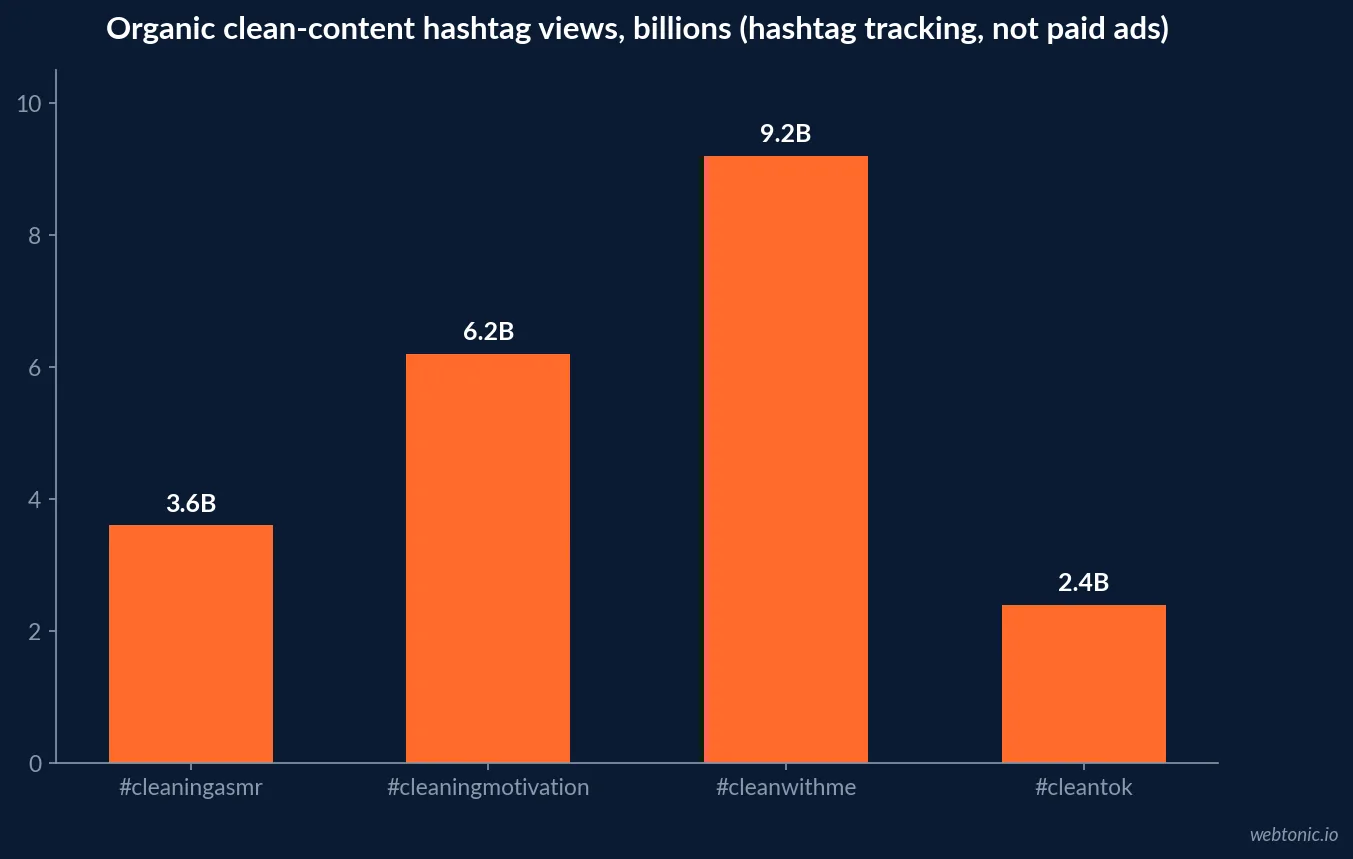
| Hashtag (organic, not paid) | Approx. tracked videos | Approx. total views | Content type |
|---|---|---|---|
| #cleantok | ≈4,200 | ≈2.4 billion | General cleaning content, satisfying/ASMR |
| #cleanwithme | n/a (broader tag) | ≈9.2 billion | Real-time cleaning routines |
| #cleaningmotivation | n/a (broader tag) | ≈6.2 billion | Before/after motivation clips |
| #cleaningasmr | n/a (broader tag) | ≈3.6 billion | Sound-focused cleaning content |
Toklytics totals only cover the videos its tracker has indexed (about 4,200 for #cleantok), so treat them as a floor, not the size of the community: TikTok itself put cumulative #CleanTok views above 78 billion when it announced the Unilever partnership in June 2023. Either way, this is organic reach, not paid inventory.
What TikTok's own small-business research actually shows
TikTok's newsroom coverage of its Oxford Economics-commissioned study reports that small and midsize business use of TikTok - paid advertising and free organic tools combined - supported a USD 24.2 billion contribution to US GDP and more than 224,000 American jobs, with SMB paid advertising and marketing specifically driving nearly USD 15 billion in 2023 US revenue. TikTok's own 2025 Small Biz Fest release puts the count of US businesses on the platform at more than 7.5 million, with 74% of them saying TikTok helped them scale.
None of this is broken out by industry. It is the strongest platform-level evidence available that small local-service businesses can succeed on TikTok in general - it is not a cleaning-specific case, and it does not distinguish paid ad spend from free organic reach in the per-business numbers.
| TikTok small-business figure (TikTok Newsroom, Oxford Economics) | Figure | Scope |
|---|---|---|
| US GDP contribution from SMB use of TikTok | USD 24.2 billion | All industries, 2023 data |
| US jobs supported | 224,000+ | All industries |
| SMB paid ad + marketing revenue driven | ≈ USD 15 billion (2023) | Paid + organic combined, all industries |
| US businesses active on TikTok | 7.5 million+ | All industries, 2025 |
| Businesses saying TikTok helped them scale | 74% | Self-reported, all industries |
The small-business owner survey that comes closest to a budget number
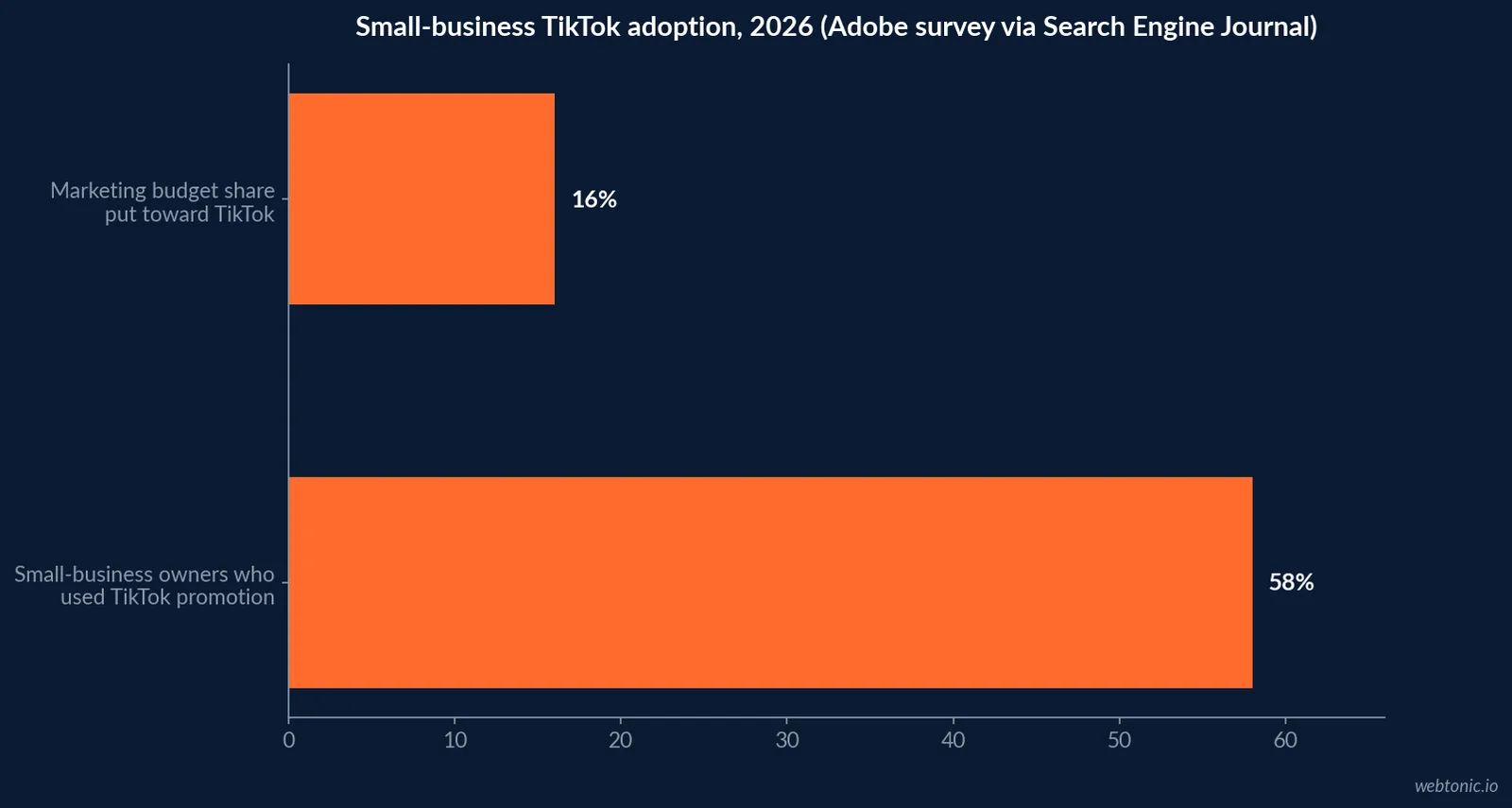
Adobe's 2026 survey of 200 US small-business owners and 800 consumers, reported by Search Engine Journal, found that 58% of the surveyed owners had already used TikTok for promotions, allocating an average of 16% of their marketing budget to TikTok content creation and a further 15% of their SEO budget to TikTok search optimization. That is still a general small-business figure, not a cleaning-specific one, but it is the closest published number to a real allocation rate rather than a platform-level GDP claim.
Applied conservatively to a cleaning company already spending on Google or Meta ads, a 10-16% test allocation of the existing digital budget - not a separate new line item - is a defensible starting point that mirrors what this survey's owners actually reported doing.
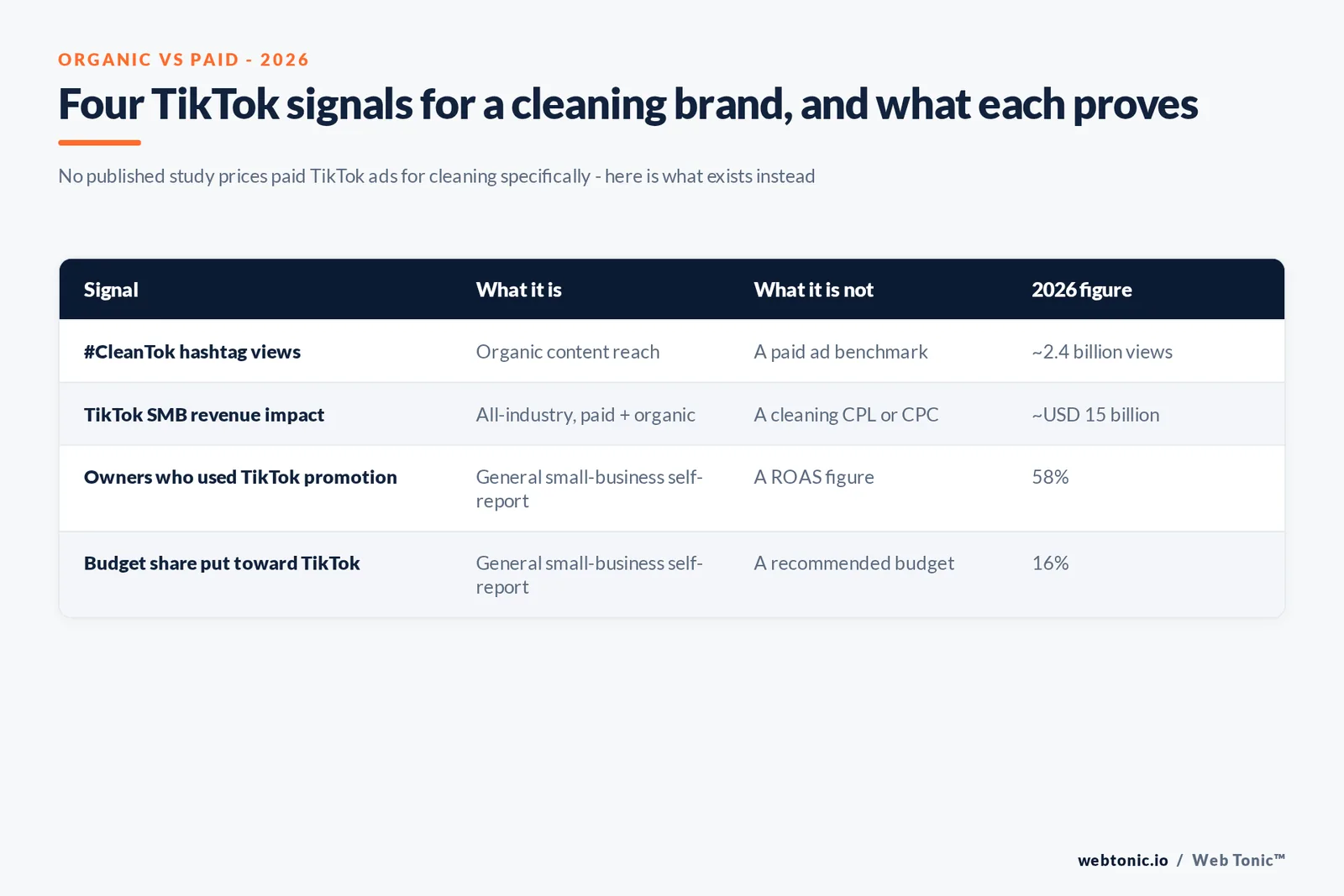
| Signal | What it is | What it is not |
|---|---|---|
| 2.4B #cleantok views | Organic content reach, cleaning-specific | A paid ad benchmark |
| USD 15B SMB TikTok revenue (2023) | All-industry, paid + organic combined | A cleaning CPL or CPC |
| 58% of owners used TikTok promotion | General small-business self-report | A ROAS or CPA figure |
| 16% of budget to TikTok content | General small-business self-report | A recommended cleaning budget |
Why organic is the rational starting point in this specific market
ISSA, the worldwide cleaning industry association, sizes the US janitorial market at roughly USD 112 billion in 2026, spread across an estimated 1.23 million businesses, with firm count growing faster (≈4.2% a year) than the market itself (≈2.7%). In a market this fragmented, a free organic channel with a genuinely large built-in audience is a more rational first move than committing paid budget to a platform with no published cleaning-specific cost data at all.
That fragmentation is also why the honest gap matters: a media buyer who assumes TikTok pricing mirrors search or social benchmarks from other categories is guessing in a market crowded enough that the guess is expensive if wrong.
| Why organic-first makes sense here | Evidence | Source |
|---|---|---|
| No published paid TikTok benchmark for cleaning exists | N/A by category | Absence of data itself |
| The organic audience is large and already engaged | ≈2.4 billion #cleantok views | Toklytics |
| The market is fragmented and price-sensitive | ≈1.23 million competing firms | ISSA |
| Small businesses already report success without heavy paid spend | 74% say TikTok helped them scale | TikTok Newsroom |
How cleaning compares on the paid channels that do publish benchmarks
Where TikTok has no published cleaning-specific ad cost data, Google and Meta both do. WordStream by LocaliQ's 2025 Home Services benchmarks put Cleaning/Maid/Butler Services at a 17.65% conversion rate and $46.99 cost per lead on paid search - the strongest results in its 16-subcategory home services set. That gives a cleaning brand a real comparison point when deciding how much of a limited budget to risk on an unproven TikTok test versus a channel with a proven, category-specific track record.
A defensible split is to keep the bulk of paid budget in the channel with published, favorable cleaning-specific data, and treat TikTok as a small, bounded test funded from the same budget rather than a new, larger line item.
| Channel | Cleaning-specific cost data published? | What that means for budget allocation |
|---|---|---|
| Google Search Ads | Yes - WordStream/LocaliQ, $46.99 CPL | Primary paid channel, proven for this category |
| Meta/Facebook Ads | Partial - home services proxy data exists | Secondary channel, directional benchmark |
| TikTok Ads | No cleaning-specific benchmark published | Small bounded test, funded from existing budget |
The compliance line that applies regardless of platform
Whatever the platform, a cleaning brand's ad creative citing customer results is bound by the same rule: the FTC's 2024 rule bans buying, selling, or fabricating consumer reviews and testimonials, with civil penalties for knowing violators. A boosted #CleanTok-style clip that shows a real job with a real customer's consent clears that bar easily; a scripted "customer" giving a manufactured quote does not, on TikTok or anywhere else.
Pairing that discipline with BrightLocal's finding that 97% of consumers already read reviews before choosing a local business reinforces the point: authentic organic content and compliant paid creative are the same asset, not a tradeoff.
A test plan built from what the evidence supports
Given the honest gap in cleaning-specific paid data, the defensible path is: build organic #CleanTok-style content first (it is free, the format is proven at scale, and it generates the raw footage a Spark Ad needs anyway), then boost the single best-performing organic post with a modest paid budget test rather than commissioning a from-scratch paid creative. Track the test against the company's own booking form, since no external benchmark exists to compare a cleaning-specific TikTok campaign against.
Any review of an existing organic clip for reused customer testimonials should also check it against the FTC's 2024 rule banning fake reviews and testimonials, which applies to ad creative on any platform, TikTok included.
What "good" would even look like for this test
Absent a published benchmark, define success before spending: a lead cost at or below the channel already proven for this category (Google's $46.99 cleaning-specific cost per lead is the honest bar to beat), a minimum sample of bookings large enough to be more than noise, and a comparison against the same clip's organic performance so the paid boost is judged on incremental reach, not total reach it would have gotten anyway.
Sizing a test budget against what a booked job is actually worth
HomeAdvisor's 2026 cost guide puts a standard house cleaning at $25 to $90 an hour. Against that per-job value, a first TikTok test of a few hundred dollars behind one boosted organic clip only needs to produce a handful of bookings to prove itself - a far lower bar than the enterprise-scale ad spend most published platform benchmarks are built around.
Setting the test size against the real value of a single job, rather than against an arbitrary percentage of the overall marketing budget, keeps the experiment honest about what it is actually trying to prove.
Where to go from here
If TikTok is one channel inside a broader paid mix, our Facebook ads cost breakdown covers how a comparable social platform prices leads, our conversion rate benchmarks by format put a TikTok test in context against search and social, and our performance creative practice can help turn organic #CleanTok-style footage into a Spark Ads test.
Frequently Asked Questions
Is there an official TikTok ad cost benchmark for cleaning companies?
No. TikTok does not publish per-industry paid advertising benchmarks, and the vendor round-ups that claim to have one rarely disclose a named sample or method. What does exist is TikTok's own Oxford Economics commissioned research on small-business impact and the platform's organic hashtag data - both are cited here, and both are labeled for what they measure: economic impact and organic reach, not a cleaning-brand paid CPC or CPL.
What is #CleanTok and is it the same as paid advertising?
No - #CleanTok is an organic content community, not a media channel a brand buys into directly. Tracked #cleantok videos have logged roughly 2.4 billion views with an average of 561,000 views per video and a 7.1% viral ratio, according to Toklytics' hashtag tracking. A cleaning brand's paid ad can reference or run alongside that aesthetic through Spark Ads boosting an organic post, but the hashtag's reach figures are not a paid-media benchmark.
Should a small cleaning company advertise on TikTok at all?
The general small-business evidence is favorable but not category-specific. TikTok's newsroom reports more than 7.5 million US businesses use the platform and that 74% of businesses on TikTok say it has helped them scale. An Oxford Economics study commissioned by TikTok found SMB paid advertising and marketing on the platform drove nearly USD 15 billion in US revenue in 2023. None of that is cleaning-specific, so treat it as a directional case for testing a small budget, not a guaranteed return.
What should a cleaning brand actually post before running paid TikTok ads?
Organic first. Given #CleanTok's scale and the platform's own data showing most small businesses use free organic tools as much as paid ones, a cleaning brand should build 10-15 organic before/after or ASMR-style cleaning clips, see which format gets genuine engagement, then boost the winner with Spark Ads rather than designing a paid creative from a blank page.
Are TikTok ads regulated the same way as Google's Local Services background-check rules?
No - TikTok's ad policies govern content and claims, not background checks or licensing, which are a Google Local Services requirement specific to that product. A cleaning brand running TikTok ads still has to comply with the FTC's 2024 rule banning fake reviews and testimonials in any ad creative that cites customer feedback, regardless of platform.
Sources
Toklytics - #cleantok TikTok hashtag tracking
TikTok Newsroom - Oxford Economics SMB economic impact report
TikTok Newsroom - Small Biz Fest 2025 release
Search Engine Journal - Adobe's 2026 TikTok search and small-business survey
Federal Trade Commission - Final rule banning fake reviews and testimonials
ISSA - The state of the cleaning and facility solutions industry, 2026
WordStream by LocaliQ - 2025 Home Services Search Advertising Benchmarks
BrightLocal - Local Consumer Review Survey 2026
HomeAdvisor - 2026 house cleaning prices