Table of contents

Vehicle listings with a walk-around video draw 19% more detail-page views, and 91% of businesses now use video as a marketing tool. The open question for 2026 dealership and powersports budgets is not whether to fund video - the data on that is settled - but where the incremental dollar goes: production, short-form cuts, or paid promotion behind the finished asset.
Key Takeaways
- 91% of businesses use video as a marketing tool in 2026, a joint all-time high.
- 93% call video an important part of their strategy.
- 67% of non-users plan to start using video in 2026.
- Feeling video "isn't needed" and cost are tied as the top barriers, both at 24%.
- Vehicle detail pages with video draw 19% more views than listings without.
- Photo-plus-video listings can see view lifts up to 195% over stock photos alone.
- Dealer sites with video coverage hold visitors 44% longer.
- Those same sites see bounce rate fall by 20%.
- Consumers watch an average of 8 videos before leaving a dealer site.
- 46% of teams are keeping video budgets flat in 2026.
- Only 9% of teams plan a large video budget increase.
- 41% of companies spent under USD 20,000 on video promotion in 2025.
- Short-form video drives the highest ROI for 48.6% of marketers.
- 59% of video marketers produce video themselves, in-house.
- BRP now reimburses up to USD 250 per video under its 2026 OEM co-op program.
Video adoption has recovered to an all-time high
Wyzowl's 2026 Video Marketing Statistics report, now in its 12th consecutive year of data and built from 266 marketing professionals and consumers surveyed in late 2025, found 91% of businesses use video as a marketing tool, matching the prior all-time high after a brief dip, and 93% call it an important part of their overall strategy. Among the minority still holding out, 67% plan to start in 2026, though that share has slipped 1 point from the year before.
The two most common objections to starting are tied: 24% say they don't feel video is needed and another 24% say it's too expensive, with lack of time (19%) close behind. For a dealership, both objections are weaker arguments than they look, since the most-cited barrier - cost - is directly contradicted by the co-op reimbursement programs OEMs are now funding (see below).

| Video marketing adoption (Wyzowl 2026) | Figure | What it signals for dealer budgets |
|---|---|---|
| Businesses using video | 91% | Video is now a baseline expectation, not a differentiator alone |
| Marketers calling it strategically important | 93% | Budget conversations should assume video is funded |
| Non-users planning to start in 2026 | 67% | The remaining gap is closing, not widening |
| Top barrier: feels unnecessary | 24% | Directly refuted by the vehicle-detail-page data below |
| Top barrier: cost | 24% | Partly offset by OEM co-op video reimbursement |
What video does to a single vehicle listing
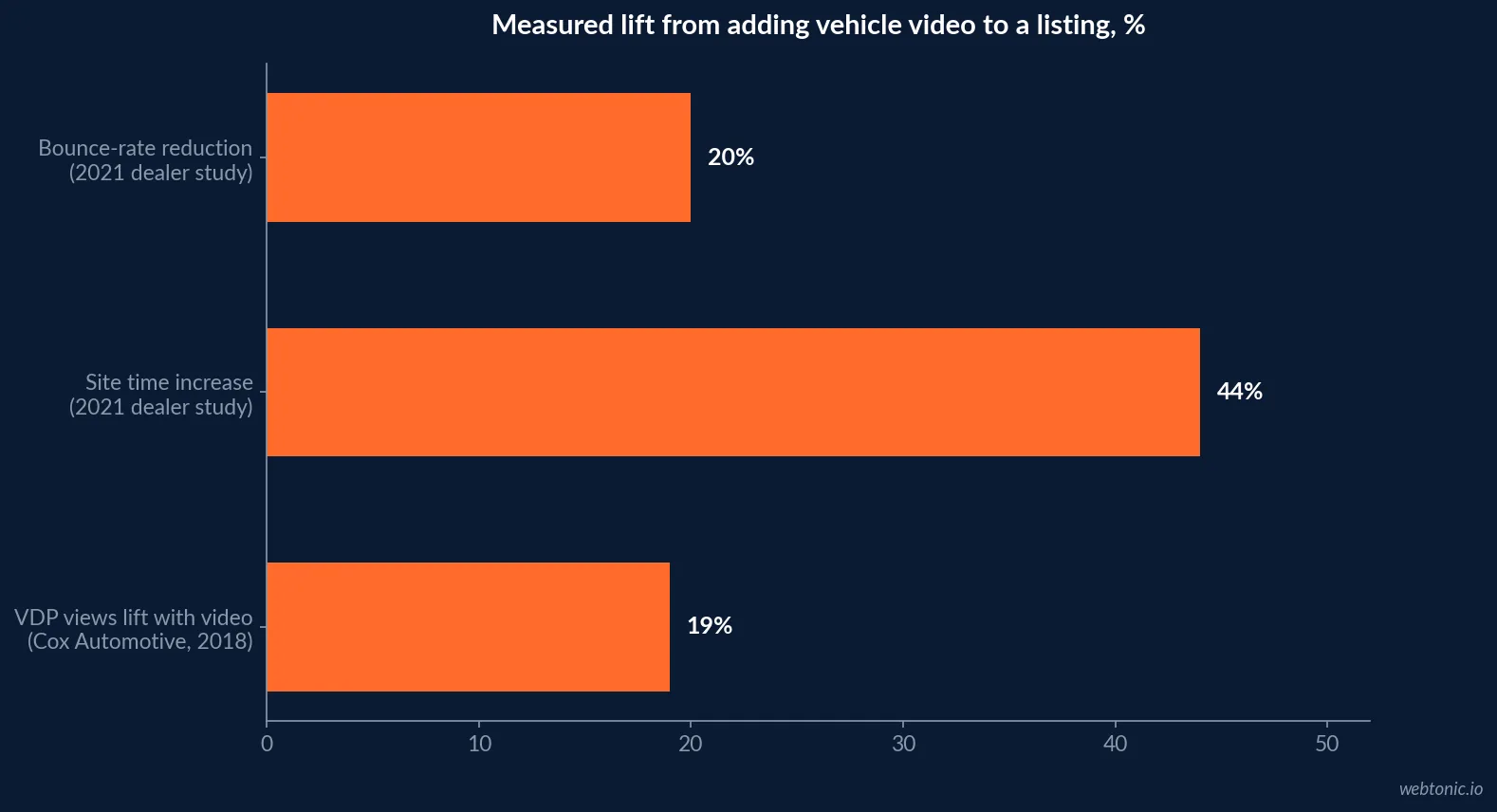
The dealer-specific evidence is older than the 2026 survey data above but remains the most direct test available. Cox Automotive's video-merchandising research found vehicle detail pages with video attached drew 19% more views than listings without one, and inventory shown with multiple custom photos plus video saw view increases as high as 195% over stock-photo-only listings - a gap large enough that photo-and-video quality functions as its own lead-generation channel, independent of any paid media spent driving traffic to the listing.
A separate nationwide LESA/Vistadash study of 100 dealerships with at least 65% video coverage found consumers spent 44% more time on dealer websites carrying vehicle video, with bounce rate falling 20% as video coverage increased. The same study found the average visitor watches 8 videos before leaving a dealer site, typically consuming either the first 25-30 seconds or a full 1.5 to 2 minutes of a walk-around, rarely something in between.
| Dealer-specific video metric | Lift | Study | Note on age of data |
|---|---|---|---|
| Vehicle detail page views | +19% | Cox Automotive video merchandising research | Directional, study conducted pre-2020 |
| Photo + video vs. stock photo views | up to +195% | Cox Automotive video merchandising research | Directional, study conducted pre-2020 |
| Site time with video coverage | +44% | LESA/Vistadash nationwide study, 100 dealers | 2021 study, most recent available at this scope |
| Bounce rate with video coverage | -20% | LESA/Vistadash nationwide study, 100 dealers | 2021 study, most recent available at this scope |
Budgets are flat, not shrinking
Wistia's 2026 State of Video Report, built from 900-plus professionals and an analysis of over 13 million videos totaling 79 million hours of viewing, found 46% of teams keeping their video budget flat this year, 40% increasing it a little and only 9% increasing it by a lot, while a small 5% are cutting spend. On the production side, almost 40% of companies spent under USD 5,000 producing video last year, and on promotion, 41% spent under USD 20,000 while 28% spent over that figure.
Read together, that is a market where video has earned a permanent budget line but is no longer treated as an obvious growth lever worth overfunding - which raises the bar on getting format and distribution right rather than simply producing more footage.
| Video budget signal (2026) | Share of companies | Source |
|---|---|---|
| Keeping video budget flat | 46% | Wistia 2026 State of Video Report |
| Increasing budget a little | 40% | Wistia 2026 State of Video Report |
| Increasing budget by a lot | 9% | Wistia 2026 State of Video Report |
| Spent under USD 5,000 on production | ~40% | Wistia 2026 State of Video Report |
| Spent under USD 20,000 on promotion | 41% | Wistia 2026 State of Video Report |
Short-form is where the ROI argument is strongest
HubSpot's 2026 State of Marketing report, surveying more than 1,500 global marketers, found short-form video is the top ROI-driving format for 48.6% of marketers, ahead of long-form video at 28.6%, live-streaming at 25.1% and user-generated content at 24% - and the report notes this dominance holds across B2C, B2B and non-profit respondents alike. For a dealership or powersports rooftop, the practical read is that a single walk-around shoot should be cut into a long-form version for the vehicle detail page and multiple short-form clips for paid social and TikTok, rather than treated as a one-format asset.
Production is staying in-house for most teams: Wyzowl found 59% of video marketers create video themselves, with only 10% relying exclusively on external vendors and 32% using a mix of both - a workable model for dealer groups with an in-house content person, less so for single-rooftop operations without one.
Powersports OEMs are now funding the production line directly
Reporting on the 2026 OEM co-op season found BRP became the first major powersports manufacturer to reimburse dealers for the cost of video content production itself, up to USD 250 per video, and the resulting footage can generate further co-op claims for an influencer fee, a paid social media promotion and YouTube ad spend on top of the production reimbursement. Honda's 2026 guidelines moved in a similar direction, allocating more co-op per vehicle unit ordered and expanding eligible digital tactics.
That directly undercuts the most-cited barrier to starting video, cost at 24% in Wyzowl's data, for any dealership on an OEM program that has added this benefit - the marginal cost of a first walk-around video is now partly or fully covered before the rooftop spends a dollar of its own budget.
Where video sits in the wider research journey
Cox Automotive's 16th annual Car Buyer Journey Study, surveying 2,300 recent vehicle buyers, found that satisfaction hit a record high in 2025 as digital tools and AI-powered platforms streamlined the shopping process - the same efficiency trend that makes a well-produced walk-around video valuable, since it answers research questions before a buyer ever requests a live video call or an in-person appointment. HubSpot's broader 2026 marketing statistics roundup puts a number on the format shift behind that: short-form video (60%) now outranks long-form video (38%) and blog posts (38%) as the most-used content format among all marketers surveyed, up from fourth place a year earlier.
For a dealership, that is the argument for treating the walk-around video as a research-stage asset first and a promotional asset second - it is competing with every other touch point in an already crowded 24-step research journey, not standing alone as an ad unit.
| Content format usage (2026) | Share of marketers | Rank | Source |
|---|---|---|---|
| Short-form video | 60% | 1st | HubSpot 2026 Marketing Statistics |
| Long-form video | 38% | 2nd (tied) | HubSpot 2026 Marketing Statistics |
| Blog posts | 38% | 2nd (tied) | HubSpot 2026 Marketing Statistics |
| Short-form video as top ROI format | 48.6% | 1st for ROI | HubSpot 2026 State of Marketing |
Setting the video line for 2026
The defensible 2026 approach: keep the production budget close to where most teams already sit (under USD 5,000 covers roughly 40% of companies), claim any OEM co-op reimbursement available for the shoot itself, cut every walk-around into both a long-form vehicle detail page asset and short-form paid social clips, and route the flat-to-modest promotion increase most teams are making toward the short-form format that 48.6% of marketers already rank as the top ROI performer. Our creative production team builds that split-format pipeline from a single shoot, and our take on whether paid social is worth the investment is a useful companion read before allocating the promotion side of the budget, and talking to us directly is the fastest way to scope a shoot against an OEM's specific 2026 co-op guidelines.
Frequently Asked Questions
How many dealerships and marketers are actually using video?
Wyzowl's 2026 Video Marketing Statistics report, surveying 266 marketing professionals and consumers in late 2025, found 91% of businesses now use video as a marketing tool, back to a joint all-time high after a slight dip the prior year, and 93% call it an important part of their overall strategy. Among the minority still not using video, 67% say they plan to start in 2026, and the top two reasons for holding off - feeling it isn't needed and cost - are tied at 24% each.
Does adding video to a vehicle listing actually change buyer behavior?
The clearest dealer-specific evidence is a Cox Automotive video-merchandising study: vehicle detail pages with video drew 19% more views than listings without one, and vehicles shown with multiple custom photos plus video saw view lifts as high as 195% over listings using stock photos alone. A separate nationwide LESA/Vistadash study of 100 dealerships found sites with video coverage held visitors 44% longer and cut bounce rate by 20%.
Are video budgets growing or staying flat in 2026?
Mostly flat. Wistia's 2026 State of Video Report found 46% of teams keeping their video budget the same this year, 40% increasing it a little, and only 9% increasing it by a lot, while 5% are cutting spend. Separately, 41% of companies spent under USD 20,000 on video promotion and advertising in 2025, and 28% spent over that figure - production and promotion are being funded as a permanent line, not treated as a growth category to chase.
Is short-form video worth a dedicated budget for a dealership?
HubSpot's 2026 State of Marketing report, surveying more than 1,500 global marketers, found short-form video is the top ROI-driving content format for 48.6% of marketers, ahead of long-form video (28.6%) and live-streaming (25.1%) - and that pattern holds across B2C, B2B and non-profit respondents alike. For a dealership, that argues for a walk-around or feature clip cut down to a short-form version, not a single long-form video used once.
Do powersports OEMs treat video budgets differently than car brands?
Yes, and the shift is recent. Reporting on the 2026 OEM co-op season found BRP became the first major powersports manufacturer to reimburse the cost of producing video itself, up to USD 250 per video, with the resulting footage eligible for further co-op claims covering an influencer fee, a paid social promotion and YouTube ad spend - a funding model most car-brand co-op programs have not matched yet.
Sources
Wyzowl - Video Marketing Statistics 2026
Wistia - State of Video Report: Video Marketing Statistics for 2026
HubSpot - 2026 State of Marketing: Data from 1,500+ global marketers
Auto Dealer Today - Nationwide study: walk-around videos increase engagement nearly 50%
Motorcycle & Powersports News - A breakdown of OEM co-op changes in 2026
Motorcycle Industry Council - Powersports industry statistics
Cox Automotive - Car Buyer Journey Study finds efficiency, digital tools and AI drive record satisfaction
HubSpot - 2026 Marketing Statistics, Trends & Data