Table of contents
Car dealerships and powersports stores both generate more leads by phone than most dashboards credit, and both leave a documented share of those leads unanswered. This page tracks the lead from click or call through to a logged, followed-up contact, using CallRail's automotive call data, NADA's advertising figures and Pied Piper's dealership response scoring.
Key Takeaways
- 37% of automotive conversations start on Google Business Profile, per CallRail.
- Google Ads drives 23% of automotive calls, organic search 22%.
- The powersports industry-wide lead response score is 44 out of 100.
- Only 47% of powersports dealers answer a web question at all.
- Just 13% offer a specific appointment time to a new lead.
- More than half of web inquiries go unanswered after 24 hours.
- Top 10% of dealer stores generate 4.5 times more leads than average.
- Paid search CPC rose 19.3% across powersports in 2025.
- More than half of dealership website traffic arrives after hours.
- Average dealership advertising spend is $586,246 a year, per NADA.
- Per-dealer digital ad conversions rose 19% year over year in Q2 2026.
- Performance Max conversions per dealer jumped 82% year over year.
- Google Search still draws 64% of network ad spend at franchised dealers.
- Missed-call rates run as high as 32% in industries CallRail tracks.
- 68% of Google Business Profile's review share slipped to 71% by 2026.
- Consumers now check six review sites on average before visiting.
The channel mix a tracking stack has to cover
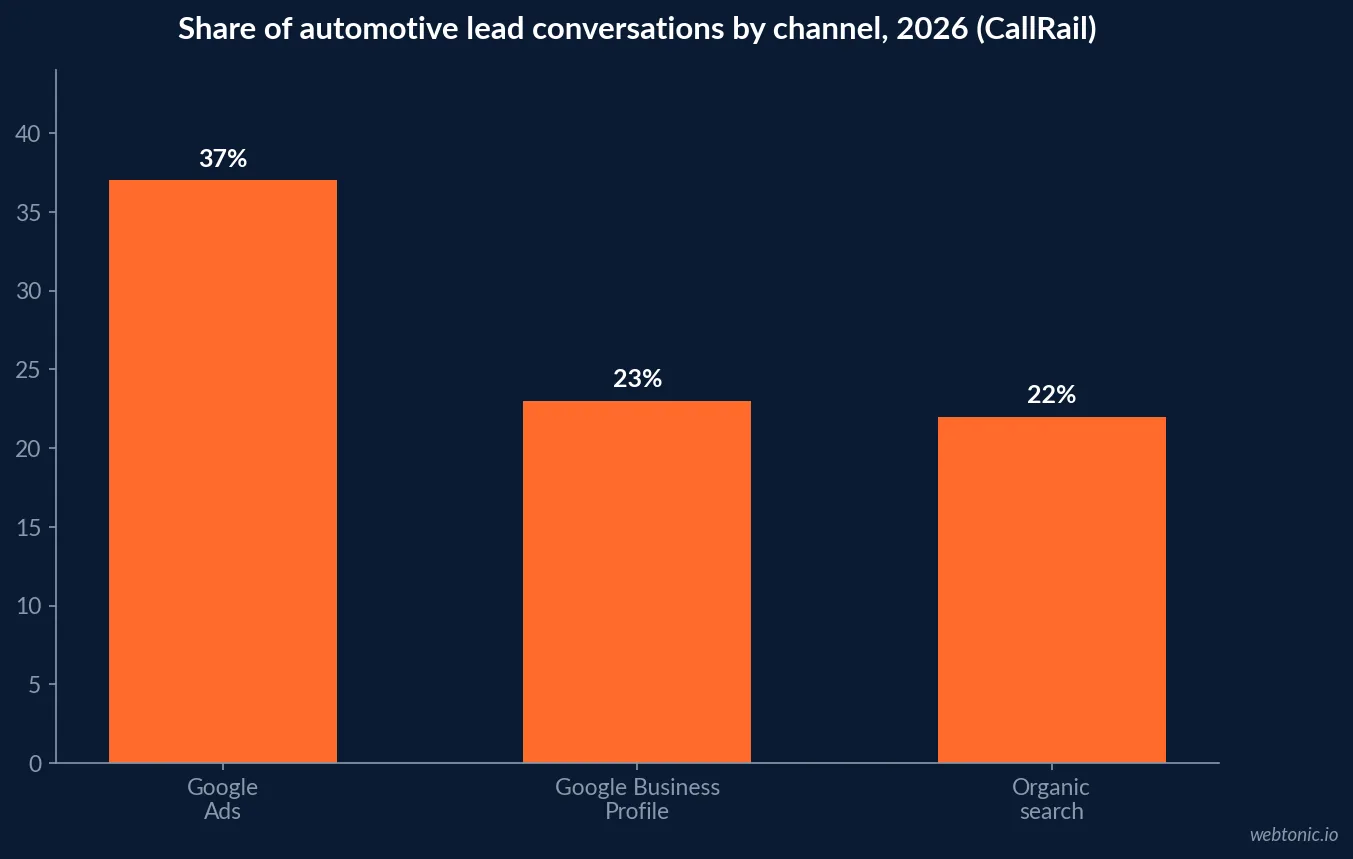
CallRail's analysis of 1.1 million leads across seven industries, including automotive, found the top three channels driving phone and text conversations industry-wide are Google Ads at 37%, Google Business Profile at 23% and organic search at 22%, with automotive skewing more heavily toward Google Business Profile calls than most of the other verticals in the sample. A dashboard that only logs web-form submissions is structurally blind to the channel most likely to be generating the call.
That matters more for powersports and dealership pairings than most retail categories, because a buyer researching a truck or an ATV is likely to call a specific location directly from a map listing rather than fill out a form first.
| Lead channel (CallRail, 1.1M leads, 7 industries) | Share of conversations | Tracking method needed |
|---|---|---|
| Google Ads | 37% | Dynamic number insertion tied to campaign/keyword |
| Google Business Profile | 23% | Location-level tracking number per listing |
| Organic search | 22% | Session-source-tagged call tracking |
| Other paid and referral | 18% (remainder) | UTM-tagged forms plus static numbers |
Where the ad spend that generates those leads is going
NADA's latest annual financial profile puts average dealership advertising spend at $586,246 a year, up 7.8% over the prior year, or $739 per new vehicle sold. Fullpath's Q2 2026 Auto Intelligence Index, tracking a nationwide network of franchised stores, found the average active dealership generated roughly 700 ad conversions in the quarter, up 19% year over year, while spend held flat at about $24,000 per store. Google Search still drew 64% of network channel spend, but Performance Max conversions per dealer jumped 82% year over year, the fastest-growing line in the index.
None of that spend produces a return if the resulting call or form goes unanswered, which is exactly what the response data below shows happening at scale.
| Spend/conversion metric (NADA/Fullpath, 2026) | Figure |
|---|---|
| Average dealership ad spend, annual | $586,246 |
| Ad spend per new vehicle sold | $739 |
| Ad conversions per active dealer, Q2 2026 | ~700 (+19% YoY) |
| Average per-dealer digital spend, Q2 2026 | ~$24,000 (flat YoY) |
| Share of network spend on Google Search | 64% |
| YoY growth in per-dealer PMax conversions | +82% |
The response gap that tracking exposes but does not fix
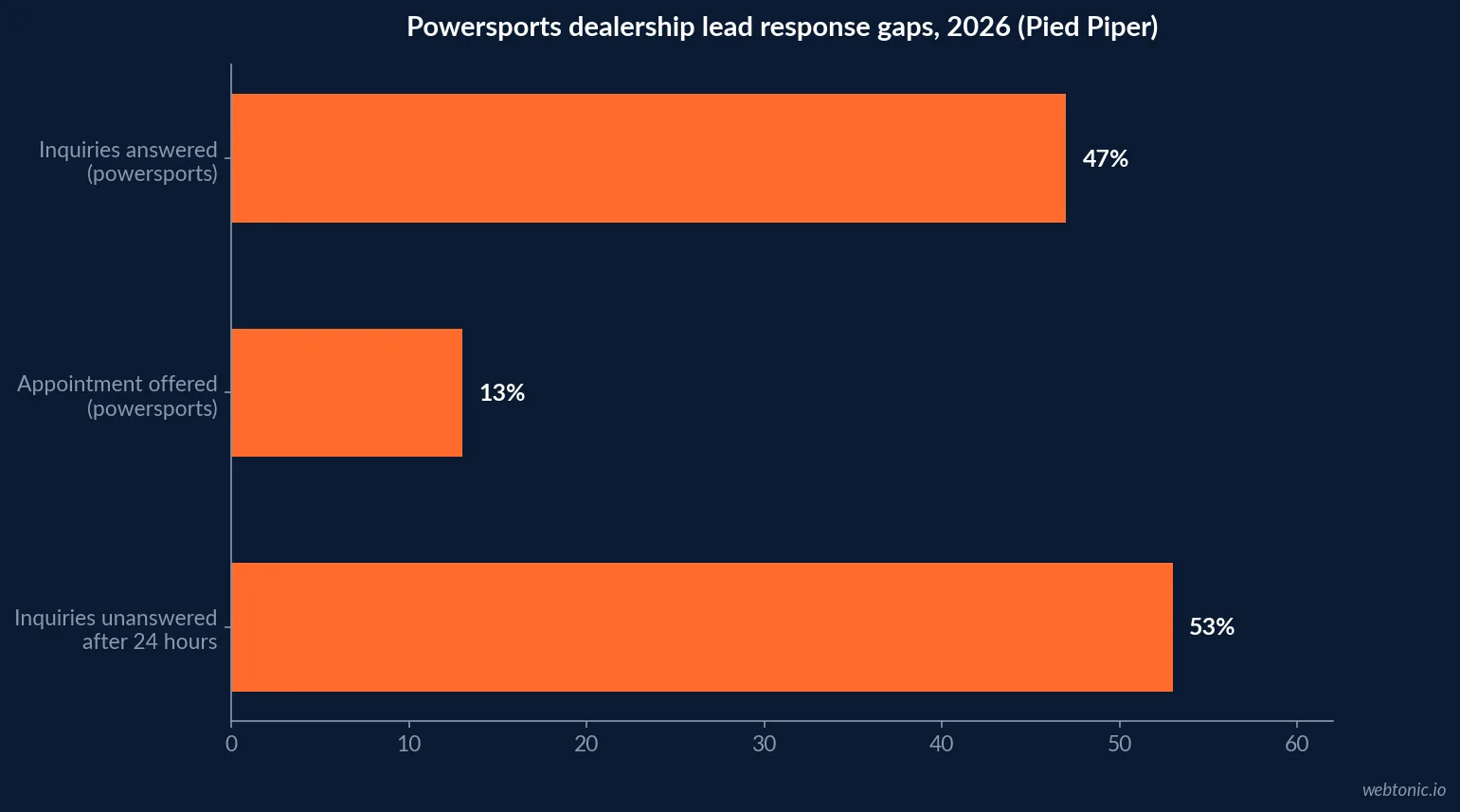
Pied Piper's 2026 Internet Lead Effectiveness study submitted real inquiries to 2,133 powersports dealership websites across every major brand and scored the reply. The industry average has been stuck in the mid-40s for five straight years, landing at 44 out of 100 in 2026. Only 47% of dealers answered a customer's question by email or text, just 13% offered an appointment for a specific date and time, and more than half of inquiries went unanswered after 24 hours.
LeadVenture's companion State of the Dealer research, built on behavior across 6,800-plus dealership websites, found more than half of all site traffic occurs after hours with most stores lacking any capture system for it, and that the top 10% of stores generate 4.5 times more leads and turn inventory 54% faster than average largely by closing that response gap, not by spending more. Paid search cost per click also rose 19.3% across the powersports segment in 2025 while conversion rates fell, which raises the cost of every lead that then sits unanswered.
| Response metric (Pied Piper/LeadVenture, 2026) | Figure | Tracking implication |
|---|---|---|
| Industry-wide average ILE score | 44 / 100 | Response time/quality must be a logged field |
| Dealers answering a customer question | 47% | Track answered vs. unanswered per lead |
| Dealers offering a specific appointment | 13% | Track appointment-offer rate as a KPI |
| Inquiries unanswered after 24 hours | >50% | Set a 24-hour SLA alert in the CRM |
| Top 10% vs. average store, lead volume | 4.5x | Response speed is the differentiator, not spend |
| Inventory turn, top 10% vs. average | +54% faster | Faster response shortens days-to-sale |
What a tracking stack for this pairing actually needs to log
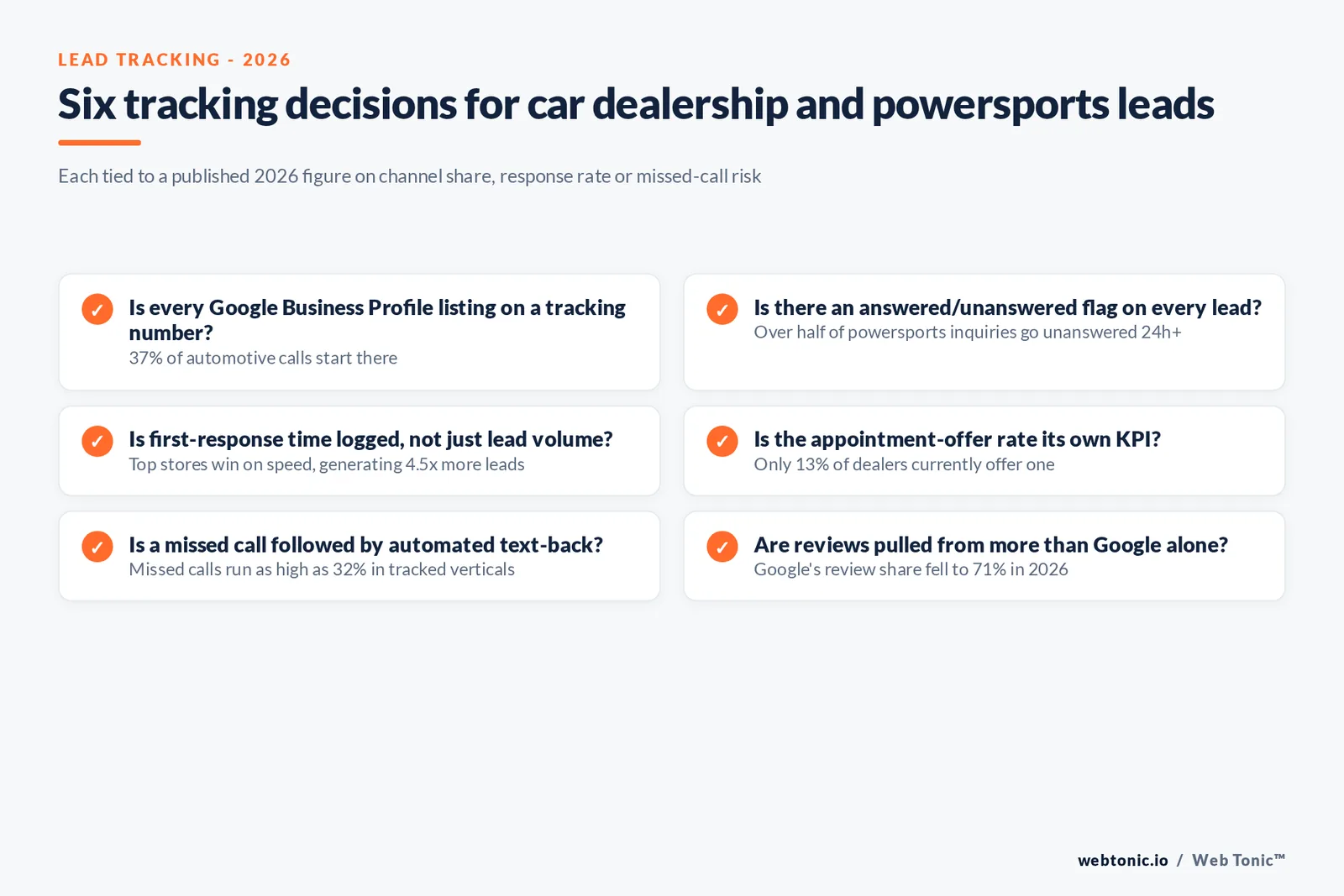
Given the channel mix and the response gap above, the minimum viable tracking build is: a call tracking number per major channel (Google Ads, Google Business Profile, organic), a logged answered/ unanswered flag on every call and form, a timestamp for first response, and an appointment-offer flag. Missed-call rates run as high as 32% in some of the industries CallRail tracks, and without automated text-back on a missed call, that share simply disappears from the pipeline with no record it ever existed.
Review-platform tracking belongs in the same build. BrightLocal's 2026 consumer survey found Google's share of review traffic slipping from 83% in 2025 to 71% in 2026, with consumers now checking an average of six review platforms before visiting, so a dashboard that only pulls Google reviews is already missing roughly three in ten review-driven touchpoints.
| Tracking build component | Why it matters here | Source figure |
|---|---|---|
| Per-channel call tracking numbers | 37% Google Ads-driven calls need attribution | CallRail |
| Answered/unanswered flag per lead | >50% of powersports inquiries go unanswered | Pied Piper |
| First-response timestamp | Top stores win on speed, not spend | LeadVenture |
| Appointment-offer flag | Only 13% of dealers currently offer one | Pied Piper |
| Missed-call text-back automation | Missed calls run up to 32% in tracked verticals | CallRail |
| Multi-platform review monitoring | Google's review share fell to 71% | BrightLocal |
How auto repair's tracking numbers compare, for context
The adjacent auto repair category, which shares many of the same lead-generation channels, gives a useful benchmark: WordStream's 2026 Search Advertising Benchmarks report puts auto repair's Google Ads cost per lead at $29.96, one of the lowest of any industry it tracks, because the category converts at 15.51% against an 8.18% all-industry average. No equivalent published benchmark exists yet for car dealerships or powersports specifically, which is exactly why building an internal tracking stack, rather than relying on an industry average that was never measured for this pairing, is the more defensible move.
Powersports Business, covering the same LeadVenture data cited above, frames the fix as operational discipline rather than a bigger media budget: dealerships that "execute the fundamentals consistently" are the ones separating from the pack, which is a tracking and process claim, not a spend claim.
Reading the numbers together
Put the spend, channel and response data side by side and the pattern is consistent: dealerships and powersports stores are spending more on lead generation and converting more of it into ad clicks, but the resulting call or form still has a documented chance of going unanswered. Fixing attribution alone cannot solve that; a dashboard needs to surface response failures as urgently as it surfaces channel performance, or the extra clicks Performance Max and search are generating are wasted downstream.
The spend context behind the leads being tracked
Innovid's 2026 Automotive Advertising Outlook found auto marketers naming fragmentation across platforms and publishers as their leading concern at 78% , ahead of cross-channel measurement complexity at 56%. That lines up directly with the channel-mix problem this page opened with: a tracking stack that cannot see Google Business Profile calls, organic search calls and paid-search calls as separate, comparable lines is exactly the fragmentation auto marketers are already flagging as their top operational risk.
| Auto marketer top concern (Innovid, 2026) | Share citing it |
|---|---|
| Fragmentation across platforms and publishers | 78% |
| Cross-channel measurement complexity | 56% |
| Demand generation as the priority | 56% |
| Cross-platform orchestration as the priority | 56% |
Next steps for a dealership or powersports group
- Add a tracking number to every Google Business Profile listing before touching paid budgets, since that channel alone drives a documented share of automotive calls.
- Set a 24-hour response SLA alert; more than half of powersports leads currently miss it.
- Log the appointment-offer rate as its own KPI, not folded into a generic "contacted" status.
- Automate missed-call text-back before increasing ad spend on channels that generate calls.
- Pull reviews from at least the top three platforms consumers actually check, not Google alone.
Our data and analytics team builds this kind of tracking stack for dealership and powersports groups, and our breakdown of cost per lead by industry gives the wider context for judging whether a given lead's cost was ever worth chasing without a fast response behind it. If your current setup cannot answer "was this lead answered in 24 hours," talk to us before the next budget increase.
Frequently Asked Questions
Where do most car dealership and powersports leads actually originate?
Phone calls, more than most dashboards admit. CallRail's analysis of 1.1 million leads across seven industries found automotive's top three channels driving conversations are Google Business Profile at 37%, Google Ads at 23% and organic search at 22% (figures vary slightly by CallRail's own reporting cuts), and automotive-industry calls specifically lean hardest on Google Business Profile of any vertical CallRail tracks. A dashboard built only around form fills is blind to the largest channel.
Why is call tracking non-negotiable for this pairing?
Because a dealership or powersports store cannot see which ad, page or listing drove a phone call without it, and phone calls are documented as the leading conversation channel in automotive. Without dynamic number insertion tied to session source, every call defaults to 'direct' in analytics, which silently over-credits organic and branded search and hides which paid channel is actually working.
What does Pied Piper's Internet Lead Effectiveness score actually measure?
Response quality on the receiving end of a tracked lead, not the lead's source. Pied Piper submitted real customer inquiries to 2,133 powersports dealership websites in 2026 and scored the reply. The industry average has sat at 44 out of 100 for a third straight year, with only 47% of dealers answering a question and 13% offering a specific appointment. A tracking stack that logs the lead but not the response time is measuring half the funnel.
How fast should a tracked lead get a first response?
Faster than half of powersports dealers currently manage. LeadVenture's 2026 State of the Dealer research, built on behavior across 6,800-plus dealership websites, found more than half of all website traffic occurs after hours with no capture system in most stores, and that the top 10% of stores generate 4.5 times more leads than average largely through faster, more complete follow-up rather than bigger budgets.
Is missed-call tracking worth building for a dealership specifically?
The industry data says yes: automotive relies on Google Business Profile calls more than any vertical CallRail measured, and a missed call in that channel is a missed lead with no retry path unless the store has automated text-back or routing in place. That single fix is cheaper than most media budget increases and directly closes the after-hours traffic gap LeadVenture documented.
Sources
CallRail - From Conversations to Conversions, 2026
NADA - 2026 Annual Financial Profile of America's Franchised New-Car Dealerships
Fullpath - Auto Intelligence Index, Q2 2026
Pied Piper - 2026 Internet Lead Effectiveness Powersports Industry Study
LeadVenture - The State of the Dealer 2026, via Motorcycle & Powersports News
BrightLocal - 2026 Local Consumer Review Survey, via AutomotiveSEO
WordStream/LocalIQ - Search Advertising Benchmarks by Industry, 2026
Powersports Business - LeadVenture State of the Dealer coverage
Innovid - 2026 Automotive Advertising Outlook