Table of contents

How we vet every listicle
Every agency featured on Web Tonic passes our 84-point editorial review before a single listicle goes live. This is how we vet each pick:
Verified client outcomes: We require real case studies with measurable KPIs — revenue, ROAS, CPA, retention — tied to the exact category being ranked. No cherry-picked wins, no unverifiable numbers.
Independent reputation: We cross-check Clutch, Google, G2, and Trustpilot ratings, and screen for review-bombing or suspicious patterns. Only operators with a consistent, verifiable track record make the cut.
Beyond that, every listing goes through a quarterly re-audit. We check 84 criteria across 6 pillars to make sure it still holds up — here are some of the checks we run:
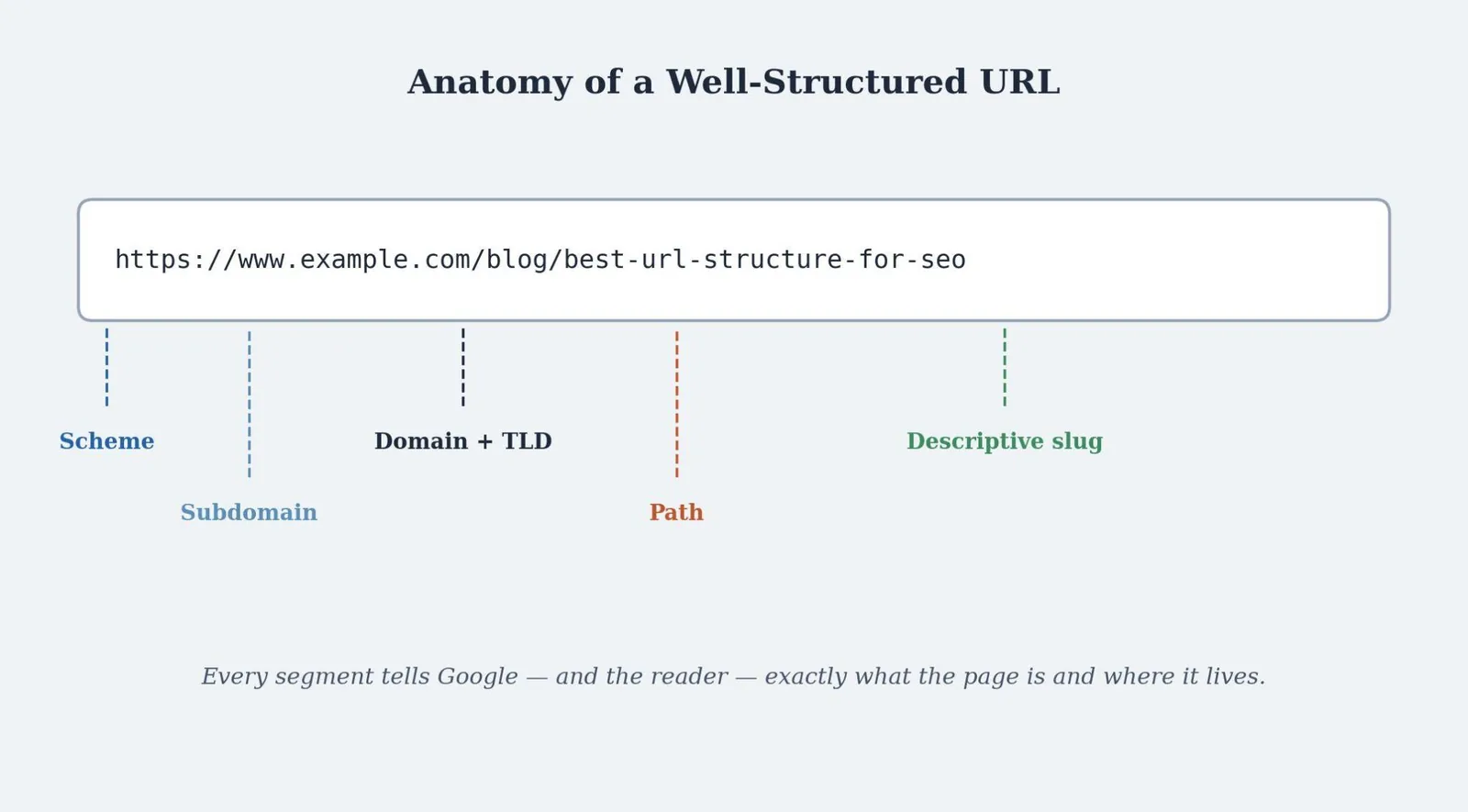
A URL is the first thing Google and a user both see before anything else on a page loads. A messy, parameter-stuffed address signals disorganization before the content even gets a chance to prove otherwise. A clean one does the opposite: it tells search engines exactly what the page is about and tells the user they're in the right place before they even click. What follows covers what actually makes a URL structure good, what Google has explicitly confirmed doesn't matter, and the specific mistakes that quietly cost websites rankings and click rates.
Key Takeaways
- Google's own URL structure documentation recommends simple, descriptive words separated by hyphens, not underscores, and warns that overly complex URLs with many parameters can waste crawl budget or block indexing entirely.
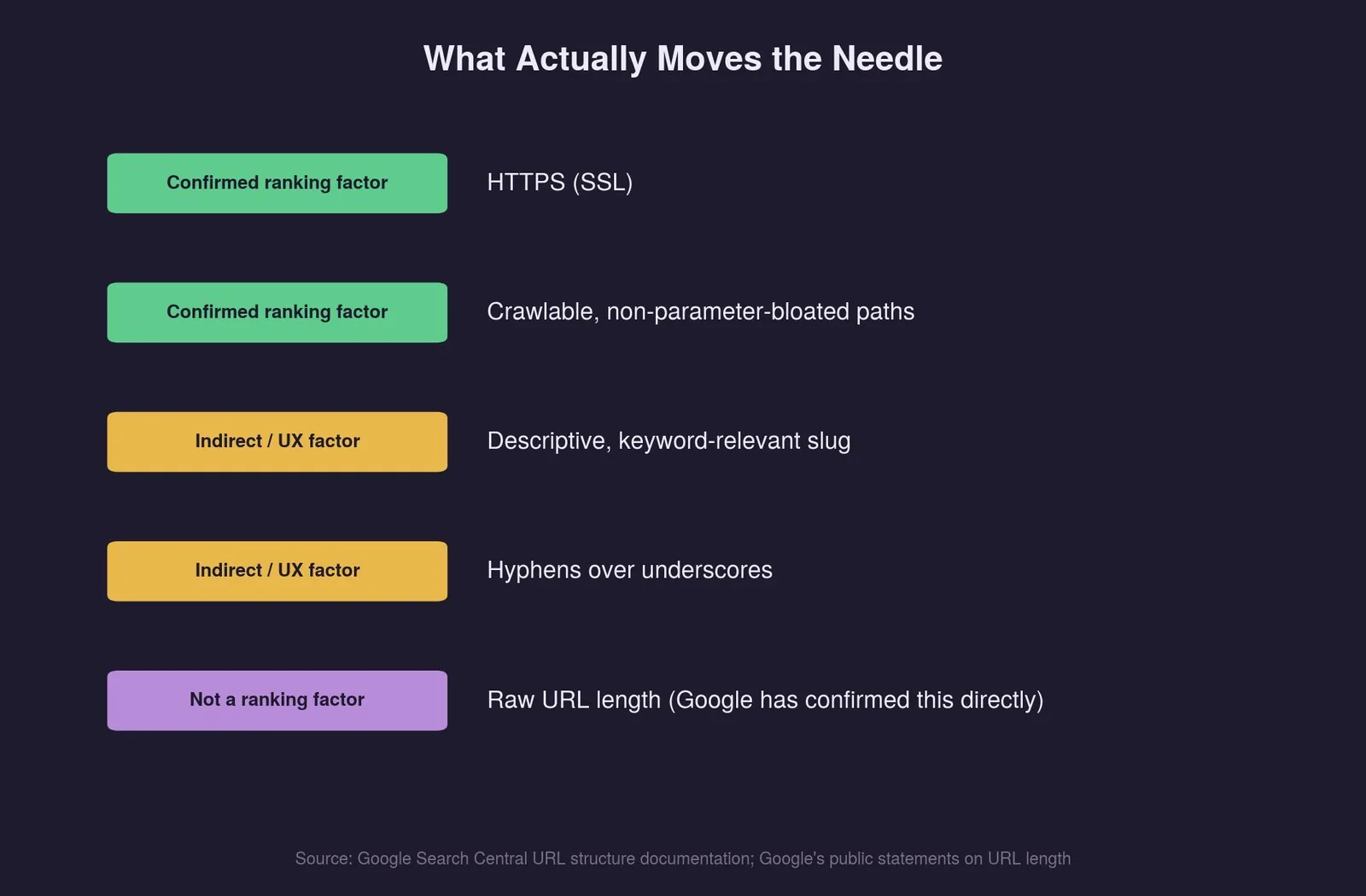
- URL length itself is not a ranking factor. Google has stated directly that URLs function as identifiers, and length has no bearing on where a page ranks.
- Hyphens and underscores are read completely differently by Google. A hyphenated slug like /seo-url-structure reads as three distinct, matchable words. An underscored one like /seo_url_structure reads as a single unbroken string.
- One analysis of 4 million search results found URLs with a keyword matching the search query earned roughly 45% more clicks than those without, according to Backlinko data cited by Loop Digital — a single-source figure worth treating as directional rather than universal.
- For international targeting, Google treats ccTLDs, subdirectories, and subdomains as equally valid options. The right choice depends on resources and management overhead, not a hidden ranking preference.
- Dynamic parameters and session IDs don't get you penalized — Google has clarified duplicate content isn't punished directly — but they waste crawl budget and dilute ranking signals across near-identical pages, which is functionally just as costly.
What Makes a URL "SEO-Friendly"?
An SEO-friendly URL is short, descriptive, uses lowercase letters and hyphens, runs on HTTPS (the SSL/TLS-secured version of the protocol), and reflects a logical site hierarchy — ideally two to four folder levels deep. Every part of a URL (Uniform Resource Locator) serves a distinct purpose: the scheme (https://) defines the connection type, the domain identifies the site, and the path and slug describe exactly where a specific page sits within it.
Google's own Search Central documentation is explicit about the goal: organize URLs "logically and in a manner that is most intelligible to humans," using UTF-8 encoding for non-ASCII characters and hyphens to separate words. That single sentence covers most of what actually matters. Get this right and the payoff shows up in user experience as much as in crawlability: people scanning Google search results can tell what a page is about from the URL alone, before they ever click through to the website.
Hyphens vs. Underscores: The One Rule Everyone Gets Right (Eventually)
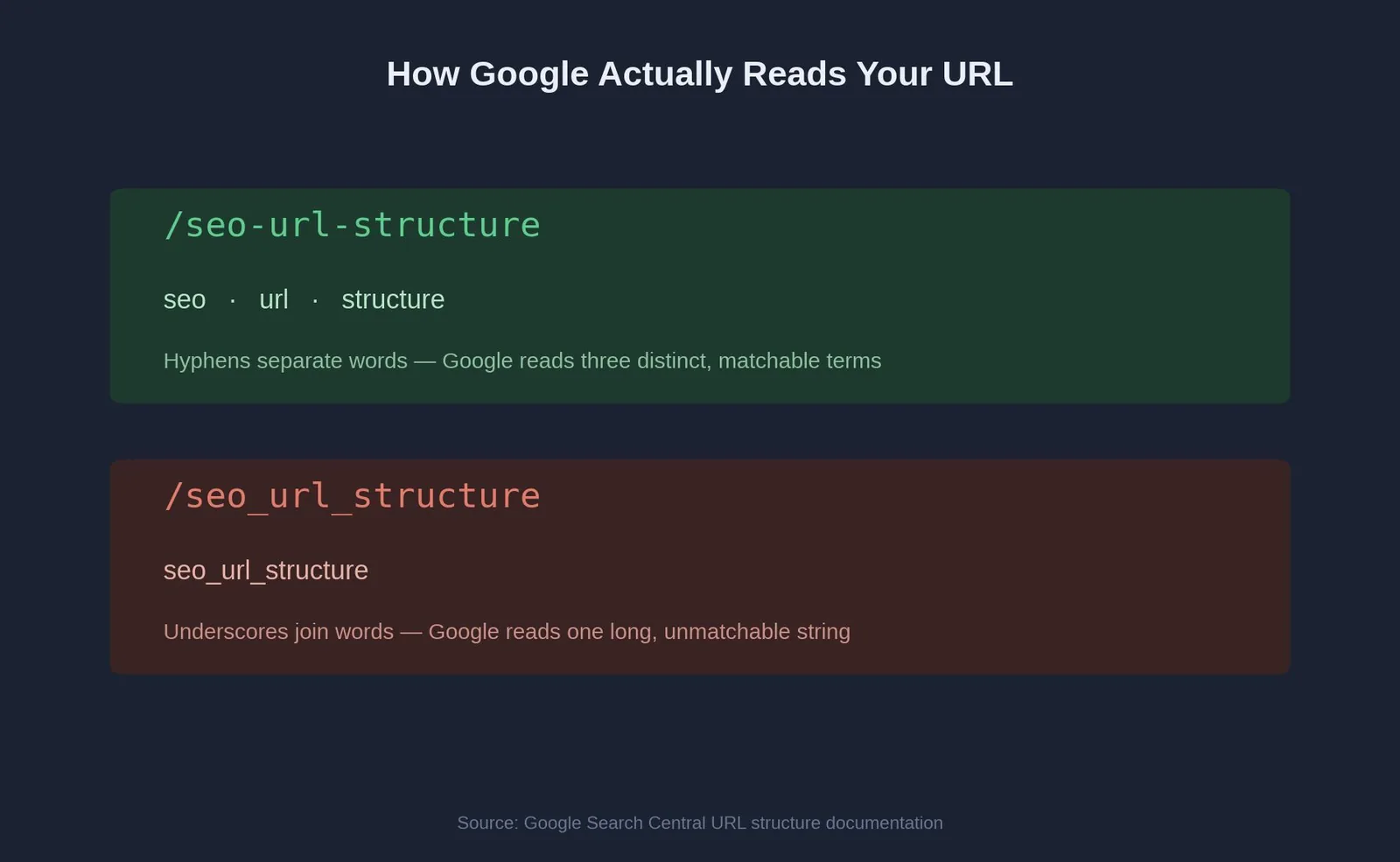
This is the most consistently confirmed best practice in URL structure, and also the most commonly violated one on older CMS platforms with default settings. Google's own documentation confirms that hyphens act as word separators while underscores act as word joiners. A slug like /best-url-structure is parsed as three individual, keyword-matchable terms. The same words joined with underscores, /best_url_structure, gets read as one long string that search engines can't break apart the same way.
One blog citing a June 2026 Bluesky post attributes to Google's John Mueller the position that hyphens in domain names carry no algorithmic penalty. Treat that as a single-source data point rather than settled Google policy, the same caution that applies to the Backlinko click-through figure above. What's well-established regardless of that specific post: avoid underscores, since Google reads them as word joiners rather than separators.
The Metric Google Says Doesn't Matter
Despite years of SEO folklore about "shorter URLs ranking better," Google has stated directly and repeatedly that URL length is not a ranking factor. Google uses URLs primarily as identifiers, not as a signal to weigh. What length does affect indirectly is user experience and click behavior: a long, cluttered URL displayed in Google search results looks less trustworthy and gets truncated more aggressively than a short, clean one, which can suppress click-through rate even though the ranking itself is untouched.
That distinction matters for where to spend effort. Chasing a shorter URL for its own sake wastes time. Writing a clearer, more descriptive one as a side effect of good information architecture is where the actual value sits.
Comparative Table: Good URL vs. Bad URL
| Element | Good example | Bad example | Why it matters |
|---|---|---|---|
| Word separator | /url-structure-guide | /url_structure_guide | Hyphens read as separate words; underscores don't |
| Case | /blog/seo-tips | /Blog/SEO-Tips | Case-sensitivity can create duplicate URLs for the same page |
| Parameters | /products/running-shoes | /products?id=8932&session=x91 | Dynamic strings and session IDs create duplicate content and confuse crawlers |
| Folder depth | /blog/url-structure | /site/content/2026/articles/blog/url-structure | Over-nesting complicates navigation and dilutes crawl efficiency |
| Descriptiveness | /best-url-structure-for-seo | /page1234 | A descriptive slug tells users and search engines what the page is about before they click |
URL Structure by the Numbers
Most URL advice is repeated without a source, so it helps to separate what has actually been measured from what is convention. Two large-scale datasets are worth knowing, and both point the same way: URL shape correlates with rankings, but weakly enough that it belongs near the bottom of a priority list.
| Finding | Figure | Source |
|---|---|---|
| Average first-page URL length | 66 characters | Backlinko / Ahrefs, 11.8 million search results |
| SERP rows analysed in the 2026 URL-length study | 27,291 SERPs, 22,250 top-10 results | seo-kreativ, DataForSEO sample |
| Keywords and industries in that sample | 2,862 keywords across 9 industries | seo-kreativ, May 2026 |
| How much the length effect shrinks once domain authority is controlled for | by roughly 36% | seo-kreativ regression analysis |
| Practical slug length most guidance converges on | 3 to 5 descriptive words | Convention, not a Google rule |
| Crawl-ratio gain we measured after restricting parameter sprawl | 20% | Web Tonic e-commerce client |
The 66 characters figure comes from Backlinko's analysis of 11.8 million Google results with Ahrefs data, and it is a correlation, not a target. The 2026 study of 27,291 SERPs goes further: shorter URLs do rank marginally better, but after controlling for an external domain-authority signal the advantage falls by about 36% and what remains is small enough that the authors argue URL length should never be a priority-one lever. On separators there is no ambiguity at all — Google's own URL structure documentation recommends hyphens over underscores outright, and Google's developer style guide repeats it for filenames.
So the honest reading is a split one: the separator rule is documented and worth enforcing site-wide, while the length rule is a weak correlation you should satisfy incidentally by writing clear slugs. If a page needs 5 words to describe itself accurately, use 5. Trimming a URL from 72 to 58 characters is not an optimisation worth a redirect.
International URLs: ccTLD, Subdirectory, or Subdomain?
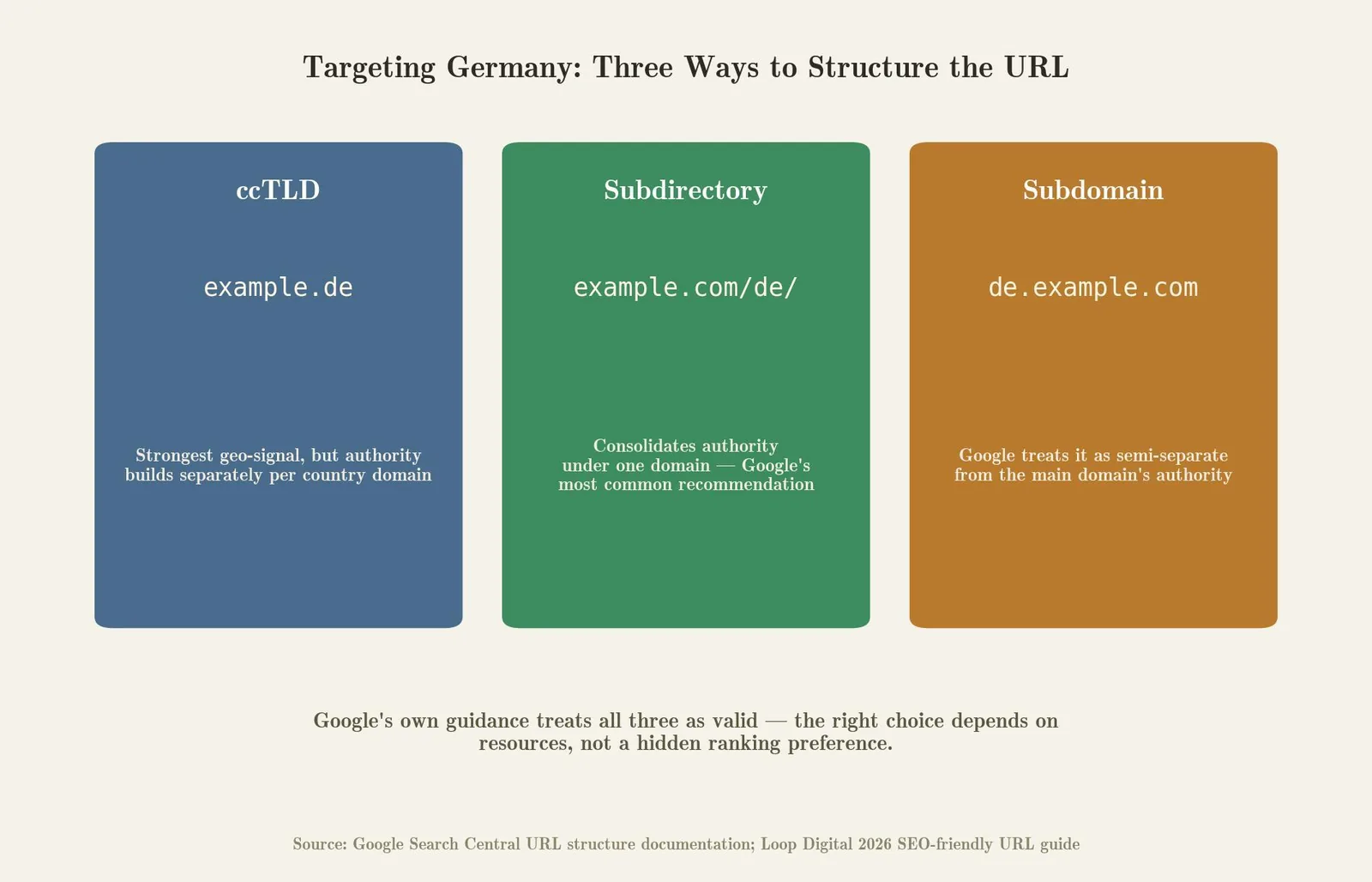
A site targeting multiple countries has three structural options, and Germany is the textbook example used across most international SEO guidance to illustrate the tradeoffs. A ccTLD is simply a country-code top-level domain — the .de or .fr at the end of an address — rather than a generic one like .com. example.de sends the strongest geographic signal but builds domain authority separately from the main site. A subdirectory like example.com/de/ consolidates all of a domain's authority in one place, which is the option most commonly recommended unless there's a specific technical reason to split. A subdomain like de.example.com sits in between: Google treats it as more separate from the root domain than a subdirectory, but not as fully independent as a separate ccTLD.
Google's own updated guidance uses this exact example, recommending either a country-specific domain or a country subdirectory to help Google understand the intended audience for regional content. None of the three is a hidden ranking advantage over the others; the right pick depends on how much separate authority-building effort a business can sustain per market. This same logic extends past URLs into social media handles and business listings, where consistent country signals across a brand's entire online footprint reinforce whichever structure the URL itself commits to.
Why UTM Parameters and Session IDs Are a Duplicate Content Risk
UTM tracking parameters, session IDs, and filter strings all append variables to the end of a URL without changing the actual page content underneath. From a user's perspective, example.com/product?utm_source=newsletter and example.com/product are the same page. From a crawler's perspective, without proper handling, they can look like separate URLs competing for the same search engine real estate.
Google's John Mueller has clarified that duplicate pages don't trigger a penalty the way some SEO folklore suggests. The real cost is crawl budget waste and diluted ranking signals — Google splits authority across near-identical URLs instead of consolidating it on one, which can suppress the exact page you wanted to rank. None of this is visible to the users clicking through from an ad or newsletter — they land on the same page either way — but unmanaged parameters can quietly suppress the click rates and rankings of the clean version they're competing against.
The scale problem is easiest to see on large e-commerce sites, where filters and parameters combine explosively. A single category page with a handful of filterable attributes can generate combinations numbering in the millions, all technically unique URLs, nearly all showing the same underlying products. One documented case study on a mid-sized e-commerce client found that introducing crawl restrictions on that kind of parameter sprawl improved crawl ratio by 20%, freeing up budget for pages that actually needed to rank.
The fix doesn't require blocking parameters outright. Use canonical tags to point tracked or parameterized URLs back to the clean version, and use the URL parameter handling available through Google Search Console to tell Google which parameters to ignore. Google Analytics still needs the UTM parameters for attribution — the goal isn't to remove tracking, just to stop it from fragmenting how the page gets indexed.
Try It Yourself: URL Structure Analyzer
Paste any URL below and get an instant structural review against Google's own guidance.
URL Structure Analyzer
Paste a URL to check its structure
Checks the path only \u2014 not a live crawl or ranking prediction, just a structural review against Google's own guidance.
Common Mistakes in URL Structure
Underscores instead of hyphens are still the single most common structural mistake, usually inherited from a CMS default setting that nobody changed before launch. It quietly undermines keyword matching on every affected page.
Dynamic parameters and session IDs left unmanaged create duplicate content at scale, particularly on larger sites where filters, sorting options, or tracking codes multiply into thousands of near-identical URL variations.
Five or six folder levels before reaching the actual content buries pages under unnecessary hierarchy and dilutes the link equity that would otherwise flow directly to them.
And redesigns that change URLs without setting up 301 redirects are among the most damaging, entirely avoidable mistakes a site can make, since they forfeit the ranking history and backlinks the old URL had already earned.
Frequently Asked Questions
Does URL length affect SEO rankings?
No. Google has confirmed directly that URL length is not a ranking factor. It can indirectly affect click-through rate through truncation and trust perception, but the length itself carries no ranking weight.
Should I use hyphens or underscores in URLs?
Hyphens. Google reads them as word separators, so each word remains individually matchable to search queries. Underscores are read as word joiners, collapsing multiple words into one unbroken string.
What's the ideal URL length or word count?
There's no fixed number Google enforces, but most current guidance converges on roughly 3 to 5 descriptive words in the slug, which balances clarity with brevity without chasing an arbitrary character limit.
Should international sites use a ccTLD, subdirectory, or subdomain?
All 3 are valid according to Google's own documentation. Subdirectories consolidate domain authority most efficiently, ccTLDs send the strongest geo-signal at the cost of separate authority-building, and subdomains sit in between.
Do UTM parameters hurt SEO?
Not inherently, but unmanaged ones can create duplicate content. Canonical tags and Google Search Console's parameter handling keep tracking data intact for Google Analytics without fragmenting how Google indexes the page.
Turning URL Structure Into a Quiet Ranking Advantage
Best URL structure for SEO isn't about chasing a shorter character count or a cleverer slug. It's about giving Google and every user a clear, honest description of what a page contains before either one commits to it. Use hyphens, keep the hierarchy shallow, manage parameters instead of leaving them unchecked, and choose an international structure that matches the resources available to maintain it. Strong content still does the heavy lifting — good URL structure just removes the quiet friction that keeps otherwise good pages from getting the crawl priority and click-through rate they've actually earned.
Start with a site-wide audit for underscores and unmanaged parameters. Both are common, both are fixable in an afternoon, and both compound in cost the longer they're left alone.
More from Web Tonic: growth marketing services, data & analytics.
Sources: developers.google.com · koanthic.com · loop-digital.co.uk · webyes.com · searchengineland.com · botify.com