Table of contents
How we vet every listicle
Every agency featured on Web Tonic passes our 84-point editorial review before a single listicle goes live. This is how we vet each pick:
Verified client outcomes: We require real case studies with measurable KPIs — revenue, ROAS, CPA, retention — tied to the exact category being ranked. No cherry-picked wins, no unverifiable numbers.
Independent reputation: We cross-check Clutch, Google, G2, and Trustpilot ratings, and screen for review-bombing or suspicious patterns. Only operators with a consistent, verifiable track record make the cut.
Beyond that, every listing goes through a quarterly re-audit. We check 84 criteria across 6 pillars to make sure it still holds up — here are some of the checks we run:
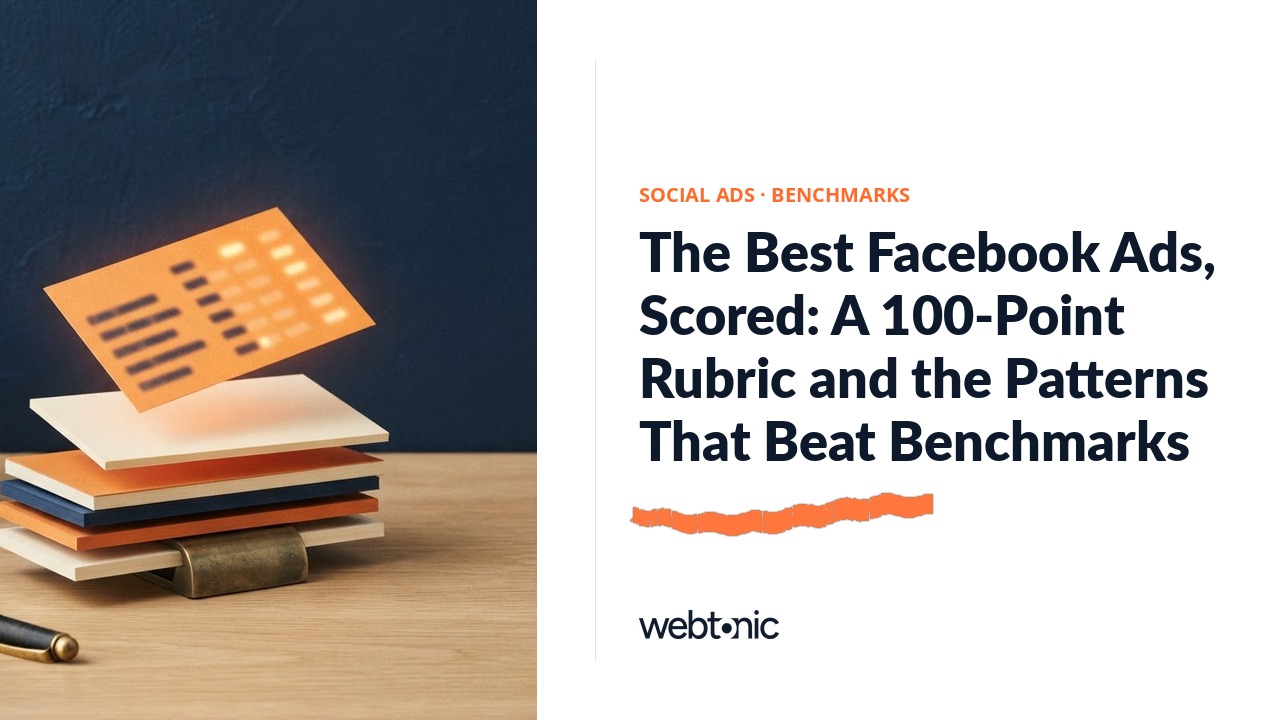
"Best" is not a design award — it is a scoring question. This page gives you a 100-point rubric, then applies it to the ads and patterns that repeatedly beat their category benchmarks.
Key Takeaways
- 5 factors decide 90% of performance: offer, hook, proof, format-to-placement fit, and friction after the click.
- The average Facebook link click-through rate sits near 0.90% — an ad in the top tier usually clears 2%.
- Average cost per lead across industries is about $27.66, so "best" means beating your own category band, not a global number.
- Lead ads and instant experiences convert best because they remove the page load between interest and action.
- The best-performing creative is rarely the most expensive — 4 of the 6 patterns below can be shot on a phone.
- Score before you spend: an ad that scores under 60 on the rubric almost never recovers with better targeting.
- Refresh at frequency 2.5; even a great ad decays after 3 to 4 weeks on the same audience.
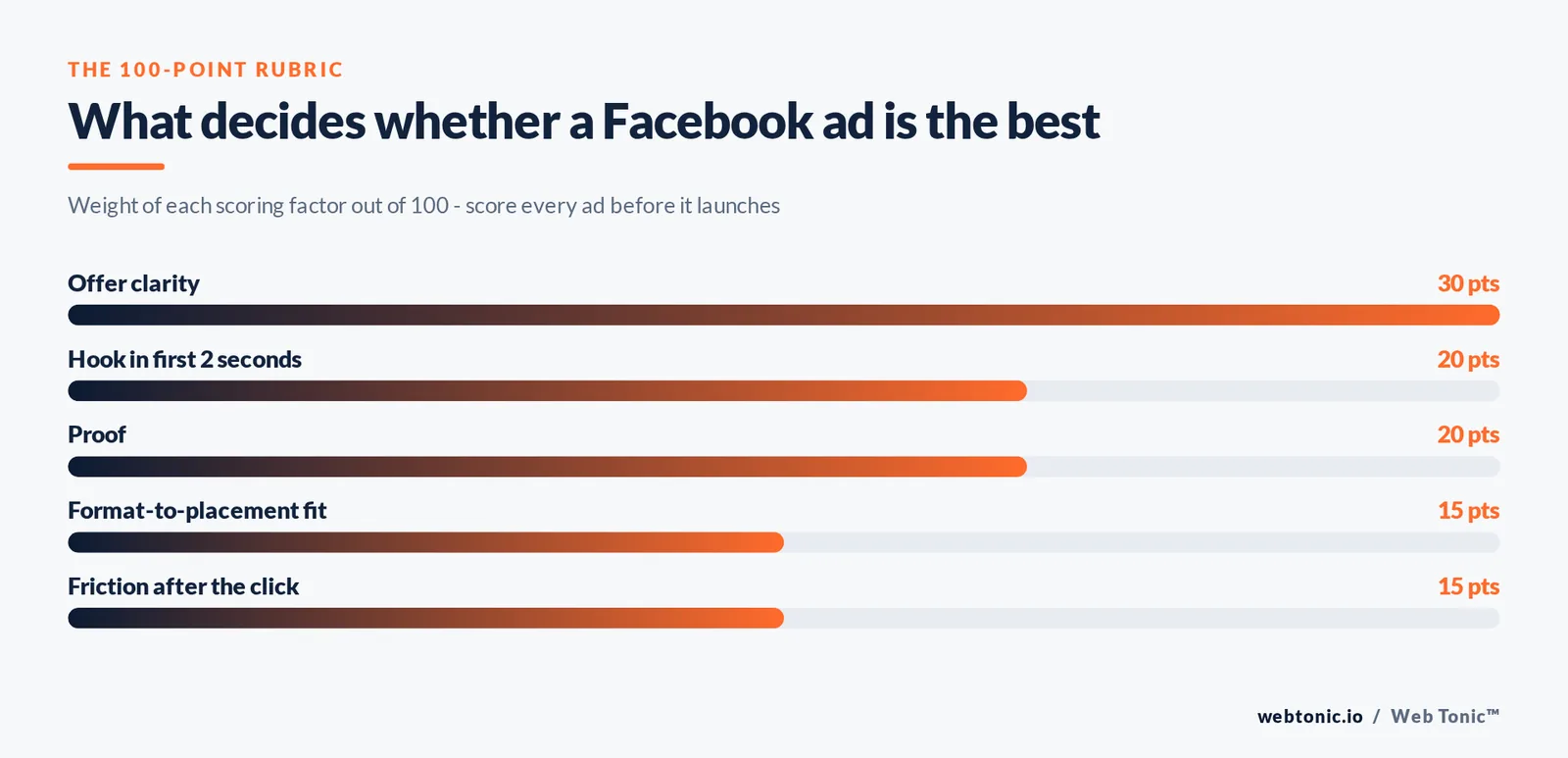
What makes a Facebook ad "the best" rather than just good
An award-winning ad and a high-converting ad are frequently not the same ad. The gap is measurement: creative that wins prizes is judged on craft, creative that wins auctions is judged on cost per outcome. Everything on this page uses the second definition. If you want a broad catalogue of formats instead of a judging framework, our companion piece on Facebook ad examples walks format by format; this page is about deciding which of them is actually best for your case.
| Scoring factor | Weight | What full marks looks like | Most common failure |
|---|---|---|---|
| Offer clarity | 30 points | A specific promise with a price, timeframe or outcome attached | "Learn more about our services" |
| Hook in the first 2 seconds | 20 points | The visual states the subject before any text is read | A logo-first opening frame |
| Proof | 20 points | A real customer, a real result, or a visible before and after | Adjectives instead of evidence |
| Format-to-placement fit | 15 points | 4:5 or 9:16 assets built for where they run | One 1:1 asset pushed to every placement |
| Friction after the click | 15 points | One page, one action, matching headline | Homepage traffic with no matching offer |
Rule 1 — score the ad out of 100 before it launches. Anything below 60 is a targeting excuse waiting to happen. WordStream's click-through rate benchmarks are the outside reference for whether your result is genuinely top tier or merely average.
The benchmarks a "best" Facebook ad has to beat
3 numbers separate a top-decile ad from an average one. Without them, "best" is decoration. Use your own category band where you have one and these published ranges where you do not; Socialinsider's benchmark study and Sprout Social's Facebook ads research both publish current figures.
| Metric | Typical average | Top-tier ad | What it tells you |
|---|---|---|---|
| Link click-through rate | ~0.90% | 2.0%+ | The hook and offer are landing |
| Cost per lead | ~$27.66 across industries | 40–60% below your category band | Offer plus form design |
| Hook rate (3-second views ÷ impressions) | 20–25% | 35%+ | Opening frame strength |
| Hold rate (thruplays ÷ 3-second views) | 10–15% | 25%+ | Whether the middle earns the end |
| Frequency at 7 days | 1.8–2.5 | Under 2.0 while scaling | Audience headroom left |
| Landing conversion rate | ~2.9% macro average | 6%+ on a matched page | Post-click friction |
Best Facebook ads for direct response, and why they work
Group 1 — the ad examples that ask for a purchase immediately. The pattern shared by the best of them is that the product does the talking in the first frame, and the copy handles the single biggest objection rather than listing features. Dollar Shave Club's paid social built on its original launch film is the textbook case: the mechanism is a blunt price-and-annoyance argument delivered by a person, not a brand voice, as the company's own history records.
| Ad example | The creative move | Why it converts | Copy it if |
|---|---|---|---|
| Dollar Shave Club — price-and-annoyance | Founder on camera naming the price out loud | Removes the "how much" objection in 3 seconds | You beat incumbents on price or hassle |
| IKEA — product in a real room | Everyday context instead of a studio | Lets the viewer place the item in their own home | You sell anything physical for the home |
| Pura Vida — customer photo as the ad | User-generated content in the feed's native style | Reads as a friend's post, not an ad | You have an engaged customer base posting already |
| Amazon — single-product clarity | One product, one price, one benefit line | Zero cognitive load at feed speed | Your catalogue has clear hero items |
Best Facebook lead ads
Group 2 — lead ad examples, where the best campaigns win on friction rather than persuasion. A lead ad opens a pre-filled form inside the app, so the entire funnel is the creative plus four fields. Fact 2 — every extra field you add reduces completion, and every qualifying question you add improves lead quality; the best lead ads deliberately trade one for the other.
| Lead ad example | Form design | Best for | Trade-off |
|---|---|---|---|
| Quote request | 3 fields, one qualifying dropdown | Home services, insurance, auto | Slightly higher cost per lead, far better close rate |
| Free trial or class pass | 2 fields plus date preference | Fitness, education, software | High volume, needs fast follow-up |
| Gated resource | Email only, higher-intent question later | B2B and professional services | Cheapest leads, longest sales cycle |
| Event or webinar registration | 3 fields plus reminder opt-in | Venues, launches, B2B demand gen | Attendance rate, not sign-ups, is the real metric |
| Appointment booking | Form plus instant calendar handoff | Dental, medical, legal, real estate | Fewer leads, highest revenue per lead |

Best Facebook video ads
Group 3 — video advertising examples, judged on the first 2 seconds and nothing else at first. Airlines and travel brands such as KLM built their most-shared social work around a single human moment rather than a route map, and the mechanism transfers to any category. Nielsen Norman Group's reading-pattern research is the underlying reason: people scan, they do not read, so a video that needs a caption to make sense has already lost.
| Video ad example | Length | Opening frame | Why it holds attention |
|---|---|---|---|
| Problem in motion | 10–15s | The frustration, shown not described | Viewer self-identifies instantly |
| Demonstration | 15–30s | Hands using the product | Curiosity about the outcome |
| Testimonial cut | 20–30s | Customer mid-sentence, no intro | Feels overheard rather than staged |
| Human moment (KLM style) | 30–45s | A face and a small surprise | Emotion carries a longer runtime |
| Fast list | 12–20s | On-screen number, e.g. "3 mistakes" | Promises a defined end point |
Best Facebook carousel and catalogue ads
Group 4 — carousel examples where the format itself does the optimising for you. A carousel lets the system re-order cards toward whichever performs, and a catalogue ad picks the product per person. Retailers including Adidas and Ford have both used sequence-based carousels to explain a product line rather than shout one price, and the pattern works for services too when each card is a step.
| Carousel structure | Cards | What each card does | Best category |
|---|---|---|---|
| Product range | 5–8 | One SKU per card, price visible | Retail and ecommerce |
| Step sequence | 4–5 | Walks through a process end to end | Services, finance, healthcare |
| Single image split across cards | 3 | Forces a swipe to see the whole scene | Brand launches |
| Before, during, after | 3 | Documents a transformation | Trades, fitness, renovation |
| Dynamic catalogue | Automatic | System selects products per viewer | Any feed with 50+ items |
Best Facebook ad copy examples
6 copy examples account for most top performers. These are the openings that repeatedly appear in effective campaigns across business types. Length matters less than the first line, because the feed truncates everything after roughly 125 characters. Plain-language guidance from plainlanguage.gov is a surprisingly good editing standard for ad copy: short sentences, concrete nouns, no throat-clearing.
| Ad copy example | Opening line shape | Works because | Risk |
|---|---|---|---|
| Named audience | "Dentists in Phoenix:" | Self-selection beats persuasion | Too narrow for broad targeting |
| Specific number | "We cut her energy bill by 31%." | Numbers read as verifiable | Must be true and documented |
| Objection first | "Yes, it costs more. Here's why." | Disarms the reflex to scroll | Needs a genuinely good answer |
| Direct question | "Still paying for storage you don't use?" | Triggers an internal answer | Overused, gets ignored fast |
| Deadline or scarcity | "3 install slots left this month." | Converts intent already present | Fake urgency destroys trust |
| Story open | "A customer called us at 11pm." | Narrative pulls past the truncation | Slow; only works with a real payoff |
Limit 3: one call to action per ad. Two CTAs measurably split attention, and the ad ends up optimising for the easier one.
Best Facebook ads by objective and by budget
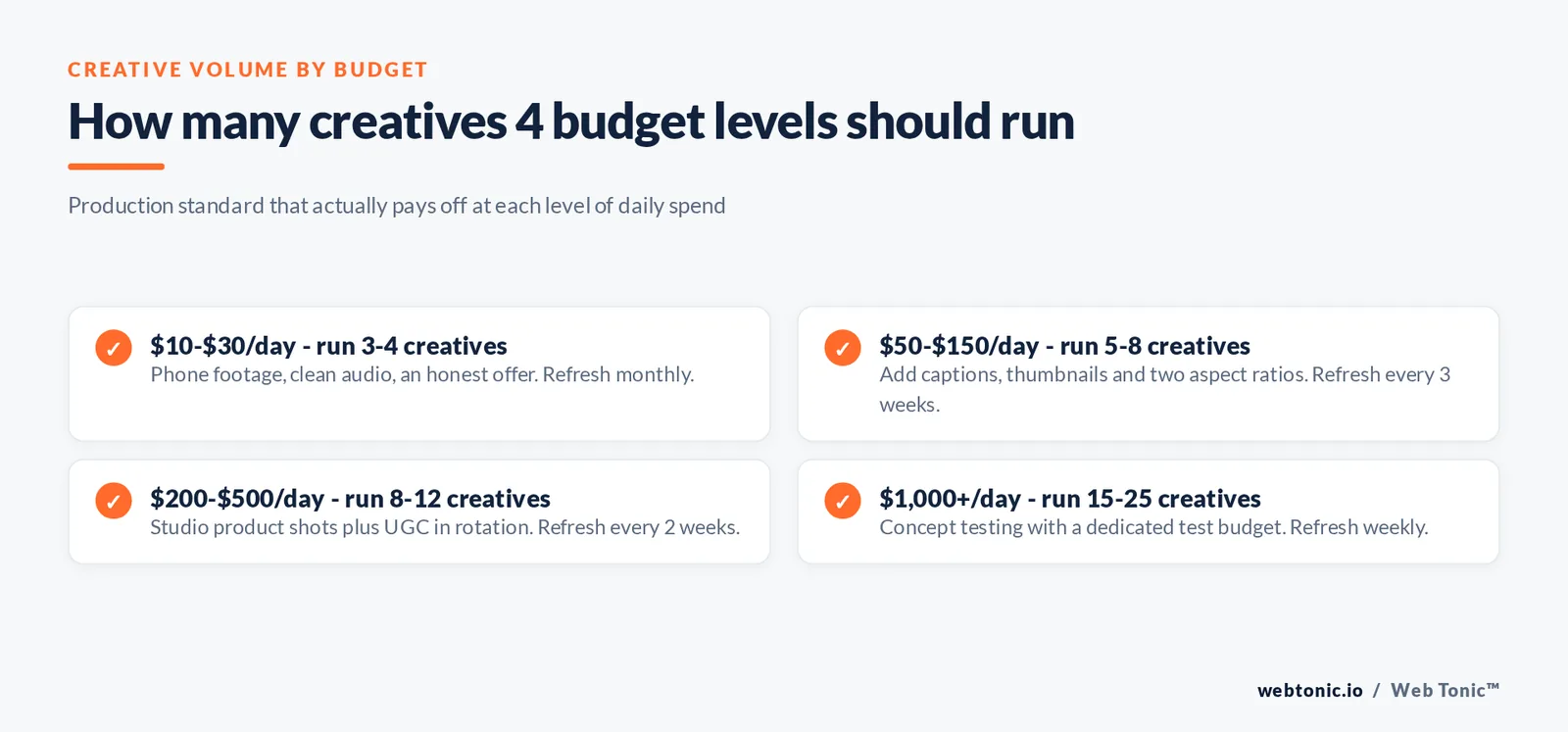
The best ad for a $20/day account is not the best ad for a $2,000/day account. Production value matters more as frequency rises, because the same audience sees the asset repeatedly. Below, the pairing that consistently produces the strongest result at each level.
| Objective | Best-performing creative type | Best placement | Judge it on |
|---|---|---|---|
| Leads | Owner-to-camera video plus instant form | Feed and Reels | Cost per qualified lead |
| Sales | Dynamic catalogue plus one hero video | Feed, Reels, Marketplace | ROAS and new-customer share |
| App installs | Screen-recorded demo, 10–15s | Reels and Stories | Cost per activated user |
| Awareness | Single striking image or 6s video | Feed with a frequency cap | Reach per dollar and recall lift |
| Messages | Question-led image | Feed and Messenger inbox | Conversations that reach a booking |
| Daily budget | How many creatives to run | Production standard that pays off | Refresh cadence |
|---|---|---|---|
| $10–$30 | 3–4 | Phone footage, clean audio, honest offer | Monthly |
| $50–$150 | 5–8 | Add captions, thumbnails, 2 aspect ratios | Every 3 weeks |
| $200–$500 | 8–12 | Studio product shots plus UGC in rotation | Every 2 weeks |
| $1,000+ | 15–25 | Concept testing with dedicated test budget | Weekly |
Best Facebook ads by target business type
8 business types, 8 different definitions of "best". The same Facebook advertising mechanics produce very different winning campaigns depending on who your customers are and what they are willing to do on a mobile screen. Use this to choose which example above to build first.
| Business type | Best ad example to copy | Target customers | Campaign objective |
|---|---|---|---|
| Ecommerce brands | Dynamic catalogue plus one UGC video | Broad, seeded with purchaser data | Sales |
| Home services | Before-and-after with an instant form | Local radius, homeowners | Leads |
| Restaurants and cafés | Food in motion, 10-second mobile video | 3–5 km radius | Reach or messages |
| Fitness and wellness | Member testimonial cut plus free trial offer | Local, interest-agnostic | Leads |
| SaaS and apps | Screen-recorded product demo | Lookalike from paying users | Trials or installs |
| Professional services | Founder to camera plus free resource | Custom list plus lookalike | Leads |
| Real estate | Listing carousel, 5–8 cards | Local plus relocation signals | Leads |
| Events and venues | Human-moment video plus countdown retargeting | Past attendees and lookalikes | Event responses |
Mobile-first specs and free tools to create the ads
Roughly 98% of Facebook's users reach the platform on a mobile device according to DataReportal's platform data, so every example on this page has to survive a vertical screen held at arm's length. That single fact drives the specs below, and there are free ways to create everything in the right shape.
| Placement | Aspect ratio | Text and media rules | Free way to create it |
|---|---|---|---|
| Feed (mobile) | 4:5 | Primary text front-loaded in 125 characters | Phone camera plus a free editor template |
| Reels | 9:16 | Keep captions clear of the bottom 20% | In-app camera with burned-in captions |
| Stories | 9:16 | One message per card, no small text | Repurpose the Reel, crop safe zones |
| Carousel | 1:1 | Consistent products and framing across cards | Phone shots on a plain wall |
| Right column (desktop) | 1.91:1 | Logo-legible at small size only | Crop an existing feed asset |
How to find the best Facebook ads in your own market
7 steps, about 45 minutes, no tools beyond a browser. The point is not to copy an ad — it is to identify which mechanism a competitor has been paying to run for months, because longevity is the only public evidence of performance.
| Step | Action | What you are looking for |
|---|---|---|
| 1. List competitors | 8–12 direct rivals plus 3 national brands in your category | A representative sample, not just the biggest |
| 2. Search the Ad Library | Filter by country and platform | Everything currently live |
| 3. Sort by run time | Note the earliest start dates | Ads live 90+ days are proven earners |
| 4. Screenshot the survivors | Capture creative plus primary text | Recurring hooks and offers |
| 5. Follow the click | Open the landing page | Offer, form length, price transparency |
| 6. Score each one | Apply the 100-point rubric above | Which factor they are winning on |
| 7. Build your differentiated version | Match the mechanism, change the angle | A claim only you can make |
Where testimonials or influencer content appear in what you find, the FTC endorsement guides govern what you can reuse and how incentives must be disclosed.
A 10-point pre-launch checklist
10 checks, 10 minutes, before any campaign spends a dollar. This is the list that will help you catch the effective-looking ad that was never going to work. Run it on every piece of social media advertising you publish, and it will save more budget than any bid adjustment.
| Check | Pass condition | Why it helps |
|---|---|---|
| 1. Offer named | A price, timeframe or outcome appears in the first line | The single biggest driver of results |
| 2. Subject visible at 2 seconds | Opening frame shows the product or the person | Wins attention before the thumb moves |
| 3. Proof present | A real customer, result or before-and-after | Real customers outperform adjectives every time |
| 4. Captions burned in | Readable with sound off | Most people watch muted |
| 5. Two aspect ratios shipped | 4:5 and 9:16 both uploaded | Stops Reels costs from tripling |
| 6. One call to action | A single next step, repeated | Two CTAs split attention |
| 7. Landing page matches | Same headline, same offer, one action | Where most Facebook marketing budget leaks |
| 8. Conversion event firing | Tested in Meta Events Manager | Without it the campaign cannot optimise |
| 9. Follow-up automated | Reply inside 60 seconds | Turns leads into booked time |
| 10. Claims documented | Every number traceable to a record | Avoids rejection and reputational damage |
Testing: how you know an ad is genuinely your best
Fact 4 — most "best ad" claims are noise. A 40-click sample cannot separate a 1.5% and a 2.2% click-through rate. Structured testing is the only route to a defensible answer, and the discipline is well documented by Optimizely and VWO.
| Test type | What to vary | Minimum sample | Decision rule |
|---|---|---|---|
| Concept test | 3–4 different mechanisms | 50 conversions per arm | Keep the winner, retire the rest |
| Hook test | First 2 seconds only | 25,000 impressions per arm | Compare hook rate, not cost per result |
| Format test | Video vs static vs carousel | 7 days, equal budget | Judge on cost per outcome |
| Offer test | The promise, same creative | 50 conversions per arm | Biggest single lever; test first |
| Landing page test | Post-click page, same ad | 1,000 sessions per arm | Conversion rate at equal traffic quality |
7 traps that make a "best" ad underperform
Each of these can halve the result of an otherwise excellent ad. They are process failures, not creative failures, which is why they survive so long.
| Trap | Symptom | Fix |
|---|---|---|
| Trap 1 — copying the example, not the mechanism | Looks like the competitor, converts nothing | Identify why theirs works, then change the angle |
| Trap 2 — one aspect ratio everywhere | Reels and Stories cost 3× more | Ship 4:5 and 9:16 versions of every asset |
| Trap 3 — no captions | Low hold rate on video | Burn in captions; assume sound off |
| Trap 4 — mismatched landing page | Good CTR, poor conversion | Repeat the ad headline on the page |
| Trap 5 — judging on 3 days of data | Winners killed in the learning phase | Decide at 50 conversions or 14 days |
| Trap 6 — no creative pipeline | Performance decays with nothing to replace it | Book a monthly shoot day |
| Trap 7 — unverifiable claims | Rejections and trust damage | Use documented results only |
Scale context matters here too: Meta reported ad impressions up 12% and average price per ad up 9% for the full year in its FY2025 results, while DataReportal tracks a reachable Facebook ad audience of roughly 2.28 billion people. More competition for the same feed means creative quality, not bid strategy, is where the remaining advantage sits.

Turning one best ad into a repeatable system
A single great ad is luck; a pipeline is a channel. The accounts that stay ahead run a fixed monthly rhythm: shoot, score, launch, retire. If you want that operated for you, our performance creative and growth marketing teams do exactly this, and a scoping conversation takes 30 minutes. More background reading sits on the Web Tonic blog, and Hootsuite's roundup of Facebook ad examples is a useful second opinion on creative variety.
FAQ
What makes the best Facebook ads different from average ones?
Offer clarity, above everything. In the 100-point rubric on this page, the offer carries 30 points because it is the factor that changes results most and costs nothing to improve. After that comes the opening two seconds, then visible proof, then whether the asset was built for the placement it runs in. Targeting matters far less than most advertisers assume, because the delivery system now finds the audience for a strong creative on its own.
What is a good click-through rate for a Facebook ad?
Published averages put link click-through rate near 0.90% across industries. A genuinely top-tier ad usually clears 2%, and anything above 3% in a competitive category is exceptional. Treat the number as directional only: a high click-through rate with a poor conversion rate normally means the creative promised something the landing page does not deliver.
Are Facebook lead ads better than sending traffic to a website?
For most service businesses, yes. Instant forms remove the page load and pre-fill known fields, so completion rates are far higher than an equivalent web form. The trade-off is lead quality, because the friction that filters casual enquiries is gone. Add one qualifying question and automate follow-up within 60 seconds and lead ads usually win on cost per booked appointment, not just cost per lead.
How often should I refresh a top-performing Facebook ad?
Watch frequency rather than the calendar. Once a 7-day frequency passes about 2.5 on a prospecting audience, click-through rate typically starts falling and cost per result rises. In practice that means every three to four weeks for small local audiences and weekly at higher spend. Retire the weakest creative each cycle rather than replacing everything at once, so you never lose a proven earner.
Can I use a competitor's ad as a template?
Copy the mechanism, not the execution. Duplicating a competitor's visual and copy produces an ad that is worse than theirs by definition, since it lacks the brand recognition that made it work. Instead, identify what an ad running for 90 or more days is doing structurally — the objection it handles, the proof it shows — and build your own version around a claim only you can make honestly.
Sources
WordStream — Average Click-Through Rate Benchmarks · Socialinsider — Facebook Benchmarks Study · Sprout Social — Facebook Ads Research · DataReportal — Essential Facebook Statistics · Meta Platforms — Fourth Quarter and Full Year 2025 Results · Nielsen Norman Group — F-Shaped Reading Pattern · Optimizely — A/B Testing Glossary · VWO — A/B Testing Guide · Federal Trade Commission — Endorsement Guides FAQ · plainlanguage.gov — Concise Writing Guidelines · Wikipedia — Dollar Shave Club · Hootsuite Blog — Facebook Ad Examples