Table of contents
Behavioral targeting still lifts click-through rates by an average of 2.1x over contextual-only ads, but 73% of marketers built that lift on third-party cookies that finished phasing out across every major browser by the first quarter of 2026. This page lays out what behavioral targeting still delivers, what it costs to run compliantly, and where the market is actually growing.
Key Takeaways
- Behavioral targeting lifts click-through rates 2.1x versus contextual-only ads.
- Ad waste on display campaigns drops 15% to 25% with behavioral targeting.
- Conversion likelihood rises 9% relative to baseline contextual targeting.
- 73% of marketers relied on third-party cookies for targeting as of the last broad survey.
- Third-party cookies were fully phased out across major browsers by Q1 2026.
- Addressable audiences shrink 20% to 50% once third-party cookies disappear.
- YouTube behavioral targeting delivers a 3x performance lift over demographic-only campaigns.
- Meta's Advantage+ Audience beats demographic targeting in 8 of 10 verticals on Meta's own benchmarks.
- 80% of B2B organizations were forecast to run marketing technology for personalization.
- 91% of marketers reported using some form of digital advertising in 2024.
- 73% of marketers use or plan to adopt customer data platforms.
- 56% of consumers do not believe companies can keep their personal data secure.
- GDPR fines have hit a single-case record of €746 million.
- Global marketing software spend reached USD 68.7 billion in 2023.
- The behavioral targeting market is projected to reach USD 12.99 billion by 2032 at a 12.15% CAGR.
- Cloud-based deployment already holds 79.6% market share in behavioral targeting tools.
- Triggered, behavior-based emails see a 2.7% average CTR improvement over batch-and-blast sends.
Behavioral Targeting at a Glance (2026)
Before the platform-by-platform detail, here is the shape of the tactic in one table: what it delivers, what it costs to lose, and where the money is flowing.
| Metric | 2026 figure | What it means |
|---|---|---|
| CTR lift vs contextual-only ads | 2.1x | Behavioral signals still out-click context alone |
| Ad waste reduction, display | 15%-25% | Fewer impressions served to non-buyers |
| Conversion likelihood lift | +9% | Measured against a contextual-only baseline |
| Addressable audience loss without 3P cookies | 20%-50% | Depends on publisher and geography |
| Marketing technology spend, global (2023) | USD 68.7B | The tooling budget behind the tactic |
| Behavioral targeting market by 2032 | USD 12.99B | 12.15% CAGR from a 2025 base |
The Third-Party Cookie Is Gone. The Question Was Never If.
Third-party cookies were used by 73% of marketers for targeting and personalization according to the last widely cited survey, and 86% of websites used third-party cookies for tracking on at least one page during the same study period, per Gitnux's behavioral targeting report. That era is over: futurefactors.ai reports third-party cookies were phased out across all major browsers by the first quarter of 2026, following Apple's App Tracking Transparency, Google's Privacy Sandbox and the EU's Digital Services Act.
The practical consequence is not that targeting stopped working. It is that the targeting has to run on data a brand actually owns, and that shift shows up everywhere from campaign builders to compliance reviews.
Performance: What Behavioral Signals Still Buy You
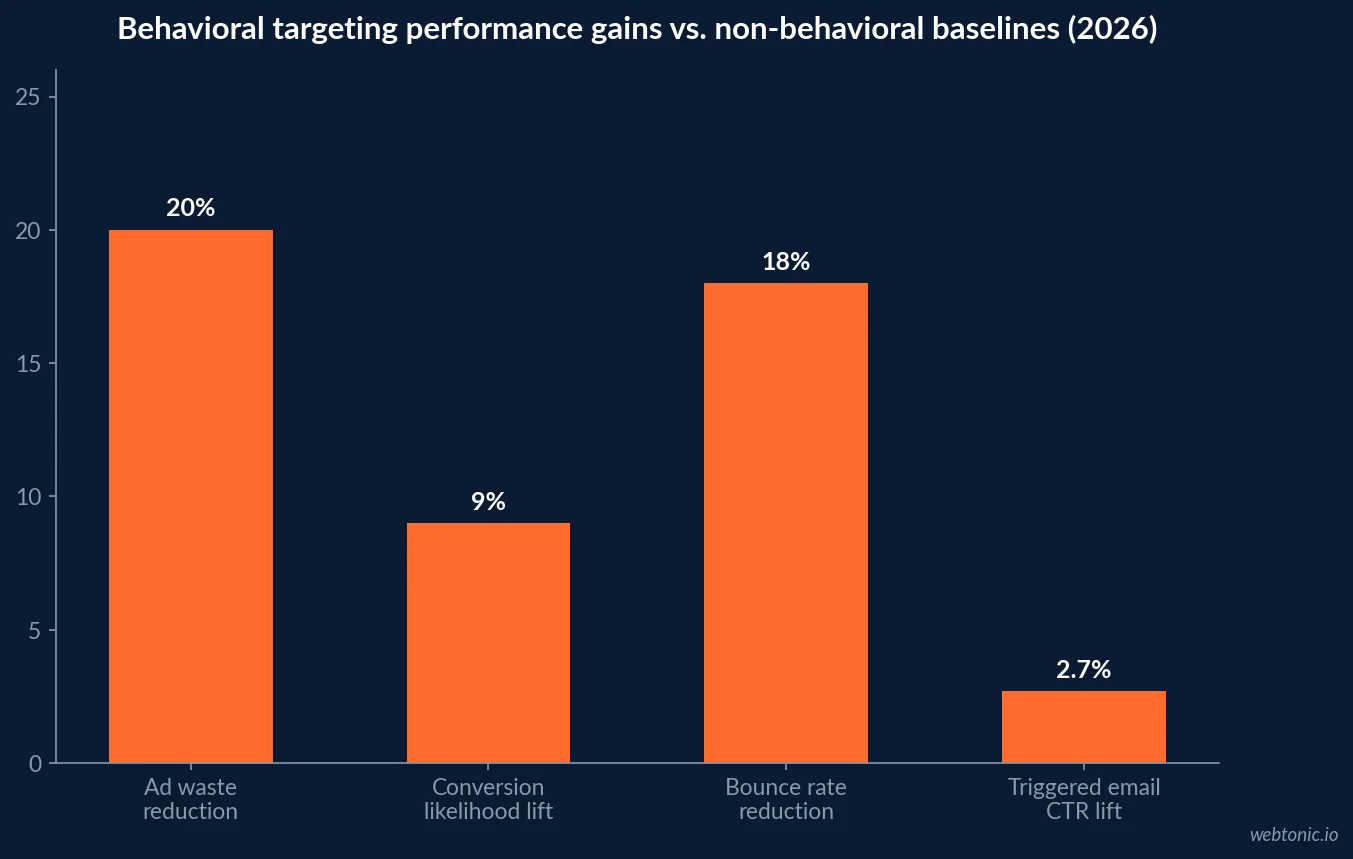
The performance case for behavioral targeting predates the cookie phase-out and still holds on first-party data. A 2020 peer-reviewed meta-analysis found behavioral targeting increased ad click-through rates by an average of 2.1x versus contextual-only targeting. A 2022 study published in Marketing Science reported behavioral targeting can reduce ad waste by 15% to 25% on online display campaigns, and a 2021 Journal of Consumer Research study measured a 9% higher conversion likelihood relative to a contextual-only baseline in controlled experiments (as compiled by Gitnux).
| Behavioral targeting outcome | Published figure | Baseline compared against |
|---|---|---|
| Click-through rate | 2.1x higher | Contextual-only targeting |
| Ad waste on display | 15%-25% lower | Non-behavioral display buys |
| Conversion likelihood | +9% | Contextual-only targeting |
| Retargeting conversion lift | +0.9 pts | Non-retargeted cohorts |
| Bounce rate on personalized pages | -18% | Non-personalized experience |
| Triggered email CTR | +2.7% | Non-triggered batch sends |
Every Major Platform Quietly Retired Demographics-First
Between Q4 2025 and Q1 2026, Meta, Google, Amazon and TikTok all repositioned their default targeting recommendations away from demographics and toward behavioral signals, according to futurefactors.ai. Meta's Advantage+ Audience is now the default recommended audience in the campaign builder, and Meta's own internal benchmarks show it outperforms demographic-targeted campaigns in 8 of 10 verticals. On YouTube, Google's case studies report a 3x performance lift from interest-based, behavioral targeting over pure demographic targeting.
LinkedIn remains the most demographic-heavy of the majors - job title, company size and seniority are still core dimensions - but even LinkedIn is layering in content-engagement and post-interaction signals as a behavioral overlay.
| Platform | 2026 default targeting shift | Reported lift vs demographics |
|---|---|---|
| Meta (Facebook/Instagram) | Advantage+ Audience is the campaign-builder default | Wins in 8 of 10 verticals |
| Google / YouTube | Interest-based, predictive audiences from search/watch behavior | 3x performance lift |
| Amazon Ads | First-party purchase behavior + browsing signals | Consolidating demographic line items |
| TikTok | Symphony tools lead on engagement/content-affinity signals | Demographics now a filter, not a base |
| Job title/seniority core, behavioral overlays added | Still the most demographic-heavy major |
Adoption: Personalization Is the Default, Not the Experiment
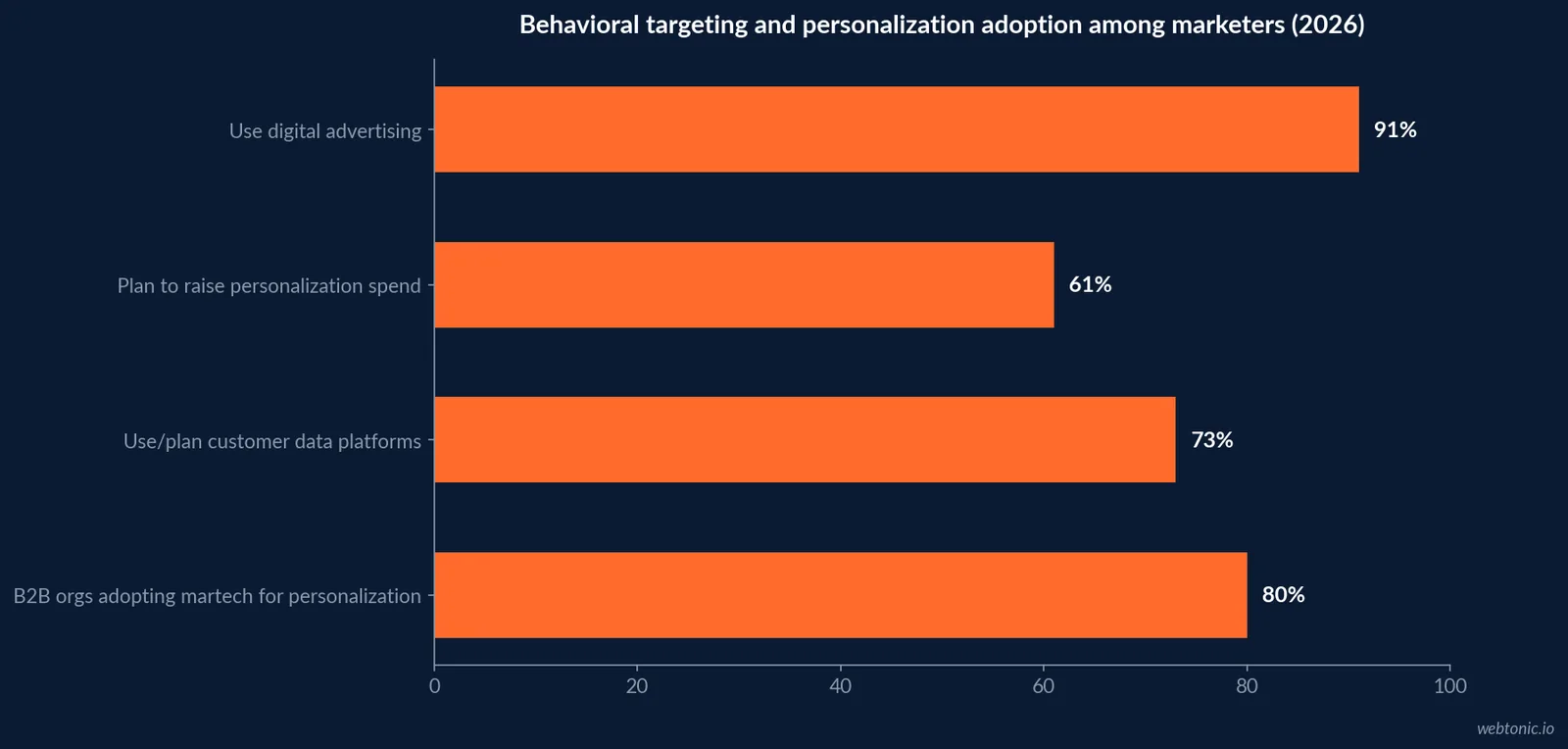
91% of marketers reported using some form of digital advertising in 2024, and 61% said they planned to increase their investment in personalization the following year. 73% of marketers reported using, or planning to adopt, customer data platforms to unify the behavioral signals that power this targeting, and Gartner-sourced figures cited by Gitnux put global end-user spending on marketing software at USD 68.7 billion in 2023, with 80% of B2B organizations forecast to run marketing technology for personalization.
Adoption at that scale is also why only 15% of marketers believe they have a genuinely unified view of their customers, per marketleaderbiz.com - the tools are in place faster than the data discipline to run them well.
What Real-Time Behavioral Data Adds Over Static Segments
Static, historical segmentation is being replaced by real-time behavioral triggers. marketleaderbiz.com reports that marketing campaigns using real-time behavioral data can achieve conversion rates up to 2.5 times higher than static or historical segments, that highly personalized, segment-specific content drives 30% greater engagement than one-size-fits-all messaging, and that A/B testing on segmented audiences produces a measurable 15% average uplift in campaign effectiveness.
The mechanism is simple: intent is time-bound. A shopper who viewed a product 10 minutes ago is a different audience member than the same shopper a week later, and static demographic buckets cannot express that difference.
| Segmentation approach | Reported conversion outcome | Source |
|---|---|---|
| Static demographic segments | Baseline | marketleaderbiz.com |
| Real-time behavioral triggers | Up to 2.5x higher conversion | marketleaderbiz.com |
| Personalized, segment-specific content | +30% engagement | marketleaderbiz.com |
| A/B-tested segmented audiences | +15% average uplift | marketleaderbiz.com |
The Cost Side: Privacy Risk and Shrinking Reach
Behavioral targeting's cost side is no longer theoretical. GDPR fines have reached a single-case record of €746 million, and 56% of people say they do not believe companies can keep their personal data secure, per Gitnux. GDPR.eu notes that fines scale specifically to make non-compliance costly for organizations of every size, not just the largest platforms.
On reach, an AppNexus and Magnite study found that targeting without third-party cookies can shrink addressable audience size by 20% to 50% depending on publisher and geography. That range is the real line item behind every "we lost reach after cookie deprecation" conversation happening in ad accounts right now.
| Risk factor | 2026 figure | Why it matters for targeting |
|---|---|---|
| Largest single GDPR fine | €746 million | Sets the ceiling on non-compliance cost |
| Consumer distrust of data security | 56% | Raises the bar for consent-based collection |
| Addressable audience loss, no 3P cookies | 20%-50% | Directly cuts campaign reach |
| Websites still using 3P cookies in the study window | 86% | Shows how uneven the transition was |
Market Size: Where the Investment Is Going
Despite the compliance overhead, the behavioral targeting tooling market keeps growing. PW Consulting projects the market will grow at a 12.15% CAGR from 2025 through 2032, reaching roughly USD 12.99 billion, with cloud-based deployment already holding 79.6% market share and North America the largest region. Transparency Market Research frames the same category as core infrastructure for online publishers and advertisers tracking browsing behavior to build comprehensive user profiles.
That investment is consistent with what marketers report doing: shifting budget from broad demographic buys into the platforms and CDPs that can act on first-party behavioral signals.
Behavioral vs. Contextual Targeting: A Straight Comparison
Neither approach has fully replaced the other. The honest comparison is about what data each one needs and what it costs when that data disappears.
| Dimension | Behavioral targeting | Contextual targeting |
|---|---|---|
| Data dependency | First-party behavioral signals, consent required | Page/content signals, no personal data |
| CTR vs baseline | 2.1x higher (published meta-analysis) | Baseline |
| Ad waste | 15%-25% lower on display | Higher without behavioral overlay |
| Privacy exposure | High - GDPR fines up to €746M | Low - no identity resolution needed |
| Reach after cookie deprecation | Shrinks 20%-50% without first-party data | Unaffected by cookie changes |
| 2026 platform default | Meta, Google, Amazon, TikTok lead with it | Still used for brand safety and scale |
Building a Compliant Behavioral Targeting Programme in 2026
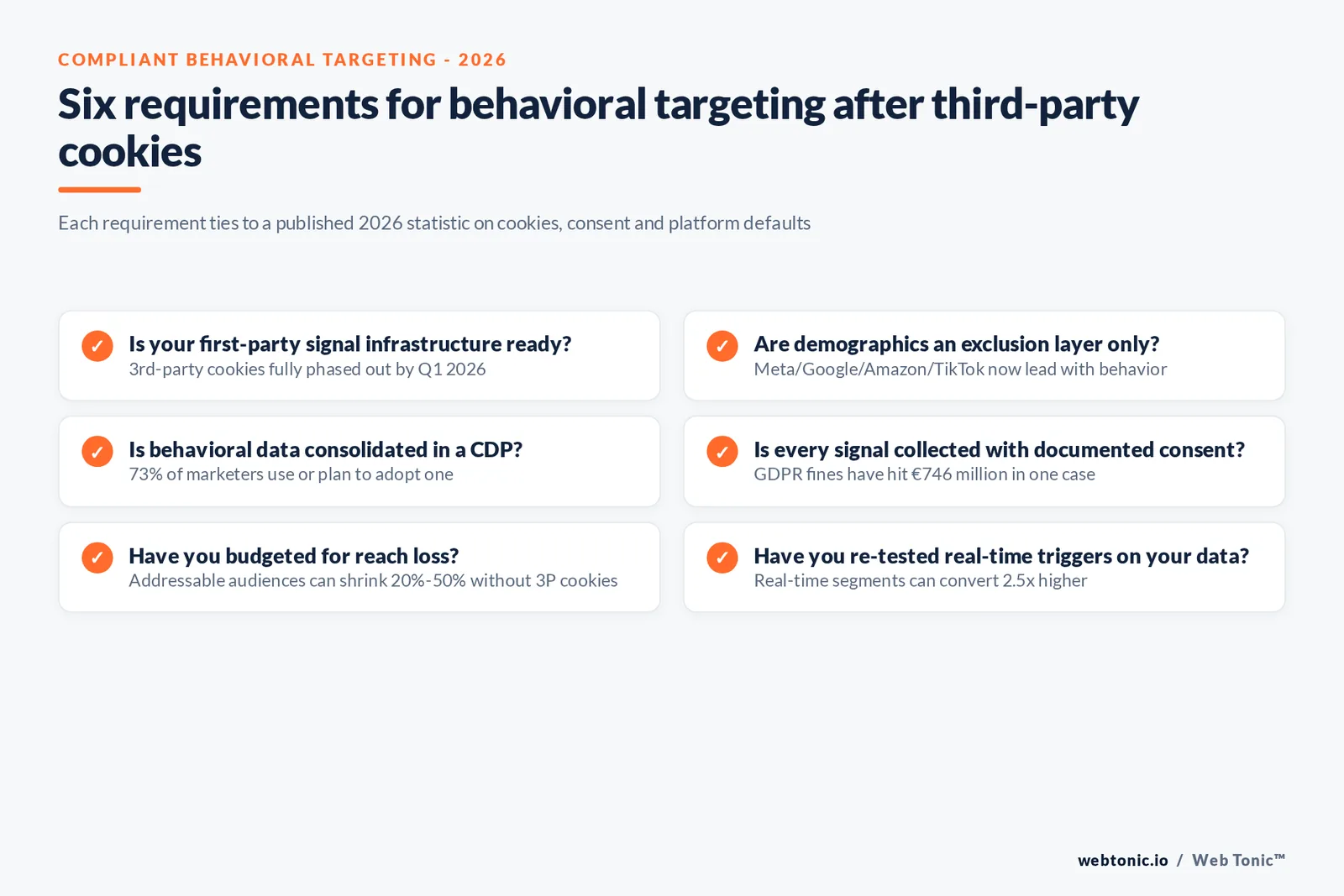
- Audit your first-party signal infrastructure - conversion tracking, enhanced conversions, Meta CAPI - before touching audience strategy; the platforms have already shifted, and thin signal pipelines cannot use the new defaults.
- Treat demographics as an exclusion layer only, not the entry point for a new campaign.
- Consolidate behavior across web, app and CRM into a customer data platform before building segments; 73% of marketers are already there or moving there.
- Document consent for every behavioral signal you collect - the €746 million fine ceiling applies to any organization, not only the largest platforms.
- Budget for reach loss: model campaigns assuming a 20% to 50% smaller addressable audience where third-party cookie-dependent inventory used to sit.
- Re-test real-time triggers against static segments on your own data; the published 2.5x lift is a ceiling, not a guarantee, until you measure it in your account.
Where This Fits in a Broader Paid Media Strategy
Behavioral targeting is one lever inside a paid media account, not a strategy on its own. If your account still leans on demographic-only audiences, our growth marketing team can help rebuild the signal layer first. If the gap is measurement rather than targeting, our data and analytics practice builds the first-party tracking that makes behavioral targeting possible post-cookie. And if you are weighing Meta's Advantage+ Audience against a more manual build, our breakdown of whether Facebook ads are worth it in 2026 is a useful next read, along with our Google Ads strategy guide for the search side of the same shift.
Frequently Asked Questions
What is behavioral targeting and how is it different from demographic targeting?
Behavioral targeting builds audiences from what people actually do - pages viewed, searches run, items added to cart, content watched - rather than who they are on paper. Meta, Google, Amazon and TikTok have all repositioned their default recommended audiences toward behavioral signals since late 2025, and Google reports a 3x performance lift from behavioral targeting over demographic-only campaigns on YouTube. Demographics still work as an exclusion layer, but they are no longer the default starting point for a 2026 campaign.
Does behavioral targeting actually outperform contextual targeting?
On the published evidence, yes, but the gap is measured in ad waste and conversion odds rather than vague lift claims. A peer-reviewed meta-analysis put the click-through rate advantage at 2.1x over contextual-only targeting, a 2022 Marketing Science study found 15% to 25% less ad waste on display campaigns, and a Journal of Consumer Research study measured a 9% higher conversion likelihood in controlled experiments. None of those numbers means contextual targeting is obsolete - it means behavioral signals earn their premium when you have enough first-party data to feed them.
What happens to targeting once third-party cookies are gone?
Addressable audience size shrinks. An AppNexus and Magnite study found that targeting without third-party cookies can cut addressable audience size by 20% to 50% depending on publisher and geography, and futurefactors.ai reports third-party cookies were fully phased out across major browsers by the first quarter of 2026. The replacement is first-party behavioral data plus platform-native signal products like Meta's Advantage+ Audience and Google's predictive audiences, not a like-for-like swap.
Is behavioral targeting still legal and low-risk under GDPR in 2026?
It is legal when it runs on consented, first-party behavioral signals, but the compliance bar is high. GDPR fines have already reached a single-case record of €746 million, and 56% of consumers say they do not believe companies can keep their personal data secure. Any behavioral targeting programme built on identity resolution across sites, rather than a brand's own consented data, is now the highest-risk version of the tactic.
How fast is the behavioral targeting market growing?
Market researchers put the segment on a double-digit growth path: PW Consulting projects a 12.15% CAGR through 2032, reaching roughly USD 12.99 billion, with cloud-based deployment already at 79.6% share and North America the largest region. That growth is being funded by marketing technology spend that Gartner-sourced figures put at USD 68.7 billion globally in 2023 alone.
Sources
Gitnux - Behavioral Targeting Statistics
Gitnux - Programmatic Advertising Statistics
Future Factors - Behavioral Signal Targeting 2026
Market Leader Business - Behavioral Targeting: 70% of Decisions in 2026
PW Consulting - Worldwide Behavioral Targeting Market 2026
Transparency Market Research - Behavioral Targeting Market
GDPR.eu - GDPR Compliance Guidelines