Table of contents

A 2026 scan of roughly 2,000 Google Tag Manager containers across 3,200 B2B SaaS websites found 56% with no consent management detected anywhere, and 4,432 dead Universal Analytics tags still firing three years after Google shut the platform down. That is the honest starting point for any claim about B2B SaaS tracking accuracy in 2026: the gap is not exotic, it is basic implementation hygiene that never got cleaned up.
Key Takeaways
- 56% of B2B SaaS sites have no consent management platform detected on the page or in GTM.
- 26% of sites double-load Google Analytics through both GTM and a separate hardcoded tag.
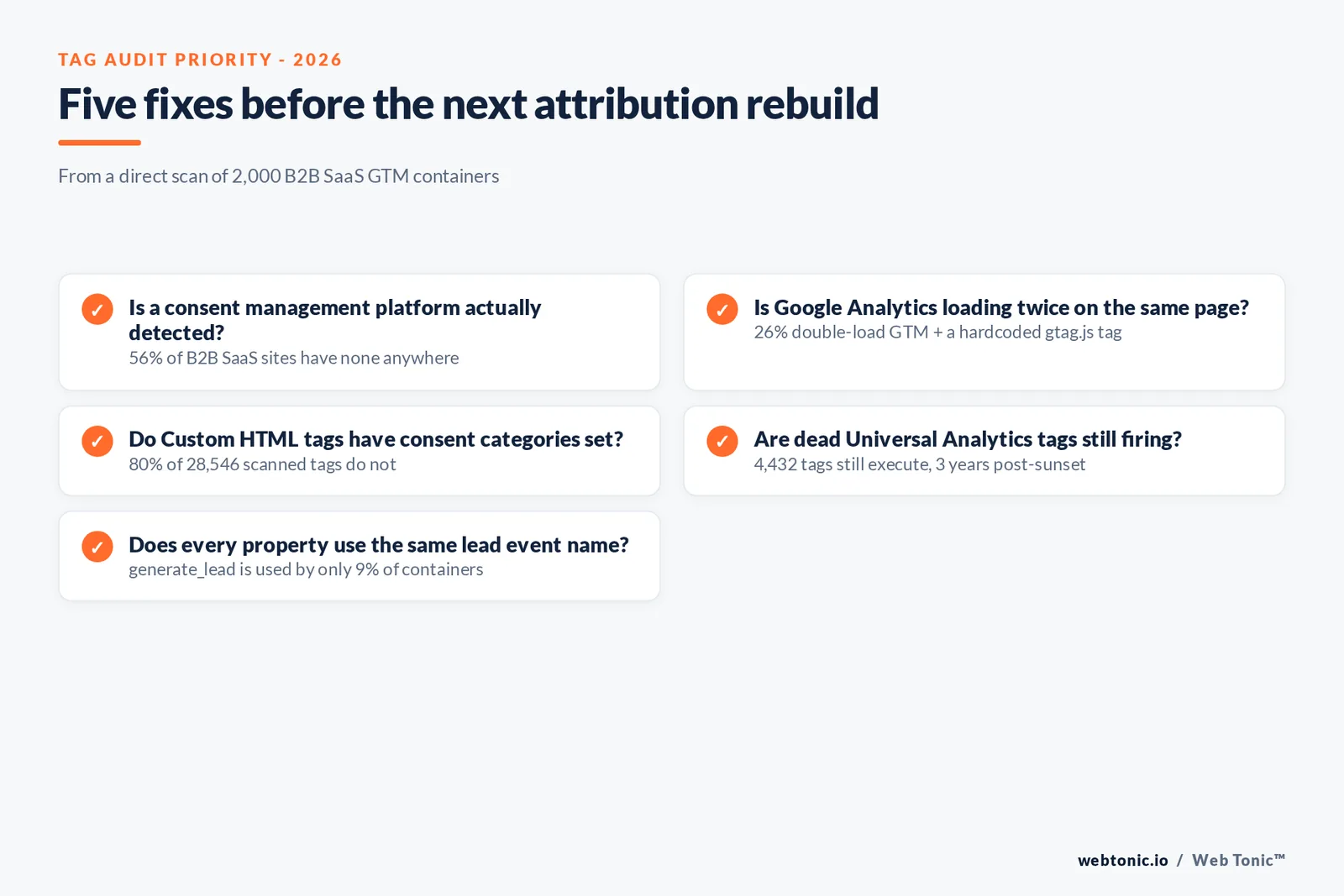
- 80% of Custom HTML tags (28,546 scanned) have no consent category configured.
- Only 20% of Custom HTML tags have consent categories configured at all.
- 4,432 Universal Analytics tags still execute, three years after platform sunset.
- The scan covered ~2,000 containers with a median of 43 tags each.
- 93% of containers have GA4 installed; 89% contain Custom HTML tags.
- Google's recommended generate_lead event is used by only 9% of containers.
- GA4 click tracking uses 8 or more different event names across the dataset, with no naming consensus.
- Sites running 4 or more ad platforms are far more likely to have a CMP (57%) than sites running one (29%).
- 48% of B2B marketers name data quality and reliability a top-three challenge (Anteriad/Ascend2).
- 44% cite meeting data privacy and compliance requirements as a top challenge.
- 41% cite siloed data or lack of system integration.
- Only 40% of B2B marketers say they use the right data to convert their audiences.
- 18% of B2B marketers track marketing activity all the way through to closed revenue.
What a direct scan finds, versus what a survey reports
Most "state of tracking" claims in B2B SaaS come from self-reported surveys. TagManifest's 2026 scan is different: it parsed roughly 2,000 publicly accessible Google Tag Manager containers across 3,200 B2B SaaS websites directly from Google's public gtm.js endpoint, plus page-level scans for consent tools and scripts loaded outside GTM. That makes it a measurement of what is actually deployed, not what teams believe is deployed -- and the gap between the two is the whole story.
The median container carries 43 tags (mean 61), with 93% having GA4 installed and 89% containing Custom HTML tags -- the tag type with the weakest default consent behavior, because unlike Google's native templates, Custom HTML does not require consent configuration at setup.
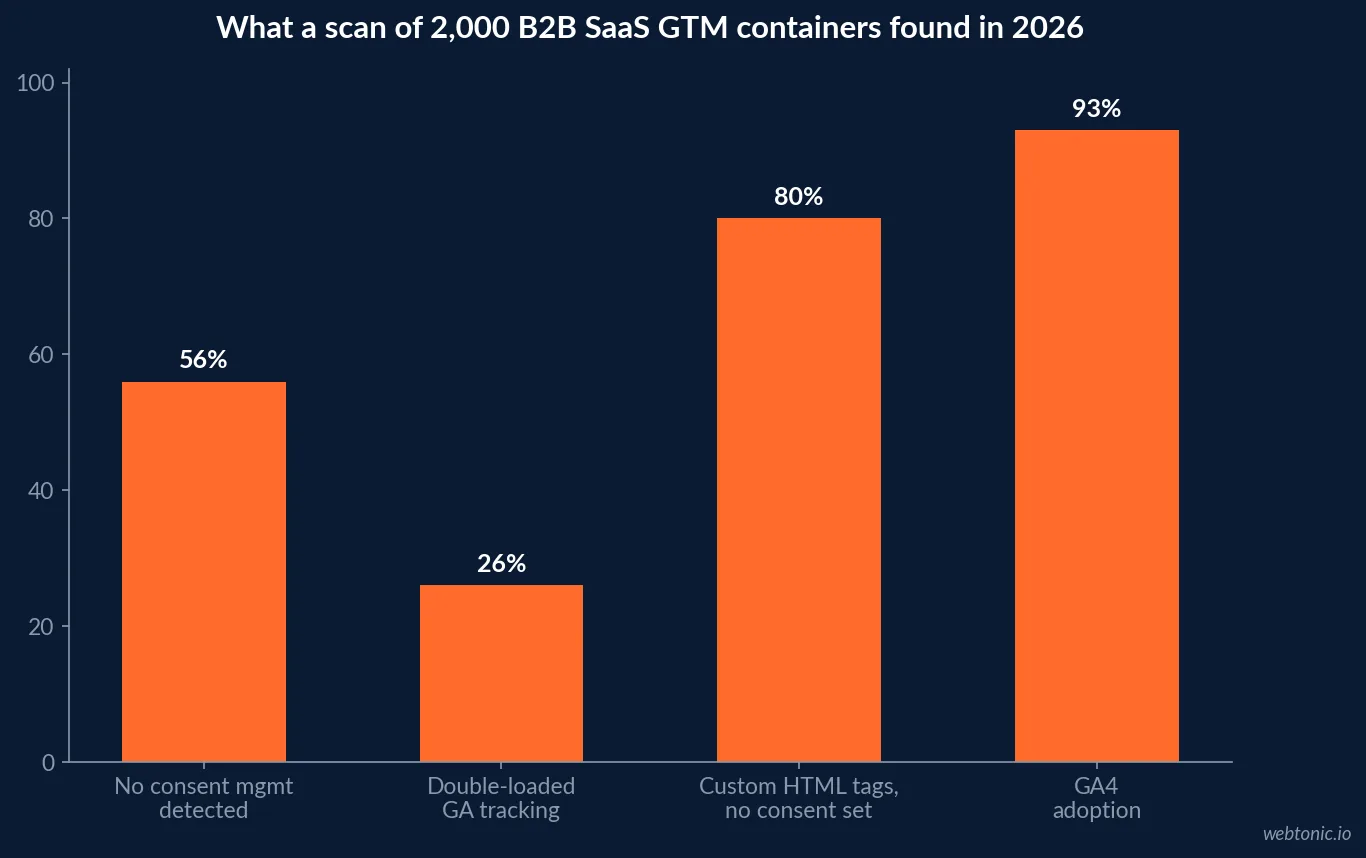
| GTM container finding (B2B SaaS, 2026) | Figure | Why it matters |
|---|---|---|
| No consent management detected anywhere | 56% | Tracking may run without lawful basis in 20+ US states |
| Sites double-loading Google Analytics | 26% | Risk of duplicate page views, inflated sessions |
| Custom HTML tags with no consent category | 80% of 28,546 tags | Native templates enforce consent; Custom HTML does not |
| Universal Analytics tags still executing | 4,432 | Firing on every page load 3 years post-sunset, data discarded |
| Containers with GA4 installed | 93% | Near-universal adoption; doesn't guarantee clean data |
The consent gap is a data-accuracy problem, not just a compliance one
Consent gaps are usually framed as a legal exposure story, but the scan makes clear they are also an accuracy story. Google's native tag templates enforce a consent configuration at setup -- 100% compliance by design, because the template requires it. Custom HTML tags default to NOT_SET and stay there unless someone actively configures them. Across 28,546 Custom HTML tags in the dataset, only 20% have consent categories configured, meaning 80% remain at the unconfigured default. Every one of those tags is firing (or being blocked inconsistently) without the categorization that would let a marketer trust whether the resulting data reflects real consented behavior or an artifact of default settings.
There is a clear adoption pattern behind who fixes this first: sites running 4 or more ad platforms are far more likely to have a consent management platform (57%) than sites running just one platform (29%) -- the accounts under the most attribution pressure are the ones that eventually invest in getting consent right.
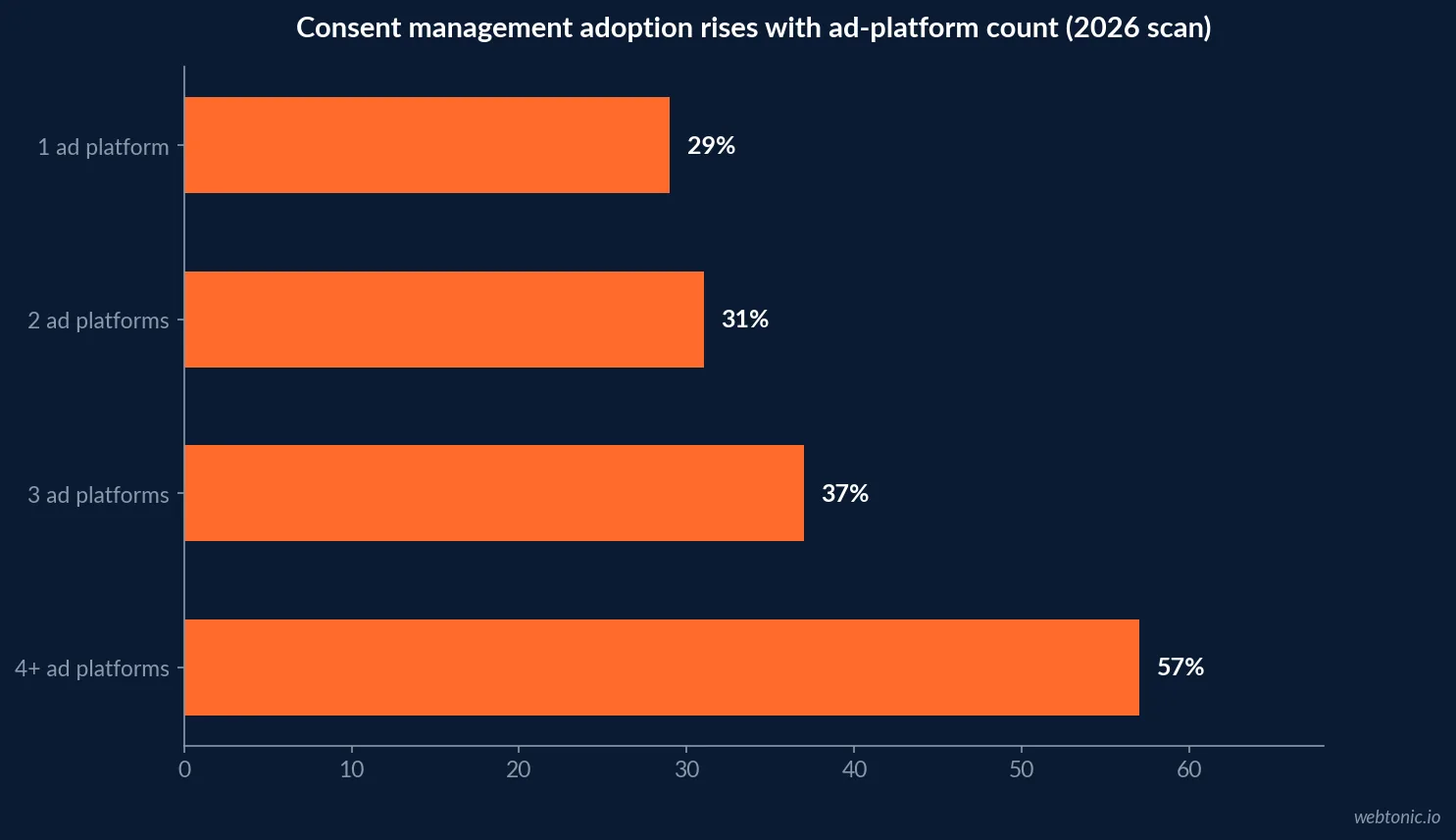
| Ad platforms run | Share with a CMP detected | Sample |
|---|---|---|
| 1 platform | 29% | 130 / 413 |
| 2 platforms | 31% | 160 / 438 |
| 3 platforms | 37% | 190 / 421 |
| 4+ platforms | 57% | 307 / 534 |
Naming inconsistency breaks cross-team comparison before privacy even enters it
Even where tracking fires cleanly, B2B SaaS teams cannot reliably compare their own numbers. GA4 click tracking across the dataset uses 8 or more distinct event names -- cta_click, click, button_click, link_click, menu_click and more -- with no naming consensus. Google's own recommended event name for lead-form submissions, generate_lead, is used by only 9% of containers. A team running HubSpot alone might carry four separate events tracking the same form submission across hubspot_form_submit, marketo_form_submit and generic variants. None of that is a privacy failure; it is a measurement-governance failure that makes "how many leads did we generate this month" a question that depends on which report you open.
| Tracking accuracy problem | 2026 prevalence | Metric it distorts | Source |
|---|---|---|---|
| No consent management platform detected | 56% of sites | Every downstream conversion metric | TagManifest 2026 scan |
| Dual GA4 load (GTM + hardcoded gtag.js) | 26% of sites | Sessions, page views | TagManifest 2026 scan |
| Custom HTML tags with no consent config | 80% of 28,546 tags | Consent-gated event volume | TagManifest 2026 scan |
| Inconsistent GA4 event naming | 8+ names for one action | Lead counts, funnel comparisons | TagManifest 2026 scan |
| Siloed data / no system integration | 41% of marketers cite it | Cross-channel attribution | Anteriad & Ascend2 2026 |
What B2B SaaS marketers say about the same gap
The scan's findings line up closely with how B2B SaaS marketers describe their own stack. Anteriad and Ascend2's 2026 B2B Marketing Edge Report, surveying 631 marketing decision-makers across the US, UK and APAC in March 2026, found 48% naming data quality and reliability among their top-three challenges, 44% citing data privacy and compliance requirements, and 41% citing siloed data or a lack of integration across systems. Against that backdrop, only 40% of respondents describe themselves as using the right data to convert their audiences -- and that smaller "Data Heroes" group reported 43% significantly exceeding goals versus 18% of everyone else, which is the clearest evidence available that the accuracy gap has a real revenue cost attached, not just a reporting inconvenience.
That self-reported gap is not unique to B2B SaaS. IAB's cross-industry State of Data 2026 survey of 430 senior planning and analytics leaders found 60% to 75% of regular users of incrementality, attribution or MMM tooling saying their own approach doesn't perform well on rigor or trust -- the same order of magnitude as the tracking and data-quality gaps found specifically inside B2B SaaS. This is a cross-industry benchmark, not a B2B SaaS-specific figure, but it confirms the gap TagManifest and Anteriad both found is not a quirk of one industry's tooling.
On attribution specifically, only 18% of the same survey's respondents track marketing activity all the way through to closed revenue with a complete attribution model. Those that do were more likely to significantly exceed their primary marketing goal: 45% versus 24% for everyone else.
| B2B marketing self-report (2026, n=631) | Figure |
|---|---|
| Cite data quality/reliability as a top challenge | 48% |
| Cite privacy/compliance requirements as a top challenge | 44% |
| Cite siloed data or lack of integration | 41% |
| Say they use the right data to convert audiences | 40% |
| Track marketing through to closed revenue with full attribution | 18% |
What is actually deployed inside the average container
The tag inventory itself explains why cleanup is not a quick job. Across all ~2,000 scanned containers, Custom HTML tags (28,546) and GA4 Event tags (28,373) are nearly tied as the dominant tag type, followed by Google Ads Conversion tags (8,837), the still-lingering Universal Analytics tags (4,432), Microsoft UET (3,850) and Google Tag (3,852). GTM itself is used by 63% of the 3,205 B2B SaaS sites TagManifest scanned, and among those users, 69% carry paused tags still sitting in the container -- not firing, but not removed either, adding to the audit burden the next time someone tries to understand what a container actually does. The median container's overall implementation quality scored 76 out of 100 on TagManifest's own health metric, a passing grade that still leaves real gaps.
| Tag type across ~2,000 B2B SaaS containers (2026) | Total tags scanned |
|---|---|
| Custom HTML | 28,546 |
| GA4 Event | 28,373 |
| Google Ads Conversion | 8,837 |
| Universal Analytics (dead since 2023) | 4,432 |
| Microsoft UET | 3,850 |
| Google Tag | 3,852 |
Consent settings exist inside the tooling; most containers just don't use them
The gap is not that Google's tooling lacks a way to gate tags on consent. Tag Manager's own consent mode documentation lets any tag require a granted consent status before it fires, and native Google tag templates enforce that configuration during setup by default. The accuracy problem the scan surfaces is adoption, not capability: 80% of Custom HTML tags never had that optional consent check turned on, because unlike the native templates, Custom HTML ships with consent unset unless a developer configures it -- and across a median of 43 tags per container, that is an easy step to skip under a deadline.
The traffic itself is less human than most dashboards assume
Consent gaps and duplicate tags sit on top of a bigger problem: a growing share of what a B2B SaaS site's analytics counts as a session was never a person. Cloudflare's own 2026 bot traffic report, compiled from Cloudflare Radar data across a network that sits behind more than 20% of the web, found that more than 50% of internet traffic is now non-human for the first time on record, with 52% of crawler requests specifically for AI training as of June 2026, up from 22% a year earlier. None of GA4's default bot filtering, which only catches a published spider list, was built for that volume of AI-era crawler traffic -- meaning conversion rates, bounce rates and session counts computed on raw traffic are increasingly measuring a mix of humans and machines without a clean way to separate them.
Marketers are aware AI is reshaping their own workflows even if they have not fully reckoned with what it is doing to their traffic data. HubSpot's 2026 State of Marketing Report found 61% of marketers believe marketing is experiencing its biggest disruption in 20 years because of AI, and 80% already use AI for content creation -- the same wave of automated activity that is also inflating the non-human share of the traffic their own analytics is trying to measure.
| Non-human traffic signal (2026) | Figure | Source |
|---|---|---|
| Share of internet traffic that is non-human | >50%, first time on record | Cloudflare Radar 2026 |
| Crawler requests specifically for AI training | 52%, up from 22% a year earlier | Cloudflare Radar 2026 |
| Mixed-use crawlers (search + agent + training) | >36% of crawler activity | Cloudflare Radar 2026 |
| Marketers who say AI is marketing's biggest disruption in 20 years | 61% | HubSpot 2026 State of Marketing |
The CRM record on the other end of the funnel has its own gaps
Even a perfectly tracked visit eventually lands in a CRM record, and that record is not guaranteed to be usable either. Reachium's 2026 audit of its own B2B contact database, an exact field-by-field count across 2,037,030 contact records after deduplication, found only 52.6% carry an email address, 40.2% carry a phone number, and just 17.3% are flagged as decision-makers. The average internal data-quality score across the same database landed at 77.1 out of 100 -- comparable to the 76-out-of-100 median health score TagManifest found on the tracking side, which suggests the roughly one-quarter gap between "collected" and "usable" data is consistent whether you are looking at a tag container or a contact record.
| B2B contact database composition (Reachium 2026, n=2,037,030) | Share |
|---|---|
| Linked to a company record | 57.4% |
| Email address present | 52.6% |
| Seniority classification present | 44.8% |
| Phone number present | 40.2% |
| Flagged as a decision-maker | 17.3% |
Where to start fixing it
The scan and the survey point to the same order of operations: fix consent and duplicate-tracking hygiene before adding another attribution tool on top of unreliable inputs, because no downstream model can correct for sessions that were double-counted at the source. Standardizing on Google's documented event names, removing dead Universal Analytics tags, and auditing Custom HTML consent configuration are all changes a team can make without new budget. Our data and analytics practice runs exactly this kind of tag audit before recommending any attribution rebuild, and our work on how we approach client measurement follows the same sequence. For a look at how this shows up on the email side of the B2B SaaS stack, see our email marketing statistics, or talk to us about auditing your own tag container before your next quarterly board report.
Frequently Asked Questions
How accurate is B2B SaaS tech tracking data in 2026?
Less accurate than most teams assume. TagManifest scanned roughly 2,000 Google Tag Manager containers across 3,200 B2B SaaS websites in 2026 and found 26% double-loading Google Analytics through both GTM and a hardcoded gtag.js tag on the same page, which risks duplicate page views and inflated session counts feeding directly into whatever attribution model sits downstream.
Is consent management the real accuracy problem, or is it something else?
Both, and they compound. The same 2026 scan found 56% of B2B SaaS sites with no consent management platform detected anywhere on the page or in the tag container, and among the tags that do fire, 80% of Custom HTML tags across 28,546 instances had no consent category configured at all -- meaning the gap is not just missing tools, it is tags shipped without the consent logic the native templates would have enforced automatically.
Are B2B SaaS marketers aware their data quality is this uneven?
Partially. Anteriad and Ascend2's 2026 B2B Marketing Edge Report, surveying 631 marketing decision-makers, found 48% naming data quality and reliability as a top-three challenge and 41% citing siloed data or lack of system integration -- but only 40% describe themselves as using the right data to convert audiences in the first place.
Does dead tracking code actually cost anything if the data is discarded anyway?
It costs page performance and audit time even when the data itself is thrown away. The GTM scan found 4,432 Universal Analytics tags still executing three years after Google sunset the platform -- firing on every page load, sending a network request, and having the response discarded on arrival, purely because nobody went back to remove the tag.
What is the single highest-leverage fix for a B2B SaaS marketing team right now?
Standardize event naming before adding another tool. The scan found GA4 click tracking using 8 or more different event names across the dataset, with Google's own recommended generate_lead event used by only 9% of containers -- meaning most teams cannot cleanly compare lead volume across their own properties, let alone against an industry benchmark.
Sources
TagManifest - The State of Google Tag Manager in B2B SaaS (2026)
Anteriad & Ascend2 - The 2026 B2B Marketing Edge Report
G2 - G2 Expands Buyer Intent Across Four Software Discovery Platforms
Google Tag Manager Help - Tag Manager consent mode support
Cloudflare - Content Independence Day, one year on: the agentic internet bot report
HubSpot - The 2026 State of Marketing Report
Reachium - What's Actually in a B2B Database: 2 Million Contacts Audited
IAB / BWG Strategy - State of Data 2026: The AI-Powered Measurement Transformation