Table of contents

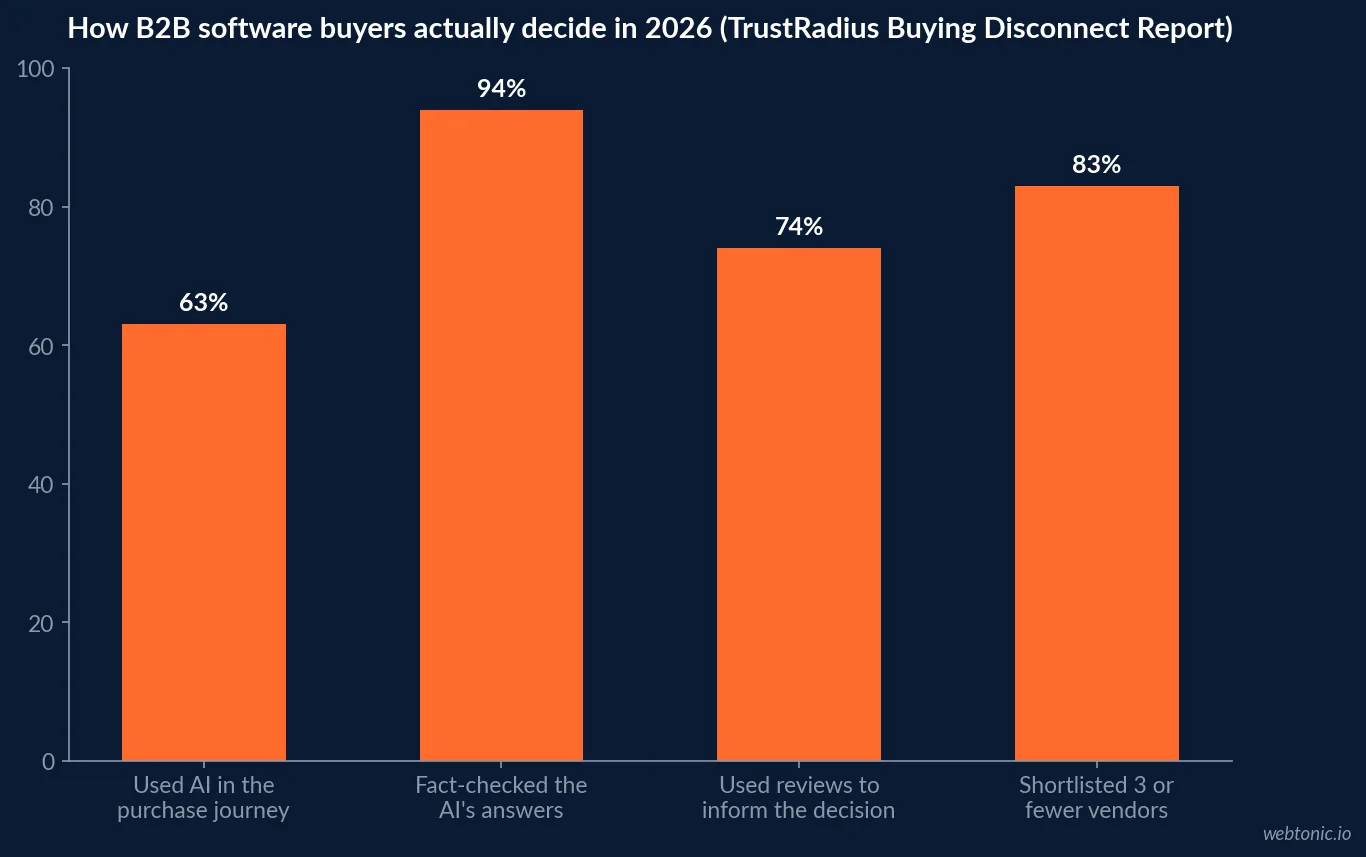
63% of B2B software buyers now use AI somewhere in their research, but 74% still say reviews are what actually inform the purchase decision. TrustRadius's 2026 B2B Buying Disconnect Report, based on 1,862 buyers and 444 vendors, is blunt about the mechanism: AI changed how fast a shortlist forms, not what a buyer trusts once it exists.
Key Takeaways
- 63% of B2B buyers used AI during their software purchase journey (TrustRadius 2026).
- Of those, 94% fact-check the AI's answers at least some of the time.
- 74% use reviews to inform their purchase decision regardless of AI use.
- 83% shortlisted 3 or fewer products.
- Analyst reports were used by just 13% of buyers, down 63% since 2022.
- Transparent pricing has been buyers' #1 wish-list item for four years running.
- 8 in 10 buyers sourced software recommendations from an AI chatbot in the past two years (G2 2026).
- Evaluation, not research, is now the longest stage of the buying journey (G2 2026).
- 39% of buyers cite IT security review as the single biggest source of delay.
- Nearly half of buyers say a CFO vetoed an already-approved deal in the last year.
- G2 hosts over 3 million verified reviews across 2,000-plus categories.
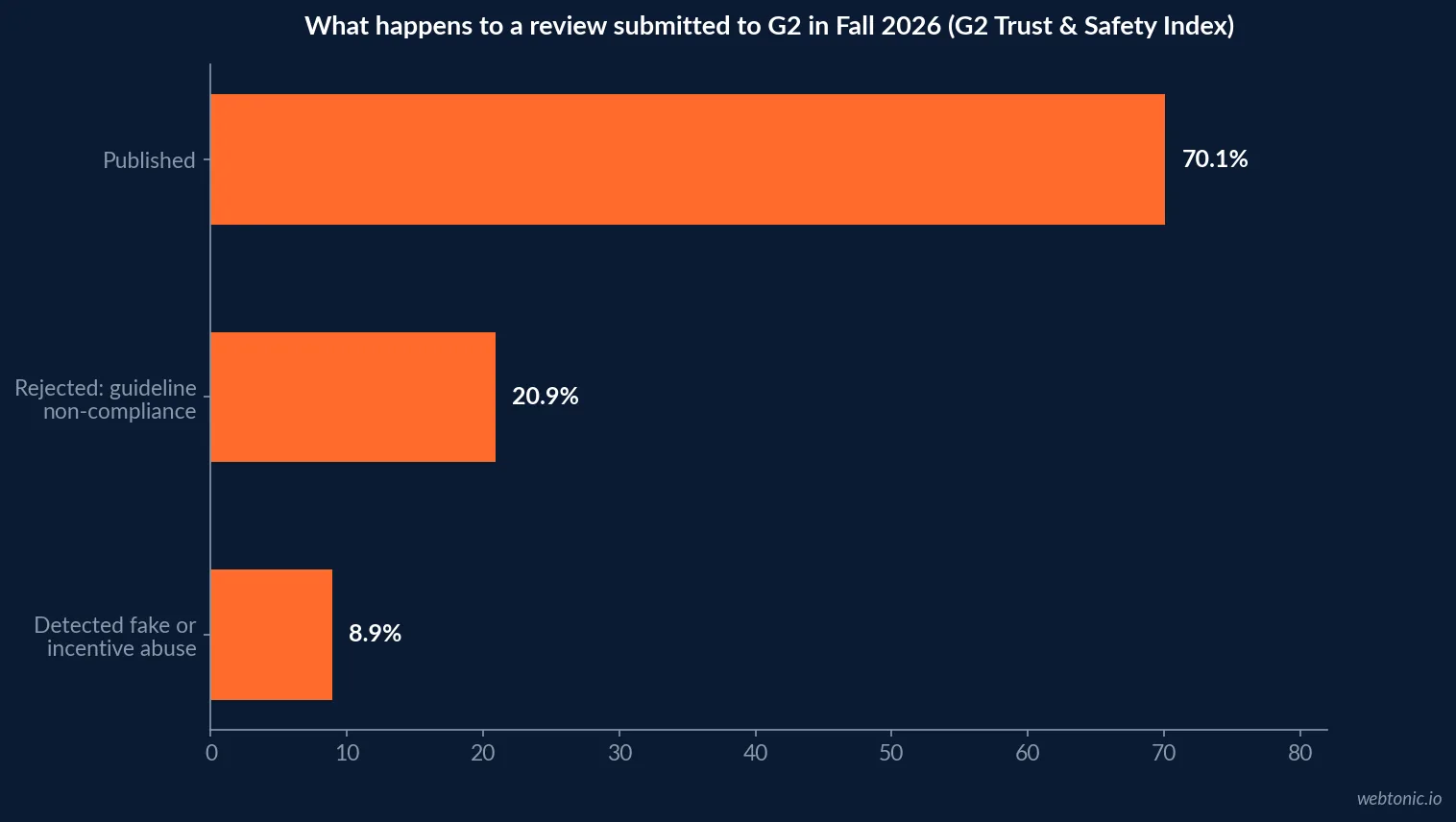
- In G2's Fall 2026 season, 70.1% of submitted reviews were published.
- 20.9% were rejected for community-guideline non-compliance.
- 8.9% (20,671 reviews) were detected as fake or incentive-abuse and removed.
- TrustRadius verifies a reviewer's employment and LinkedIn or business email before publishing.
- The FTC's 16 CFR Part 465 rule bars undisclosed insider reviews on any platform, B2B included.
The 2026 benchmarks at a glance
Two independent 2026 surveys anchor this page. TrustRadius's B2B Buying Disconnect Report surveyed 1,862 technology buyers and 444 technology vendors in January 2026. G2's Buyer Behavior Report: The Evaluation Maze surveyed more than 1,000 B2B software buyers and decision-makers, plus interviews with more than 50 B2B sales and marketing leaders. Both are the platforms' own published research, cited here with their stated sample sizes.
| Metric (2026) | Figure | Source |
|---|---|---|
| Buyers who used AI in the purchase journey | 63% | TrustRadius B2B Buying Disconnect Report |
| Of those, buyers who fact-check AI's answers | 94% | TrustRadius B2B Buying Disconnect Report |
| Buyers who use reviews to inform the decision | 74% | TrustRadius B2B Buying Disconnect Report |
| Buyers who shortlisted 3 or fewer products | 83% | TrustRadius B2B Buying Disconnect Report |
| Buyers who used analyst reports to decide | 13% (-63% since 2022) | TrustRadius B2B Buying Disconnect Report |
| Buyers sourcing recommendations from an AI chatbot | 8 in 10 | G2 2026 Buyer Behavior Report |
Why the shortlist got faster but the deal got slower
G2's 2026 report describes evaluation, not research, as the new bottleneck: discovery has compressed from hours of browsing to a single AI prompt, but 39% of buyers now name IT security review as the single biggest source of delay once a vendor is shortlisted, and nearly half of buyers say a CFO vetoed a deal that had already cleared internal approval. 7 in 10 say the pace of AI-related innovation is pushing them to request shorter contract terms. A vendor's review profile now has to do double duty - win the AI-sourced shortlist, then survive the finance-and-security scrutiny that follows it.
| Stage of the 2026 B2B buying journey | What the data shows | Source |
|---|---|---|
| Discovery | 8 in 10 buyers sourced a recommendation from an AI chatbot in 2 years | G2 2026 |
| Shortlisting | 83% narrowed to 3 or fewer vendors | TrustRadius 2026 |
| Evaluation | Now the longest stage of the journey, surpassing research | G2 2026 |
| Internal approval - security | 39% name IT security review as the top delay | G2 2026 |
| Internal approval - finance | Nearly half report a CFO veto of an approved deal | G2 2026 |
| Contracting | 7 in 10 push for shorter terms given the pace of AI change | G2 2026 |
How the two biggest review platforms police authenticity
G2's Fall 2026 Trust & Safety Index reports 230,998 reviews submitted that season across a review base of 3 million-plus verified reviews spanning 2,000-plus software and services categories. Of those submissions, 70.1% were published, 20.9% were rejected for community-guideline non-compliance, and 8.9% (20,671 reviews) were detected as fake or tied to incentive abuse and removed before publication.
TrustRadius runs a different, more manual model: every reviewer's employment and the legitimacy of their LinkedIn profile or business email is checked before publication, and every review is read by a human before it goes live. Both platforms exist because unmoderated reviews are gameable, and both publish their own moderation numbers as the proof that they are not.
| Review platform | Moderation model | 2026 disclosure |
|---|---|---|
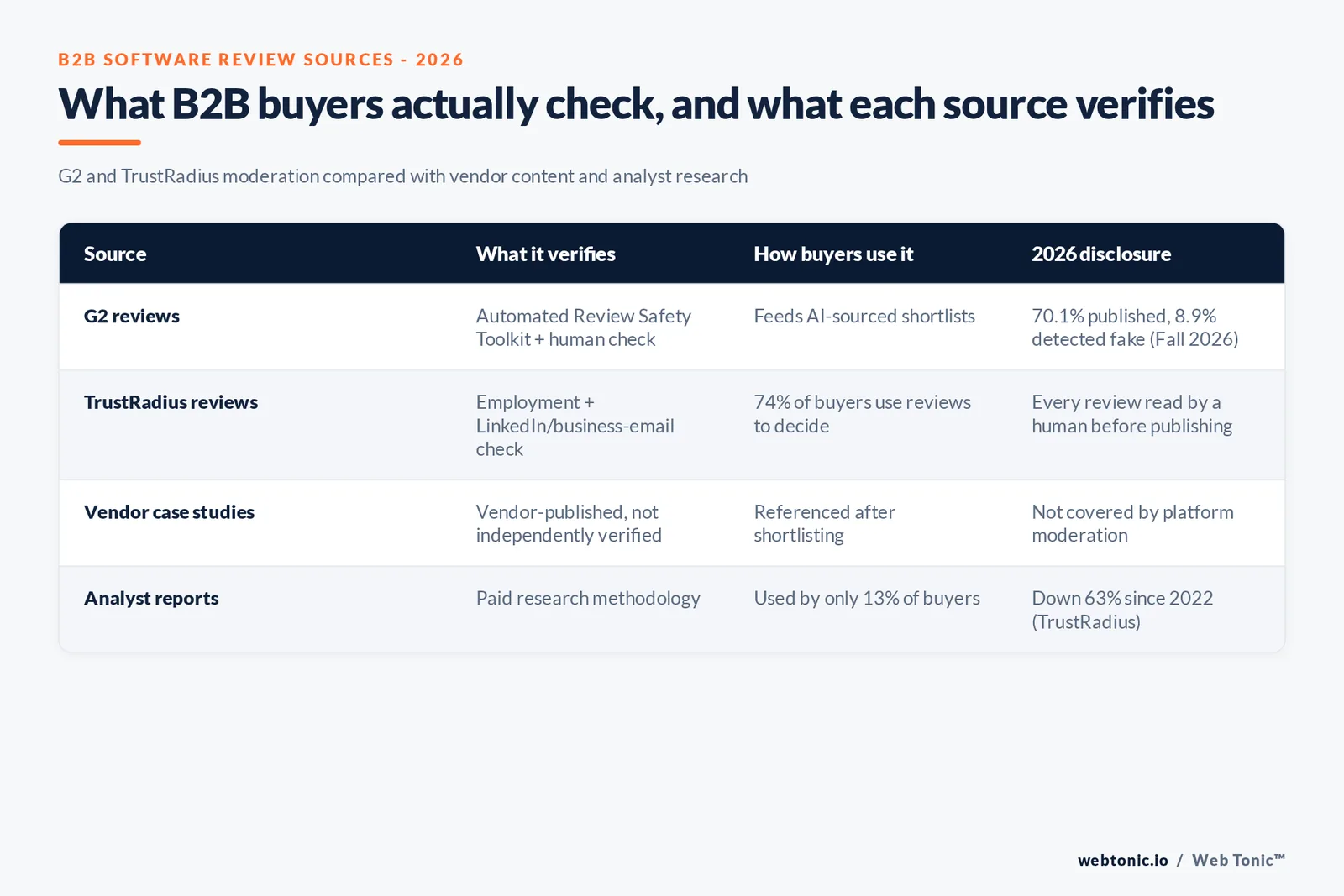
| G2 | Automated Review Safety Toolkit + human check | 70.1% published, 8.9% detected fake/incentive abuse (Fall 2026) |
| TrustRadius | Manual employment + LinkedIn/business-email verification | Every review read by a human before publishing |
| Trustpilot (cross-industry benchmark) | AI-assisted + automated detection | 4.5M fake reviews removed in 2024, 90% caught automatically |
| Analyst reports (Gartner-style) | Paid research methodology, not open review | Used by only 13% of buyers to decide (down 63% since 2022) |
The friction the review platforms did not create
G2's own reporting on the 2026 shift is careful to separate two problems that look similar from the outside. Discovery got faster because AI compressed research into a single prompt. Evaluation got slower because the internal buying committee - security, finance, procurement - did not get any faster at the same time. A vendor cannot fix the second problem with a better G2 profile; a strong review profile only guarantees a spot on the shortlist the AI chatbot compiles, not a pass through the CFO and security review that comes after it.
| What compressed vs. what didn't (2026) | Direction | Source |
|---|---|---|
| Time to build a shortlist | Faster (AI-assisted) | G2 2026 Buyer Behavior Report |
| Time spent in evaluation | Longer - now the longest stage | G2 2026 Buyer Behavior Report |
| Reliance on analyst reports | Down 63% since 2022 | TrustRadius 2026 |
| Reliance on reviews specifically | Steady at 74% of buyers | TrustRadius 2026 |
| Internal approval friction (security, finance) | Up - named the top delay by 39% of buyers | G2 2026 Buyer Behavior Report |
Where the FTC's rule reaches inside B2B software marketing
The FTC's 16 CFR Part 465 rule, final in August 2024, is written to cover reviews broadly, not just consumer retail. It prohibits creating or buying reviews from someone with no real product experience, prohibits compensation conditioned on posting a specific sentiment, and specifically prohibits a business disseminating an undisclosed insider review - an employee, officer or agent posting a review of their own company's product without disclosing the relationship. A SaaS company asking its own team to post reviews to inflate a G2 score, without disclosure, sits squarely inside the conduct the rule targets, on top of whatever the platform's own moderation catches first.
Building a review programme around how buyers actually decide
- Prioritize G2 and TrustRadius profile completeness before analyst outreach - analyst reports now influence only 13% of decisions, down 63% since 2022, while review platforms feed the AI-sourced shortlist directly.
- Request reviews at renewal and at a clear win moment, not only from champions who already love the product - selective solicitation is the pattern both platforms' moderation teams are built to catch.
- Never route review requests through anyone with an equity or compensation stake in the outcome without disclosure - that is the exact insider-review conduct 16 CFR 465 prohibits.
- Publish security and pricing detail proactively - 39% cite IT security review as the top delay and transparent pricing has been buyers' top wish-list item for four straight years.
- Treat a thin review profile as a shortlist risk, not just a trust risk - with 83% of buyers narrowing to 3 or fewer vendors, a sparse or dated profile can mean never making the list the AI chatbot compiles in the first place.
What review-management and G2/TrustRadius programme support costs
Some review platforms sell managed campaigns to help vendors collect reviews at scale; list prices for those programmes and for third-party review-management software should be checked on the vendor's own current pricing page, since tiers move with review volume and reporting depth. Budget the comparison against the cost of not clearing an 83%-of-buyers shortlist of three, not against a flat marketing line item.
Where review strategy fits a broader pipeline plan
A G2 or TrustRadius profile is one input into a wider funnel, not a substitute for it. SaaS teams running paid search programmes should expect branded-term click-through to track review volume the same way local-search click-through does for other categories, since a buyer researching a vendor by name is already reading the review count before clicking an ad. Teams building out a data intelligence layer across the funnel should treat review-platform traffic as a stage worth tracking on its own, not folding it into generic organic. Read more about how this site approaches growth work on the about page, or get in touch to talk through a specific pipeline.
| Self-audit question | Why it matters | 2026 source |
|---|---|---|
| Are our G2 and TrustRadius profiles both complete? | Both feed AI-sourced shortlists differently | G2 2026 / TrustRadius 2026 |
| Are we requesting reviews at renewal, not only from champions? | Selective asking is what platform moderation is built to catch | G2 Trust & Safety Index |
| Is our pricing page current and public? | Transparent pricing is buyers' #1 wish-list item, 4 years running | TrustRadius 2026 |
| Have we disclosed any employee-authored reviews? | Undisclosed insider reviews violate 16 CFR 465 | FTC final rule, Aug 2024 |
| Do we have fewer than 3 recent reviews on either platform? | 83% of buyers shortlist 3 vendors or fewer | TrustRadius 2026 |
Frequently Asked Questions
Do B2B software buyers still read reviews now that they use AI to research?
Yes - TrustRadius's 2026 B2B Buying Disconnect Report, based on 1,862 technology buyers and 444 vendors, found 63% used AI somewhere in their purchase journey, but 74% still use reviews to inform the decision, and 94% of buyers who used AI said they fact-check its answers at least some of the time. AI changed how buyers start researching, not what they trust once a shortlist forms.
How many vendors make it onto a typical B2B software shortlist?
83% of buyers in the same TrustRadius survey shortlisted 3 or fewer products. G2's 2026 Buyer Behavior Report, from a separate survey of more than 1,000 B2B buyers, found 8 in 10 had sourced software recommendations from a tool like ChatGPT or Google AI Mode in the past two years - meaning the shortlist now forms faster, but only three vendors typically clear it, which raises the cost of not being one of them.
Are analyst reports like Gartner still influential in B2B software decisions?
Less than they were. TrustRadius's 2026 report found analyst reports were used by only 13% of buyers to make their purchase decision, a 63% decrease since 2022. The same report found product demos, free trials, prior experience and user reviews ranked ahead of analyst research among the resources buyers said actually influenced them.
How does G2 stop vendors from gaming their review score?
G2 publishes a seasonal Trust & Safety Index. In its Fall 2026 edition, G2 reported 230,998 reviews submitted across its 3-million-plus review base, of which 70.1% were published, 20.9% were rejected for community-guideline non-compliance, and 8.9% (20,671 reviews) were detected as fake or incentive-abuse and removed. TrustRadius runs a comparable manual step, verifying a reviewer's employment and LinkedIn or business email before a review is published.
Does the FTC's fake-review rule apply to B2B software review platforms?
Yes. The FTC's 16 CFR Part 465 rule (final August 2024) is not limited to consumer products - it prohibits any business from buying, selling or incentivizing reviews conditioned on sentiment, and separately prohibits an undisclosed insider review, such as an employee posting a five-star review of their own company's product without disclosing the relationship.
Sources
TrustRadius - Building Buyer Trust: Review Quality Report 2025
TrustRadius - 2026 B2B Buying Disconnect Report (via PR Newswire)
TrustRadius - How TrustRadius verifies reviews
G2 - 2026 Buyer Behavior Report: The Evaluation Maze
G2 - Why B2B deals stall after the AI shortlist
G2 - Fall 2026 Trust & Safety Index
G2 - Review Validity policy
FTC - Final rule banning fake reviews and testimonials (16 CFR 465)
Trustpilot - Trust Report 2025
BrightLocal - Local Consumer Review Survey 2026