Table of contents
73% of B2B buyers say they prefer hearing from vendors by email over any other outreach channel, per Sopro's own 97.9 million-email dataset - which should settle the "email is dead, LinkedIn won" debate that keeps resurfacing in SaaS sales circles. The real question for a software seller is which reply-rate benchmark to plan against and how to sequence the two channels together.
Key Takeaways
- 73% of B2B buyers prefer vendor outreach by email, per Sopro's own survey data.
- 75% say email prospecting returns "good to excellent" ROI, only 3% report negative ROI.
- 3.43% is the average cold email reply rate across Instantly's 2026 benchmark.
- Top-quartile senders reach 5.5%, elite senders exceed 10.7%.
- Woodpecker's median reply rate is 1.5% across 56,614 tracked campaigns.
- Belkins' narrower 2026 dataset of 7,530,489 emails reports 0.45%.
- Established domains see response rates improve 73% versus newly warmed domains.
- Lead rates improve 62% on established domains in the same Sopro test.
- Email-only campaign lead rates fell 29% year on year, per Sopro's 2025 report.
- The average organization runs 269 SaaS platforms in its own tech stack.
- 60% of B2B marketers call their stack "more complex than a black hole".
- A cold call before the email lifts reply rate to 3.44%, nearly double email alone.
- Email alone replies at 1.81% in Gong's 28 million-plus email dataset.
- LinkedIn InMail acceptance typically runs 10-25%, a different metric than reply rate.
- A complete LinkedIn profile lifts InMail acceptance by 87%.
- 5,000+ messages/day to Gmail triggers mandatory SPF, DKIM and DMARC since Feb 2024.
- CAN-SPAM (16 CFR 316) sets the federal floor for every commercial email to a US address.
What SaaS buyers themselves say they prefer
Sopro's State of Prospecting 2025 report, drawn from its own dataset of 97.9 million outreach emails and 21.6 million multi-channel touchpoints, found 73% of B2B buyers prefer vendor outreach by email over any other channel, and 75% of B2B businesses report email prospecting returns "good to excellent" ROI, with only 3% reporting negative ROI. That is buyer-stated preference data, not a vendor's sending-platform benchmark, and it is a useful corrective every time a "LinkedIn killed cold email" post recirculates.
| Buyer preference metric (Sopro's own data) | Figure |
|---|---|
| B2B buyers preferring vendor outreach by email | 73% |
| B2B businesses rating email prospecting ROI "good to excellent" | 75% |
| B2B businesses reporting negative email prospecting ROI | 3% |
| Outreach emails analyzed for the 2025 report | 97.9 million |
| Multi-channel touchpoints analyzed alongside | 21.6 million |
The reply-rate numbers to actually plan against
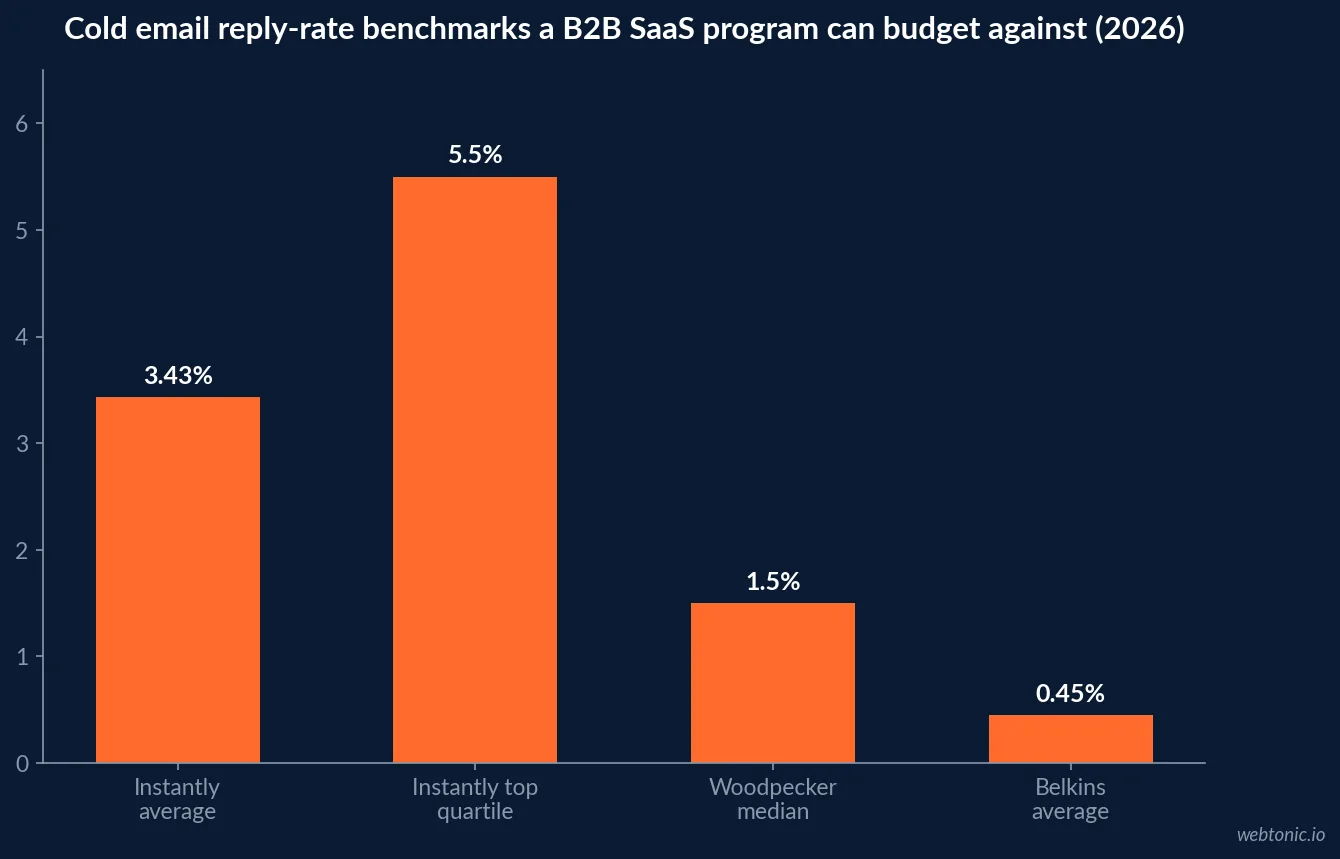
Instantly's Cold Email Benchmark Report 2026 puts the platform-wide average reply rate at 3.43%, the top quartile at 5.5%, and elite senders (top decile) above 10.7%. Woodpecker's own benchmark tool, drawn from 56,614 tracked campaigns, reports a lower median of 1.5% alongside a 26% median open rate across 37,000 campaigns. Belkins' 2026 study of 7,530,489 of its own client emails reports a stricter 0.45% average. A SaaS program sending at real volume into a saturated vertical should expect a number closer to Woodpecker's or Belkins' figure than to Instantly's headline average, because SaaS buyers are among the most heavily prospected audiences on the internet.
| Vendor dataset | Reported figure | Sample | What it measures |
|---|---|---|---|
| Instantly 2026 | 3.43% average / 5.5% top quartile / 10.7%+ elite | Platform-wide sends through Dec 2025 | Reply rate |
| Woodpecker | 1.5% median / 26% open rate | 56,614 campaigns / 37,000 campaigns | Reply and open rate |
| Belkins 2026 | 0.45% average | 7,530,489 client emails | Unique replies / total sends |
| Sopro 2025 | 97.9M emails analyzed, buyer preference not reply rate | 97.9 million emails / 21.6 million touchpoints | Buyer-stated channel preference and ROI rating |
Why domain reputation is a bigger lever in SaaS than in most verticals
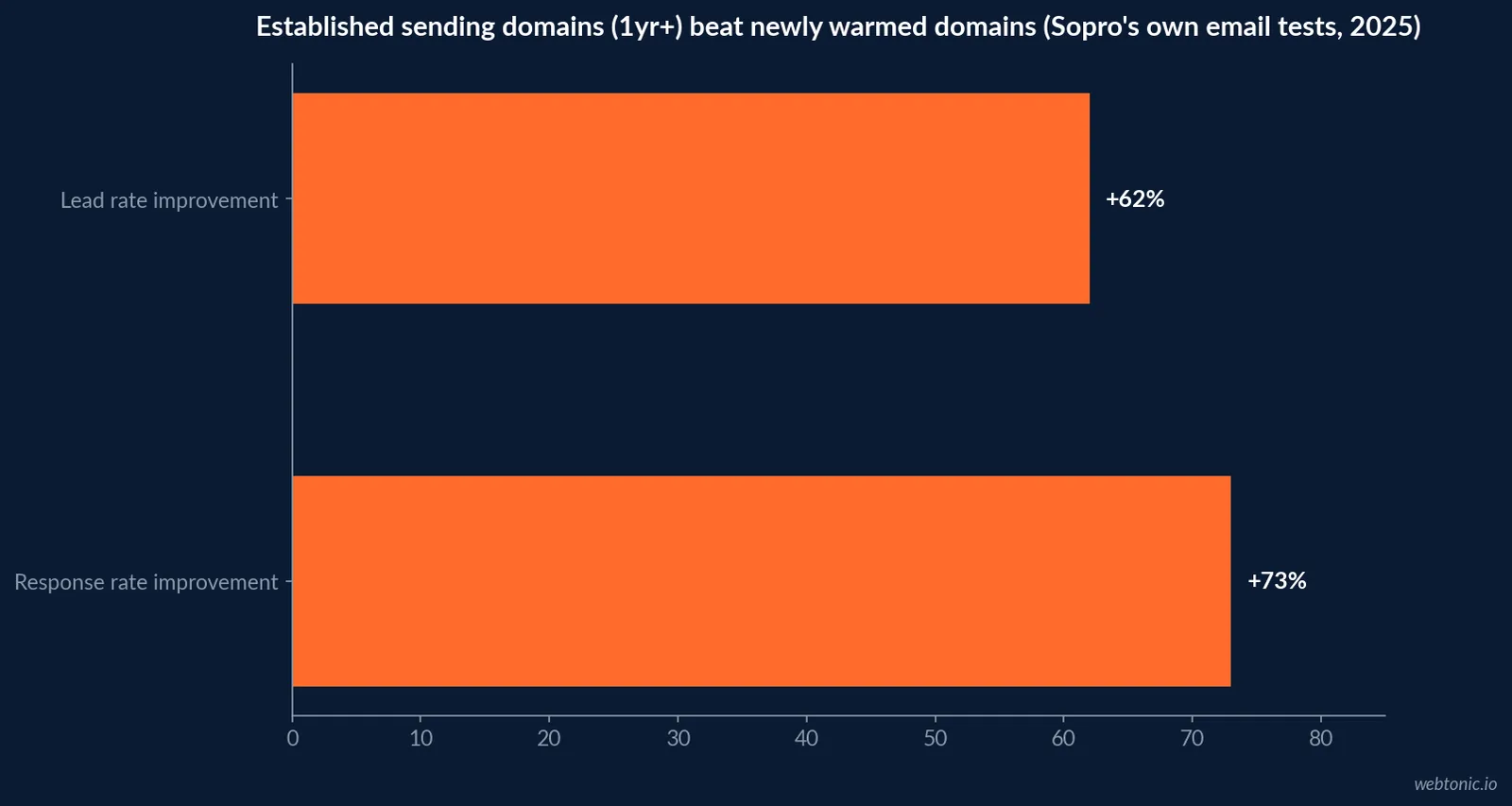
SaaS outbound competes for attention inside one of the most prospected inboxes in B2B. Sopro's own email prospecting tests found established domains (at least a year old) saw response rates improve 73% and lead rates improve 62% compared with newly warmed domains - and separately reported that email-only campaign lead rates fell 29% year on year as anti-spam measures tightened and self-service outreach tools flooded inboxes with generic messaging. For a SaaS team, warming a domain properly before scaling volume is arguably a higher-leverage move than any single copy or subject-line change.
| Domain and channel discipline (Sopro's own tests) | Effect | Why it matters for SaaS |
|---|---|---|
| Domain age 1 year+ vs newly warmed | +73% response rate | SaaS inboxes are the most heavily targeted; reputation compounds |
| Same domain-age comparison | +62% lead rate | Reputation converts to pipeline, not just replies |
| Single-channel (email-only) campaigns | -29% lead rate year on year | Argues for pairing email with a second channel |
| Multi-channel sequences (email + call/LinkedIn) | Held up better than email-only | Matches Gong's call-pairing finding below |
Does a call, or LinkedIn, actually change the outcome?
Gong's own analysis of 28 million-plus cold emails found a cold email sent with no call replied at 1.81%, while the same rep's email backed by a cold call replied at 3.44%. LinkedIn's own analysis of InMail sending reports acceptance typically in the 10-25% range, with a complete profile lifting acceptance by 87% - a different metric (message acceptance, not a completed reply) that measures closer to an email open rate than a conversation.
For a SaaS sales motion running quota-carrying reps, the practical read is a three-touch sequence - LinkedIn connection request, cold email, and a call attempt - rather than picking one channel as the permanent winner over the others.
| Channel | What the metric measures | Published figure | Source |
|---|---|---|---|
| Cold email, no call | Full reply | 1.81% | Gong, 28M+ email dataset |
| Cold email + cold call | Full reply | 3.44% | Gong, same dataset |
| LinkedIn InMail | Message acceptance | 10-25% | LinkedIn's own analysis |
| LinkedIn InMail, complete profile | Acceptance lift | +87% | LinkedIn's own analysis |
What Google and Yahoo require before a SaaS team can send at scale
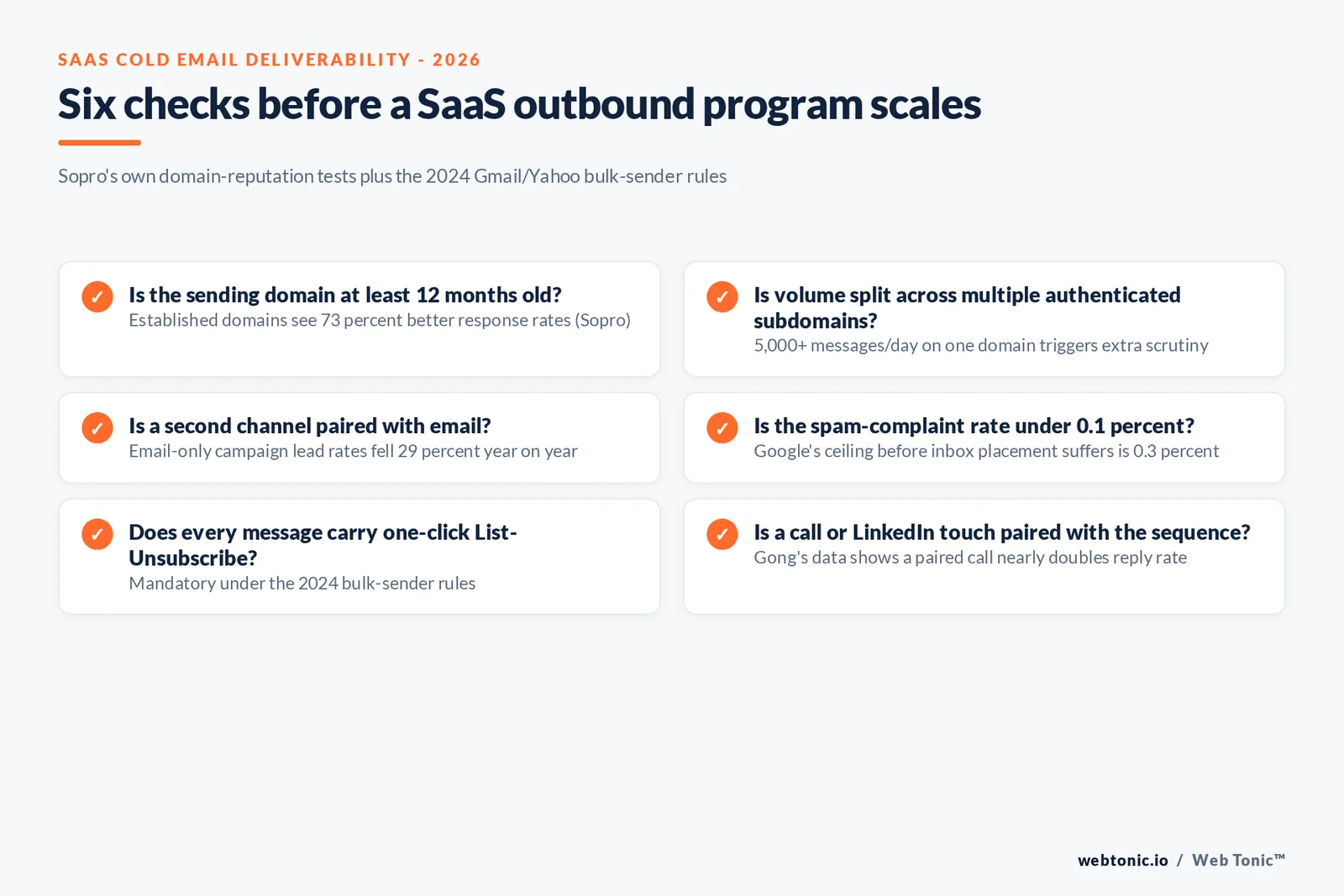
Under the Gmail bulk-sender guidelines effective February 2024, any sender pushing 5,000 or more messages a day to Gmail addresses must authenticate with SPF, DKIM and a DMARC policy, support one-click unsubscribe, and keep the spam-complaint rate under 0.3% - Google's own guidance recommends staying under 0.1%. Yahoo's Sender Hub requires the same authentication floor for bulk senders. SaaS teams running multiple SDRs off a shared domain are the most likely to accidentally cross the 5,000-message threshold without realizing it - splitting volume across multiple properly authenticated subdomains is standard practice for exactly this reason.
The CAN-SPAM Rule, 16 CFR Part 316, sets the federal floor underneath both providers' rules for every commercial email sent to a US recipient, at any volume.
| Requirement (2024 rules) | Google threshold | Yahoo threshold | Consequence of missing it |
|---|---|---|---|
| SPF + DKIM + DMARC | Mandatory at 5,000+/day | Mandatory for bulk senders | Authentication failure, spam folder |
| Spam-complaint rate | Under 0.3%, target 0.1% | Same intent, no separate number published | Domain reputation damage |
| One-click unsubscribe | Mandatory at 5,000+/day | Mandatory for bulk senders | Non-compliant headers rejected |
| CAN-SPAM opt-out honor window | 10 business days (federal law) | 10 business days (federal law) | FTC enforcement exposure |
What actually gets a SaaS cold email opened
Sopro's own survey of 400 B2B buyers asked which subject-line style they were more likely to open. Personalized subject lines - carrying the recipient's name or company - led at 66%, followed by offers at 62%, questions and topical/trend hooks tied at 56%, and humor at 51%. Shocking or alarmist framing performed worst at 29%, which matters for SaaS specifically because urgency-heavy subject lines are one of the most common patterns in software outbound and, per this data, one of the least effective.
| Subject-line style (Sopro's own 400-buyer survey) | More likely to open |
|---|---|
| Personalized with recipient name or company | 66% |
| An offer | 62% |
| A question | 56% |
| Topical / trend / current affairs | 56% |
| Humorous | 51% |
| Intriguing / mystery / clickbait | 43% |
| Time-sensitive / urgent | 44% |
| Shocking / alarmist | 29% |
Sequencing outbound against paid demand
Outbound and paid search answer different buying stages for a SaaS company - outbound reaches a prospect before they are actively searching, paid search catches them once they are. See our Google Ads agency practice for how the two typically get sequenced inside one B2B SaaS pipeline, and our performance creative practice for how subject-line and opening-line testing borrows directly from paid-ad copy testing discipline. For the channel's cross-industry baseline, see our cold email outbound statistics hub. If your outbound program needs auditing against the 2024 sender rules above, talk to us.
Frequently Asked Questions
Do B2B SaaS buyers actually prefer email over LinkedIn?
Yes, by their own stated preference. Sopro's State of Prospecting 2025 report, drawn from its own dataset of 97.9 million outreach emails, found 73% of B2B buyers prefer to hear from vendors via email - the most commonly preferred outreach channel in its survey - and 75% of B2B businesses say email prospecting returns 'good to excellent' ROI, with only 3% reporting negative ROI. That preference does not mean LinkedIn should be dropped; it means email should not be dropped in favor of it either.
What reply rate should a SaaS cold email program plan against?
Instantly's Cold Email Benchmark Report 2026, built from platform-wide sending data through December 2025, puts the average reply rate at 3.43%, the top quartile at 5.5%, and elite senders (top 10%) above 10.7%. Woodpecker's own benchmark tool, drawn from 56,614 campaigns, reports a lower median of 1.5% with a 26% median open rate across 37,000 campaigns. Belkins' narrower 2026 study of 7,530,489 of its own client emails reports 0.45% on a strict unique-replies-over-sends basis - a SaaS team running high volume should expect a number nearer the lower end of that range, not the platform-wide average.
Why does domain age matter more for SaaS outbound than it used to?
Because SaaS is one of the most heavily prospected verticals, and the mailbox providers have tightened accordingly. In Sopro's own email prospecting tests, established domains (at least a year old) saw response rates improve 73% and lead rates improve 62% compared with newly warmed domains - a gap large enough that domain age alone can outweigh copy quality as a lever.
Is LinkedIn actually a better channel than email for SaaS sellers?
It measures a different thing. LinkedIn's own data on InMail sending reports acceptance typically in the 10-25% range, with a complete profile lifting acceptance by 87%, but that figure tracks whether a message gets opened at all, closer to an email open rate than a completed reply. Gong's 28 million-plus email dataset found email alone replies at 1.81%, while the same rep's email paired with a cold call replies at 3.44% - the honest read is a coordinated sequence across both channels, not a single winner.
How complicated is the average SaaS buyer's own tech stack, and does that affect outreach?
Sopro cites a 2024 report finding the average organization runs 269 SaaS platforms, with 60% of B2B marketers describing their own stack as 'more complex than a black hole.' A buyer already managing that many tools is a harder inbox to earn attention in, which is one reason Sopro's own data shows single-channel, email-only campaign lead rates fell 29% year on year while multi-channel sequences held up better.
Sources
Sopro - The State of Prospecting 2025
Instantly - Cold Email Benchmark Report 2026
Woodpecker - Free cold email benchmarks tool
Belkins - B2B cold email response rates, 2026 study
Gong - Does cold email even work any more? (28M+ email dataset)
Gong - The hidden power of cold calling (300M+ call dataset)
LinkedIn - Data on sending InMails and acceptance rates
Google - Email sender guidelines (Gmail bulk-sender rules)
Yahoo - Sender Hub best practices
eCFR - 16 CFR Part 316, CAN-SPAM Rule