Table of contents
Channel and partnerships now account for a meaningfully larger share of B2B software revenue than they did two years ago. The question worth answering with data, not vibes, is whether that partner-sourced revenue is actually cheaper than paid acquisition once commission, fraud and cookie-window losses are priced in.
Key Takeaways
- 69% of B2B SaaS leaders are increasing partnership investment in 2026 (PartnerStack/Wynter).
- 35% of pipeline is partner-influenced or sourced at mid-market and enterprise companies.
- 63% say partner-led GTM motions accelerate active sales cycles.
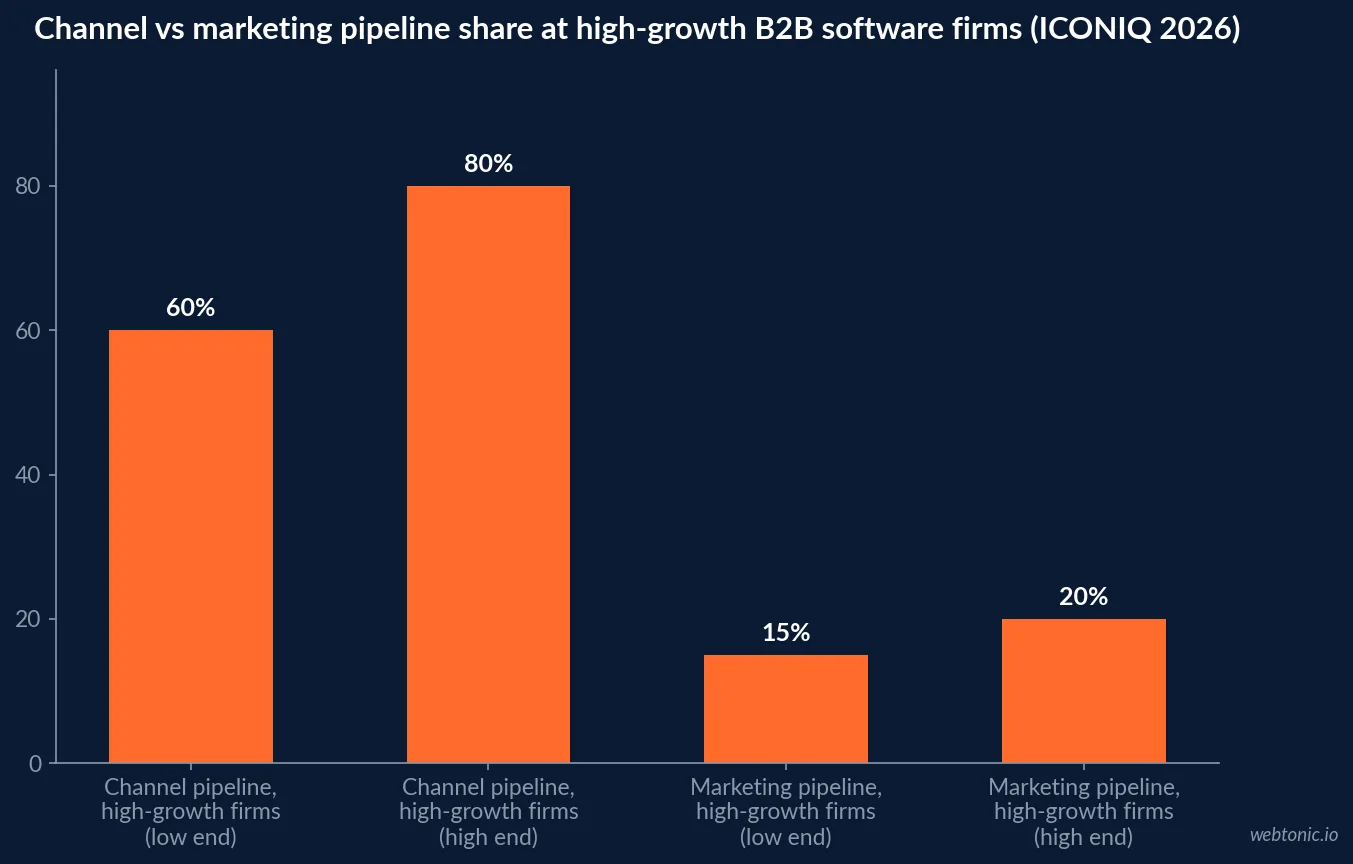
- Channel-generated pipeline runs 60% to 80% of total pipeline at high-growth firms (ICONIQ 2026).
- Marketing-sourced pipeline is only 15% to 20% at the same high-growth firms.
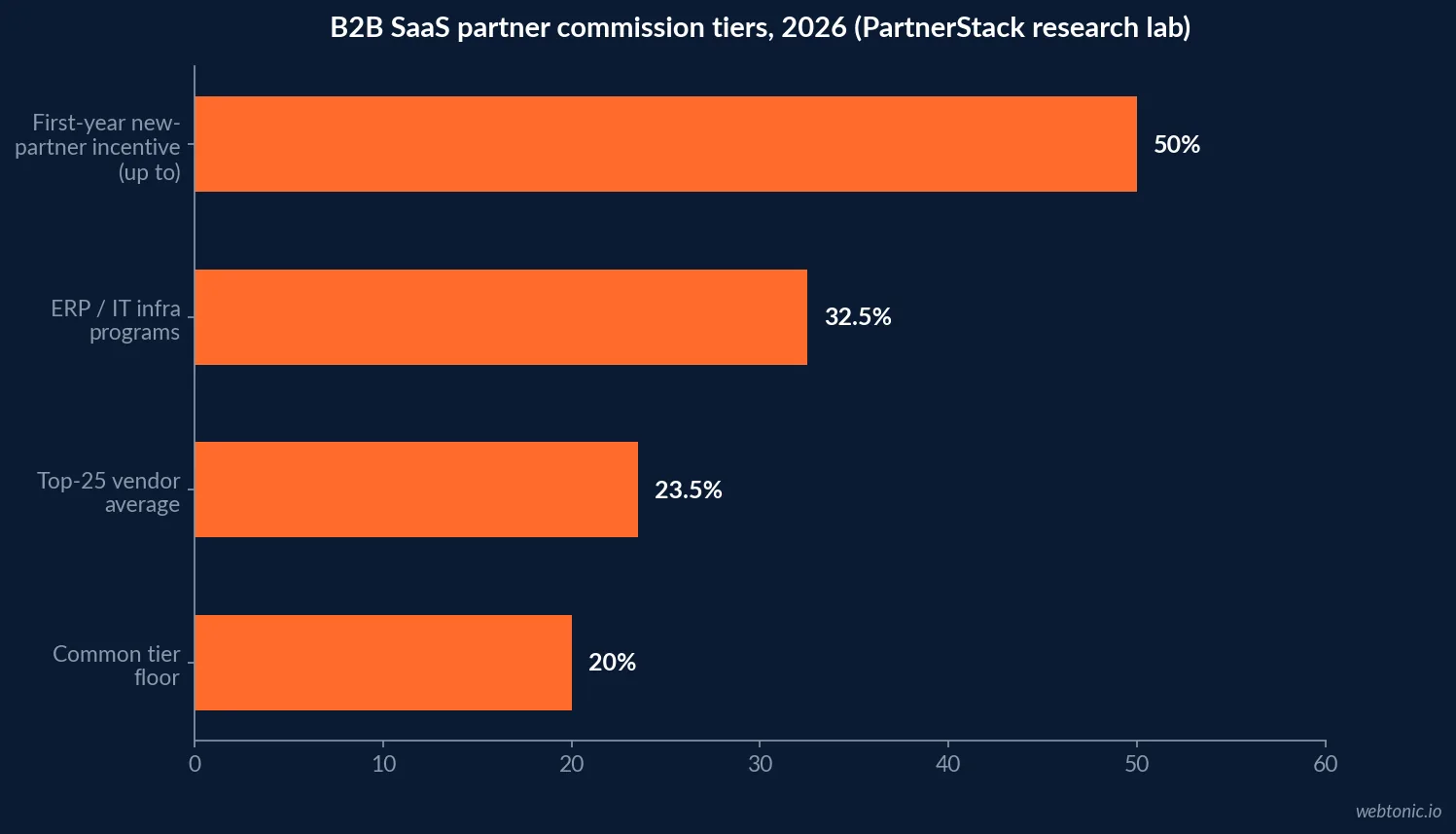
- PartnerStack's top 25 vendors pay an average 23.5% commission.
- ERP and IT infrastructure programs pay 30% to 35% on average.
- Some programs front-load up to 50% revenue share in year one only.
- Active partner earnings grew 19% year over year across PartnerStack's network.
- Total commissions paid out grew 54% over the same period.
- ERP-specific partner commissions grew 61% from Q1 2024 to Q1 2025.
- 30% of brands allocate 10% to 20% of budget to affiliate, per impact.com's own 2025 survey.
- 38% allocate 21% to 30% of budget to the channel.
- The cross-industry median cookie window is 60 days in 2026.
- 28% of programs use a 30-day-or-shorter window, mostly low-ticket categories.
- SaaS and B2B lead-gen fraud is dominated by form-fill and fake trials, not click fraud (Scaleo 2026).
Why the "still worth it" question is being asked now
Two years of compressed growth and rising paid-acquisition costs pushed B2B SaaS go-to-market teams to re-examine every channel's real, fully-loaded cost - not just its headline CAC. ICONIQ's 2026 State of Go-to-Market report, based on a survey of over 150 B2B software CROs, CEOs and sales leaders, found that at high-growth companies, channel-generated pipeline now accounts for 60% to 80% of total pipeline, against only 15% to 20% sourced from marketing. That is the strongest direct signal that partnerships have moved from side channel to primary pipeline engine at the fastest-growing accounts.
PartnerStack and Wynter's State of Partnerships in GTM 2026 report corroborates the shift from the vendor side: 69% of B2B SaaS leaders surveyed are increasing partnership investment, and none reported decreasing it.
How much revenue is actually partner-sourced
PartnerStack's own research lab data shows mid-market and enterprise companies reporting 35% of pipeline as partner-influenced or partner-sourced, with larger companies consistently reporting a bigger share than smaller ones. 63% of B2B SaaS companies surveyed say partner-led go-to-market motions accelerate active sales cycles rather than just adding volume, which is the argument for treating partnerships as a pipeline-velocity lever, not only a top-of-funnel one.
| Metric (2025-2026) | Figure | Source | What it measures |
|---|---|---|---|
| B2B SaaS leaders increasing partner investment | 69% | PartnerStack/Wynter GTM 2026 | Budget direction |
| Pipeline partner-influenced/sourced, mid-market+enterprise | 35% | PartnerStack research lab | Revenue attribution |
| Leaders saying partners accelerate sales cycles | 63% | PartnerStack/Wynter GTM 2026 | Velocity, not just volume |
| High-growth firm channel-sourced pipeline share | 60-80% | ICONIQ State of GTM 2026 | Pipeline mix |
| High-growth firm marketing-sourced pipeline share | 15-20% | ICONIQ State of GTM 2026 | Pipeline mix |
What the commission actually costs
PartnerStack's own data on its top 25 highest-performing vendors shows an average payout around 23.5% of the transaction, clustering at 20%, 25% and 30% commission tiers in that order. Certain categories pay noticeably more: ERP and IT infrastructure software programs pay 30% to 35% on average, and some vendors front-load a 50% first-year revenue share to win a partner's initial attention, stepping down at renewal.
Growth is real, not just rate inflation: PartnerStack's 2026 report shows active partner earnings up 19% and total commissions paid out up 54% year over year across its network, with ERP-category partner commissions specifically up 61% from Q1 2024 to Q1 2025.
| Commission tier or growth metric | Figure | Source | Category |
|---|---|---|---|
| Top-25 vendor average commission | 23.5% | PartnerStack research lab | Cross-category |
| Common commission tiers | 20% / 25% / 30% | PartnerStack research lab | Cross-category |
| ERP and IT infrastructure commission | 30-35% | PartnerStack research lab | ERP/IT infra |
| First-year-only front-loaded share | Up to 50% | PartnerStack research lab | New-partner incentive |
| Active partner earnings growth | +19% YoY | PartnerStack 2026 report | Network-wide |
| Total commissions paid out growth | +54% YoY | PartnerStack 2026 report | Network-wide |
Where the budget for it comes from
impact.com's own State of Affiliate Marketing Research Report 2025, built from a survey of over 1,500 marketers, publishers and creators across 8 countries, found 30% of brands allocating 10% to 20% of their marketing budget to affiliate, 38% allocating 21% to 30%, and a further 20% committing 31% to 50%. Only a small minority put more than half their budget behind the channel. For a SaaS team weighing this against a paid search budget, that puts affiliate solidly in the "material line item," not "test budget," category for most respondents.
| Budget allocation to affiliate (2025) | Share of brands | Source |
|---|---|---|
| 10% to 20% of marketing budget | 30% | impact.com 2025 report |
| 21% to 30% of marketing budget | 38% | impact.com 2025 report |
| 31% to 50% of marketing budget | 20% | impact.com 2025 report |
| More than 50% of marketing budget | 6% | impact.com 2025 report |
The part that erodes the ROI: fraud and fake trials
Affiliate-tracking vendor Scaleo's State of Affiliate Fraud 2026 report, built from more than 1 billion tracked clicks across over 500 programs, names SaaS and B2B lead generation as dominated by form-fill fraud and fake trial registrations rather than click fraud, because the conversion event a partner is paid on - a signup or trial activation - is comparatively cheap to fabricate compared to a real purchase. That is a structural argument for paying commission on an activated, paying account rather than a raw signup, whatever the commission tier looks like on paper.
Cookie windows: last-click is the wrong model for enterprise sales cycles
Aggregated 2026 data from Awin, CJ Affiliate and Rakuten, compiled by TrackRev, puts the cross-industry median cookie window at 60 days, with 28% of programs - concentrated in e-commerce and low-ticket B2C SaaS - running 30 days or shorter. An enterprise SaaS deal routinely takes longer than 60 days from first partner touch to signature, which means a last-click, short-window program structurally under-credits the partner who actually opened the deal.
How partner-sourced revenue compares to paid acquisition
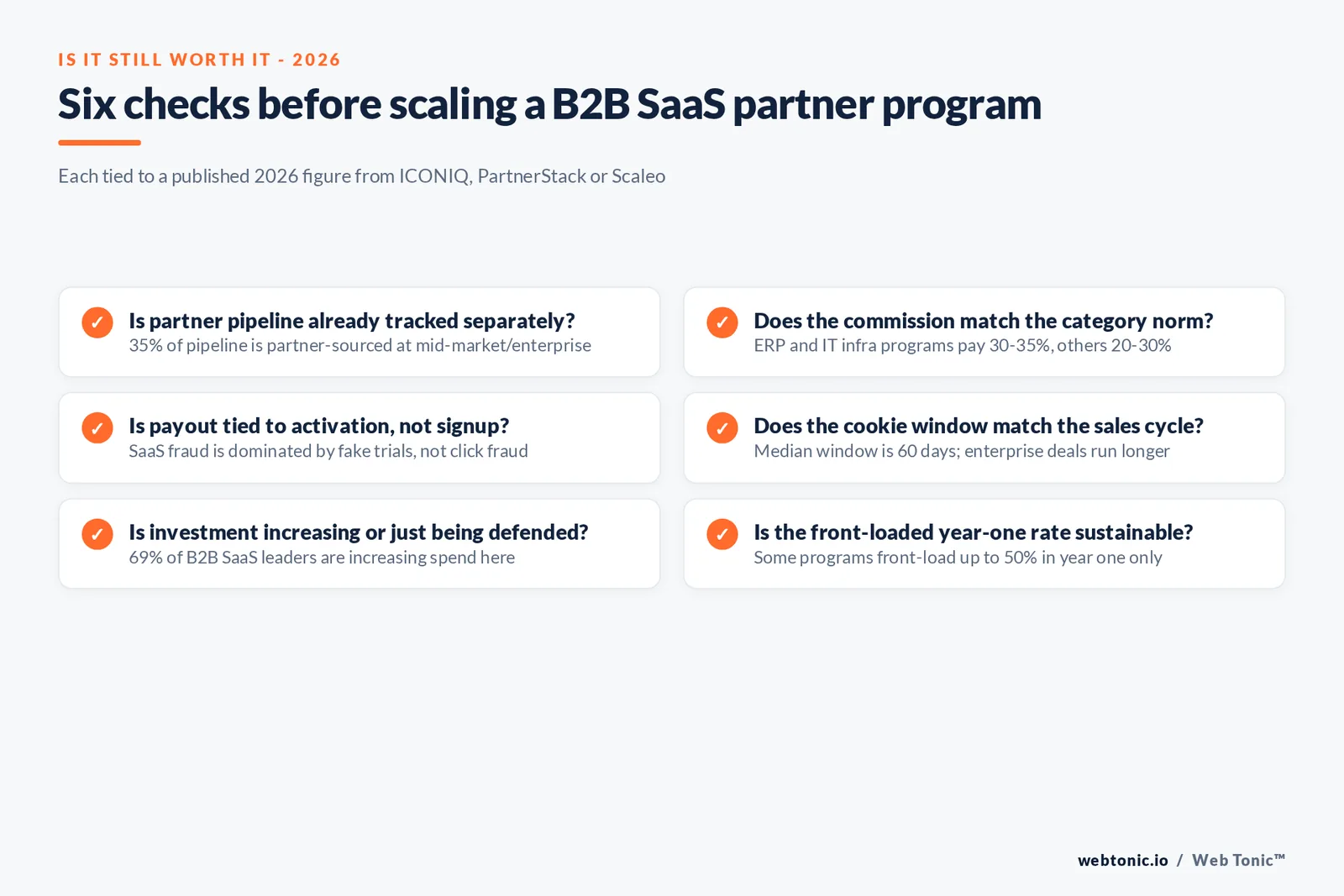
The honest comparison is not commission percentage against zero - it is commission percentage against the fully-loaded cost of the paid channel it displaces. Our analysis of paid social ROI and Google Ads pricing guide both show CAC climbing across paid channels through 2026, which is the backdrop that makes a 20% to 35% commission on a closed, activated account look structurally cheaper than continuing to bid up the same paid keywords for a shrinking marginal return.
The catch is attribution discipline: without a cookie window and fraud filter matched to an enterprise sales cycle, the commission line item inflates faster than the pipeline it is meant to buy. Our data and analytics practice builds that reconciliation before a partner program's spend is trusted at face value.
Governance: what to put in the partner agreement
Whatever the commission tier, the FTC's 16 CFR Part 255 Endorsement Guides still apply to any B2B partner or reseller receiving compensation for a recommendation used in marketing - the material connection has to be disclosed where the recommendation is actually seen. Pair that with a chargeback clause tied to churn inside the first 60 to 90 days, which is standard practice for recurring-revenue commission and directly addresses the fake-trial fraud pattern documented above.
| Agreement clause | What it protects against | Tied to which figure above |
|---|---|---|
| Disclosure requirement (16 CFR 255) | Undisclosed compensated recommendations | FTC Endorsement Guides |
| Chargeback on churn inside 60-90 days | Paying commission on a fake or short-lived trial | Scaleo fraud data |
| Activation-based, not signup-based, trigger | Form-fill and fake-trial fraud | Scaleo fraud data |
| Attribution window matched to sales cycle | Under-crediting a long-cycle partner deal | TrackRev 60-day median |
What the same buyer's paid-CAC benchmark looks like
The comparison a finance lead actually wants is partner CAC against paid CAC for the same buyer. Benchmarkit's CY-2025 B2B SaaS benchmarks put median customer acquisition cost payback at 16 months and median lifetime value to acquisition cost at 4.1 times across paid and blended channels. A partner-sourced deal that closes on a 20% to 35% one-time or first-year commission, with no ongoing paid media spend behind it, compares directly against that payback window rather than against zero.
Engagement-model data adds another angle: Sagefrog's 2026 B2B Marketing Mix Report, built from nearly 500 B2B marketers, found 35% of external marketing work bought project-based, 28% on ongoing retainer, 24% through freelancers or contractors and the rest hybrid - a reminder that the partner channel itself is usually managed inside one of those same commercial structures, not as a fully separate discipline.
| Benchmark (2025-2026) | Figure | Source | Relevance to partner-channel ROI |
|---|---|---|---|
| Median CAC payback, B2B SaaS | 16 months | Benchmarkit CY-2025 | Ceiling a partner deal should beat |
| Median LTV:CAC, B2B SaaS | 4.1x | Benchmarkit CY-2025 | Baseline efficiency to compare against |
| External work bought project-based | 35% | Sagefrog 2026 B2B Marketing Mix | How partner spend is usually structured |
| External work bought on retainer | 28% | Sagefrog 2026 B2B Marketing Mix | Alternative commercial structure |
| External work via freelancers/contractors | 24% | Sagefrog 2026 B2B Marketing Mix | Smallest-scale alternative |
The verdict for 2026
By the numbers, yes - partnerships are worth running for most B2B SaaS companies in 2026, and the shift toward them is accelerating rather than plateauing. The caveat is structural, not directional: pay on activation rather than signup, match the cookie window to the real sales cycle, and price the commission against the paid channel it actually displaces - a 16-month CAC payback benchmark, not zero. Talk to us if you want that comparison run against your own funnel numbers, or see how our paid search benchmarking prices the channel it would otherwise displace.
Frequently Asked Questions
Is a B2B SaaS affiliate or partner program still worth running in 2026?
The volume argument is strong: PartnerStack and Wynter's State of Partnerships in GTM 2026 report found 69% of B2B SaaS leaders increasing partnership investment and 35% of pipeline already partner-influenced or sourced at mid-market and enterprise companies. ICONIQ's own 2026 State of Go-to-Market survey of 150-plus B2B software leaders found channel-generated pipeline accounts for 60% to 80% of total pipeline at high-growth companies, versus 15% to 20% from marketing. The caveat is fraud exposure and payout structure, which decide whether that pipeline is actually profitable.
What commission rates do B2B SaaS affiliate and partner programs pay?
PartnerStack's own research lab reports its top 25 highest-performing vendors paying an average commission around 23.5%, clustering at 20%, 25% and 30% tiers, with certain categories like ERP and IT infrastructure software paying 30% to 35%. Some programs offer up to 50% revenue share in the first year only, stepping down after renewal.
How much of B2B software revenue actually comes through partners now?
ICONIQ's 2026 State of Go-to-Market data, drawn from a survey of over 150 B2B software CROs, CEOs and sales leaders, reports channel and partnership motions now account for a growing share of pipeline at the fastest-growing companies, alongside a shift away from pure direct-sales dependence. PartnerStack's own 2025 data shows active partner earnings grew 19% and total commissions paid out grew 54% year over year across its network.
What is the fraud risk in a SaaS affiliate program specifically?
Affiliate-tracking vendor Scaleo's 2026 fraud report, built from over 1 billion tracked clicks across 500-plus programs, flags SaaS and B2B lead generation as dominated by form-fill fraud and fake trial registrations rather than click fraud, because the conversion event - a form submission or trial signup - is comparatively easy to fabricate without a real card or install.
How long is the typical cookie window on a SaaS affiliate program?
Aggregated 2026 data from Awin, CJ Affiliate and Rakuten, compiled by TrackRev, puts the cross-industry median cookie window at 60 days, with 28% of programs - concentrated in e-commerce and low-ticket B2C SaaS - using 30 days or shorter. Enterprise SaaS sales cycles routinely outlast even the 60-day median, which is the main argument for first-touch or multi-touch attribution over last-click.
Sources
ICONIQ - State of Go-to-Market 2026
PartnerStack/Wynter - State of Partnerships in GTM 2026
PartnerStack - Partner-influenced revenue by company size
PartnerStack - Commission benchmarks among top vendors
PartnerStack - 2026 revenue precision report
impact.com - State of Affiliate Marketing Research Report 2025
Scaleo - State of Affiliate Fraud 2026
TrackRev - Affiliate program benchmarks 2026
Benchmarkit - CY-2025 B2B SaaS performance metrics benchmarks
Sagefrog - 2026 B2B Marketing Mix Report
Federal Trade Commission - 16 CFR Part 255 Endorsement Guides