Table of contents

No vendor publishes an auto-repair-specific video marketing budget, so this page builds one from Wyzowl and Wistia's 2026 cross-industry spend and ROI data, then applies it to what a repair bay can realistically produce. Every figure below is dated and labeled by source.
Key Takeaways
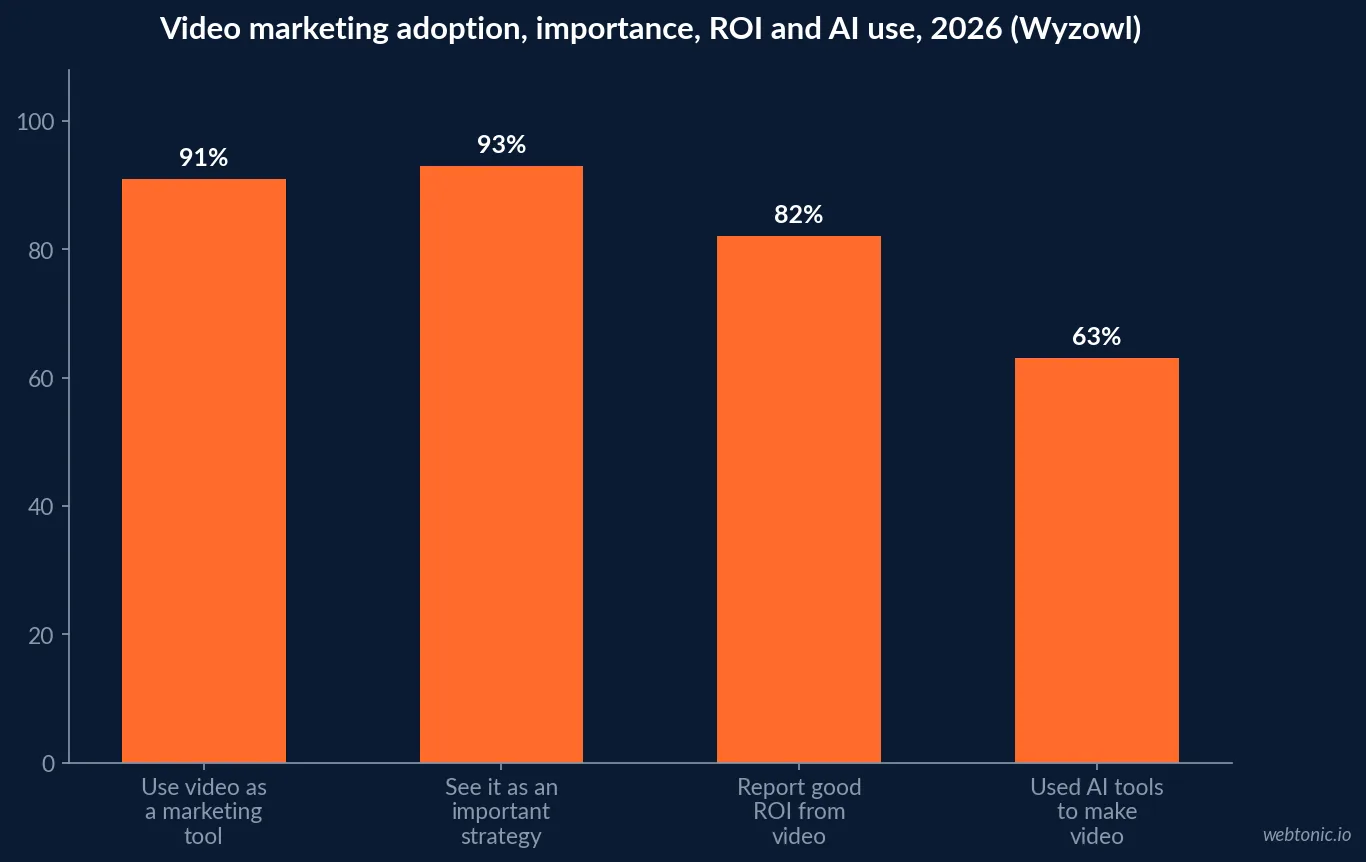
- 91% of businesses use video as a marketing tool in 2026.
- 93% of marketers see video as an important part of their strategy.
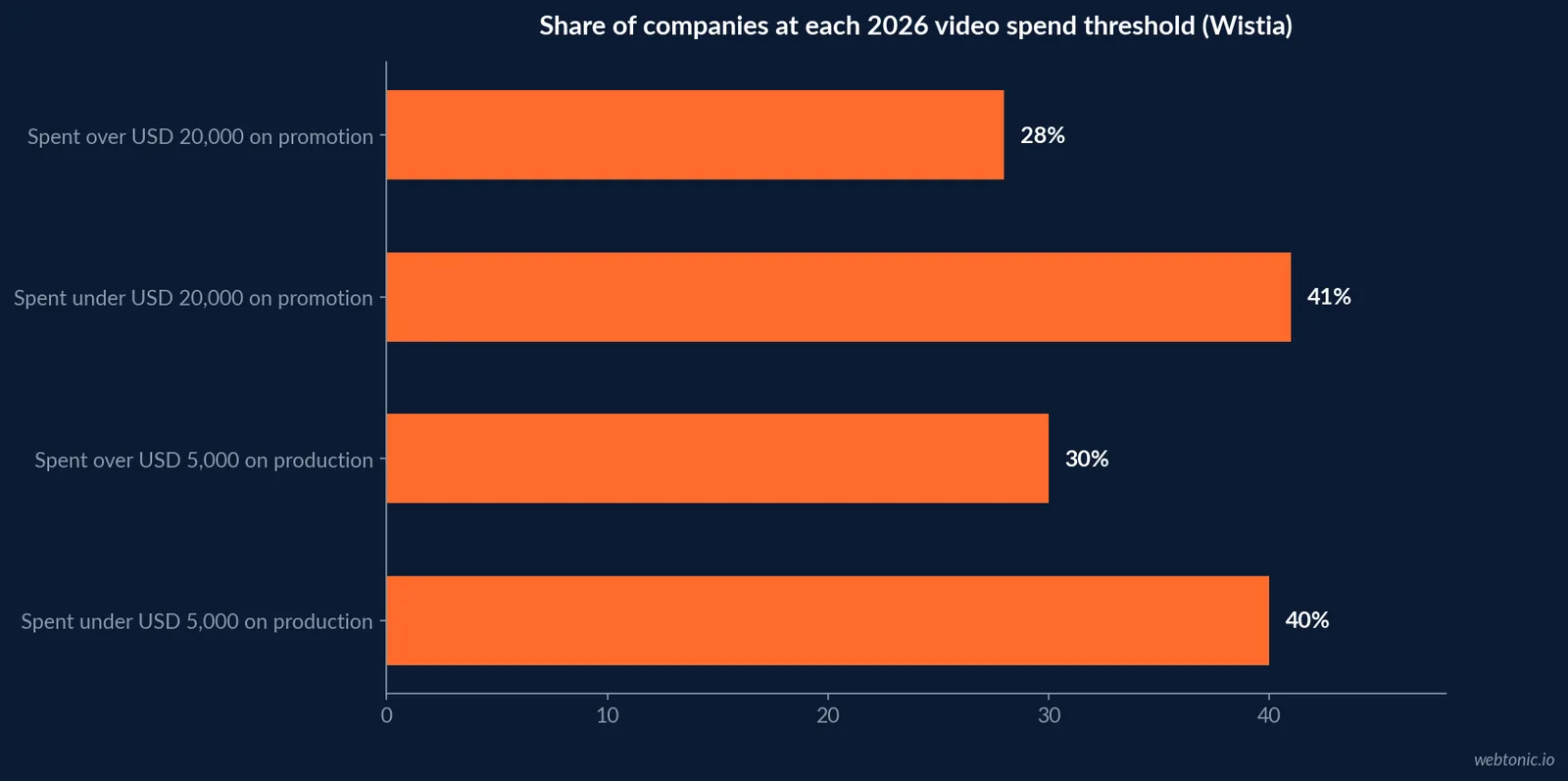
- Almost 40% of companies spent under USD 5,000 producing video last year.
- Just over 30% spent more than USD 5,000 on production.
- 41% spent under USD 20,000 on video promotion in 2025; 28% spent more.
- 82% of marketers who use video call the ROI good.
- 85% say video helped generate leads; 83% say it increased sales directly.
- 63% of video marketers have used AI tools to create or edit video, up from 51%.
- 51% of video marketers mostly create live action video.
- 67% of marketers who don't use video plan to start in 2026.
- 92% of teams plan to spend the same or more on video in 2026.
- 17% of marketers don't even track their video spend.
- The average U.S. light vehicle is 13.0 years old, a record.
- Roughly 299,000 auto mechanic businesses compete for that fleet's repair spend.
Benchmarks at a glance
These come from two 2026 video-marketing surveys and the aftermarket data that sets the size of the market a shop's video is meant to reach.
| Metric | 2026 figure | Source |
|---|---|---|
| Businesses using video as a marketing tool | 91% | Wyzowl, 2026 Video Marketing Statistics |
| Spent under USD 5,000 on production last year | ~40% | Wistia, 2026 State of Video Report |
| Spent over USD 5,000 on production | ~30% | Wistia, 2026 State of Video Report |
| Marketers reporting good ROI from video | 82% | Wyzowl, 2026 Video Marketing Statistics |
| Used AI tools to help make video | 63% | Wyzowl, 2026 Video Marketing Statistics |
| Average U.S. light vehicle age | 13.0 years | S&P Global Mobility / Lang Aftermarket iReport |
Video adoption is back near its all-time high
Wyzowl's 2026 State of Video Marketing survey, now in its twelfth year, found 91% of businesses use video as a marketing tool, back near joint all-time highs after a slight dip in 2025, and 93% of video marketers call it an important part of their overall strategy. Of the businesses that still don't use video, the two most common reasons are tied at 24% each: they don't feel it's needed, or they consider it too expensive. Another 19% cite lack of time. Even so, 67% of marketers who don't currently use video plan to start in 2026.
None of that is auto-repair-specific, but it describes the environment a shop's video decision is made in: video is now the default, not the exception, across the marketers surveyed.
| Reason for not using video (Wyzowl 2026) | Share of non-users |
|---|---|
| Don't feel it's needed | 24% |
| Too expensive | 24% |
| Lack of time | 19% |
| Unclear on the ROI | 10% |
| Don't know where to start | 10% |
| Unable to convince decision-makers | 5% |
What production actually costs, by the numbers
Wistia's 2026 State of Video Report puts real numbers on the budget question: almost 40% of companies spent under USD 5,000 producing video last year, while just over 30% spent more than USD 5,000. The rest didn't track an exact figure, likely because video spend was folded into a broader marketing budget - which lines up with Wyzowl's finding that 17% of marketers aren't tracking their video spend at all.
For a repair shop, the lower band is the realistic starting point: a phone-shot before/after sequence, a short explainer of a completed repair, and basic editing software cost closer to hundreds of dollars than thousands. The higher band applies once a shop hires a videographer for a recurring monthly or quarterly series.
| Video spend category (Wistia 2026) | Share of companies | Threshold |
|---|---|---|
| Production budget | ~40% | Under USD 5,000 |
| Production budget | ~30% | Over USD 5,000 |
| Promotion/advertising budget | 41% | Under USD 20,000 |
| Promotion/advertising budget | 28% | Over USD 20,000 |
| Plan to increase production budget this year | 40% | n/a |
| Plan to keep production budget flat | 46% | n/a |
What the spend actually buys, according to the people who use it
Wyzowl's 2026 ROI data is the strongest argument for spending at all: 82% of marketers who use video say it has given them a good return, down from an all-time high of 93% but still a dominant result. Specifically, video helped increase web traffic (82%), generate leads (85%), directly increase sales (83%), and reduce support queries (57%) for the marketers who use it.
How marketers measure that ROI varies: 67% quantify it through video views, 63% through engagement (likes, shares, reposts), and 52% through leads or clicks. Only 32% tie it directly to bottom-line sales, which is worth knowing before a shop expects a single video to show up cleanly in the appointment book.
| What video helped with (Wyzowl 2026) | Share of marketers reporting it |
|---|---|
| Increased user understanding of the product/service | 93% |
| Increased brand awareness | 93% |
| Generated leads | 85% |
| Directly increased sales | 83% |
| Increased web traffic | 82% |
| Kept visitors on the site longer | 82% |
| Reduced support queries | 57% |
The format worth shooting first
Wyzowl's 2026 data is specific about which video type dominates: 51% of video marketers mostly create live action video, ahead of animated (23%) and screen-recorded (19%). For a repair shop that has no animation budget and no reason to build one, that is good news - the most commonly produced format is also the cheapest one for a shop to shoot itself: a phone camera, a bay, and a completed job.
Of the specific use cases marketers create video for, social media video leads at 69%, followed by explainer video (68%) and testimonial video (57%). A repair shop's most natural starting point sits at the overlap of those three: a short, phone-shot explainer of a completed job, posted to social, doubling as a soft testimonial when a customer appears in it.
AI is already changing who can afford to make video
63% of video marketers say they've used AI tools to help create or edit marketing video in 2026, up sharply from 51% the year before. That shift matters most for a small shop: AI-assisted editing tools lower the skill and time barrier that keeps some owners from starting at all, which is one of the reasons Wyzowl's own non-user data shows 24% still call video too expensive even as adoption climbs elsewhere.
Why the fleet a shop is filming for keeps needing more of this
S&P Global Mobility's Lang Aftermarket iReport puts the average U.S. light vehicle at a record 13.0 years old at the start of 2026, and roughly 299,000 auto mechanic businesses compete for that fleet's repair spend, per Cox Automotive's 2026 Fixed Operations study. An older, more failure-prone fleet means more of the exact repair moments - a worn brake pad, a cracked hose - that make credible, specific video content, and a more crowded field means a shop that shows its work on video has a real differentiator against competitors that don't.
Where to publish it: YouTube's reach versus short-form's engagement
Pew Research Center's 2025 survey of U.S. adults found 84% say they ever use YouTube, still the single most widely used platform it tracks, ahead of Facebook (71%) and Instagram (50%). That reach argument favors uploading a repair shop's videos to YouTube even if the primary audience is found elsewhere - it is the largest available shelf for a video that keeps working long after it is posted.
Short-form platforms tell a different story on engagement. Socialinsider's 2026 benchmark data, tracked year over year, found TikTok's average engagement rate fell from 3.70% in 2025 to 2.60% in 2026, while Instagram Reels held steady at 0.45% and YouTube Shorts rose slightly to 0.30%. TikTok still leads by a wide margin and averages 50 comments per video versus 20 on Reels and 10 on Shorts - meaningful if a shop's goal is conversation and word of mouth rather than pure reach.
| Short-form platform (2026) | Average engagement rate | YoY change | Source |
|---|---|---|---|
| TikTok | 2.60% | down from 3.70% | Socialinsider, 2026 |
| Instagram Reels | 0.45% | steady | Socialinsider, 2026 |
| YouTube Shorts | 0.30% | up slightly | Socialinsider, 2026 |
| YouTube (any format) | 84% of U.S. adults ever use it | n/a | Pew Research Center, 2025 |
Reviews research is now telling shops to add video too
The recommendation to invest in video isn't confined to video-industry surveys. BrightLocal's 2026 Local Consumer Review Survey explicitly advises businesses to prioritize video as a marketing channel for 2026, noting that consumers are increasingly turning to video for recommendations and that businesses should support customers and creators who post video reviews, use their clips in marketing, and make the business itself visually appealing on camera. That is an independent signal, from reputation research rather than video-industry research, pointing at the same conclusion.
A simple budget model for a first year of video
Combining the Wistia and Wyzowl figures into a single starting plan: treat the first year as a production-light, promotion-light test rather than a full campaign.
| Budget tier | Annual production spend | Annual promotion spend | What it produces |
|---|---|---|---|
| Starter (phone-shot) | Under USD 1,000 (editing app, basic mic) | USD 0-500 boosted posts | 4-8 short clips, social-native |
| Wistia's lower band | Under USD 5,000 | Under USD 20,000 | A handful of edited videos plus boosted promotion |
| Wistia's higher band | Over USD 5,000 | Over USD 20,000 | A recurring series with hired production |
Frequently Asked Questions
What should a small auto repair shop budget for video production?
No study prices video for auto repair specifically, so the closest verified anchor is Wistia's 2026 State of Video Report: almost 40% of companies spent under USD 5,000 producing video last year, and just over 30% spent more than that. A shop starting with phone-shot repair walkthroughs and one edited explainer sits comfortably in that lower band; a shop hiring a videographer for a recurring series moves toward the higher one.
Is video actually worth the time for a repair shop?
The evidence from marketers who already use it is strongly positive. Wyzowl's 2026 survey found 82% of marketers who use video say it gives them a good return, and video specifically helped increase web traffic (82%), generate leads (85%) and directly increase sales (83%) for the businesses using it. None of that is auto-repair-specific, but it is a large, current cross-industry signal that the format converts when used.
What kind of video should a repair shop make first?
Live action, not animation. Wyzowl's 2026 data shows 51% of video marketers mostly create live action video, well ahead of animated (23%) and screen-recorded (19%). For a repair shop, that maps directly onto the easiest asset to produce: a phone-shot before/after clip or a short explainer of a completed repair, rather than anything requiring animation software.
Should a shop use AI tools to make its videos?
Increasingly, yes, though it's a fast-moving choice. Wyzowl's 2026 survey found 63% of video marketers have used AI tools to help create or edit marketing video, up sharply from 51% the year before. For a shop without in-house editing skill, AI-assisted editing tools lower the production cost that keeps 17% of marketers from even tracking their video spend today.
How much should go to promoting the video versus making it?
Wistia's 2026 data splits the two clearly: 41% of companies spent under USD 20,000 promoting video in 2025, and 28% spent over that. Production and promotion are tracked as separate line items by most marketers, and a shop's paid promotion budget for a single strong video (boosted on Facebook or Instagram, for instance) should be planned separately from what it cost to shoot and edit.
Web Tonic's performance creative team builds video content for local service brands. See how paid video promotion compares to other channels in this Facebook Ads cost breakdown, or check our conversion rate statistics for how video-driven landing pages tend to perform. Want a video plan scoped for a specific shop? Talk to our team.
Sources
Wyzowl, Video Marketing Statistics 2026
Wistia, State of Video Report 2026
S&P Global Mobility / Lang Aftermarket iReport, 2026
Cox Automotive, 2026 Fixed Operations and Ownership Study
Auto Care Association, 2026 factbook release
Pew Research Center, Americans' Social Media Use 2025
Socialinsider, TikTok vs. Reels vs. Shorts 2026
BrightLocal, 2026 Local Consumer Review Survey