Table of contents
No study publishes auto-repair-specific social media benchmarks, so this page builds the case from small-business platform-adoption data, review-trust research, and the sheer size of the field a repair shop's feed is competing inside: roughly 299,000 mechanic businesses nationwide. Every cross-industry figure below is labeled as such.
Key Takeaways
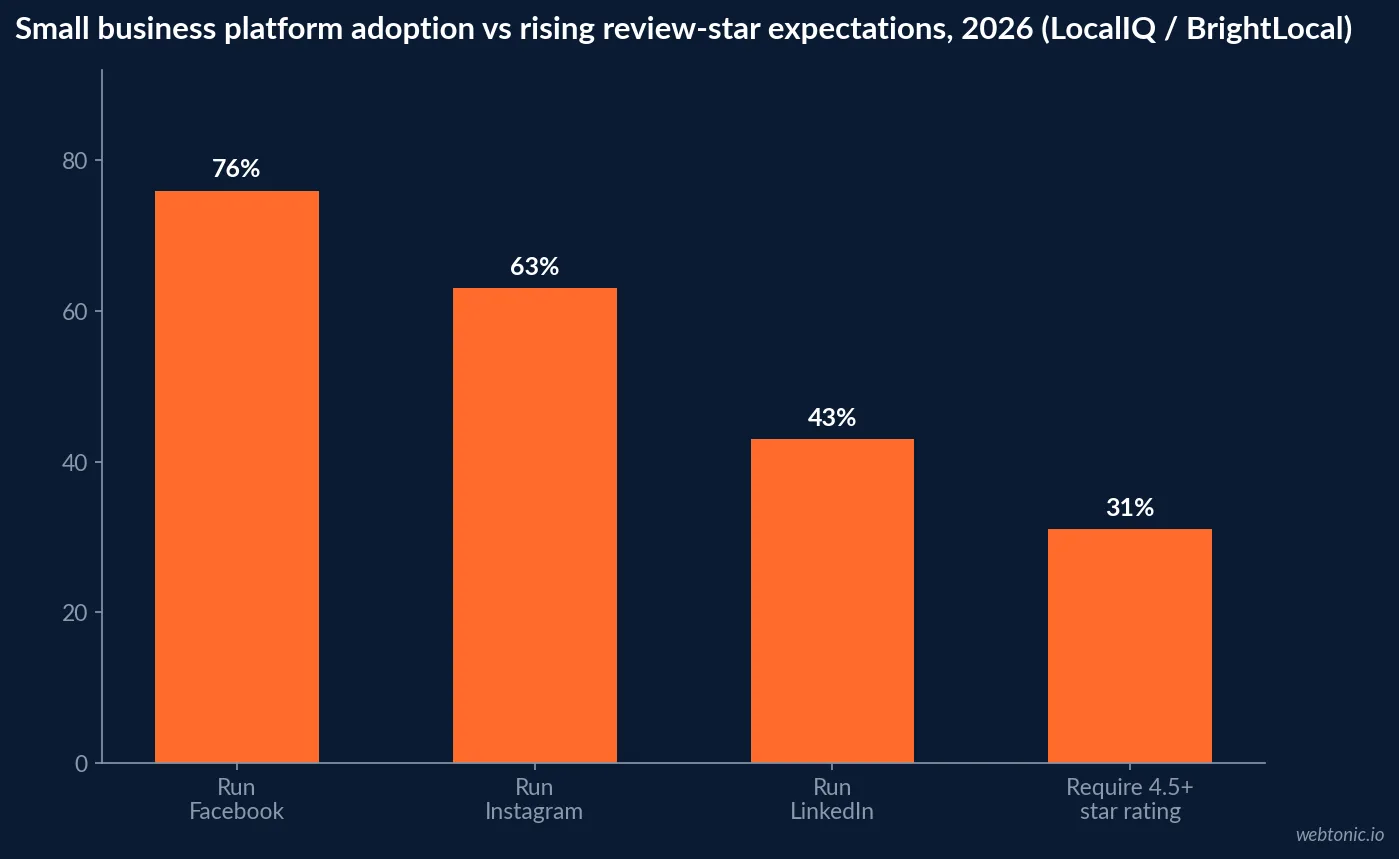
- 76% of small businesses run Facebook as part of their marketing (cross-industry).
- 63% run Instagram and 43% run LinkedIn.
- 52% of small businesses use social media marketing at all; 47% run social ads.
- 91% of consumers access social platforms from a mobile device.
- Less than 5% of brands use Facebook video ads - a stated gap, not a strength.
- 92% of consumers care about star ratings when choosing a business.
- 31% now require 4.5+ stars, up from 17% one year earlier.
- 63% of active AI users trust AI business recommendations.
- 42% of all consumers trust AI platforms as much as reviews.
- About 299,000 auto mechanic businesses operate in the U.S., up 12% since 2018.
- 69% of video marketers say social media video is their top use case for video.
- People spend 50% more with businesses that respond to reviews.
- 93% of people read online reviews before a purchase.
Benchmarks at a glance
These come from three separate research lines: small-business platform adoption, local review trust, and the count of shops a repair business's social presence is actually competing against.
| Metric | 2026 figure | Source |
|---|---|---|
| Small businesses running Facebook | 76% | LocalIQ, Small Business Marketing Trends |
| Small businesses running Instagram | 63% | LocalIQ, Small Business Marketing Trends |
| Small businesses running LinkedIn | 43% | LocalIQ, Small Business Marketing Trends |
| Consumers requiring 4.5+ stars | 31%, up from 17% | BrightLocal, Local Consumer Review Survey 2026 |
| Auto mechanic businesses, U.S. | ~299,000, +12% since 2018 | Cox Automotive, 2026 Fixed Ops Study |
| Active AI users who trust AI recommendations | 63% | BrightLocal, AI Trust research |
Which platforms small businesses actually run
No vendor segments platform adoption by auto repair alone, so the closest verified anchor is LocalIQ's small-business marketing research: 76% of small businesses run Facebook, 63% run Instagram, and 43% run LinkedIn, up from 55 million to 67 million small businesses with a LinkedIn presence in a single year. More broadly, 52% of small businesses use social media marketing at all, ahead of the 47% running social ads and 40% running search ads.
For a repair shop specifically, that maps cleanly onto what the medium is good at: Facebook and Instagram carry visual, local proof - a finished brake job, a clean bay, a thank-you post from a repeat customer - while LinkedIn's business-first audience is a better fit for chasing fleet or commercial accounts than everyday retail traffic.
| Small business social stat (cross-industry, 2026) | Figure |
|---|---|
| Use social media marketing at all | 52% |
| Use social media advertising | 47% |
| Run Facebook | 76% |
| Run Instagram | 63% |
| Run LinkedIn | 43% |
| Access social from a mobile device | 91% |
The gap almost nobody is closing: video ads
LocalIQ's data flags a specific opening: less than 5% of brands use Facebook video ads, even though video consistently outperforms static creative on engagement. For a repair shop, that gap is an opportunity rather than a burden - a single dashcam-style repair clip or a 20-second before/after reel can stand out simply because so few local competitors are posting one.
Reviews are the conversion layer social feeds feed into
Social posts build awareness; reviews close the decision. BrightLocal's 2026 Local Consumer Review Survey found 92% of consumers care about star ratings when choosing a business, and the bar keeps rising: 31% will now only use a business with 4.5 stars or more, up from 17% the year before, and 68% require at least 4 stars, up from 55%. Separately, LocalIQ's small-business data shows 93% of people read online reviews before a purchase, and people spend 50% more with businesses that respond to reviews.
The practical implication for a shop's social strategy: every post is an audition for the review a prospect will read next, and every review response is content that a social visitor may also see.
| Review-trust signal | Share of consumers | Source |
|---|---|---|
| Care about star ratings at all | 92% | BrightLocal 2026 |
| Require 4+ stars | 68% (up from 55%) | BrightLocal 2026 |
| Require 4.5+ stars | 31% (up from 17%) | BrightLocal 2026 |
| Read reviews before a purchase | 93% | LocalIQ Small Business Marketing Trends |
| Spend more with businesses that respond to reviews | +50% | LocalIQ Small Business Marketing Trends |
AI is already sitting between a search and a shop's social profile
BrightLocal's dedicated AI-trust research found nearly two-thirds (63%) of active AI users trust AI tools' recommendations, while only 10% distrust them. More strikingly, 42% of all consumers now trust AI platforms as much as traditional reviews for local business decisions, rising to 64% among AI users specifically. Half of consumers (50%) trust AI to accurately summarize real reviews, climbing to 71% among active AI users. A repair shop's social captions, photos, and review responses are exactly the raw material those summaries are built from, which is a new reason to keep posts specific and factual rather than generic.
How crowded the feed actually is
Cox Automotive's 2026 Fixed Operations and Ownership Study counts roughly 299,000 auto mechanic businesses operating in the U.S., up 12% since 2018. A meaningful share of that field will have some Facebook or Instagram presence, which means simply "having a page" is not a differentiator. Consistency and responsiveness are: a profile posted to weekly with real photos and answered reviews reads as active; one updated quarterly reads as abandoned, regardless of follower count.
The market a social feed is fishing in
The stakes behind a single post are larger than they look. The Auto Care Association puts the U.S. total aftermarket at USD 599.7 billion in 2026, growing 5.4%, and S&P Global Mobility's Lang Aftermarket iReport puts the average U.S. light vehicle at a record 13.0 years old at the start of 2026 - meaning the pool of people who will need a mechanic this year, not just once, keeps growing. A social feed with even a modest, engaged local following is a real claim on that demand, which is worth more than the follower count alone suggests.
Responding to reviews is itself a growing behavior
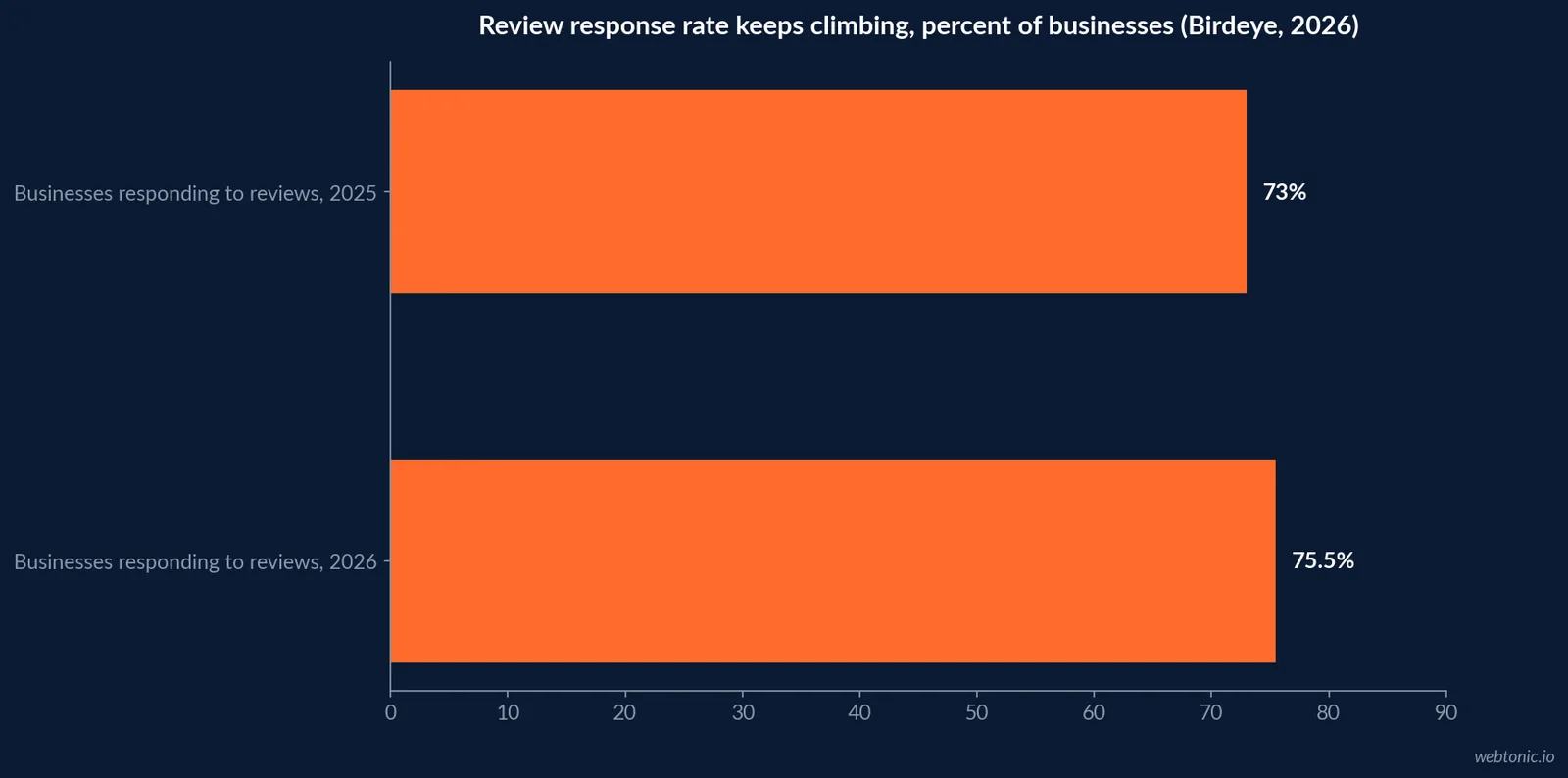
Birdeye's State of Online Reviews 2026 report found business response rates to reviews climbed to 75.5% in 2026, the highest rate recorded in its dataset, up from 73% in 2025. That rising baseline means a shop that ignores reviews is falling further behind the norm each year, not holding steady against it - one more reason review responses and social posting increasingly function as the same reputation job.
| Review-response behavior | 2025 | 2026 | Source |
|---|---|---|---|
| Businesses responding to reviews | 73% | 75.5% | Birdeye, State of Online Reviews 2026 |
| Reviews with written comments | 81% | 79.8% | Birdeye, State of Online Reviews 2026 |
What a realistic engagement benchmark looks like
Platform-wide engagement benchmarks for very small, local accounts are thin, and the few that exist carry real caveats. One 2026 tracking study of local businesses (Boomp, a small sample of 23 businesses, 14 with a live platform connection) measured engagement rates for the three best-covered platforms within half a point of each other: Instagram at 2.60%, LinkedIn at 2.58% and Facebook at 2.10%. The finding worth keeping is the gap between platforms is small - so platform choice is not where a repair shop's results will be won or lost.
| Platform (small sample, n=23 local businesses) | Measured engagement rate |
|---|---|
| 2.60% | |
| 2.58% | |
| 2.10% | |
| TikTok | 0.42% |
| YouTube | 0.17% |
Where video fits inside the social mix
Wyzowl's 2026 State of Video Marketing survey found 69% of video marketers say social media video is their most common use case for video content, ahead of explainer video at 68% and testimonial video at 57%. A repair shop does not need a production budget to act on that: a phone-shot before/after clip or a 15-second walkthrough of a completed job covers the same ground the survey's respondents ranked highest.
A short posting checklist built from the data above
- Post on Facebook and Instagram first - the two platforms 76% and 63% of small businesses already run, and the two best suited to visual repair proof.
- Respond to every review, since businesses that do see customers spend 50% more, and the norm for responding has risen to 75.5%.
- Keep captions factual and specific (the part, the symptom, the fix), since AI tools are already summarizing that language for 42% of consumers who trust them as much as reviews.
- Add one short video a month, given social video is the top use case for 69% of video marketers and under 5% of brands run Facebook video ads.
- Treat LinkedIn as a fleet/commercial channel, not a retail one - useful for the 43% of small businesses that run it, but a poor fit for everyday walk-in traffic.
None of this requires a large following. A shop competing against roughly 299,000 other mechanic businesses does not win that count by volume of posts; it wins by being the profile that still looks active, answered, and specific the third time a prospect checks it before booking.
Frequently Asked Questions
Which social platforms should an auto repair shop actually run?
No study breaks platform performance out by auto repair specifically, so the honest anchor is LocalIQ's 2026 Small Business Marketing Trends data: 76% of small businesses run Facebook, 63% Instagram and 43% LinkedIn. For a repair shop, Facebook and Instagram carry the local, visual proof (before/after bay shots, customer thank-yous) that matters most; LinkedIn's audience skews B2B and fits fleet or commercial accounts more than walk-in retail customers.
Does posting on social media matter more than being on Google reviews?
They are not substitutes. BrightLocal's 2026 research found 92% of consumers care about star ratings when choosing a business, and review platforms are where that trust decision gets made. Social profiles do a different job: they are where a shop demonstrates the work (photos, videos, staff) before a prospect ever reaches the review page. Treat social as top-of-funnel proof and reviews as the conversion gate.
Is AI changing how people find a mechanic on social and search?
It is starting to. BrightLocal's AI-trust research found that among people who already use AI tools, 63% trust AI business recommendations, and 42% of all consumers now trust AI platforms as much as traditional reviews for local business decisions. A shop's social proof (photos, captions, review responses) is increasingly the raw material AI tools summarize when a customer asks 'find me a good mechanic near me.'
How crowded is the market a repair shop's social feed is competing in?
Very. Cox Automotive's 2026 Fixed Operations and Ownership Study counts roughly 299,000 auto mechanic businesses operating in the U.S., up 12% since 2018. Most will have some Facebook or Instagram presence, which makes consistent posting and responsive review management the differentiator, not simply having a profile.
What does a realistic engagement rate look like for a small local business?
Treat any single number here cautiously - platform engagement varies enormously by follower count and content type. One 2026 tracking study of local businesses (Boomp, n=23, 14 with a live platform connection) measured engagement rates within half a point of each other across the three best-measured platforms: Instagram at 2.60%, LinkedIn at 2.58% and Facebook at 2.10%. The sample is small enough that the headline finding - platform choice matters less than consistency - is more useful than the exact percentages.
Web Tonic builds social content and performance creative programs for local service businesses. For the paid side of the channel mix, see our Facebook Ads ROI analysis, or browse agencies we rate for Facebook Ads. Want a review of a shop's current social presence? Talk to our team.
Sources
LocalIQ, Small Business Marketing Statistics 2026
BrightLocal, 2026 Local Consumer Review Survey
BrightLocal, AI Trust research 2026
Cox Automotive, 2026 Fixed Operations and Ownership Study
Wyzowl, Video Marketing Statistics 2026
Boomp, State of Local Business Social Media 2026
Auto Care Association, 2026 factbook release
S&P Global Mobility / Lang Aftermarket iReport, 2026
Birdeye, State of Online Reviews 2026