Table of contents
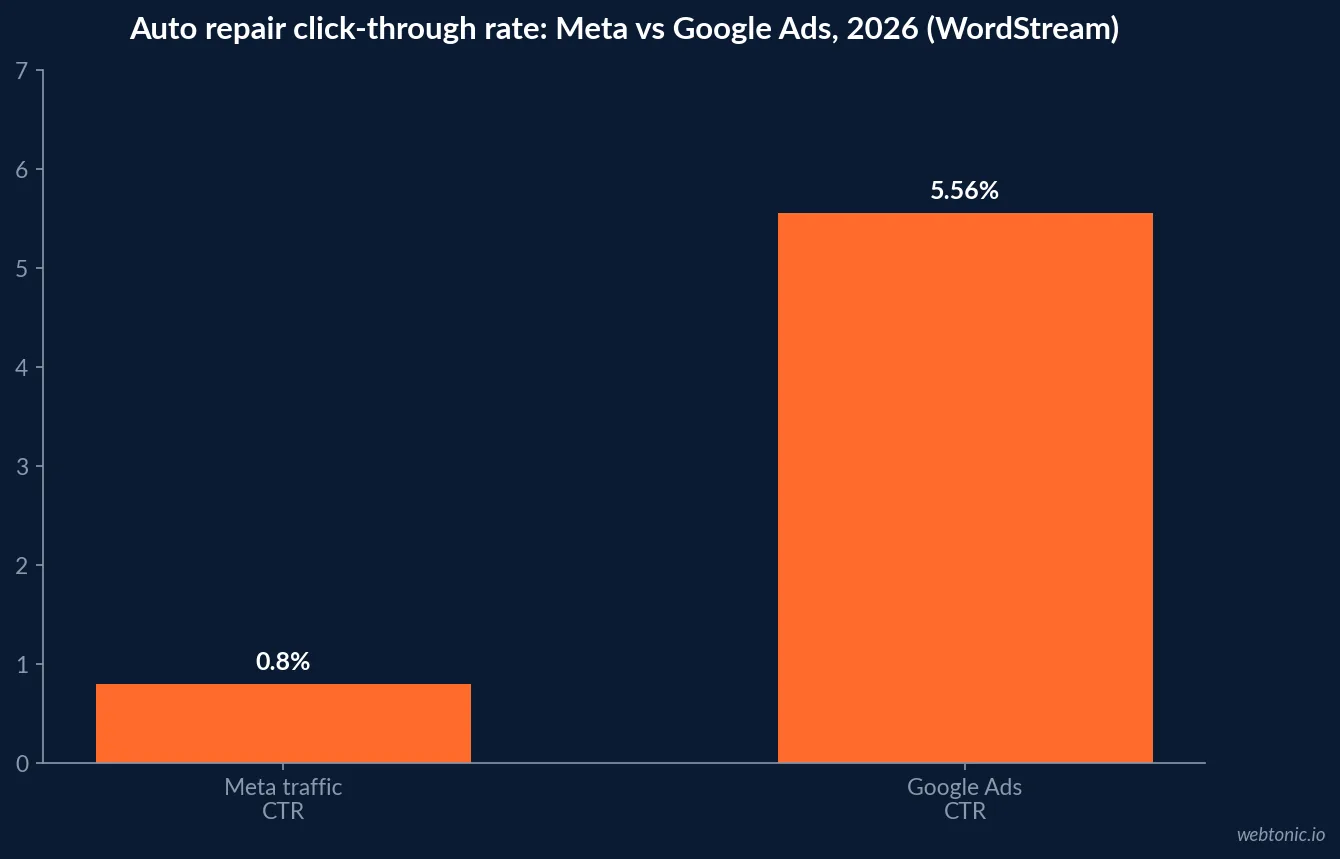
For Automotive — Repair, Service & Parts, WordStream's 2026 benchmark data shows a 0.80% click-through rate on Meta traffic campaigns against a 5.56% click-through rate on Google Ads — the weakest performer on both platforms, but seven times further apart on Meta than on Google. This page puts the two channels' 2026 numbers side by side for one category, rather than reviewing either platform on its own.
Key Takeaways
- Meta traffic-campaign CTR for auto repair is 0.80%, the lowest of any tracked industry.
- Google Ads CTR for the same category is 5.56%, seven times higher.
- Auto repair's Meta CTR fell 27% year over year, one of the three steepest declines WordStream tracked.
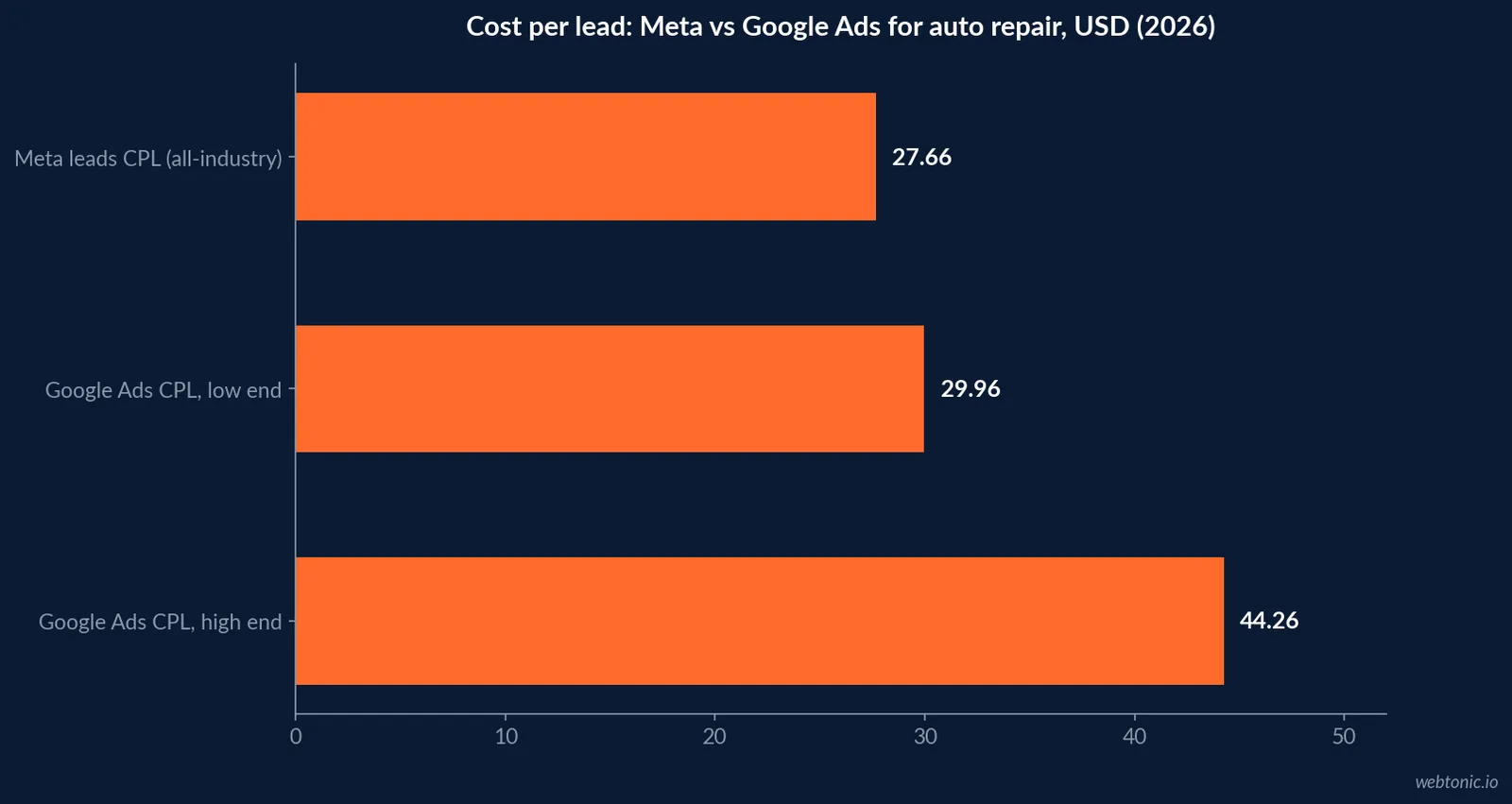
- Google's cost per lead for the category runs $29.96 to $44.26 across two 2026 studies.
- Meta's all-industry average CPC for traffic campaigns is $0.70 in 2026.
- Google's average CPC for the category is $4.35 to $5.31.
- Meta's average cost per lead across industries is $27.66 for leads-objective campaigns.
- Meta's average conversion rate on leads campaigns is 7.72% across industries.
- Google's conversion rate for Auto Service & Repair is 11.94%.
- Only 58% of inbound automotive calls are answered by a person (Invoca 2026), a tax on both channels.
- 91% of advertisers analyzed by Metricool run ads on Meta alone versus 5% on TikTok only.
- Meta CPM rose from $1.97 to $2.64 year over year (Metricool 2026, cross-industry).
- Roughly 29% of service visits go to General Repair shops versus 27% to dealerships (Cox Automotive 2025).
- The U.S. auto aftermarket is forecast to grow 5.4% in 2026 to $599.7 billion (Auto Care Association).
- Dealership share of service visits fell from 68% to 58% for vehicles under 2 years old since 2018 (Cox Automotive).
The channel comparison, side by side
WordStream publishes both benchmark sets from an overlapping client base, which makes a direct comparison possible for one category rather than an apples-to-oranges guess. Its 2026 Google Ads Benchmarks and Facebook Ads Benchmarks reports both track Automotive — Repair, Service & Parts as a named category, and both flag it as the worst-performing industry on click-through rate for their respective platform.
That double-bottom finish is not a coincidence. It reflects the same underlying fact from two angles: repair demand is real but intermittent, so an audience that is not actively searching (Meta) clicks even less than one that is barely searching (Google).
| Metric (2026) | Google Ads, Automotive Repair/Service/Parts | Meta Ads, same category / all-industry | Read |
|---|---|---|---|
| Click-through rate | 5.56% | 0.80% (Meta traffic, category-specific) | Google wins by 7x |
| Cost per click | $4.35 – $5.31 | $0.70 (Meta traffic, all-industry) | Meta clicks cost far less |
| Cost per lead | $29.96 – $44.26 | $27.66 (Meta leads, all-industry) | Roughly comparable |
| Conversion rate | 11.94% (category-specific) | 7.72% (Meta leads, all-industry) | Google converts better here |
| YoY CTR trend | Stable, automotive down 5.56% overall | Down 27% for this category | Meta lost ground faster |
Why the click-through rate gap is this wide
WordStream's Facebook report names the mechanism directly: categories like Automotive — Repair, Services, and Parts "can't always rely on compelling visuals to increase their Facebook ad CTRs" because "it's harder to get clicks on ads for industries where only some of the audience is going to be in market." The same report found the category's Meta traffic-campaign CTR fell 27% year over year, the second-steepest decline it tracked after Real Estate's 36% drop.
Google Ads does not solve intermittent demand, it simply times the ad to the moment demand shows up. That is the entire reason its 5.56% category CTR, itself the lowest across Google's 22 tracked industries, still comes in seven times higher than Meta's figure for the same work.
Where the cost numbers flip the story
Cost per click tells the opposite story from click-through rate. Meta's all-industry average cost per click for traffic campaigns is $0.70 in 2026, a fraction of Google's $4.35 to $5.31 for this category. But a cheap click that almost nobody takes, and that converts at a fraction of Google's rate once they do, is not automatically the better buy. Meta's own leads-objective data shows a 7.72% average conversion rate across industries against Google's 11.94% for Auto Service & Repair specifically.
Once cost per click and conversion rate are multiplied through, cost per lead lands closer than either metric alone suggests: $29.96 to $44.26 on Google versus $27.66 on Meta's all-industry leads average. The honest read is that the two channels arrive at a similar lead price by very different routes, not that one is decisively cheaper.
| Metric (all-industry unless noted) | Figure | Source | Note |
|---|---|---|---|
| Meta traffic CPC, 2026 | $0.70 | WordStream Facebook Ads Benchmarks | Down from $0.77 in 2025 |
| Meta leads CPC, 2026 | $1.92 | WordStream Facebook Ads Benchmarks | Up from $1.88 in 2025 |
| Meta leads CPL, 2026 | $27.66 | WordStream Facebook Ads Benchmarks | Up from $22.87 in 2025 |
| Meta leads CVR, 2026 | 7.72% | WordStream Facebook Ads Benchmarks | Down from 8.67% in 2025 |
| Meta CPM, 2026 | $2.64 | Metricool 2026 Social Ads Report | Up from $1.97 in 2025 |
Where the market is actually placing its bets
Metricool's 2026 Social Ads Report, built from 44,355 advertisers and 628,969 Meta and TikTok campaigns, found 91% of advertisers analyzed run ads on Meta alone, and that average spend per Meta campaign climbed 47% year over year, to $718.45. Meta remains the default social ad platform even in a category where its click-through rate is this weak, largely because of the retargeting and awareness value a repair shop gets between actual repair events.
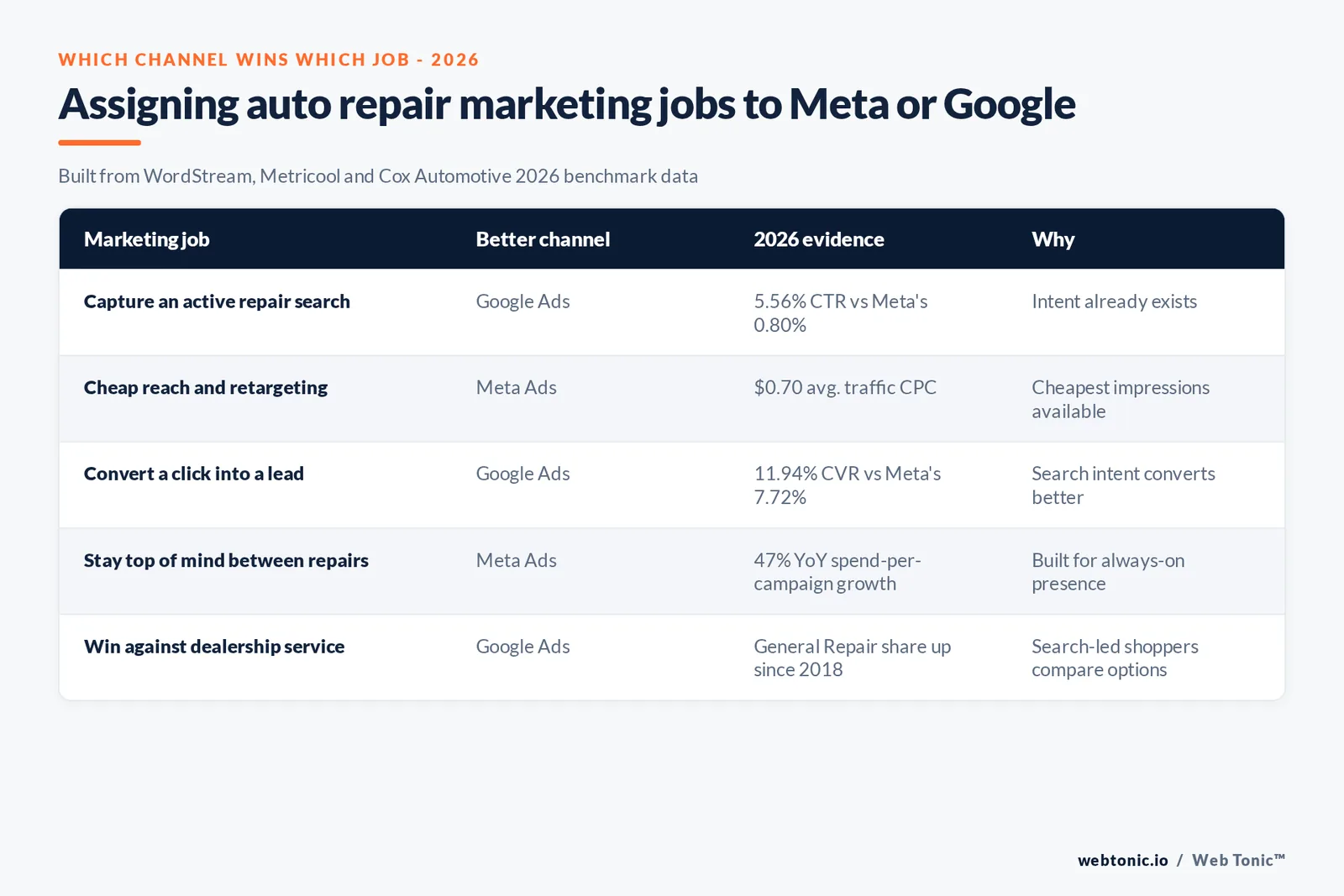
That is the real argument for keeping a Meta line in the budget: not as a lead-generation channel competing head-to-head with search, but as the always-on presence that keeps a shop top of mind for the next time a customer's check-engine light comes on.
Who is actually driving to the shop, by channel
Consumer behavior backs up the split. Cox Automotive's 2026 Fixed Ops and Ownership Study reports that General Repair shops captured 27% of service visits in 2025, close behind dealerships at 29%, and that dealership share of service visits for vehicles under two years old fell from 68% to 58% since 2018 as independent and mobile options gained ground. Growth in demand is going to independent shops precisely the kind of business searching, not scrolling, for a solution.
That is consistent with a Google-led lead generation strategy: the buyer is already choosing between General Repair and a dealership, a decision search captures better than an interrupt-style feed ad.
| Where service visits go (Cox Automotive) | 2025 share | 2018 share | Trend |
|---|---|---|---|
| Dealership | 29% | 33% | Declining |
| General Repair | 27% | 25% | Growing |
| Quick Lube | 14% | 12% | Growing |
| Tire Store | 10% | 12% | Declining |
| Independent / OEM Mobile (combined) | 4% | N/A (new category) | Emerging |
A defensible budget split
Given the data above, most shops should weight lead-generation spend toward Google Ads, where the category's cost per lead is already priced against real repair intent, and run Meta as a smaller retention and awareness line rather than a second lead-generation channel competing for the same job. Our growth marketing team builds that split by channel role rather than by even percentage, which matches how these two platforms actually perform for this category.
For the Meta side specifically, see our breakdown of when Facebook ads are worth the spend and our Facebook Ads pricing breakdown; both apply the same industry-benchmark logic used above.
What each platform's own reporting is built to measure
Part of why shops mix up the two channels' value is that each platform's native reporting answers a different question. Google Ads reports against search terms already tied to intent, which is why its conversion and cost-per-lead numbers read as more "trustworthy" to a shop owner. Meta's reporting leans on attribution windows and lookalike audience overlap, metrics that describe reach and retargeting quality rather than in-the-moment need. Comparing the two platforms' own dashboards without normalizing for that difference is a common way shops misjudge which channel is "working."
| Reporting question | Google Ads answers it with | Meta Ads answers it with |
|---|---|---|
| Is there demand right now? | Search volume and impression share | Not directly measured |
| Did this ad reach the right person? | Keyword match type | Lookalike / interest audience |
| Did the click become a customer? | Call tracking, form conversions | Pixel/Conversions API events |
| Is the brand staying visible? | Not the platform's core strength | Frequency and reach reporting |
A note on measurement before you commit a split
Neither comparison above means much without call tracking on both channels, since Invoca's 2026 data shows the answer-rate gap (58% of automotive calls answered) applies regardless of which platform generated the call. A shop that adds call tracking before reallocating budget gets a real Meta-versus-Google comparison instead of two different guesses about which channel's leads actually picked up the phone.
What to re-check every quarter
Both benchmark sets move year over year — Meta's category CTR alone fell 27% in the latest cycle — so a split that made sense last year may not this year. Track your own cost-per-lead by channel against the ranges above rather than assuming last quarter's split still holds, and pair it with call-answer-rate tracking, since Invoca's 2026 data shows 58% of inbound automotive calls going answered is the ceiling both channels are working against regardless of platform.
Want a second opinion on the split? Talk to our team, or see how our Meta Ads practice approaches local-service accounts.
Frequently Asked Questions
Does Meta or Google Ads perform better for an auto repair shop?
Neither wins outright; they win different jobs. WordStream's 2026 data shows Automotive — Repair, Service & Parts posting a 0.80% click-through rate on Meta traffic campaigns, the weakest of any tracked industry on that platform, versus a 5.56% click-through rate on Google Ads, also the weakest in that dataset but seven times higher. Google captures a repair search already in progress; Meta has to interrupt someone who was not looking for a mechanic at all.
Why does auto repair perform so poorly on Meta specifically?
WordStream's Facebook Ads Benchmarks report puts it plainly: industries like Automotive — Repair, Services, and Parts 'can't always rely on compelling visuals' because only part of the audience is in-market at any moment, and the category's Meta traffic-campaign CTR fell 27% year over year, one of the three steepest declines WordStream tracked. A repair need is triggered by a breakdown, not a scroll, so most of the audience Meta shows the ad to simply is not shopping yet.
Is Meta still worth running for a repair shop?
As a complement, yes, for a different job than lead capture. Meta's own cross-industry data shows traffic-objective clicks averaging $0.70 in 2026, cheap enough to build brand recall and retarget past customers between actual repair events. Google's Automotive - Repair, Service & Parts cost per lead of $29.96 to $44.26 is the number to protect with search budget; Meta budget is better spent keeping the shop visible for the next time a check-engine light comes on.
How much cheaper is a Meta click than a Google click for this category?
On a straight cost-per-click basis, Meta's all-industry traffic-objective average of $0.70 (2026) is far below Google's Automotive - Repair, Service & Parts average of $4.35 to $5.31. But a Meta click at 0.80% CTR and no active search intent converts at a fraction of the rate a Google click does, so cost per click alone understates what Google's more expensive traffic is actually worth to a shop chasing booked appointments.
What is the honest way to split a limited budget between the two?
Put the majority of a lead-generation budget on Google Ads, where the category's cost per lead ($29.96 to $44.26) is already priced against real repair intent, and treat Meta as a smaller, always-on retention and awareness line rather than a lead-generation channel competing for the same dollar. That split matches what the benchmark data actually shows each platform is built to do for this category.
Sources
WordStream - 2026 Google Ads Benchmarks
WordStream - Facebook Ads Benchmarks 2025/2026
LocaliQ - Automotive Search Advertising Benchmarks for 2026
Metricool - Social Media Advertising Trends 2026 (2026 Social Ads Report)
Invoca - The Invoca Automotive Lead Conversion Benchmarks Report 2026
Cox Automotive - 2026 Fixed Ops and Ownership Study
Auto Care Association - 2027 Auto Care Factbook release