Table of contents
No study prices a LinkedIn lead specifically for auto repair, because retail repair customers are not on LinkedIn buying brake jobs. The honest version of this page prices the two buyers who are there - fleet and commercial accounts, and the technicians a shop needs to hire - against cross-industry vendor benchmarks, labeled as such throughout.
Key Takeaways
- No published benchmark prices a LinkedIn lead by auto repair specifically - every figure below is cross-industry vendor data.
- Median cost per lead is USD 164 for a content offer on LinkedIn Lead Gen Forms (Kiin Labs 2026).
- Median cost per lead is USD 343 for a demo request, the closer proxy for a fleet contract inquiry.
- A "good" (p25) content-offer cost per lead is USD 67; a good demo cost per lead is USD 131.
- Metadata.io's separate 153-advertiser sample puts LinkedIn's blended average at USD 202 per lead.
- Median LinkedIn click-through rate is 0.39%, against 0.67% in Metadata's sample (Fibbler / Metadata 2026).
- Median cost per click is USD 16.47 (Fibbler); Metadata's sample reports USD 9.39.
- Median CPM is USD 61.41 (Fibbler 2026).
- Thought-leader style content earns a 1.35% median click-through rate, the top format measured.
- Document ads reach a 5.20% engagement rate despite low click-through.
- Motor Vehicle Parts Manufacturing, the closest adjacent industry code, sees a USD 68 median content-offer cost per lead (Kiin Labs).
- General trades job vacancies are up 30% against a shrinking entry pipeline (Randstad 2026).
- 72% of young office workers are considering a switch to skilled trades (LinkedIn 2026).
- Average time to hire a skilled trades worker is now 56 days, exceeding desk-based roles at 54.
Why this page starts with who buys, not what it costs
An auto repair shop's retail customer does not shop for a mechanic on LinkedIn. The two audiences that legitimately are there are commercial: fleet, facilities and procurement managers who award recurring maintenance contracts, and candidates for the technician roles a shop struggles to fill. Every benchmark below is cross-industry LinkedIn vendor data - no study segments LinkedIn performance by auto repair specifically - applied to those two buyers rather than to a retail audience that simply is not on the platform for this purchase.
| LinkedIn benchmark (2026, cross-industry) | Figure | Source |
|---|---|---|
| Median cost per lead, content offer | USD 164 | Kiin Labs Lead Gen Forms Benchmarks |
| Median cost per lead, demo request | USD 343 | Kiin Labs Lead Gen Forms Benchmarks |
| p25 "good" cost per lead, content offer | USD 67 | Kiin Labs |
| p25 "good" cost per lead, demo request | USD 131 | Kiin Labs |
| Blended average cost per lead, 153-advertiser sample | USD 202 | Metadata.io |
| Median click-through rate | 0.39% (Fibbler) / 0.67% (Metadata) | Fibbler / Metadata.io |
Pricing the fleet-account campaign, not the retail one
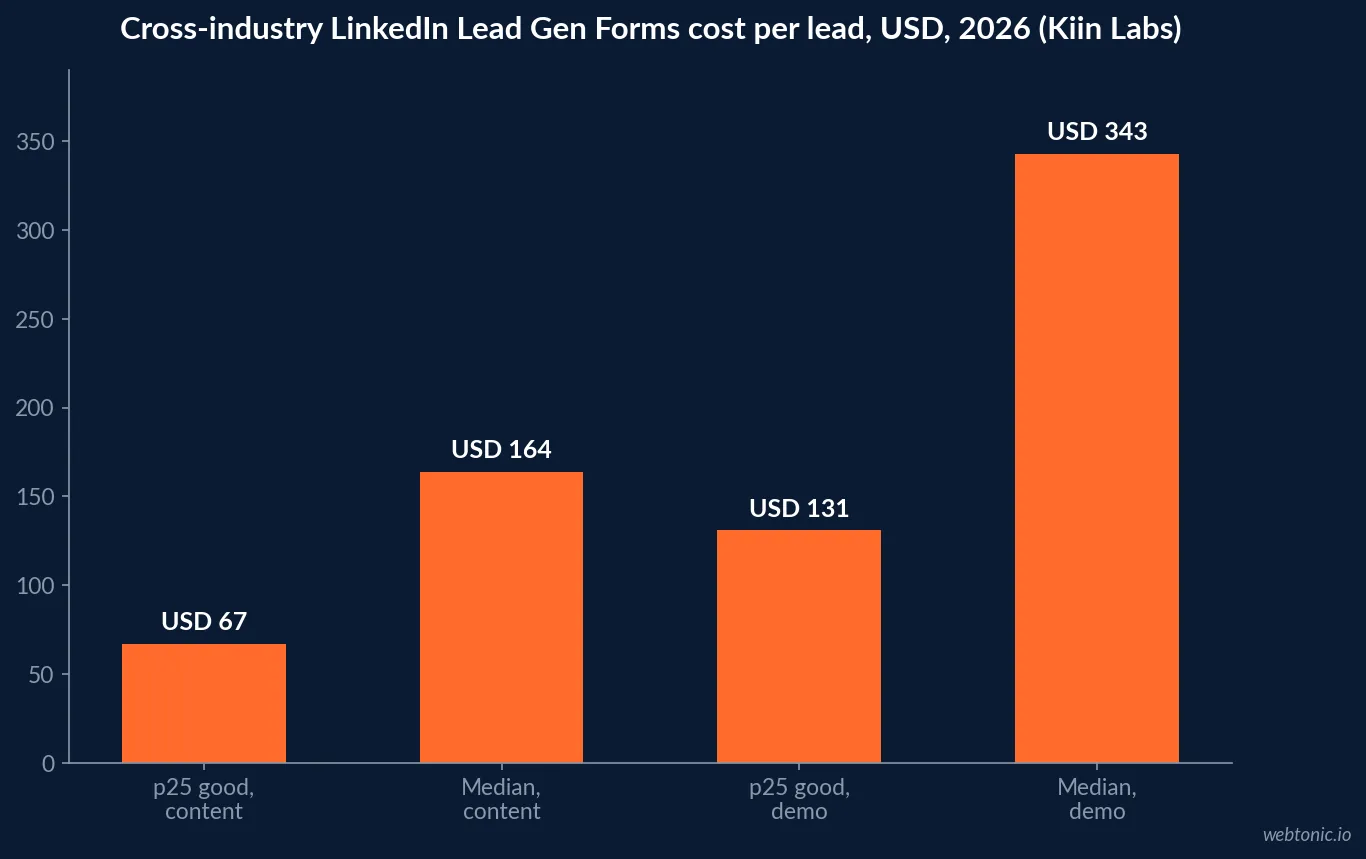
Kiin Labs' 2026 Lead Gen Forms Benchmarks, built from 489 advertiser accounts and USD 13.6 million in tracked spend, treats content offers and demo requests as separate products: a median USD 164 for a downloadable guide or checklist against USD 343 for a demo or consultation request. A fleet-maintenance contract inquiry behaves like a demo request - a considered, recurring commercial decision - so the realistic planning number sits closer to the USD 343 median, with USD 131 as the achievable "good" target Kiin Labs reports at the 25th percentile.
Among the 107 industries Kiin Labs tracks, Motor Vehicle Parts Manufacturing - the closest automotive-adjacent code in its table - sees a USD 68 median content-offer cost per lead, among the cheaper rows in the dataset. That is directional evidence the broader automotive B2B space is not an expensive LinkedIn category, even without a repair-specific row.
| Ad format (2026) | Median CTR | Median CPC | Engagement rate | Source |
|---|---|---|---|---|
| Thought Leader-style content | 1.35% | USD 6.95 | 1.84% | Fibbler |
| Single image | 0.38% | USD 16.03 | 0.59% | Fibbler |
| Document ads | 0.11% | USD 15.25 | 5.20% | Fibbler |
| Video | 0.09% | USD 30.55 | 0.32% | Fibbler |
| Carousel | 0.05% | USD 28.98 | 0.17% | Fibbler |
What a document ad is good for in this account
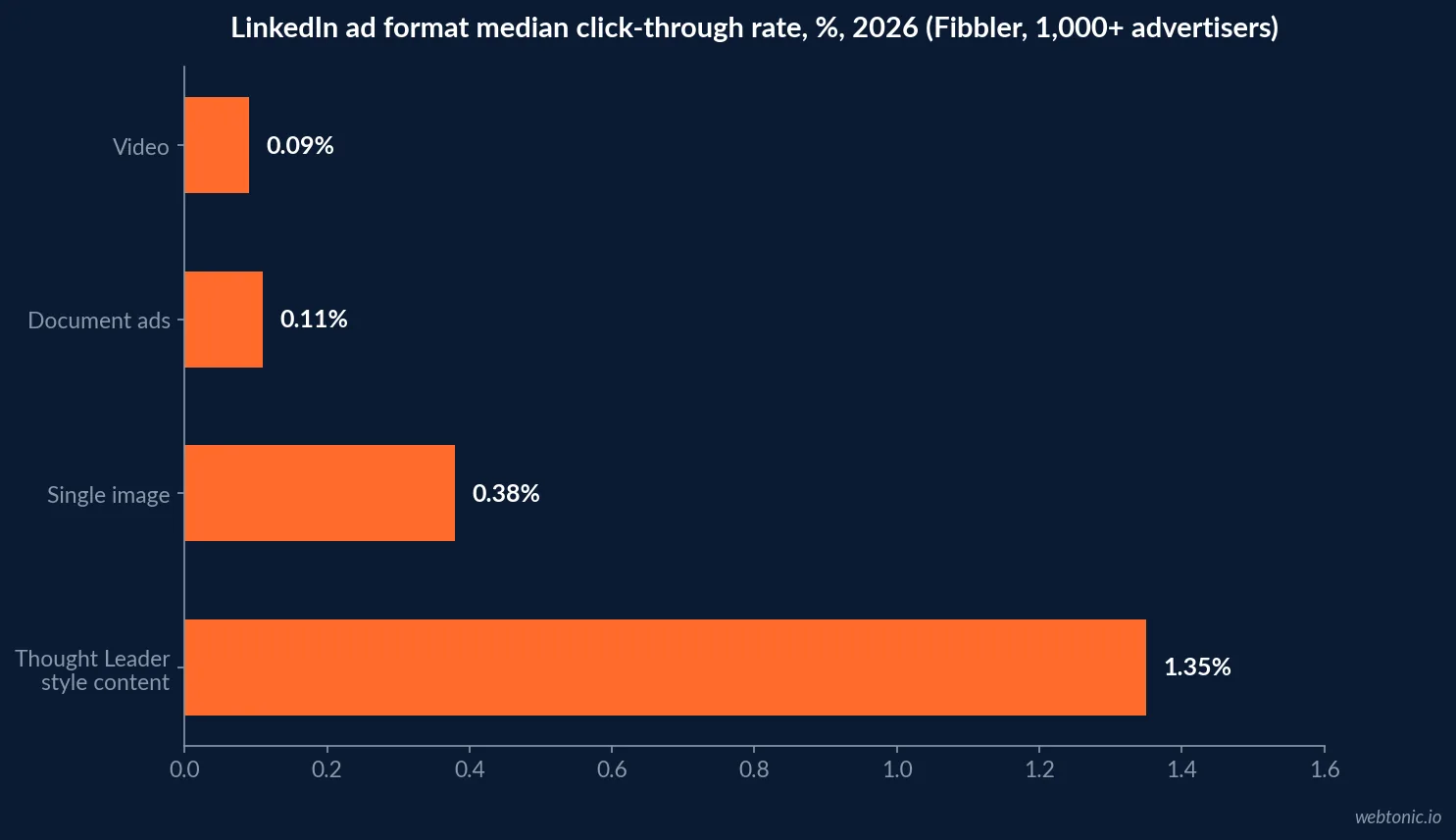
Document ads carry a low click-through rate but the highest engagement rate Fibbler measured across formats, at 5.20% - people open and read them without necessarily clicking through. That fits a fleet-maintenance rate card, a service-level agreement outline or a multi-location capability sheet better than a single-image ad built for a click. Thought-leader style content, at a 1.35% median click-through rate, is the better format for the recruiting side of this account, where the goal is a candidate clicking to a job post rather than downloading a document.
The second campaign this account is quietly running: hiring
LinkedIn's own 2026 graduate-hiring research found entry-level hiring down 6% year over year while 72% of young office workers say they are considering a switch to skilled trades, and 12% already have. Randstad's parallel analysis of over 150 million U.S. job postings found general trades vacancies up 30% and the average time to hire a skilled trades worker now at 56 days, exceeding the 54-day average for desk-based professional roles for the first time.
That is a labor market moving toward the trades for once, and it means a shop's LinkedIn recruiting spend is buying into a genuinely improving supply of candidates, not fighting the historical trend.
| Trades hiring signal (2026) | Figure | Source |
|---|---|---|
| Entry-level hiring, year over year | Down 6% | LinkedIn Economic Graph |
| Young office workers considering a trades switch | 72% | |
| Already made the switch | 12% | |
| General trades vacancies, since 2022 | Up 30% | Randstad |
| Average time to hire a skilled trades worker | 56 days | Randstad |
| Average time to hire a desk-based professional | 54 days | Randstad |
What the wider LinkedIn benchmark says about the platform baseline
Kiin Labs' full 2026 LinkedIn Ads Benchmarks report puts the blended median cost per lead across all offer types at USD 185, explicitly flagging it as "useless" on its own because it mixes every advertiser's offer mix into one number. That is the report's own warning against using a single LinkedIn CPL figure for planning - exactly the trap a repair shop would fall into without splitting content offers from demo requests the way this page does above.
Metadata.io's separate 153-advertiser sample corroborates the order of magnitude: a USD 202 blended average cost per lead at a 0.67% click-through rate and a 5.9% click-to-lead rate, alongside a USD 9.39 cost per click - lower than Fibbler's larger sample, a reminder that LinkedIn benchmarks vary meaningfully by methodology even before an industry is layered on.
| LinkedIn baseline metric (2026) | Fibbler (1,000+ advertisers) | Metadata.io (153 advertisers) |
|---|---|---|
| Median click-through rate | 0.39% | 0.67% |
| Median cost per click | USD 16.47 | USD 9.39 |
| Median CPM | USD 61.41 | USD 63.19 |
| Blended cost per lead | n/a (see Kiin Labs split) | USD 202 |
| Click-to-lead rate | n/a | 5.9% |
How to scope the budget without a repair-specific benchmark
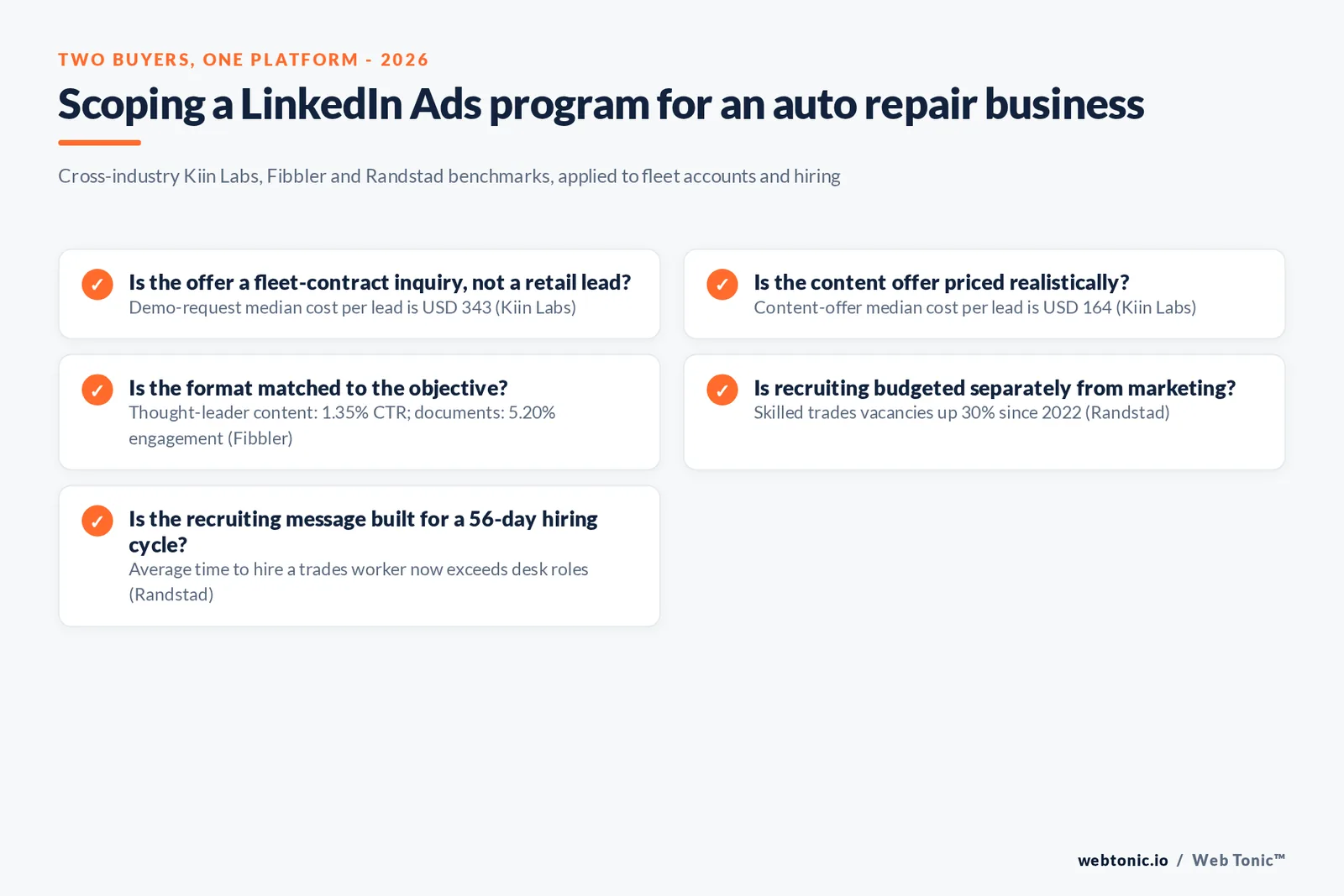
Treat the fleet-account campaign and the recruiting campaign as two separate line items with two separate cost expectations - a USD 343 median demo-request cost per lead for commercial accounts, and a recruiting cost per applicant that should be judged against the 56-day time-to-hire benchmark, not against a marketing CPL at all. Lead with document ads for the fleet-contract offer and thought-leader content for the recruiting post, matching Fibbler's format data to each objective. Our growth marketing team scopes exactly this kind of two-audience LinkedIn account for local service businesses, our data and analytics practice builds the split reporting that keeps a fleet-contract lead from being averaged in with a job applicant, and our cost-per-lead-by-industry piece is the right companion read for benchmarking the rest of the media mix around it.
Frequently Asked Questions
Is LinkedIn even a real channel for an auto repair shop?
Not for consumer bay traffic - nobody searches for a brake job on LinkedIn. It is a real channel for two specific buyers: fleet or facilities managers who award recurring commercial maintenance contracts, and the technicians a shop needs to hire in a trades market where, per Randstad's 2026 analysis of over 150 million U.S. job postings, general trades vacancies are up 30% and skilled-trades demand is growing three times faster than professional roles. Both of those audiences are LinkedIn-native; the shop's retail customer usually is not.
What does a LinkedIn lead cost, since no auto repair-specific figure exists?
No published study prices a LinkedIn lead specifically for auto repair, so the honest baseline is cross-industry vendor data, labeled as such. Kiin Labs' 2026 Lead Gen Forms Benchmarks report, drawn from 489 advertiser accounts and USD 13.6 million in tracked spend, puts the median cost per lead at USD 164 for a content offer and USD 343 for a demo request, with a p25 'good' mark of USD 67 and USD 131 respectively. Metadata.io's 153-advertiser B2B benchmark set puts LinkedIn's blended average at USD 202 per lead. Expect a fleet-account campaign to land closer to the demo-request end of that range, since it is selling a considered service contract, not a content download.
What does LinkedIn charge to just reach the audience, before a lead converts?
Fibbler's 2026 benchmark set, built from more than 1,000 B2B advertisers and over USD 200 million in analyzed spend, reports a median click-through rate of 0.39%, a median cost per click of USD 16.47 and a median cost per thousand impressions of USD 61.41. Metadata.io's smaller 138-advertiser LinkedIn sample reports a similar 0.67% click-through rate at USD 9.39 per click. Either way, LinkedIn's cost per click runs several times a typical Google Ads click, which is the trade-off for reaching a named title at a named company rather than anyone searching a keyword.
Which ad format and audience actually work for this kind of campaign?
Fibbler's format breakdown shows Thought Leader-style content earning the highest engagement, a median 1.35% click-through rate against 0.38% for a standard single image ad, while document ads convert attention into engagement at a 5.20% rate despite a low click-through rate - useful for a downloadable fleet-maintenance rate card. For targeting, Kiin Labs' industry-level data shows Motor Vehicle Parts Manufacturing, the closest adjacent industry code to auto repair in its dataset, at a USD 68 median content-offer cost per lead - among the cheaper industries in its 107-row table.
Is technician recruiting on LinkedIn actually competitive with fleet-account marketing?
It should get its own budget line, not compete with the fleet campaign for the same spend. LinkedIn's own 2026 graduate research found entry-level hiring down 6% year over year while 72% of young office workers say they are considering a switch to skilled trades. Randstad's parallel analysis found the average time to hire a skilled trades worker, 56 days, now exceeding the average for desk-based professional roles at 54 days. A shop competing for technicians is effectively running a second, unrelated LinkedIn campaign against a labor market moving in its favor for the first time in years.
Sources
Kiin Labs - LinkedIn Cost Per Lead by Industry 2026
Kiin Labs - LinkedIn Ads Benchmarks 2026, Lead Gen Forms
Fibbler - LinkedIn Ads Benchmarks 2026
Metadata.io - B2B Advertising Benchmarks 2026
LinkedIn - How Graduates Can Find the Best Job Opportunities in 2026
4 Corner Resources - Randstad USA skilled trades hiring analysis, 2026