Table of contents

Nielsen's 2026 Marketing ROI Blueprint found 85% of marketers confident they can measure ROI, but only 32% actually measure it holistically across channels. That 53-point gap, not a lack of tools, is the honest answer to whether audience measurement is improving campaign ROI in 2026 -- the tools exist, and most teams are not yet using them the way the vendors' own case studies assume.
Key Takeaways
- 85% of marketers are confident in their ROI measurement (Nielsen).
- Only 32% of those marketers measure ROI holistically across media.
- 38% now prioritize sales or ROI as their top success metric.
- 60% incorporate both reach/frequency and ROI in cross-media measurement.
- 27% still measure sponsorship spend in isolation.
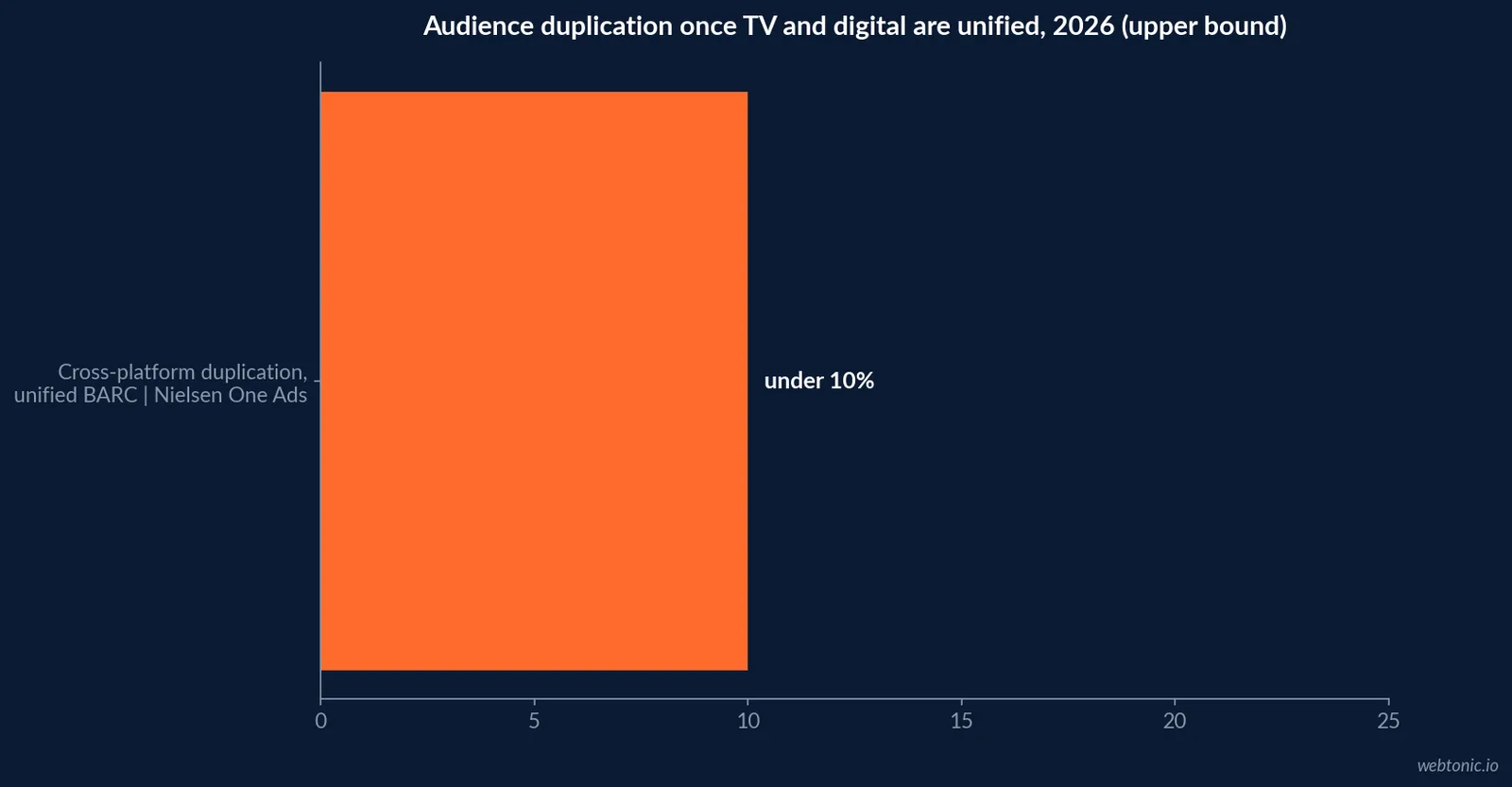
- A unified BARC | Nielsen One Ads deployment found under 10% audience duplication across TV and digital.
- Nielsen's Ad Intel now covers 95% of the U.S. CTV ad market across 20+ platforms.
- Google's Chrome third-party cookie phase-out was canceled in April 2025 and remains canceled through 2026.
- 69% of marketers report a decreased ability to reach consumers on Apple devices (Epsilon).
- 76% of consumers' time online is spent on the open web, outside any single platform login.
- 55% of marketers say they are not fully prepared for identifier deprecation despite the delay.
- Advertisers who connect offline and app data to Google's Data Manager see an average 26% increase in incremental ROAS.
- Enhanced conversions users see an average 11% increase in Search conversions versus standard imports.
- Accenture's Marketing Investment Navigator reports business-outcome improvements of 17% and above where deployed.
- 76% of buy-side decision-makers use at least one of incrementality testing, attribution or MMM (IAB/BWG 2026).
- Only 39% use all three measurement approaches together, despite each answering a different question.
- 60% to 75% of regular users say their current measurement approach doesn't perform very well.
- 77% of marketing mix model users say gaming spend is underrepresented in their model.
The confidence-to-practice gap, in one Nielsen number
Nielsen's Marketing ROI Blueprint is a direct survey of brand and media investment leaders, and it produces the cleanest evidence available on whether measurement tooling is closing the ROI question or just restating it. 85% express confidence in their ability to measure ROI. Only 32% actually measure it holistically across traditional and digital media. The other three findings sharpen the picture: 38% now treat sales or ROI as the top success metric rather than reach, 60% combine reach/frequency with ROI in a cross-media view, and 27% still measure sponsorship on its own, disconnected from the rest of the plan.
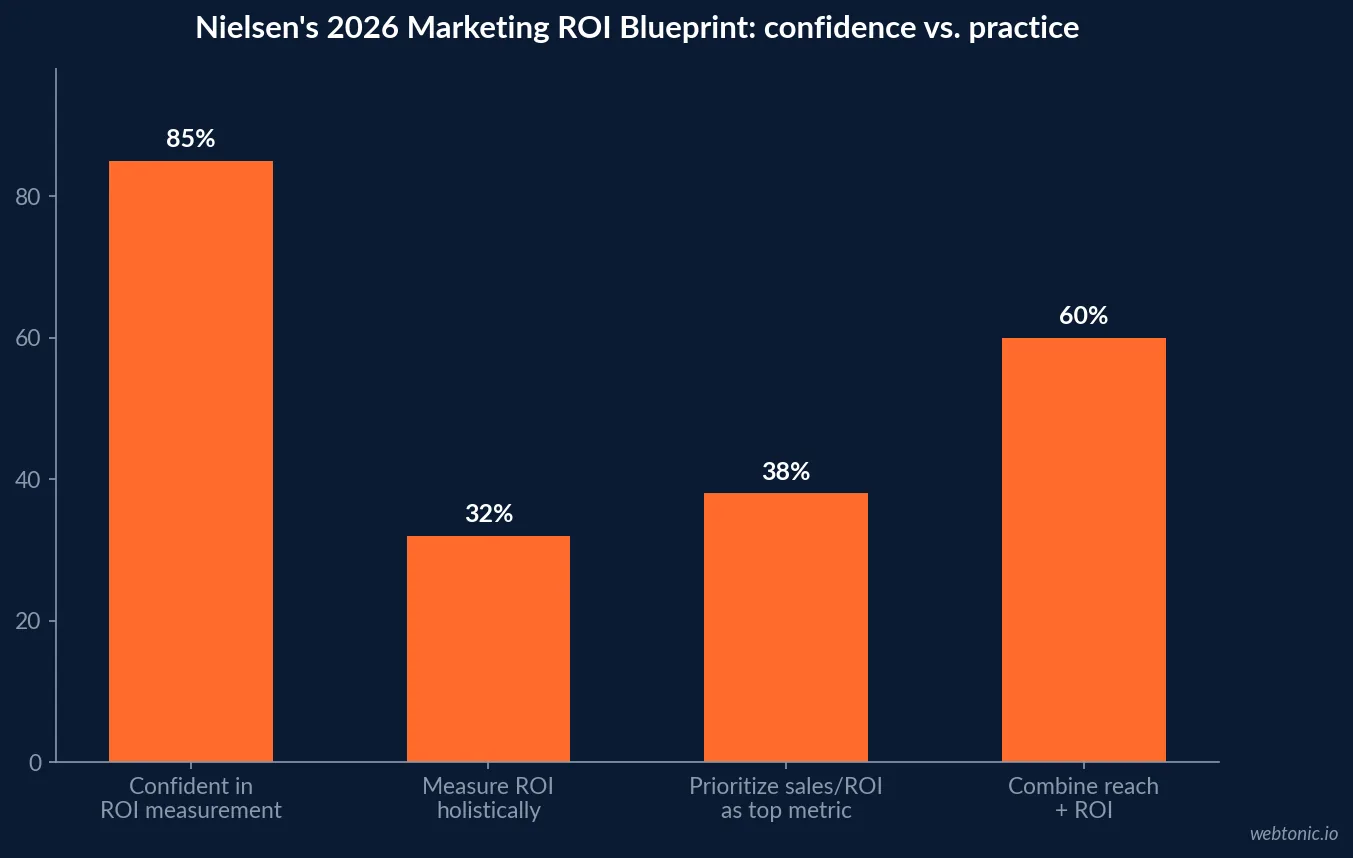
| Nielsen ROI Blueprint metric (2026) | Share of marketers | What it tells you |
|---|---|---|
| Confident in ROI measurement ability | 85% | Stated confidence, not verified practice |
| Measure ROI holistically across channels | 32% | The actual practice gap |
| Prioritize sales/ROI as top metric | 38% | A shift away from pure reach |
| Combine reach/frequency with ROI | 60% | Partial cross-media adoption |
| Measure sponsorship in isolation | 27% | A remaining blind spot |
Where unified measurement actually delivered a verifiable number
The clearest counter-example to "tools don't move ROI" comes from a cross-screen deployment, not a survey. During the ICC Men's T20 World Cup 2026, JioStar's BARC | Nielsen One Ads solution combined linear television data with Nielsen's digital measurement across connected TV, mobile and desktop. The result was cross-platform duplication under 10% across every participating campaign -- meaning television and digital were mostly reaching distinct audiences, and the combined buy delivered real incremental reach rather than repeated impressions counted twice.
That is the mechanism by which measurement tooling improves ROI in practice: not by producing a bigger number, but by removing double-counting that was previously inflating -- or hiding -- the true reach of a cross-media plan. Nielsen separately expanded its Ad Intel coverage to more than 20 individual CTV platforms, reaching 95% of the U.S. CTV ad market, specifically to make that kind of unified view possible outside of one-off event campaigns.
The identifier story marketers keep telling themselves is wrong
Google canceled its plan to phase out third-party cookies in Chrome in April 2025, and that cancellation has held through 2026. A Forbes Agency Council piece from September 2026 makes the point bluntly: "we're holding off because cookies are going away anyway" was a defensible sentence in a client meeting for three years, and it explained away unbuilt server-side pipelines and click-based reporting proxies. The deadline that sentence depended on is gone. The measurement infrastructure gap it was excusing is not.
That gap is real even without full cookie deprecation. Epsilon's research on preparing for a world without third-party cookies found 69% of marketers already reporting a decreased ability to reach consumers on Apple devices, and roughly 55% still not fully prepared for identifier changes that are already partly in effect. Meanwhile 76% of consumers' time online is spent on the open web, outside any authenticated walled garden -- exactly where identity resolution is hardest and measurement tools have the most work left to do.
| Identifier and identity signal (2026) | Figure | Source |
|---|---|---|
| Chrome third-party cookie phase-out status | Canceled April 2025, still canceled | Forbes Agency Council |
| Marketers reporting reduced Apple device reach | 69% | Epsilon |
| Consumers' time spent on the open web | 76% | Epsilon / Adweek |
| Marketers not fully prepared for identifier change | ~55% | Epsilon |
| Consumers owning at least one Apple device | 70% | Epsilon |
The measurement teams themselves say their own tools underperform
The most direct answer to "are audience measurement tools improving ROI" comes from the people who own the tools. IAB's State of Data 2026 report, based on a BWG Strategy survey of 430 senior US planning and analytics decision-makers, found that between 76% and 67% of the buy-side already use at least one of the three leading advanced measurement approaches -- incrementality testing, attribution analysis, and marketing mix models. But only 39% use all three together, even though each measures something the others cannot: incrementality isolates causal lift, attribution captures the conversion path, and MMM informs budget allocation across the whole mix.
Regular users of each approach were then asked point-blank whether it performs well, and the answer was not reassuring: 60% to 75% of regular users across all three approaches say their current method doesn't perform very well on rigor, coverage, timeliness, trust or operational efficiency. Marketing mix models fare worst on completeness -- 77% of MMM users say gaming spend is underrepresented in their model, followed by commerce media at 50% and creator/influencer marketing at 48%.
| Measurement approach (IAB/BWG 2026, n=430) | Adoption among buy-side | Regular users saying it underperforms |
|---|---|---|
| Incrementality testing | 76% | 60-75% |
| Attribution analysis (MTA, first-party) | 73% | 60-75% |
| Marketing mix models (MMM) | 67% | 60-75% |
| All three used together | 39% | n/a |
| Channel most cited as underrepresented in MMM (2026) | Share of MMM users flagging it |
|---|---|
| Gaming | 77% |
| Commerce media | 50% |
| Creator / influencer marketing | 48% |
| Other traditional media (radio, print, OOH, direct mail) | 46% |
| Digital out-of-home (DOOH) | 43% |
Where connected data does move the ROAS number
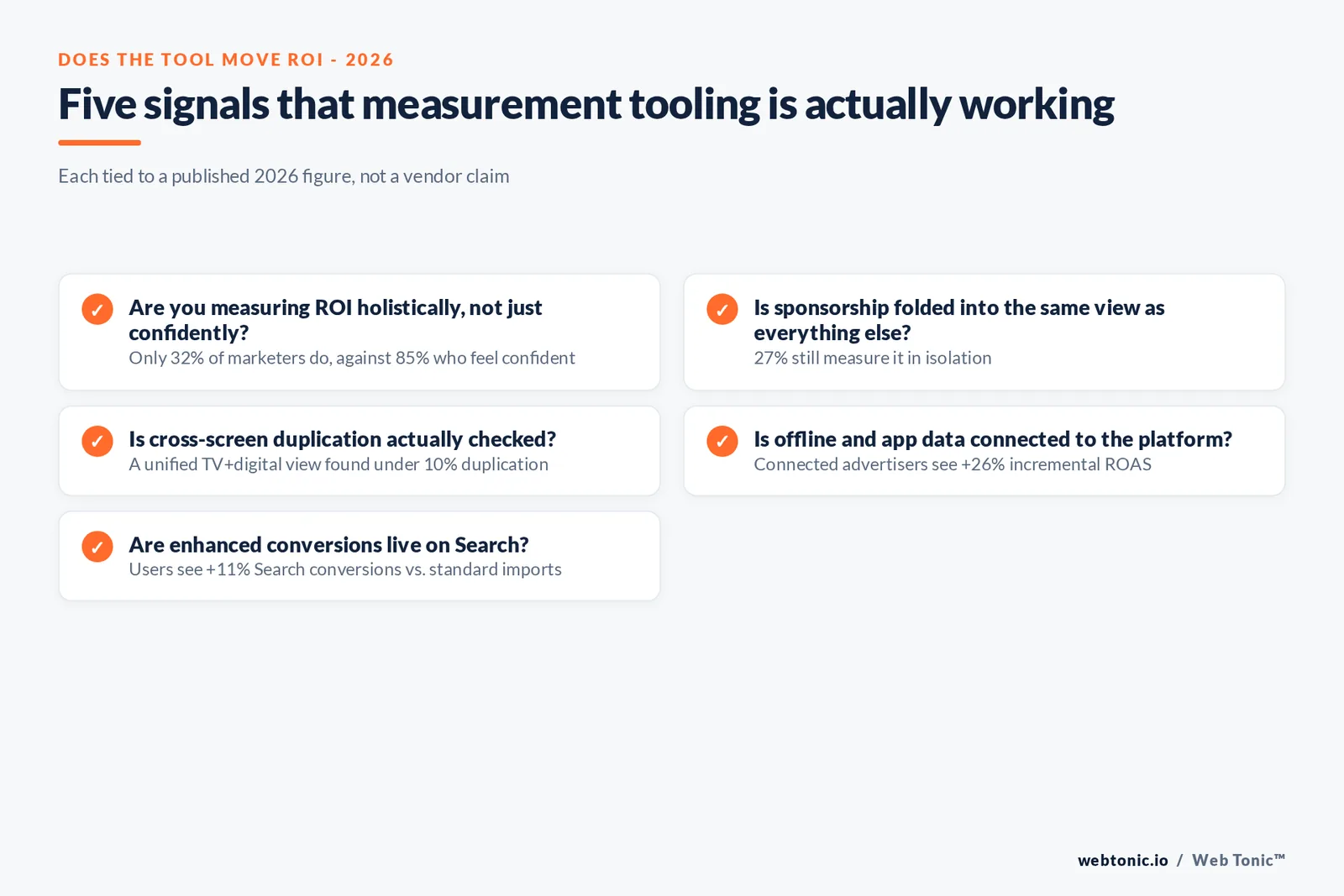
Google's own measurement updates give one of the few platform-reported, quantified ROI lifts tied directly to audience data connection: advertisers who connect offline and app data to Data Manager see an average 26% increase in incremental ROAS, and advertisers using enhanced conversions see an average 11% increase in Search conversions compared with standard conversion imports. Accenture's newly launched Marketing Investment Navigator, which unifies marketing mix modeling, attribution, sales lift and brand lift into one platform built on Amazon's authenticated signals, reports initial deployments improving business outcomes by 17% and above, at roughly twice the speed of prior approaches.
Read together with Nielsen's confidence gap, the pattern is consistent: audience measurement tools improve ROI specifically when they connect previously siloed data into one view, and mostly fail to when they are deployed as another isolated dashboard layered on top of the same fragmented stack. The same logic explains why G2's 2026 expansion of its Buyer Intent product unified four separate research platforms -- G2, Capterra, Software Advice and GetApp -- into one signal feed: G2 reports customers gaining up to 2x more signals and 36% more accounts actively in-market once the previously siloed platforms were combined into a single audience view.
| Measurement pattern | Reported 2026 impact | Condition required | Source |
|---|---|---|---|
| Connecting offline + app data to a unified platform | +26% incremental ROAS | First-party data pipeline exists | Google Data Manager |
| Enhanced conversions vs. standard imports | +11% Search conversions | Server-side conversion setup | |
| Unified cross-screen TV + digital measurement | <10% audience duplication | Deduplicated identity graph | BARC | Nielsen One Ads |
| Unified MMM + attribution + brand/sales lift | +17%+ business outcomes, 2x speed | Authenticated-scale signal source | Accenture Marketing Investment Navigator |
| Isolated single-channel dashboard | No verified lift; formalizes existing guesswork | None (the failure mode) | Nielsen ROI Blueprint pattern |
What this means for a marketer choosing where to invest next
The honest read of 2026 audience measurement research is conditional, not universal: tools improve ROI when they close a real data gap -- offline-to-online, TV-to-digital, platform-to-platform -- and mostly restate existing uncertainty when they are bought to fill a confidence gap instead. Before adding another platform, it is worth running Nielsen's own test on your own stack: are you actually measuring ROI holistically, or simply confident that you are? Our growth marketing team builds measurement plans around that distinction, and our Meta Ads practice works directly with the connected-data patterns behind the platform-reported ROAS lifts above. For a related benchmark on what a qualified lead should cost once measurement is unified, see our cost-per-lead data by industry, or talk to us about auditing your own confidence-to- practice gap.
Frequently Asked Questions
Are audience measurement tools actually improving campaign ROI?
Unevenly. Nielsen's Marketing ROI Blueprint found 85% of marketers confident in their ability to measure ROI, but only 32% actually measure it holistically across traditional and digital media. Where tools are deployed with a unified, deduplicated view -- as in the BARC | Nielsen One Ads cross-screen study -- they can show genuinely incremental reach. Where they are bolted onto a fragmented stack, they mostly formalize the same guesswork with a nicer dashboard.
What is the biggest measurement gap audience tools still have to close?
Duplication and identity, not raw coverage. The BARC | Nielsen One Ads deployment during the ICC Men's T20 World Cup 2026 found cross-platform duplication under 10% once television and digital were unified into one measurement view -- proof that fragmented single-platform tools were previously either double-counting or under-counting reach without anyone being able to tell which.
Did third-party cookie deprecation ever actually happen?
Not as planned. Google canceled its Chrome third-party cookie phase-out in April 2025, and that cancellation has held through 2026. A Forbes Agency Council piece from September 2026 argues this removed the industry's long-running excuse for not building real measurement infrastructure, since the deadline everyone was waiting out no longer exists.
How exposed are marketers to identifier changes even without full cookie deprecation?
Materially. Epsilon's research on preparing for a world without third-party cookies found 69% of marketers reporting a decreased ability to reach consumers on Apple devices, and 76% of consumers' time online is spent on the open web where no single platform login can identify them -- meaning identity gaps exist even where cookies technically survive.
What is the fastest fix for a marketer whose measurement confidence outpaces their practice?
Close the reporting gap Nielsen measured directly: move from measuring reach or delivery in isolation to a single cross-media view that includes ROI, and stop treating any one channel -- sponsorship included, per Nielsen's 27% figure -- as exempt from that unified view.
Do audience measurement teams think their own tools are working?
Mostly not, by their own admission. IAB's State of Data 2026 report, based on a BWG Strategy survey of 430 senior US planning and analytics decision-makers, found 60% to 75% saying their current incrementality, attribution or MMM approach doesn't perform very well on rigor, coverage, timeliness, trust or efficiency. Only 39% use all three approaches together, even though each one answers a different question.
Sources
Nielsen - The Marketing ROI Blueprint
JioStar - BARC | Nielsen One Ads cross-screen findings, ICC Men's T20 World Cup 2026
Nielsen - Cross-media ad strategy: what's missing in your ROI equation
Forbes Agency Council - Cookies survived, but marketers' excuse for bad measurement didn't
Adweek / Epsilon - Identifier deprecation won't kill the open web
Google - New updates to the measurement suite in Google Ads
Accenture Song - Accenture Marketing Investment Navigator launch
IAB / BWG Strategy - State of Data 2026: The AI-Powered Measurement Transformation
G2 - G2 Expands Buyer Intent Across Four Software Discovery Platforms