Table of contents

Attention-tracking spend is splitting into two budgets in 2026: a shrinking martech subscription line and a growing media-activation line where the tracking is bundled into the bid itself. This page analyzes where the money is actually going, not what the metric itself measures.
Key Takeaways
- Martech now takes 19.4% of the marketing budget, a five-year low.
- That is down from 26.6% in 2021, per Gartner's CMO Spend Survey.
- 62% of CMOs still plan to invest more in marketing technology.
- 56% shifted martech budget to consumption pricing in the past year.
- Just 9% moved the other way and cut consumption-based spend.
- 88% of media experts track attention in some capacity.
- 54% of that tracking runs on proxy signals, not direct eye-tracking.
- 39% of tracking is built in-house rather than bought from a vendor.
- The IAB/MRC guidelines landed in November 2025, the first accreditation standard.
- Adelaide's AU Quality Floor excludes the bottom 10% of scored placements pre-bid.
- That filter now runs natively inside Amazon DSP, moving tracking into activation.
- Adelaide's benchmark spans over 100,000 domains.
- That is 11 million-plus monthly placements across 18 industries.
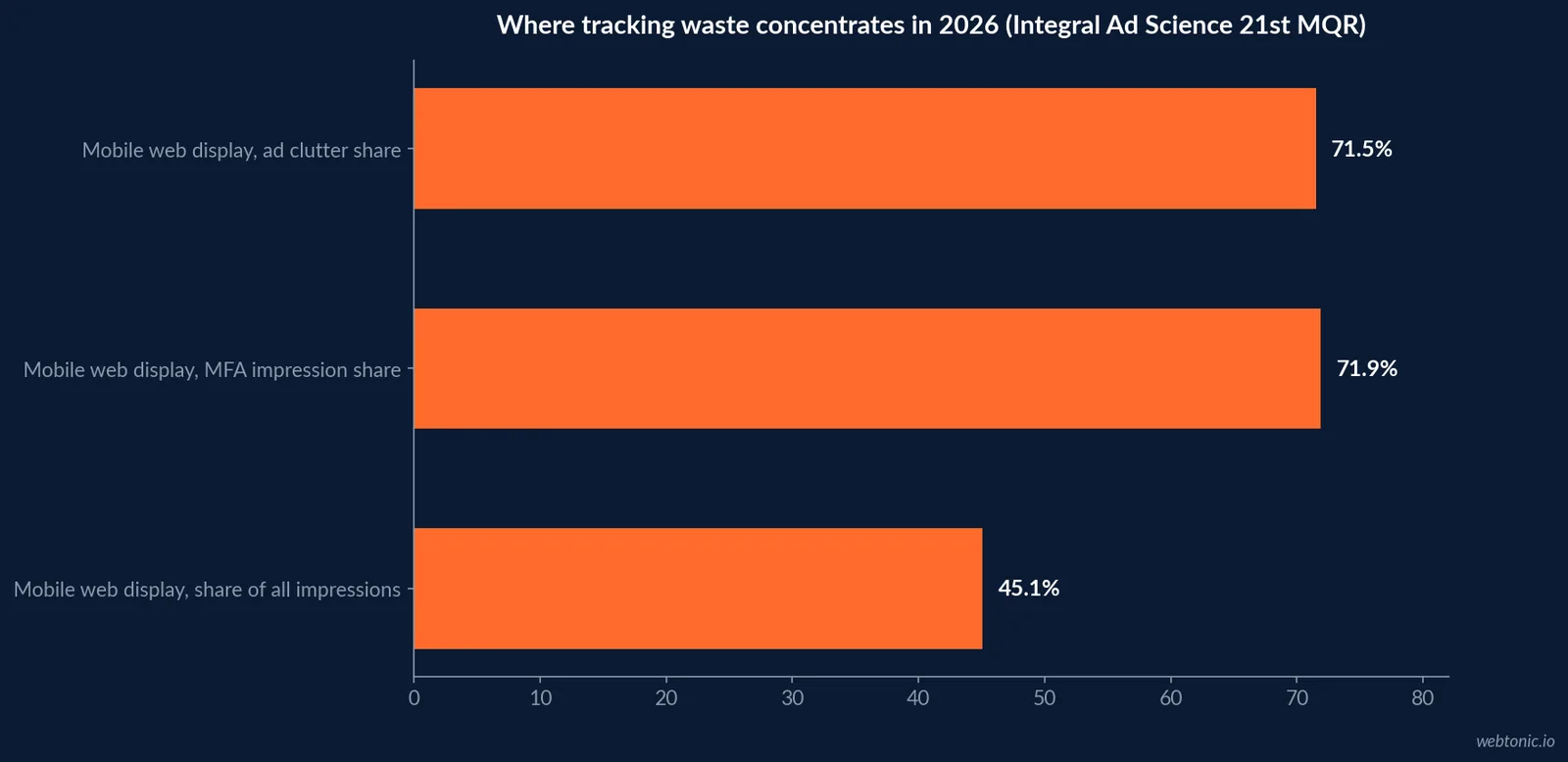
- Mobile web display carries 45.1% of impressions in IAS's tracked dataset.
- But it holds 71.9% of Made-for-Advertising impressions, the highest-risk share.
- Mobile MFA rates run 4 times higher than on desktop.
- 41% of organizations have real-time budget controls for consumption-priced tools.
- Half are continually renegotiating contracts to avoid usage-cost spikes.
Two budgets, one metric
Attention tracking gets funded from two different places depending on how a vendor sells it. A reporting dashboard that scores past campaigns is a martech purchase, billed and renewed like any other SaaS tool. A pre-bid filter that changes which impressions get bought is a media-activation cost, absorbed into the buy itself. Adelaide's launch inside Amazon DSP is the clearest example of the second model: its AU Quality Floor segment excludes Made-for-Advertising sites and the bottom 10% of AU-scored placements before a bid is placed, converting a tracking score directly into a bidding rule with no separate tool invoice.
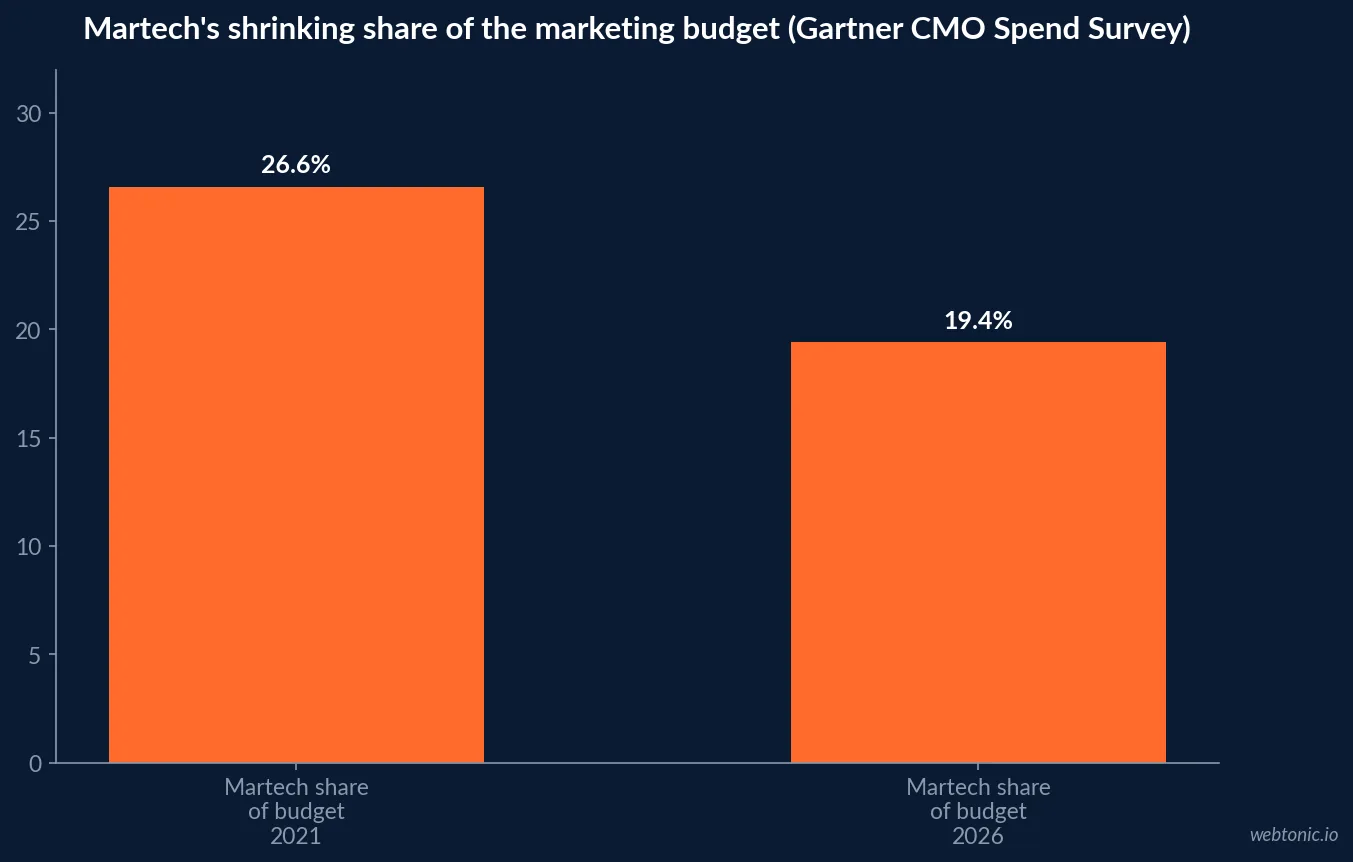
The shrinking martech line attention tools compete inside
The 2026 Gartner CMO Spend Survey of 401 CMOs found martech's share of the marketing budget fell to a five-year low of 19.4%, down from 26.6% in 2021, even as 62% of respondents planned to spend more on marketing technology this year. The mechanism behind the drop is a pricing shift: 56% of organizations increased the share of their martech budget on consumption-based pricing in the past year, against only 9% who cut it. Gartner also found 41% of organizations have built, or are building, real-time controls over that spend, and roughly half are continually renegotiating contracts to avoid unexpected usage costs.
A standalone attention-tracking subscription is, by definition, one more consumption-priced line inside a budget that is actively being squeezed and re-negotiated - which is the structural reason more attention vendors are moving into bundled media activation instead.
| Martech budget metric (2026) | Figure | Source |
|---|---|---|
| Martech share of marketing budget | 19.4% | Gartner CMO Spend Survey |
| Martech share of budget, 2021 | 26.6% | Gartner CMO Spend Survey |
| CMOs planning to spend more on martech | 62% | Gartner CMO Spend Survey |
| Shifted budget to consumption pricing | 56% | Gartner CMO Spend Survey |
| Cut consumption-based allocation | 9% | Gartner CMO Spend Survey |
| Building real-time spend controls | 41% | Gartner CMO Spend Survey |
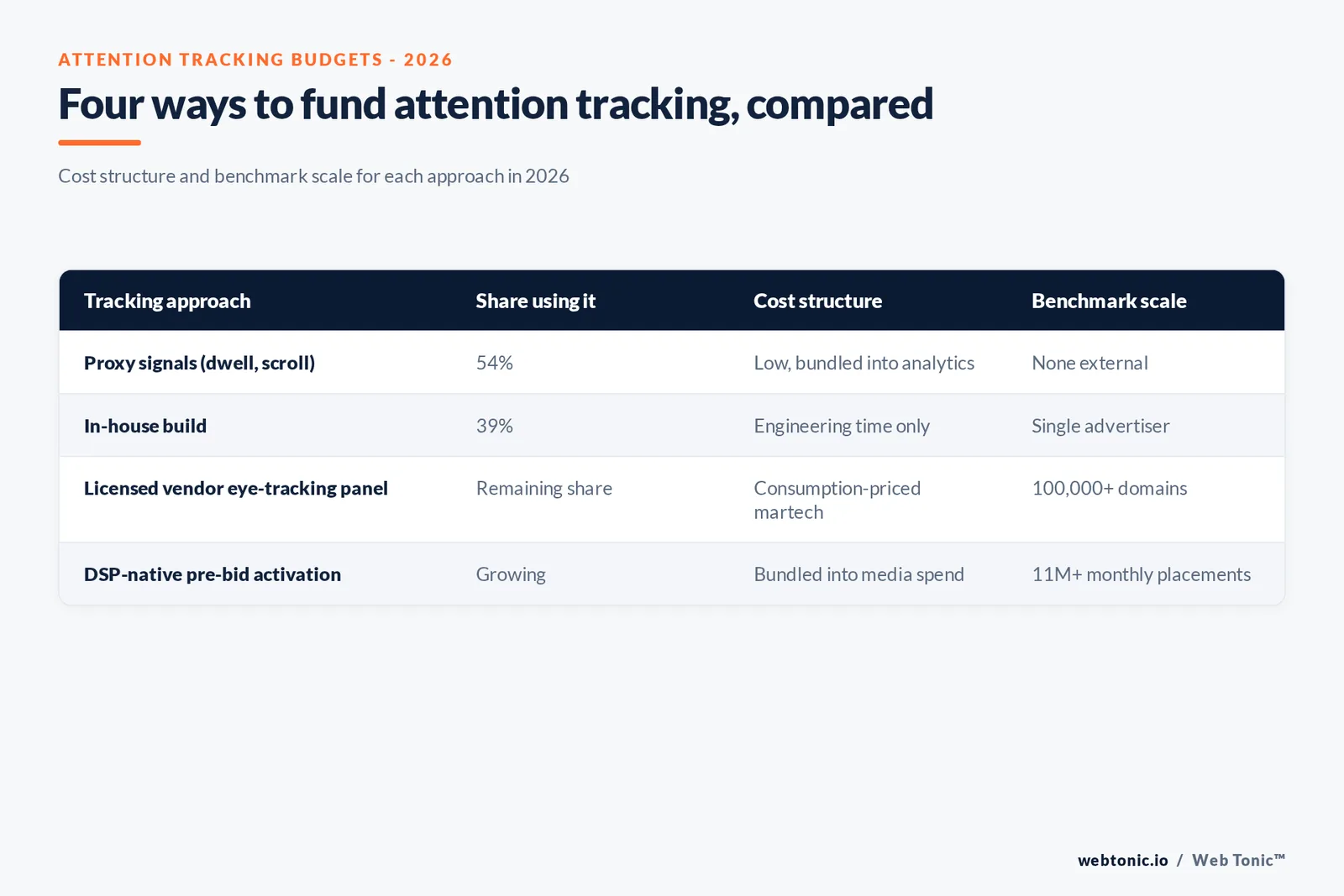
What the tracking budget is actually buying
Lumen Research's landscape survey found 88% of media experts already track attention in some capacity, but the rigor of that tracking splits sharply: 54% rely on proxy signals like dwell time or scroll depth rather than direct eye-tracking or gaze-prediction data, and 39% run an in-house build instead of licensing a vendor's benchmarked panel. Neither of those approaches carries the same evidentiary weight as a vendor whose methodology has cleared the IAB and Media Rating Council's Attention Measurement Guidelines, published in November 2025 as the industry's first standardized accreditation framework for attention data.
A tracking budget is not a single purchase decision - it is a choice between three different cost structures: a proxy-signal dashboard (cheapest, lowest rigor), an in-house build (no vendor fee, but no external benchmark), or an MRC-track vendor (highest cost, the only one with an audit trail).
| Tracking approach | Share using it (2026) | Typical cost structure | Benchmark scale |
|---|---|---|---|
| Proxy signals (dwell, scroll depth) | 54% | Low / bundled into existing analytics | None external |
| In-house build | 39% | Engineering time, no vendor fee | Single-advertiser only |
| Vendor eye-tracking / gaze panel | Remaining share | Licensed, often consumption-priced | 100,000+ domains (Adelaide) |
| DSP-native pre-bid tracking | Growing | Bundled into media spend | 11M+ monthly placements |
The accreditation cost hiding inside a tracking budget
An MRC-accredited vendor is not the same purchase as an unaccredited one, and the difference shows up in price. The IAB and Media Rating Council's Attention Measurement Guidelines, published November 2025, require any vendor seeking accreditation to disclose its full methodology and submit to MRC-designed audits conducted by independent CPA firms - a process that typically runs six to eighteen months and is paid for by the vendor, not the MRC itself. That audit cost gets passed through in the vendor's rate card, which is why a tracking budget built around an accredited provider should expect a premium over a proxy-signal dashboard or an in-house build.
The trade-off is a compliance trail a buyer can actually point to internally when a CFO asks what the tracking spend is verifying - something neither proxy signals nor an in-house build can offer.
| Tracking option | Audit / compliance trail | Relative cost | Best fit |
|---|---|---|---|
| MRC-accredited vendor | CPA-audited, 6-18 month process | Highest | Regulated or CFO-scrutinized budgets |
| Non-accredited vendor panel | Self-disclosed methodology only | Mid | Fast-moving, lower-scrutiny campaigns |
| Proxy signals / in-house build | None external | Lowest | Early-stage or exploratory tracking |
Where mistracked spend concentrates
Integral Ad Science's 21st Media Quality Report, built on more than 300 billion daily digital interactions, found mobile web display carried 45.1% of measured impressions but an outsized 71.5% of global ad clutter and 71.9% of Made-for-Advertising impressions - with an MFA rate four times higher than on desktop. A tracking budget that treats every placement type equally is under-covering exactly the inventory generating most of the waste it exists to catch.
The practical fix inside a tracking allocation is to weight coverage toward mobile web display first, since that is where the gap between impressions bought and impressions worth tracking is largest.
| Placement type | Share of impressions | Share of ad clutter / MFA | Tracking priority |
|---|---|---|---|
| Mobile web display | 45.1% | 71.5% clutter / 71.9% MFA | Highest |
| Desktop display | Remaining share | MFA rate 4x lower than mobile | Standard |
| Video (CTV + social) | Growing share | Lower clutter, higher viewability | Standard |
The consumption-pricing risk inside the tracking line
Most attention-tracking tools are now sold on the same consumption-based pricing model reshaping martech generally, which changes how a planner should budget for them. Per the Gartner CMO Spend Survey, 56% of organizations increased their martech budget's exposure to consumption pricing in the past year, and roughly half of organizations running consumption-priced tools are continually renegotiating contracts to avoid unexpected usage spikes. A tracking tool billed per impression measured, rather than a flat license, can quietly outgrow its budgeted line the moment a campaign scales - the opposite of the fixed martech-fee assumption most annual budgets are still built around.
The practical guard is the same real-time control Gartner recommends generally: cap the measured-impression volume per contract period before signing, not after the first overage invoice.
| Consumption-pricing risk | 2026 figure | Source | Mitigation |
|---|---|---|---|
| Orgs shifting martech budget to consumption pricing | 56% | Gartner CMO Spend Survey | Cap volume in the contract |
| Orgs cutting consumption-based allocation | 9% | Gartner CMO Spend Survey | n/a |
| Orgs building real-time spend controls | 41% | Gartner CMO Spend Survey | Adopt the same control for tracking tools |
| Orgs continually renegotiating contracts | ~50% | Gartner CMO Spend Survey | Negotiate a ceiling upfront |
A working allocation rule for the tracking budget
Fund DSP-native pre-bid tracking from the media line wherever the DSP supports it - it is the only approach with both a benchmark large enough to trust (Adelaide's 11 million-plus monthly placements) and no incremental martech fee. Keep a smaller, separate martech line for reporting-only dashboards, and treat proxy-signal tracking as a stopgap rather than a permanent architecture, given that more than half the industry is already leaning on it by default rather than by choice. Prioritize whatever budget remains toward mobile web display coverage, where the waste is concentrated.
Our data and analytics practice builds that allocation into a client's existing measurement stack, and our breakdown of what paid search actually costs covers where tracking spend sits alongside media and platform fees. For the wider spend picture, see our digital marketing statistics roundup or reach out to our team directly.
Frequently Asked Questions
Is attention tracking a martech cost or a media cost?
Increasingly a media cost. Adelaide's AU Media Quality and AU Quality Floor products now run inside Amazon DSP as pre-bid segments, meaning the tracking layer is bundled into the media buy rather than billed as a separate SaaS line. That matters because the Gartner CMO Spend Survey found martech's share of the marketing budget fell to a five-year low of 19.4% in 2026, down from 26.6% in 2021 - a shrinking pool that a standalone attention-tracking subscription now has to compete inside.
What does an attention-tracking pre-bid filter actually exclude?
Adelaide's AU Quality Floor, launched in Amazon DSP, is built as a single-click waste-exclusion filter that removes Made-for-Advertising-designated sites and the bottom 10% of AU-scored placements before a bid is even placed. That is a tracking decision converted directly into a media-buying rule, which is why more attention vendors are pushing into DSP-native activation instead of a post-campaign reporting dashboard.
How much of the industry is tracking attention with real data versus a workaround?
Lumen Research's landscape survey found 88% of media experts track attention in some form, but only a minority use direct eye-tracking or gaze-prediction data: 54% rely on proxy signals such as dwell time or scroll depth, and 39% run an in-house build rather than a vendor's tracked panel. A tracking budget spent on proxy signals is buying a different, cheaper thing than one spent on MRC-aligned eye-tracking data.
What changed for attention-tracking vendors in late 2025?
The IAB and Media Rating Council published the first standardized Attention Measurement Guidelines in November 2025. The guidelines require a vendor seeking MRC accreditation to disclose its methodology and submit to MRC-designed audits, which gives a buyer tracking data with a compliance trail for the first time rather than a proprietary black-box score.
Where is tracking spend most at risk of being wasted?
In mobile web display. Integral Ad Science's 21st Media Quality Report found mobile web display carried 45.1% of measured impressions but accounted for 71.5% of global ad clutter and 71.9% of Made-for-Advertising impressions - meaning a tracking budget that does not specifically cover this placement type is measuring the smallest share of the actual waste.
Sources
Chief Marketer - 2026 Gartner CMO Spend Survey
Adelaide - AU pre-bid targeting in Amazon DSP
Lumen Research - The attention metrics landscape survey
IAB - Attention Measurement: The Industry Framework
Integral Ad Science - 21st Media Quality Report
EMARKETER - Attention Metric (AU) by channel and platform
Media Rating Council - IAB/MRC Attention Measurement Guidelines