Table of contents
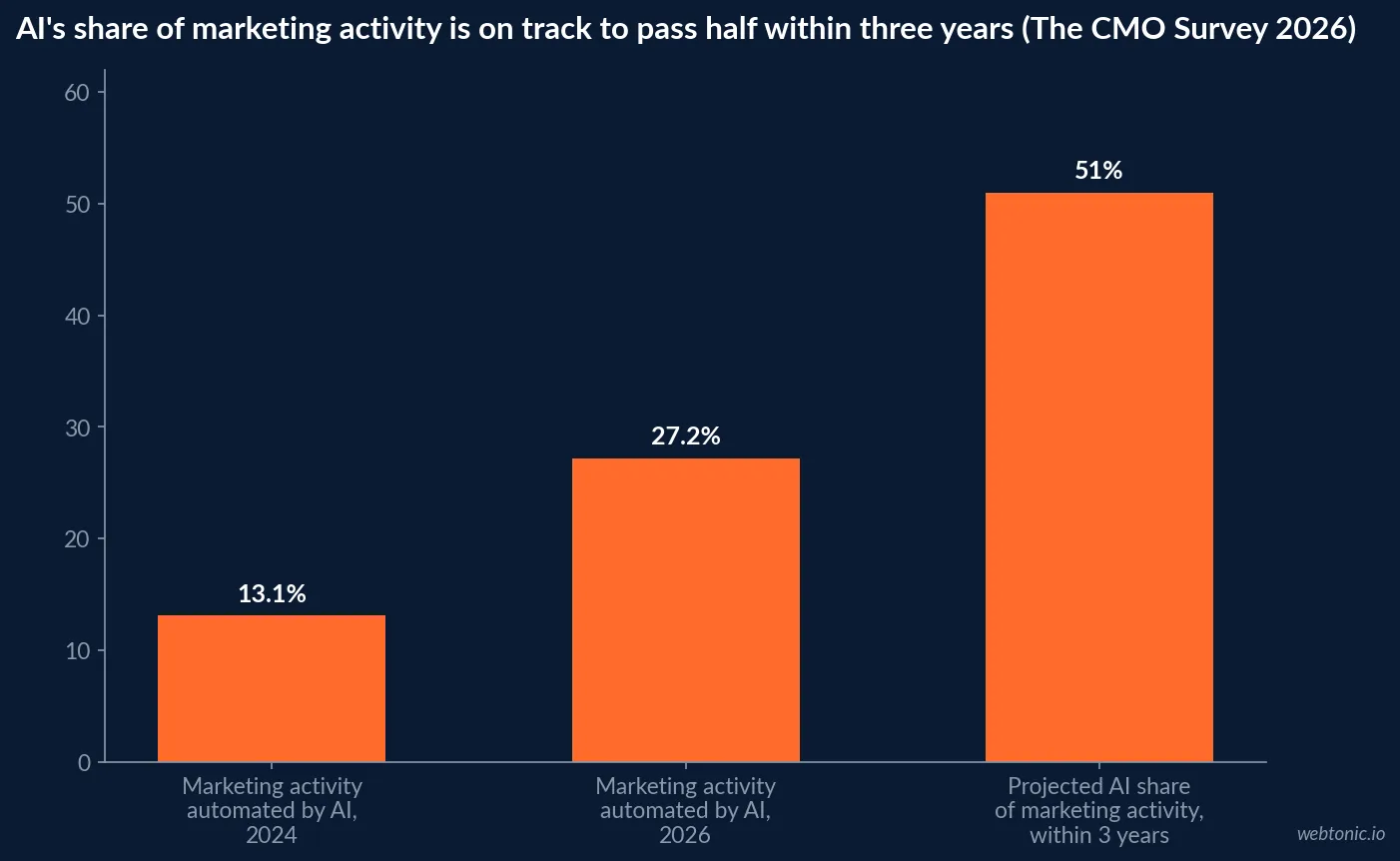
AI's share of marketing activity has roughly doubled since 2024 and is projected to pass half within three years, even as martech budgets shrink as a share of spend and marketing headcount growth slows. This page tracks that adoption curve across four independent 2026 practitioner surveys - The CMO Survey, HubSpot, Salesforce and the Marketing AI Institute - rather than a single vendor's self-reported numbers.
Key Takeaways
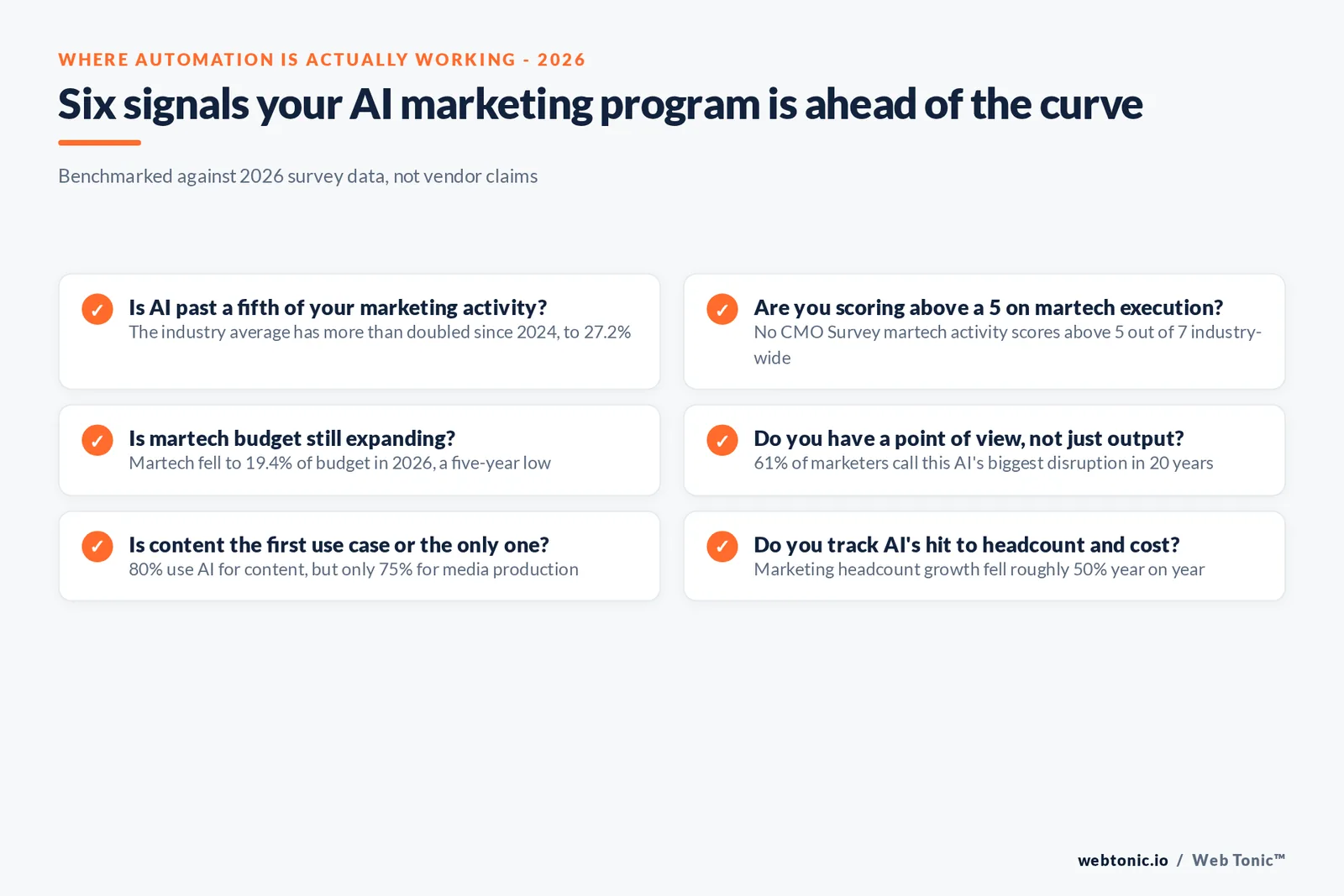
- AI use in marketing rose from 13.1% of activities in 2024 to roughly 27% in 2026.
- Companies project AI will handle more than half of marketing activities within three years.
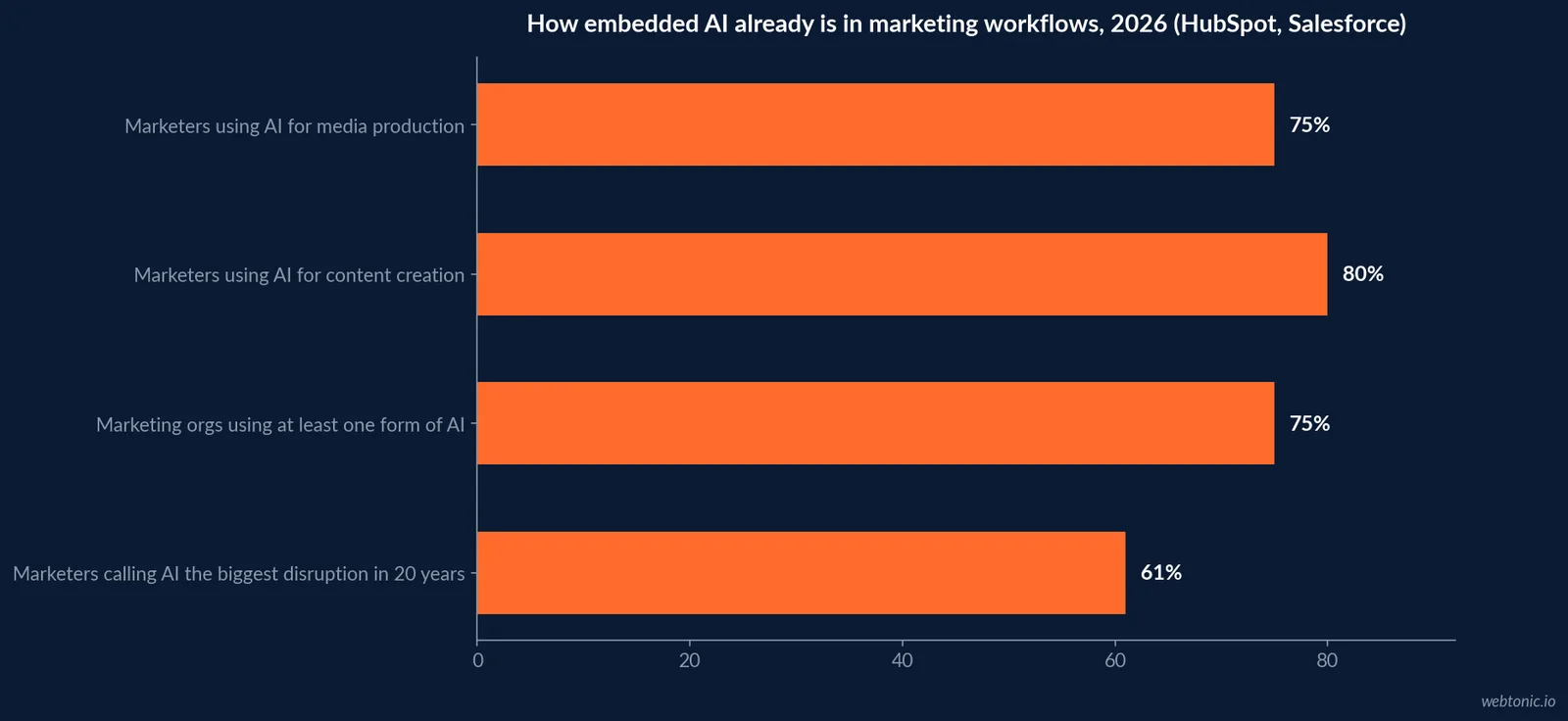
- 80% of marketers use AI for content creation, per HubSpot's 2026 survey.
- 75% use it for media production in the same survey.
- 61% call this the biggest marketing disruption in 20 years.
- 75% of marketing organizations use at least one form of AI, per Salesforce.
- Martech fell to 19.4% of marketing budget, a five-year low.
- That is down from 26.6% of budget in 2021.
- Yet 62% of CMOs still planned to invest more in martech in 2026.
- 56% shifted budget toward consumption-based martech pricing.
- Marketing budgets held at 9.0% of company revenue.
- Marketing spend grew just 1.7% year over year, the smallest increase since 2021.
- Marketing headcount growth fell roughly 50% year on year.
- No martech capability activity scores above 5 out of 7 on self-rated performance.
- The global marketing automation market reached USD 8.08 billion in 2026.
- It is forecast to hit USD 11.06 billion by 2030.
- More than 2,100 professionals answered the Marketing AI Institute's 2026 survey.
The adoption curve, in one comparison
The CMO Survey, running since 2008 out of Duke's Fuqua School of Business, is the longest-running independent tracker of marketing activity in the US, and its 35th edition puts a number on how fast AI moved from experiment to infrastructure inside marketing organizations.
| Metric | 2024 | 2026 | Projected, +3 years |
|---|---|---|---|
| AI share of marketing activities | 13.1% | ~27% | More than 50% |
| Marketing spend growth, year on year | - | 1.7% | - |
| Marketing headcount growth, year on year | - | Down ~50% | - |
Where marketers say AI is already working
HubSpot's 2026 State of Marketing report, drawn from more than 1,500 global B2B and B2C marketers, and Salesforce's 10th-edition State of Marketing report both converge on the same read: AI adoption is no longer the differentiator, execution quality is. Both surveys report AI touching the large majority of marketing workflows already in production, not in pilot.
| Use case / adoption signal | 2026 figure | Source |
|---|---|---|
| Marketers using AI for content creation | 80% | HubSpot 2026 State of Marketing |
| Marketers using AI for media production | 75% | HubSpot 2026 State of Marketing |
| Marketing orgs using at least one form of AI | 75% | Salesforce State of Marketing, 10th ed. |
| Call AI the biggest marketing disruption in 20 years | 61% | HubSpot 2026 State of Marketing |
| Marketers who say AI is raising customer expectations | 86% | Salesforce State of Marketing, 10th ed. |
Why martech budget share is falling, not rising
Gartner's 2026 CMO Spend Survey, covering 401 CMOs and reported through Chief Marketer, found the mean share of marketing budget allocated to martech fell to 19.4% in 2026 - a five-year low, down from 26.6% in 2021 - even though 62% of CMOs planned to invest more in martech technology overall. The explanation is a pricing shift, not a retreat: 56% of respondents increased how much of their martech budget uses consumption-based pricing, against just 9% who decreased it.
| Martech budget metric (Gartner 2026 CMO Spend Survey) | Figure |
|---|---|
| Martech share of marketing budget, 2021 | 26.6% |
| Martech share of marketing budget, 2026 | 19.4% |
| CMOs planning to invest more in martech | 62% |
| Shifted more spend to consumption-based pricing | 56% |
| Decreased consumption-based pricing allocation | 9% |
| Labor share of marketing budget, up from 21.9% | 24.5% |
The readiness gap behind the adoption numbers
The CMO Survey's own martech capability self-ratings are the clearest evidence that adoption is outrunning organizational readiness: on a 1-to-7 scale, no martech activity - including "generating technology ROI" and "integrating marketing technologies into our customer funnel" - scores above a 5. Training the team and hiring the right skills score lowest of all, at 3.9 and 3.7 respectively.
| Martech capability (1-7 scale, The CMO Survey 2026) | Self-rated score |
|---|---|
| Selecting vendors | 4.9 |
| Tactical use of data | 4.8 |
| Integrating systems | 4.8 |
| Generating technology ROI | 4.5 |
| Demonstrating that ROI to leadership | 4.2 |
| Training the team | 3.9 |
| Hiring the necessary skills | 3.7 |
What Marketing AI Institute's larger sample adds
The Marketing AI Institute's 2026 State of AI for Business report surveyed more than 2,100 professionals across roles and industries between February and April 2026, making it the largest of the four surveys cited here. Its core finding is a tension: a pervasive wait-and-see posture among both individuals and organizations, alongside a striking disconnect over how AI will affect jobs - a pattern consistent with The CMO Survey's own readiness gap, from a broader, cross-industry sample rather than marketing leaders alone.
That wait-and-see posture is worth taking seriously precisely because it sits next to genuinely fast adoption elsewhere in the same dataset. Organizations are not universally cautious - they are cautious about the parts of AI adoption that touch governance, headcount planning and jobs, while moving quickly on the parts that touch content and campaign execution. Treating "AI adoption" as one undifferentiated trend line misses that split, and it is the split that actually predicts which programs stall six months into a rollout.
The market growing underneath the adoption curve
The software category enabling all of this is itself expanding. The Business Research Company sizes the global marketing automation market at USD 8.08 billion in 2026, up from USD 7.39 billion in 2025 at a 9.3% CAGR, attributing growth to AI-powered customer insight, real-time campaign optimization and deeper CRM and CDP integration. It projects the market reaching USD 11.06 billion by 2030.
That growth rate is notably slower than the adoption-of-AI-activity numbers above, and the gap is informative on its own: marketing teams are absorbing more AI capability into existing platforms and workflows faster than they are buying new dedicated automation software, which tracks with Gartner's finding that martech budget share is falling even as usage climbs. The market is growing by expanding what each existing seat can do, not primarily by multiplying the number of tools a team runs.
| Marketing automation market metric | 2025 | 2026 | 2030 (forecast) |
|---|---|---|---|
| Global market size (USD billions) | 7.39 | 8.08 | 11.06 |
| Compound annual growth rate | - | 9.3% | 8.2% |
Reading the four surveys as one picture, not four opinions
These four surveys were fielded independently, by different organizations, on different samples, and they still land on the same shape: adoption climbing fast, budget share for dedicated martech shrinking, and a self-rated readiness gap that none of the four organizations sugarcoats in its own report. That convergence across independent methodologies is a stronger signal than any single number in isolation - if only one survey showed the readiness gap, it would be reasonable to suspect sample bias; four independent surveys showing the same pattern is closer to a settled fact about where the industry is in 2026.
The practical implication for a marketing leader building next year's plan is to treat the adoption percentage and the readiness percentage as two separate budget lines rather than one. The tools are largely already bought or easy to buy; the training, process redesign and ROI measurement that turns tool access into actual capability is the part every one of these four surveys says is still missing. Budgeting for that gap explicitly, as its own line item alongside software and media spend, is the single change most likely to move a program from the adoption statistics above into the smaller set of teams actually capturing the return on them.
The budget-cutting reflex still lands on marketing first
The CMO Survey's 2026 data also tracks what happens when results miss expectations, and marketing is still the first line item touched. When profits fall short, 53.1% of company executives say they focus on cutting expenses rather than investing in growth - up from 46% a year earlier - and marketing budgets are cut 45.4% of the time when that happens, more often than any other expense category. That reflex sits uncomfortably next to the survey's own finding that digital marketing's contribution to company performance has grown, with nearly three-quarters of companies now rating its impact as strong.
| Budget pressure signal (The CMO Survey 2026) | Figure |
|---|---|
| Executives who cut expenses first when profits miss | 53.1%, up from 46% |
| Times marketing is the expense category cut | 45.4% |
| Companies rating digital marketing's impact as strong | ~75% |
| Growth in customer-impact durability since 2022 | Up to 6 months longer |
Where automation is genuinely paying off versus creating drag
Put the numbers side by side and a clear split appears: adoption, budget commitment and top-line market growth are all rising together, but the self-rated capability to execute, train and prove ROI on that investment is not keeping pace. The practical read for a marketing leader is not whether to adopt AI - the 2026 data shows that decision has already been made across the industry - but whether the organization has budgeted for the training and integration work the adoption curve is now outrunning.
Our growth marketing practice builds AI-augmented campaign workflows against exactly these adoption benchmarks, and our data and analytics team closes the readiness gap the CMO Survey data shows most organizations are still carrying. For the wider digital marketing picture beyond AI specifically, see our digital marketing statistics hub, or talk to us about where your own program sits against these numbers.
Frequently Asked Questions
How much of marketing activity is actually run by AI now?
The CMO Survey's 2026 edition reports AI use in marketing has nearly doubled in two years, from 13.1% of marketing activities in 2024 to roughly 27% in 2026, and companies project AI will handle more than half of all marketing activities within three years. That is adoption of AI as an operating layer, not a single generative-AI writing tool bolted onto an existing workflow.
Is martech budget growing along with AI adoption?
No, and that is the counterintuitive finding. Gartner's 2026 CMO Spend Survey, covering 401 CMOs, found martech's share of marketing budget fell to 19.4% in 2026, a five-year low, down from 26.6% in 2021 - even as 62% of CMOs planned to invest more in martech overall. Budgets are shifting toward consumption-based pricing models rather than shrinking outright.
What are marketers actually using AI for in 2026?
HubSpot's 2026 State of Marketing report, based on 1,500-plus global marketers, found 80% use AI for content creation and 75% for media production, and 61% call this AI moment marketing's biggest disruption in 20 years. Salesforce's State of Marketing (10th edition) separately reports 75% of marketing organizations use at least one form of AI, with personalization and campaign-performance prediction as leading use cases.
Is the marketing automation software market itself growing?
Yes. The Business Research Company sizes the global marketing automation market at USD 8.08 billion in 2026, up from USD 7.39 billion in 2025 at a 9.3% CAGR, and projects USD 11.06 billion by 2030 as AI-powered customer insight and real-time campaign optimization features spread through the category.
Is marketing headcount growing or shrinking as AI adoption rises?
Shrinking, relative to prior years. The CMO Survey 2026 reports marketing headcount growth down roughly 50% year on year, even as marketing spend grew only 1.7% and budgets held at 9.0% of company revenue. The combination - flat spend, falling headcount growth, rising AI use - is the clearest single signal that AI is being asked to absorb capacity rather than simply augment existing teams.
Sources
The CMO Survey - Highlights and Insights Report 2026
HubSpot - 2026 State of Marketing: Data from 1,500+ Global Marketers
Salesforce - State of Marketing, 10th Edition (Appendix)
Marketing AI Institute - 2026 State of AI for Business Report
The Business Research Company - Marketing Automation Global Market Report 2026
Chief Marketer - Gartner 2026 CMO Spend Survey coverage