Table of contents
Anchor text correlates weakly with rankings, Google names "optimized anchor text" only in the context of paid or placed links, and most sites already write descriptive internal anchors without being told to. This page separates the large-scale correlation data from Google's own published guidance, using 2026-verified sources rather than a single blog's recycled percentages.
Key Takeaways
- Ahrefs analyzed 384,614 ranking pages across 19,840 keywords for its anchor study.
- The exact-match-to-ranking Spearman correlation is just 0.1436 by average.
- By median, that correlation is 0.1869 - both read as weak.
- Most SEOs now recommend exact-match anchors stay between 1% and 5% of a profile.
- The Backlinko/Ahrefs study covers 1,183,680 keywords.
- That study includes 11,835,086 ranking URLs in total.
- Anchor text is documented as Google ranking factor #88 of roughly 200.
- Internal link anchor text is factor #104; brand-name anchors are #161.
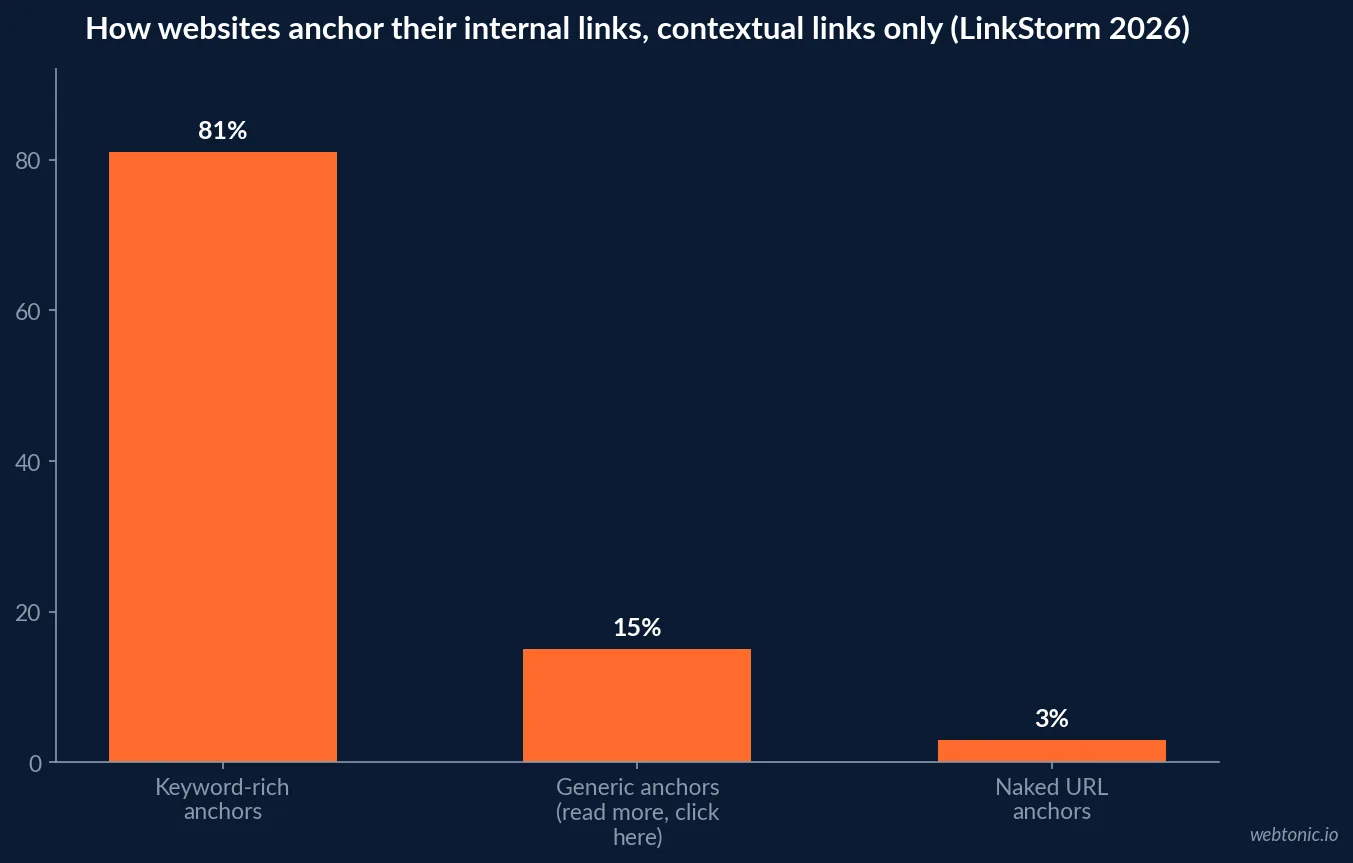
- 81% of internal link anchors are keyword-rich and descriptive.
- About 15% of internal anchors are still generic, like "click here."
- About 3% of internal anchors are naked URLs.
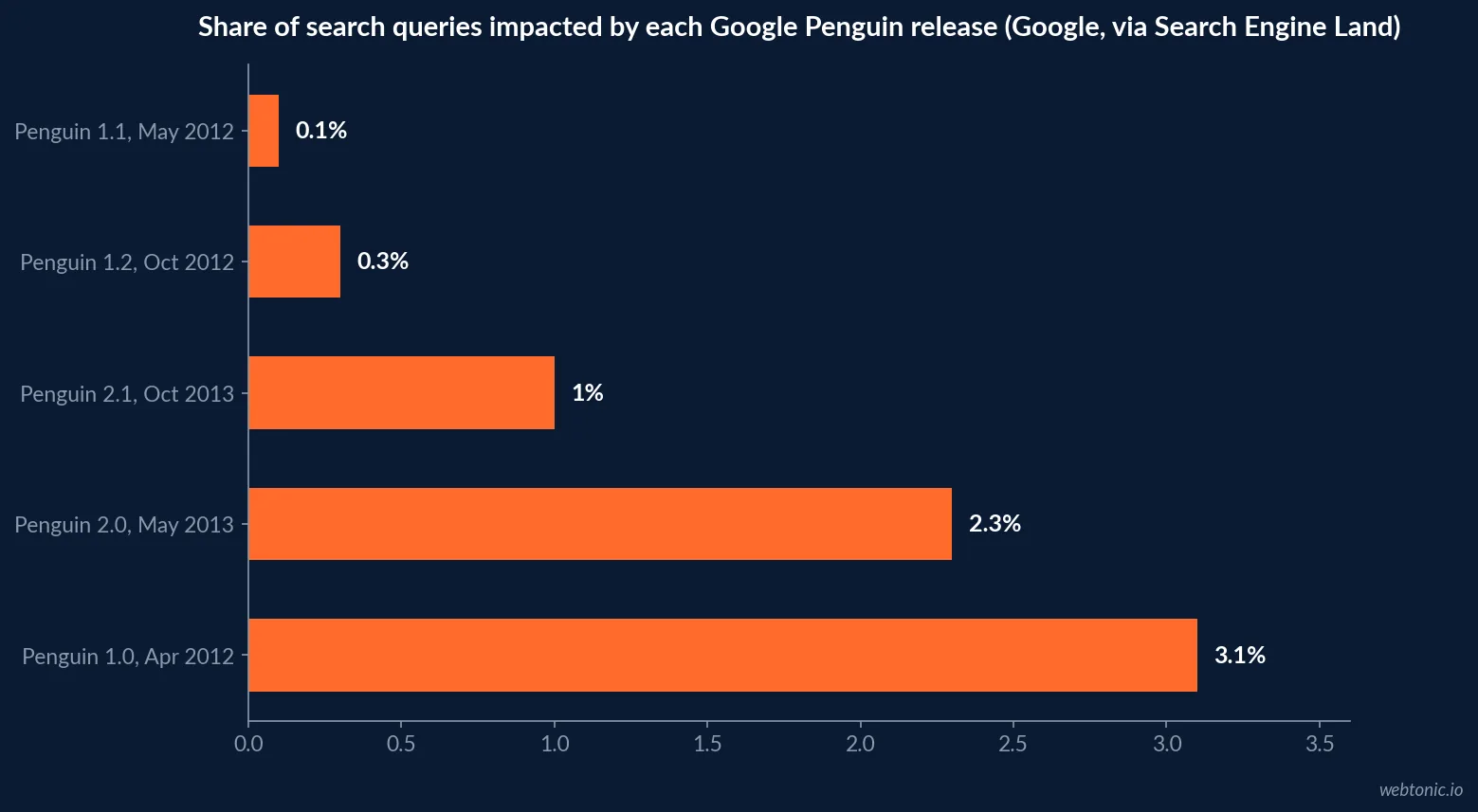
- Google's first Penguin release affected 3.1% of search queries.
- Penguin 2.0 in 2013 affected 2.3% of queries; Penguin 1.2 affected just 0.3%.
- Penguin became a real-time core signal in September 2016.
- Google's link documentation gives zero numeric anchor ratio targets.
- Its spam policies name "optimized anchor text" only for paid or placed links.
- A 2026 survey of 500 SEO professionals found link building budgets still concentrated in agencies.
The correlation studies, read correctly
Ahrefs conducted the largest public correlation study specifically isolating anchor text: 19,840 keywords, the top 20 results for each, 384,614 total ranking pages. The headline chart looks like a strong relationship until the median line is added, which flattens toward zero for most ranking positions - the average is skewed by a small number of outlier pages with unusually high exact-match shares.
| Correlation study | Sample size | Exact-match correlation | Read |
|---|---|---|---|
| Ahrefs anchor text study, average | 384,614 pages / 19,840 keywords | 0.1436 (Spearman) | Weak |
| Ahrefs anchor text study, median | 384,614 pages / 19,840 keywords | 0.1869 (Spearman) | Weak |
| Backlinko + Ahrefs ranking factors study | 11,835,086 ranking URLs / 1,183,680 keywords | Backlink factors weigh far more than anchor share alone | Directional, not anchor-isolated |
What Google's own documentation actually says
Two Google Search Central pages cover anchor text, and neither publishes a percentage. The link best-practices page defines good anchor text as descriptive, reasonably concise, and relevant to both the page it sits on and the page it links to, and suggests a simple test: read the anchor text alone, out of context, and check whether it still makes sense. The spam policies page is where the phrase "optimized anchor text" appears, and it is attached specifically to advertorials, guest posts and distributed press releases where payment was exchanged for the placement - not to ordinary editorial links or a site's own internal navigation.
| Google documentation | What it defines | What it does not define |
|---|---|---|
| Link best practices (SEO Link Best Practices for Google) | Good anchor text: descriptive, concise, relevant | Any numeric ratio or ideal link count |
| Spam policies (Spam Policies for Google Web Search) | "Optimized anchor text" in paid/placed links | A universal exact-match ceiling |
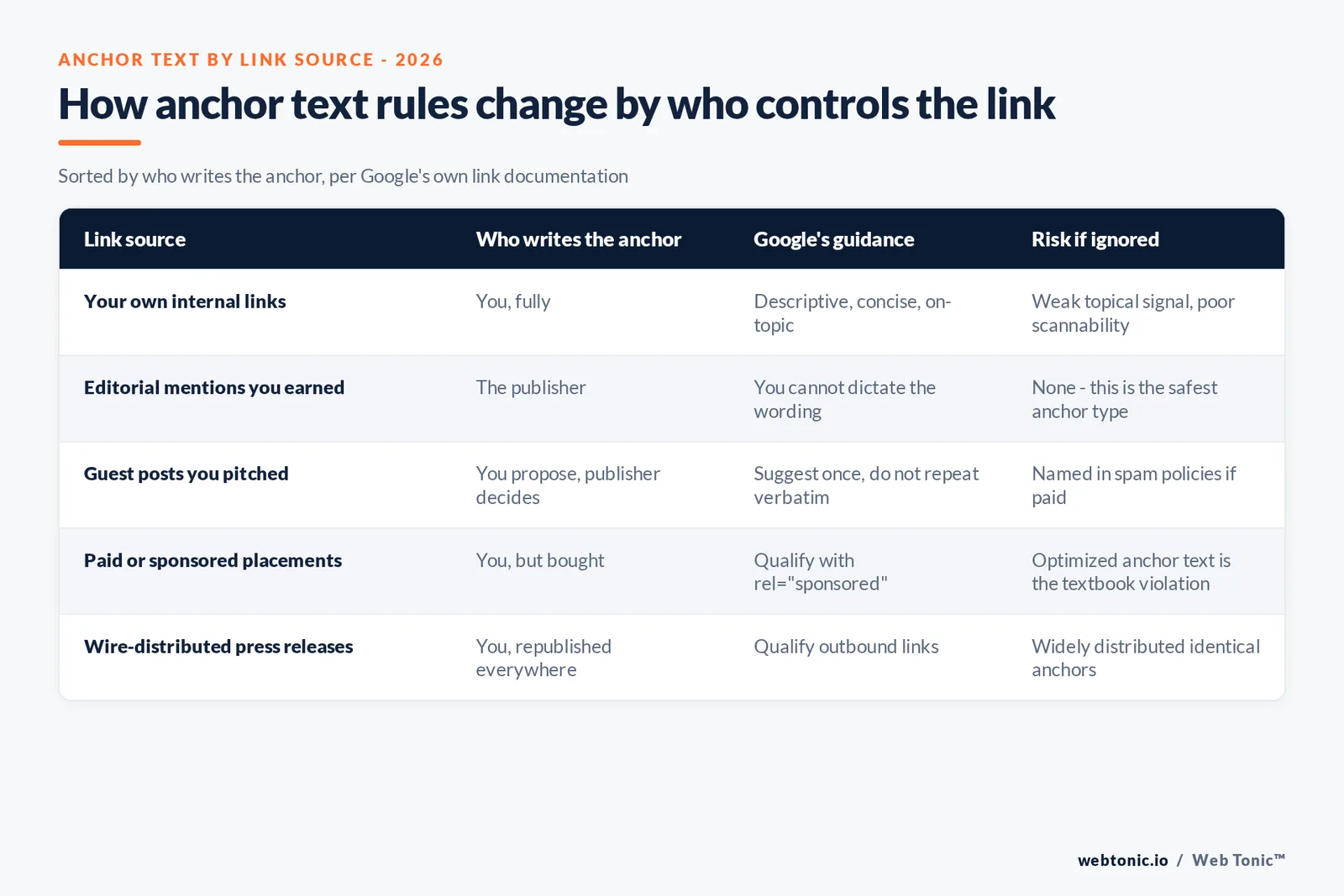
How anchor text rules change by who writes the link
The distinction that actually resolves most anchor text confusion is not what an anchor looks like, it is who controls its wording. An anchor you write on your own site carries different guidance than one you pitch to a guest-post editor, which is different again from one attached to a paid placement.
Penguin: the update that made anchor text a risk, not just a signal
Anchor text correlating weakly with rankings does not mean it is risk-free. Google's Penguin update, first released April 24, 2012, was built to catch manipulative link schemes, including over-optimized anchor text, and it directly penalized affected pages rather than merely discounting the signal. Google itself reported the query-level impact of each release, which shrank steadily as the update matured before becoming a continuous, real-time part of the core algorithm in 2016.
| Penguin release | Date | Share of queries affected |
|---|---|---|
| Penguin 1.0 | April 24, 2012 | ~3.1% |
| Penguin 1.1 | May 26, 2012 | <0.1% |
| Penguin 1.2 | October 5, 2012 | ~0.3% |
| Penguin 2.0 | May 22, 2013 | ~2.3% |
| Penguin 2.1 | October 4, 2013 | ~1% |
| Penguin 3.0 | October 17, 2014 | ~1% |
| Penguin 4.0 (real-time) | September 23, 2016 | Ongoing, folded into core algorithm |
How the industry actually reports building links today
A 2026 survey of 500 SEO professionals - agency owners, in-house marketers, specialists and freelancers - found link building spend still runs mostly through agencies and freelancers serving clients rather than direct in-house teams, with digital PR the most widely used tactic. Anchor text strategy sits downstream of that structure: whoever controls the placement, agency or in-house team, is the one actually deciding what the anchor says.
| Link building landscape, 2026 | Figure | Source |
|---|---|---|
| SEO professionals surveyed | 500 | State of Link Building 2026 survey |
| Respondents who are agency owners or freelancers | 47% | State of Link Building 2026 survey |
| Anchors that are keyword-rich (internal links) | 81% | LinkStorm, 2.5M internal links |
| Anchors that are still generic | 15% | LinkStorm, 2.5M internal links |
Anchor text tools worth knowing before you audit a profile
Auditing an existing backlink profile's anchor distribution is a tooling problem before it is a strategy problem. Majestic's Anchor Text Analyser, for example, segments a profile into generic text, keyword-related terms, naked links and brand mentions, and can visualize the mix as a word cloud across a domain or a single URL - useful for spotting an over-optimized cluster before Google does. The tool's API can also return up to 250 anchor phrases for a given domain or URL, which is enough to compare a site's own anchor mix against a set of competitors rather than judging it in isolation.
Running that kind of comparison across a handful of competing domains in the same niche is usually more informative than benchmarking against an industry-wide average, because acceptable anchor ratios shift with a site's age, authority and the competitiveness of its target keywords - a pattern the correlation studies above confirm indirectly, since the exact-match share alone explains so little of the variance in ranking position.
A useful sanity check before any competitive comparison: pull your own top 10-20 ranking pages first, not a sample of the whole domain. Anchor distribution on a handful of commercially important pages tends to look very different from the domain-wide average, because those are exactly the pages that have accumulated the most guest-post and outreach links over time - and therefore the pages where an over-optimized cluster is most likely to be hiding. Compare that same set of pages against three or four direct organic competitors and the picture usually resolves quickly - either the whole niche runs a similar anchor mix, in which case a slightly higher exact-match share is unlikely to be the reason a page under-ranks, or one competitor stands out with a visibly different profile, which is worth a closer look either way.
Reading the Backlinko/Ahrefs study correctly
The joint Backlinko and Ahrefs correlation study remains the largest of its kind: 1,183,680 keywords, more than 11.8 million ranking URLs, over 10 million of them unique. It did not isolate anchor text the way Ahrefs' dedicated study did - it measured roughly 200 documented ranking factors side by side, including onsite factors crawled directly from more than a million pages. Its main conclusion for anchor text specifically is consistent with the isolated study: backlink quantity and quality (measured through metrics like referring domains and URL Rating) correlate far more strongly with rankings than anchor text composition does on its own.
| Ranking factor category | What the joint study measured | Where anchor text sits |
|---|---|---|
| Backlink quantity/quality | Referring domains, URL Rating, link count | Correlates more strongly than anchor composition |
| Onsite content factors | Word count, content relevance, over 1M crawled pages | Separate from anchor-driven signals |
| Anchor text composition | Exact-match share isolated in Ahrefs' companion study | Weak, isolated correlation (0.14-0.19) |
Setting an anchor text policy that survives an audit
Write internal anchors the way the 81% majority already does: descriptive, on-topic, readable out of context. For earned and pitched external links, propose wording once and let the publisher decide - the spam policies attach risk to payment, not to a descriptive suggestion. For paid placements, qualify the link and do not chase an exact-match phrase across every guest post; the correlation data does not support that it moves rankings meaningfully, and the spam policies specifically name that pattern as link spam.
The practical version of this policy fits on one page: cap exact-match anchors at roughly 5% of new links added in any given quarter, let branded and naked-URL anchors make up the majority by default, and treat any single guest-post partner asking for the identical exact-match phrase twice as a signal to change the wording, not repeat it. None of that requires waiting on Google to publish a number it has never published in a decade of documentation - the correlation data and the spam policy language already give a defensible, evidence-based ceiling.
If an anchor text audit surfaces a profile that already looks over-optimized, our data and analytics team can model the exposure before you touch a single link, and our growth marketing practice can rebuild the acquisition mix around descriptive, editorially-earned links instead. For the wider link-building picture beyond anchor text specifically, see our link building statistics hub, or talk to us about a full backlink profile review.
Frequently Asked Questions
Does exact-match anchor text still help rankings in 2026?
Weakly, and the weak correlation is real, not folklore. Ahrefs' study across 19,840 keywords and 384,614 ranking pages found the Spearman correlation between exact-match anchor share and ranking position at just 0.1436 using averages and 0.1869 using medians - both far below what most SEOs assume when they see the raw scatter plot. Most SEOs now recommend keeping exact-match anchors between roughly 1% and 5% of a backlink profile rather than chasing a higher share.
What does Google actually say about anchor text, in its own documentation?
Google's Search Central link documentation says good anchor text is "descriptive, reasonably concise, and relevant to the page that it's on and to the page it links to," and recommends testing an anchor by reading it out of context to see if it still makes sense. Its spam policies separately name "optimized anchor text" specifically in the context of paid or placed links - guest posts, advertorials and distributed press releases - not ordinary editorial or internal links.
How do most sites actually write their internal anchor text?
A 2.5-million-link study by LinkStorm, focused on contextual internal links, found about 81% of anchors are keyword-rich and descriptive, roughly 15% are generic phrases like "read more" or "click here," and about 3% are naked URLs. Most sites already follow Google's own stated preference; the gap is the remaining 15% of generic anchors, which is also where anchor-to-target topical relevance tends to be weakest.
Did Google ever actually penalize sites for their anchor text?
Yes, directly. Google's Penguin update, first released April 24, 2012, was built specifically to catch manipulative link schemes including over-optimized anchor text, and Google itself reported it affected roughly 3.1% of English-language search queries on that first release - the largest of any Penguin iteration before it became a real-time signal inside the core algorithm in 2016.
Is there an ideal ratio of branded to keyword anchors?
There is no single published threshold, and any source that quotes one to a decimal point is offering an opinion, not a finding. What the largest correlation study available - the Backlinko and Ahrefs joint analysis of 1.18 million keywords and more than 11.8 million ranking URLs - actually shows is that anchor text is one signal among roughly 200 documented ranking factors, and it correlates far more weakly with rankings than domain-level authority metrics do.
Sources
Ahrefs - What Is Anchor Text? (384,614-page correlation study)
Backlinko - Google's 200 Ranking Factors
Backlinko + Ahrefs - Google Ranking Factors Correlation Study: Methods & Results
Google Search Central - SEO Link Best Practices for Google
Google Search Central - Spam Policies for Google Web Search
LinkStorm - 2.5 Million Internal Links Study
Majestic - Backlink Anchor Text Analyser
Reporter Outreach - State of Link Building 2026: A Survey of 500 SEO Pros
Nielsen Norman Group - Writing Hyperlinks