Table of contents
AIDA's four stages, Attention, Interest, Desire and Action, now have direct, passively- measured benchmark data behind them rather than just theory. On Device's 650-study Brand Lift benchmark for IAB UK, DISQO's 1,700-campaign effectiveness database and YOC's high-impact-format meta- study each measure a different slice of the same funnel. Mapped together, they show where advertising reliably moves people, and where it reliably stalls.
Key Takeaways
- On Device analyzed 650 passively-measured Brand Lift studies for IAB UK's 2026 benchmark report.
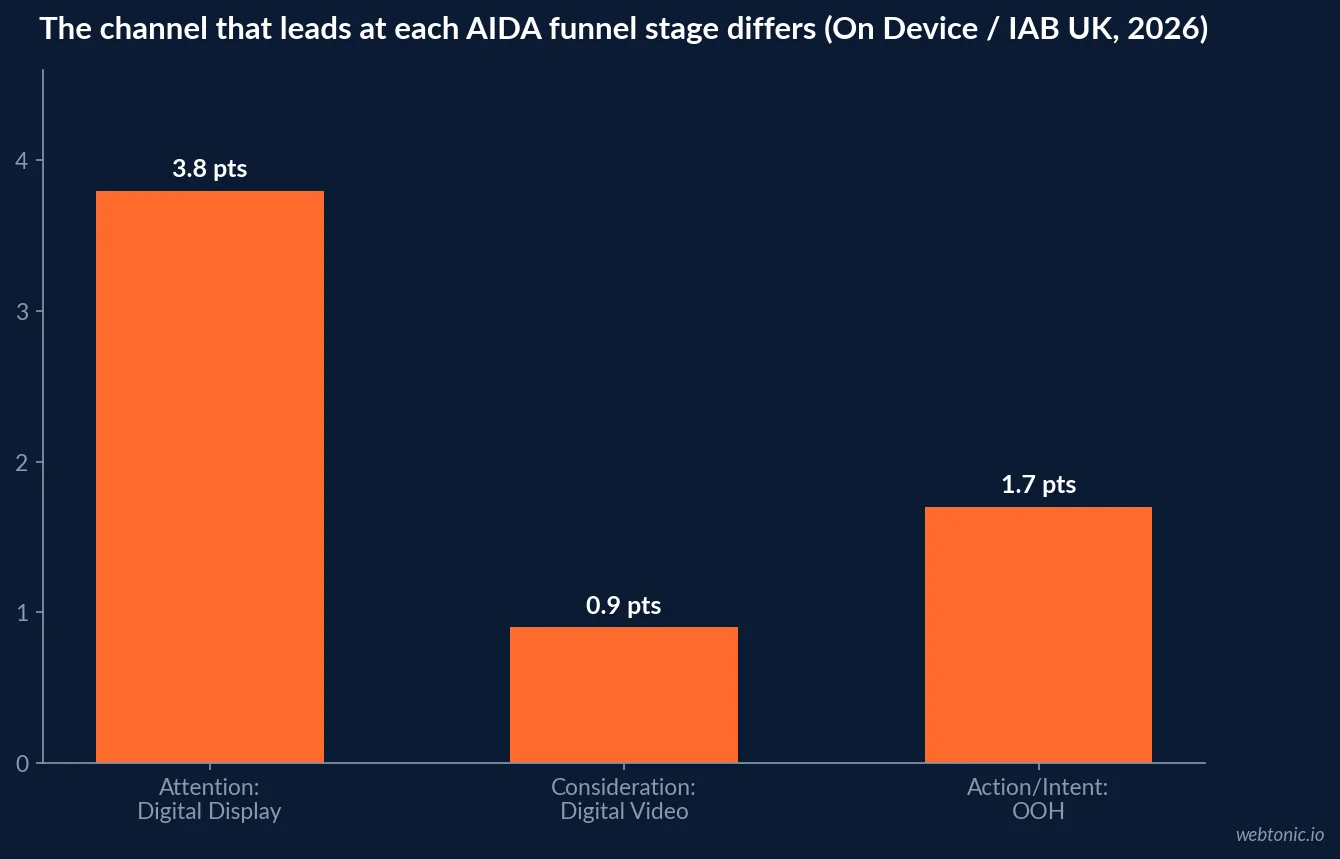
- Digital Display delivers the strongest Attention/Awareness uplift, at 3.8 percentage points.
- Consideration is now the hardest AIDA stage to move across every channel tested.
- The strongest Consideration performer, Digital Video, moves it only 0.9 points.
- OOH delivers the strongest Action/Intent uplift, 1.7 percentage points, beating every other channel by at least a full point.
- Digital Display shows no measurable movement on intent despite leading on awareness.
- OOH is the only channel to perform strongly at both the Attention and Action ends of the funnel.
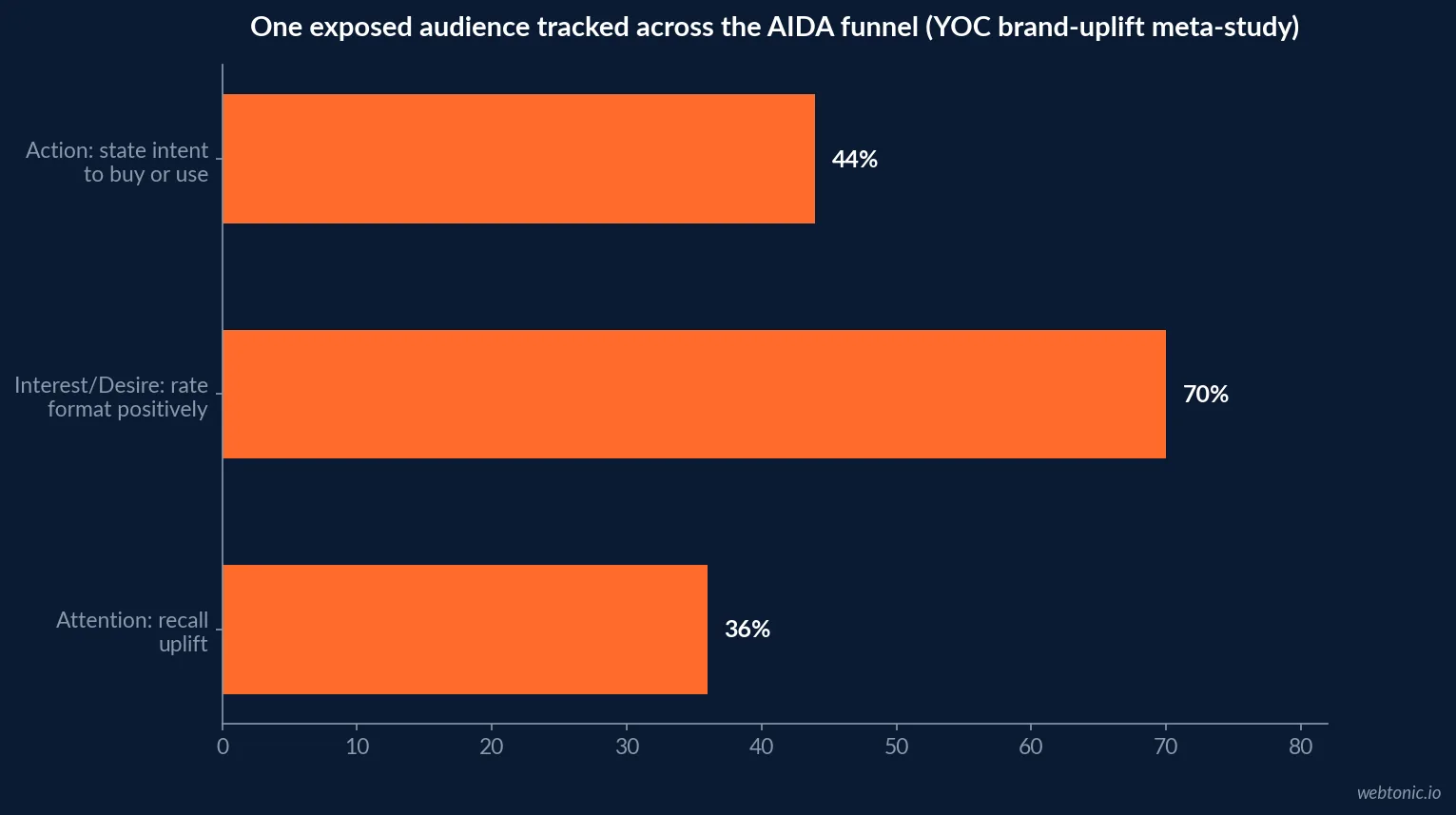
- YOC's meta-study found an average recall uplift of 36% in the Attention phase.
- Roughly 70% of people exposed rated the format positively in the Interest/Desire phase.
- 44% of people exposed stated they wanted to buy or use the product in the Action phase.
- DISQO's benchmark spans roughly 1,700 campaigns and 17 lift metrics.
- For consumable categories, DISQO measured purchase intent up 2.44 points and favorability up 3.05 points.
- For durable-goods categories, category e-commerce activity rose 2.05 points and competitive search rose 0.64 points.
- Across DISQO's broader normative database, unaided awareness moves only 0.30 points on a typical campaign, the hardest brand metric to shift.
- Brand favorability moves about 3 points on a typical campaign, the biggest mover among attitude metrics.
Attention: still the easiest stage to buy, still the shallowest one
On Device's State of Brand Lift in 2026, built for IAB UK from 650 passively-measured Brand Lift studies across five media groupings (Digital Video, Digital Audio, Digital Display, TV and OOH), found Digital Display delivers the strongest Awareness uplift measured, 3.8 percentage points, with every channel group performing "strongly" at this stage. That confirms the oldest AIDA assumption — Attention is buyable at scale — but the same study is explicit that Digital Display's strength stops there: it shows no measurable movement on intent at all.
YOC's cross-brand meta-study of high-impact ad formats found a similar Attention-stage result from a different angle: an average recall uplift of about 36% among people exposed, evidence that visually dominant formats are memorable even when they are not yet persuasive.
| AIDA stage | Best-performing channel | Uplift | Source |
|---|---|---|---|
| Attention (Awareness) | Digital Display | +3.8 percentage points | On Device / IAB UK, 2026 |
| Interest/Desire (Consideration) | Digital Video | +0.9 percentage points | On Device / IAB UK, 2026 |
| Action (Intent) | OOH | +1.7 percentage points | On Device / IAB UK, 2026 |
| Attention (recall) | High-impact formats, all types | +36% recall uplift | YOC meta-study |
Interest and Desire: the stage advertising is worst at moving right now
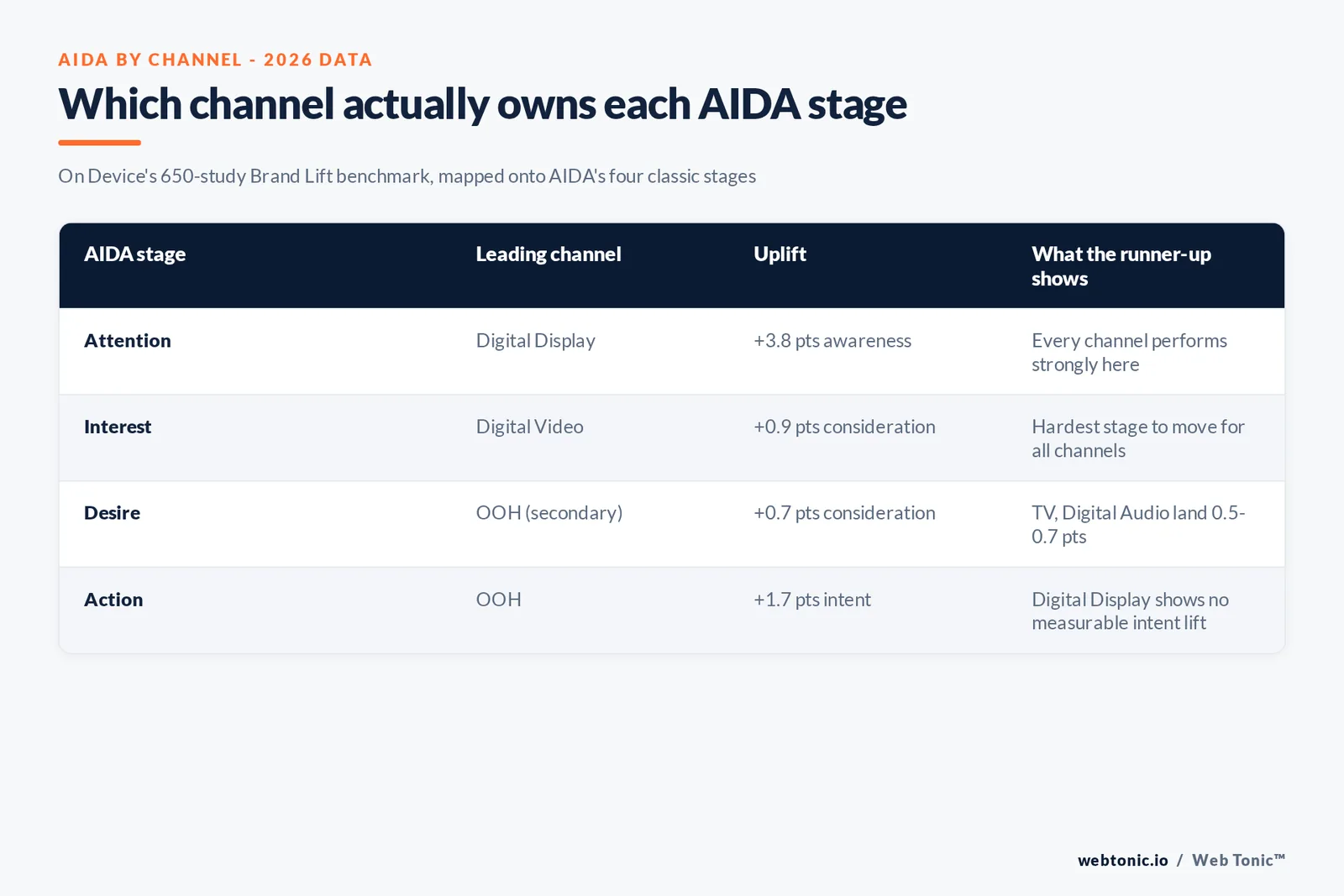
On Device's report is unusually direct about the middle of the funnel: Consideration is now the hardest metric to shift for every media channel tested. Even the best performer, Digital Video, only moves it 0.9 percentage points, with OOH close behind at 0.7 points and TV and Digital Audio landing in a 0.5 to 0.7 point range. That is a structural gap, not a channel-selection problem: no format in this benchmark reliably converts Attention into the kind of active brand consideration that AIDA's "Interest" and "Desire" stages describe.
YOC's meta-study offers a more optimistic read on the same stage when the format is high-impact specifically: roughly 70% of people who came into contact with a high-impact format rated it positively. The gap between On Device's cross-market benchmark and YOC's high-impact-format result is itself a finding — format quality matters more at this stage of AIDA than at Attention, where volume alone moves the needle.
| Channel | Consideration uplift (percentage points) | Source |
|---|---|---|
| Digital Video | 0.9 (strongest) | On Device / IAB UK, 2026 |
| OOH | 0.7 | On Device / IAB UK, 2026 |
| TV | 0.5-0.7 (range) | On Device / IAB UK, 2026 |
| Digital Audio | 0.5-0.7 (range) | On Device / IAB UK, 2026 |
| High-impact formats (any channel) | ~70% rate positively | YOC meta-study |
Action: where OOH is the outlier and Digital Display goes quiet
On the Action stage, On Device's data names a clear leader: OOH delivers the strongest lower-funnel intent uplift measured, 1.7 percentage points, beating every other channel group by at least a full percentage point, and it is the only channel in the study to perform strongly at both the Attention and Action ends of the funnel simultaneously. Digital Display, the Attention-stage leader, shows the opposite pattern: strong recall, no measurable intent movement at all.
YOC's meta-study measured Action even more directly: 44% of people exposed to a high-impact format stated they wanted to buy or use the product, on the same audience whose recall and consideration were tracked earlier in the same study. That closes the AIDA loop on a single cohort rather than assuming Attention gains automatically compound into Action.
| Category type (DISQO, ~1,700 campaigns) | Metric | Lift |
|---|---|---|
| Consumables | Ad Awareness | +0.93 points |
| Consumables | Favorability | +3.05 points |
| Consumables | Purchase Intent | +2.44 points |
| Durable goods | Unaided Awareness | +0.51 points |
| Durable goods | Category Site Visitation | +0.96 points |
| Durable goods | Category E-commerce Activity | +2.05 points |
| Durable goods | Competitive Search | +0.64 points |
Category changes which AIDA stage is actually reachable
DISQO's benchmark work, drawn from more than 1,700 campaigns and 17 lift metrics, shows the AIDA path is not the same shape for every category. Consumable goods over-index on attitude: favorability up 3.05 points and purchase intent up 2.44 points, which makes sense given consumables are typically bought in-store off top-of-mind recall rather than researched online. Durable goods over-index on measurable behavior instead: category e-commerce activity up 2.05 points and competitive search up 0.64 points, evidence that Desire is translating into active research rather than an immediate purchase decision.
DISQO's broader normative database also confirms which metrics resist movement across the board: unaided awareness moves only 0.30 points on a typical campaign, the hardest brand metric in the dataset to shift, while brand favorability moves about 3 points, the largest mover among attitude metrics measured.
Attention itself is not one number, and it does not guarantee lift
The Advertising Research Foundation's Phase 3 Attention Measurement Validation Initiative, released in June 2026 and analyzing four national campaigns across TV, online video, social and digital display, found television and online video consistently generated higher attention than social media and digital display across every measurement approach tested. That is a second, independent confirmation of the Attention-stage channel hierarchy On Device and YOC each measure differently.
The ARF study's more important finding for AIDA planning is a warning against assuming the funnel is linear: it found no simple one-to-one relationship between attention and upper-funnel brand lift. Lower-attention channels sometimes produced meaningful recall gains when they carried enough media weight and frequency, while higher-attention channels did not always produce the strongest lift on their own. Attention should be read alongside impression volume, not as a standalone proxy for Awareness.
| ARF Phase 3 finding (June 2026, 4 national campaigns) | Takeaway for AIDA planning |
|---|---|
| TV and online video generate higher attention than social/display | Confirms the Attention hierarchy via a second, independent method |
| No simple one-to-one link between attention and brand lift | Attention is not a stand-alone proxy for Awareness gains |
| Lower-attention channels can still deliver recall with enough weight | Reach and frequency still matter alongside attention scores |
| Attention measures align less at the placement level than the channel level | Compare channels broadly before comparing specific placements |
The narrowest Action metric of all: the click itself
Brand lift measures intent, but search advertising still measures Action as a literal click. WordStream by LocaliQ's 2026 benchmark report, its 10th edition and drawn from over 13,000 search campaigns across 23 industries, puts the average Google Ads click-through rate at 6.64% in 2026, with Arts and Entertainment leading at 12.75% and Automotive repair and service trailing at 5.56%. That range, more than double between the best and worst category, is a category effect on the Action stage almost as large as the channel effects On Device measured for Intent.
Read alongside On Device's finding that Digital Display leads Attention but shows no measurable Intent movement, WordStream's data is a reminder that a search ad's "click" and a display ad's "brand lift intent" are measuring different points on the same AIDA curve, and a campaign optimized for one will not automatically perform on the other.
| Search-ad Action metric (WordStream by LocaliQ, 2026, 13,000+ campaigns) | Figure |
|---|---|
| Average click-through rate, all industries | 6.64% |
| Highest-CTR category: Arts and Entertainment | 12.75% |
| Lowest-CTR category: Automotive repair and service | 5.56% |
| Average conversion rate, all industries | 8.18% |
What this means for planning against AIDA in 2026
The consistent thread across On Device, YOC and DISQO is that Attention is now a commodity and Action is a specialty: broad-reach formats reliably buy recall, but converting that recall into consideration and then intent takes a channel or format matched to the specific stage, not more of the same media that won Attention. Planning a full AIDA path in 2026 means budgeting a genuine Attention channel like Digital Display, a genuine Consideration channel like Digital Video, and a genuine Action channel like OOH, rather than assuming one format can carry all four stages on volume alone.
Our performance creative team builds format-specific creative for each stage of a funnel like this rather than resizing one asset across channels, and our data and analytics practice instruments the handoff between stages so a campaign's Attention spend can be measured against its own Action outcome. For the paid- social side of the Interest stage specifically, see our analysis of whether Facebook ads are worth it in the current environment.
Frequently Asked Questions
Which AIDA stage is hardest to move with advertising in 2026?
Consideration, which sits between Interest and Desire in AIDA terms. On Device's benchmark analysis of 650 passively-measured Brand Lift studies for IAB UK found consideration is now the hardest metric to shift across every one of the five media channels it tracks, with the strongest performer, Digital Video, moving it only 0.9 percentage points.
Which channel drives Attention (Awareness) best?
Digital Display, per the same On Device benchmark: it delivered the strongest awareness uplift measured in the report, 3.8 percentage points, ahead of every other channel group tested. The same study found Digital Display showed no measurable movement on intent, which is the report's clearest illustration that a channel built for Attention is not automatically built for Action.
Which channel actually drives Action (purchase intent)?
Out-of-home. On Device's data shows OOH delivering the strongest lower-funnel intent uplift measured, 1.7 percentage points, outperforming every other channel by at least a full percentage point, and it is the only channel in the study to perform strongly at both the Attention and Action ends of the funnel simultaneously.
Do high-impact ad formats move people all the way to a stated intent to buy?
YOC's cross-brand meta-study of high-impact formats found an average recall uplift of about 36% in the awareness phase, roughly 70% of people who saw the format rated it positively in the consideration phase, and 44% of people exposed stated they wanted to buy or use the product in the action phase. That is a full AIDA-style funnel measured on the same exposed group, not four separate studies stitched together.
Does category matter for which AIDA stage responds best?
Yes, per DISQO's benchmark work across roughly 1,700 campaigns. Consumable categories over-index on attitude shifts, purchase intent up 2.44 points and favorability up 3.05 points in DISQO's data, while durable goods categories over-index on behavior, with category e-commerce activity up 2.05 points and competitive search up 0.64 points. The Attention-to-Action path is not the same shape for every product type.
Sources
IAB UK / On Device - The State of Brand Lift in 2026
On Device - The State of Brand Lift in 2026 (full benchmark report PDF)
YOC - Brand Uplift meta-study
DISQO - A marketer's guide to advertising industry benchmarks
DISQO - Industry-level differences in brand lift and outcomes lift
WordStream by LocaliQ - 2026 Google Ads Benchmarks
Advertising Research Foundation - Phase 3 Attention Measurement Validation Initiative (2026)