Table of contents
An AI marketing advisory is a short, diagnostic engagement that decides which parts of your marketing are ready for AI, which are not, and in what order to fix that. It is a readiness and sequencing exercise, not a tool purchase.
Almost every team has already bought AI. Very few can say what it changed. This page explains what the engagement contains, what an AI readiness assessment actually inspects, and the honest signals that you need one rather than another subscription.
Key Takeaways
- 87% of marketers use generative AI in at least one recurring workflow, up from 51% in 2024 — adoption is no longer a differentiator.
- Gartner's 2026 CMO Spend Survey found CMOs allocate 15.3% of marketing budgets to AI, yet only 30% report mature AI readiness.
- 88% of B2B leaders say AI is part of their marketing strategy, but only 21% are very confident they use it effectively.
- The CMO Survey measures AI performing a mean 24.2% of marketing activities — real, but far from the automation narrative.
- An advisory engagement is scoped in 2 to 4 weeks and produces a decision list, not a demo.
- The single most common blocker is data: only 21% of organisations call their CRM data AI-ready.
What an AI marketing advisory actually contains
The deliverable is a set of decisions with evidence attached. Everything below is an artifact you keep after the engagement ends, which is the test of whether an advisory was real work or a slide deck.
| Deliverable | What it contains | What it prevents |
|---|---|---|
| Readiness assessment | Scored state of data, workflows, governance, skills and measurement | Buying a tool your data cannot feed |
| Use-case shortlist | 6–10 candidate workflows ranked by hours saved and risk | Pilots chosen by whoever is loudest |
| Data remediation list | Named fields, duplicates, consent gaps, owners and dates | Confident output built on bad inputs |
| Governance rules | Approval path, disclosure policy, prohibited inputs, review cadence | Legal and brand exposure discovered publicly |
| Measurement plan | Baseline hours and quality scores per workflow before rollout | An unfalsifiable claim that AI helped |
| Sequenced roadmap | What to run in weeks 1–4, 5–12 and quarter two, with owners | Twelve simultaneous pilots and no conclusions |
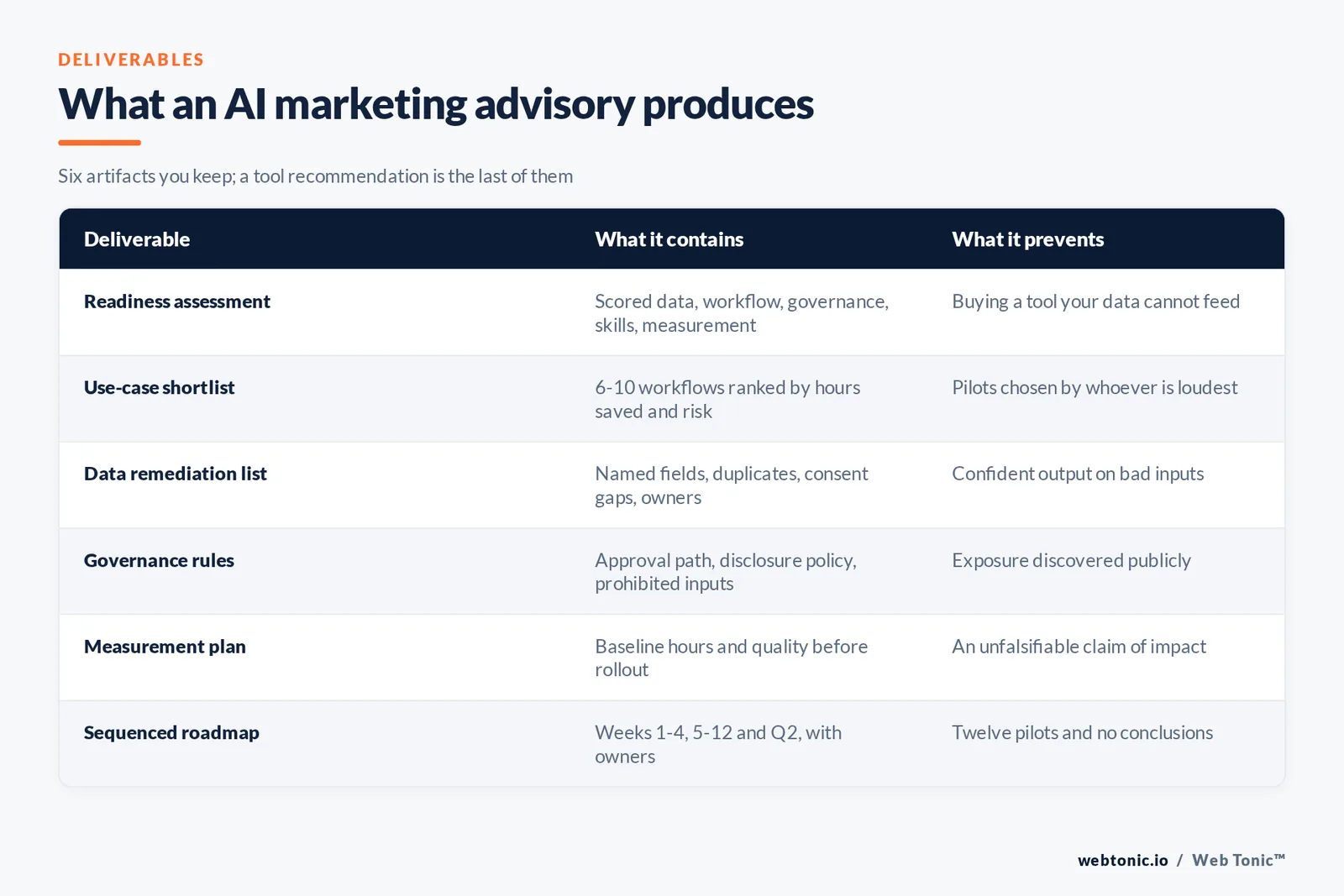
Notice what is absent: a tool recommendation on day one. Vendor selection is the last step, because the shortlist depends on which workflows survive the readiness scoring. A serious engagement should be able to end with "do nothing new this quarter, fix these four data problems first" — and often does.
The gap the engagement closes
The numbers on adoption and the numbers on effectiveness no longer describe the same reality. Digital Applied's 2026 compilation puts generative AI use at 87% of marketers in at least one workflow, up from 51% in 2024. Stripo's research summary pairs that with McKinsey's figure of 88% regular organisational AI use.
Confidence has not followed. StudioNorth's AI Readiness Report found 88% of B2B leaders saying AI is now part of their marketing strategy while only 21% feel very confident they are using it effectively. The 2026 Gartner CMO Spend Survey of 401 CMOs is blunter: 70% call becoming an AI leader a critical 2026 goal, 15.3% of budget is already committed, and only 30% report mature or fully developed readiness.
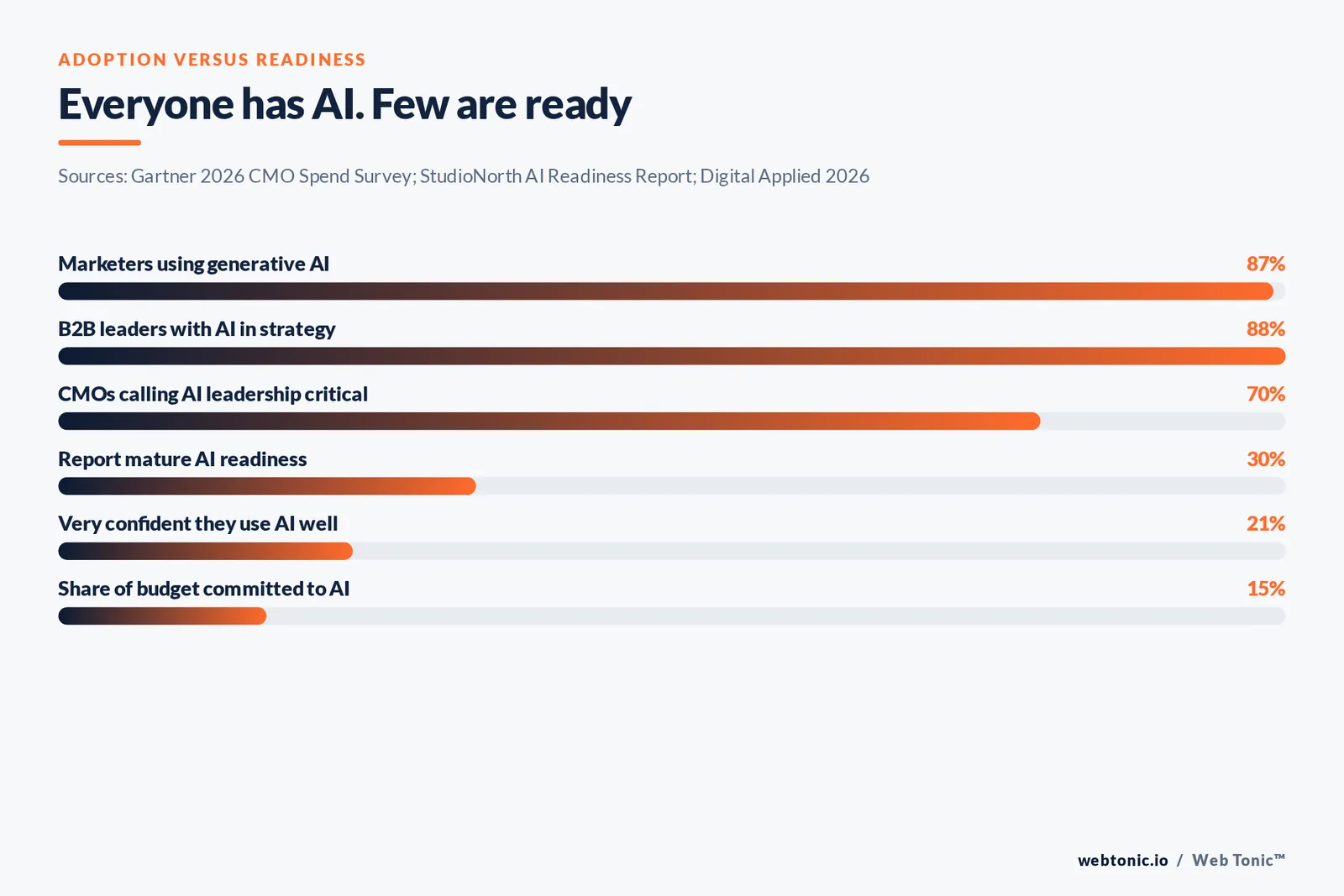
Depth is the other half of the story. The CMO Survey data, drawn from 308 US marketing leaders, shows AI performing a mean 24.2% of marketing activities and generative AI a mean 22.4% — with leaders projecting well over half within three years. Meanwhile the MMA and EY AI Marketing Maturity Study reports that 84–88% of adopters already see medium to high business impact. Both things are true: the teams with impact are the ones that fixed the plumbing first, and the advisory exists to tell you which group you are in.
What an AI readiness assessment inspects
Readiness is not a single score. Five layers move on different timelines, and a weak layer three makes any spend on layer one wasted.
| Layer | The question it answers | Typical failure found |
|---|---|---|
| Data | Is customer and performance data complete, deduplicated and permissioned? | Only 21% call CRM data AI-ready |
| Workflow | Which repeated tasks are documented enough to automate? | The process only exists in one person's head |
| Measurement | Do we have a pre-AI baseline to compare against? | No hour or quality baseline was ever recorded |
| Governance | Who approves output, and what inputs are prohibited? | No named owner, no disclosure rule |
| Skills | Can the team edit and reject AI output competently? | Tool access granted, judgement never trained |
| Economics | What is the fully loaded cost per workflow, including review time? | Licence cost counted, editing hours ignored |
The economics row is the one clients underestimate most often. An output that needs 40 minutes of expert correction is not a 90% time saving, and the assessment forces that arithmetic into the open. Our data intelligence practice handles the plumbing side of the same problem when the diagnosis points there.
When you actually need one
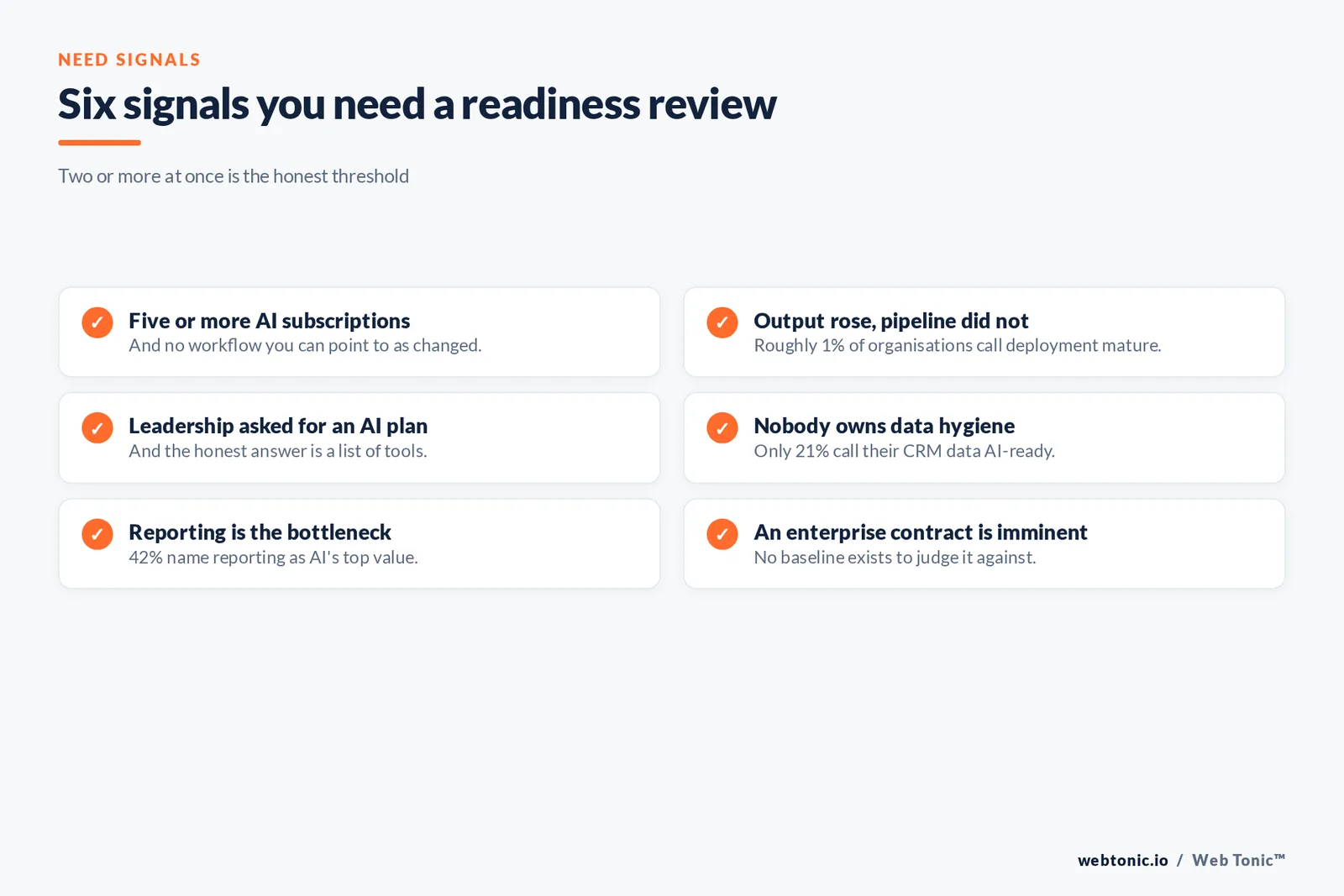
Two or more of these at once is the honest threshold. One on its own is usually a project, not an advisory.
- You have 5+ AI subscriptions and cannot say which one changed an outcome.
- Output volume rose but pipeline did not — a pattern visible across B2B AI adoption data, where roughly 1% of organisations describe deployment as mature.
- Leadership has asked for an AI plan and the honest answer is a list of tools.
- Nobody owns data hygiene, so every AI answer inherits the same errors.
- Reporting is the bottleneck: AgencyAnalytics' 2026 benchmarks found 42% of teams name reporting as AI's top value while 47% still cannot attribute multi-session journeys.
- You are about to sign an enterprise AI contract without a baseline to judge it against.
When you do not need one
If your constraint is capacity on a single known task — writing more variants, resizing more creative, tagging more assets — buy the tool and measure it. An advisory is for the case where the constraint is unclear or where the answer must survive scrutiny from a board or a buyer.
Equally, if you have fewer than roughly a dozen repeated marketing workflows, the assessment will be short and you may be better served by a single working session. Skip the diagnosis when you already know the answer; commission it when the disagreement inside the room is about facts rather than preferences.
What the first 90 days should produce
A readiness engagement that ends without a changed operating routine has failed, whatever the deck says. The sequence that works is unglamorous: baseline, fix, then automate.
| Window | What exists at the end of it | Signal it went wrong |
|---|---|---|
| Weeks 1–2 | Workflow inventory with hours per task and an owner per task | Access still incomplete |
| Weeks 3–4 | Scored readiness by layer plus a written data remediation list | Scores with no evidence behind them |
| Weeks 5–8 | Two or three pilots running against a recorded baseline | Ten pilots, no baseline |
| Weeks 9–12 | Keep, kill or expand decision per pilot, in writing | Everything is "promising" |
| Handover | Governance rules and prompts documented for the team | Knowledge leaves with the consultant |

Two or three pilots is deliberate. State of AI Marketing 2026 reports enterprise adoption at 87% with average AI budget share reaching 18%, up from 11% a year earlier — plenty of spend, and the teams that convert it into results run fewer, better-instrumented tests. Adoption trajectory data shows a 36-percentage-point swing in two years, so the competitive advantage has moved from having AI to governing it.
What it costs and how engagements are shaped
Advisory work in this category is normally sold as a fixed-scope diagnostic rather than an open retainer, because the output is a finite set of decisions. Market shape matters more than any single number: the fee should be small relative to what it stops you from spending. A team about to commit the 15.3% of budget Gartner records as the 2026 AI allocation is deciding on a large number, and the assessment exists to make that decision falsifiable.
Three engagement shapes cover almost every case. A 2-week readiness sprint suits a single marketing team with one CRM and one ad platform: inventory, scoring, remediation list, stop. A 4-week assessment adds pilot design and a governance policy, which is the right shape when procurement or legal must sign off. A quarterly advisory cadence only makes sense after the first assessment, and only when the roadmap has more than 10 workflows queued behind it — otherwise you are paying for meetings.
Beware of the fourth shape: an assessment bundled free into a tool purchase. Survey work across 2,140 marketing professionals in 14 countries shows how crowded the vendor field has become, and a diagnosis whose conclusion is fixed in advance is worth exactly what you paid for it. Independence is the product.
Choosing between the advisory options in front of you
Most buyers are choosing between four things at once, and the labels overlap badly. Sorting them by the question each one answers ends the confusion faster than comparing proposals line by line.
| Option | Best when | Wrong when |
|---|---|---|
| AI readiness assessment | You must decide whether to spend, and on what, with evidence | The constraint is one known, documented task |
| AI implementation project | Readiness is already scored and two pilots are chosen | Data ownership and consent are unresolved |
| Marketing operations consulting | The plumbing, not the intelligence layer, is the bottleneck | Processes are clean and the question is genuinely about AI |
| Fractional marketing leadership | You need someone to own the decisions for two or three quarters | You need one answer, once, in writing |
The overlap between rows one and three is the most common mistake we see. If reporting takes days and nobody agrees on the definition of a qualified lead, an AI project will industrialise that disagreement at speed. Fix definitions and ownership first; the tooling decision gets easier and cheaper afterwards.
How this differs from buying more AI tools
A tool answers "can this task be done faster". An advisory answers "which tasks should exist at all, and what has to be true before software touches them". The second question is where the money is, because it removes work rather than accelerating it.
Web Tonic runs this as a fixed-scope diagnostic before any build work: readiness scoring, a remediation list, and a sequenced roadmap your team can execute without us. That deliberate order — diagnose, fix data, then automate — is what our AI marketing advisory is built around, and it is why we will happily tell a client to postpone a purchase. If the diagnosis points at execution capacity instead, growth marketing and performance creative pick it up from there, and you can talk to us about which door you need. More background reading sits on the Web Tonic blog.
Related reading
- Marketing Team Structure & Hiring Advisory: what it is and when you actually need one
- Growth Advisory / Growth Consulting: what it is and when you actually need one
- EOS / Scorecard & KPI Advisory: what it is and when you actually need one
- Marketing Strategy Consulting services at Web Tonic
Frequently Asked Questions
How long does an AI readiness assessment take?
Two to four weeks for a marketing function with a normal stack. The variable is access: if CRM, ad platform and analytics access takes ten days to arrange, the calendar stretches while the work does not.
Is this the same as an AI strategy deck?
No. A strategy deck describes an intent; a readiness assessment scores current state against evidence and names the fields, workflows and owners that must change. If there is no remediation list with dates, it is a deck.
What if our data is a mess?
That is the most common finding and it is useful, not embarrassing. Only 21% of organisations describe their CRM data as AI-ready, so the remediation list usually becomes the first phase of work and any tool decision waits behind it.
Can we run the assessment ourselves?
Yes, and small teams often should. The two things internal teams struggle with are neutrality — scoring a workflow you personally built — and the baseline discipline of recording hours and quality before any change.
How do we know whether it worked?
By the baseline. Hours per workflow, rework rate, output acceptance rate and cost per completed task, measured before the pilot and again at 90 days. Without those four numbers, any claim about AI impact is unfalsifiable.
Sources: Digital Applied, AI Marketing Statistics 2026 · Stripo Research, Generative AI in Marketing 2026 · StudioNorth, AI Readiness Report 2025–2026 · Gartner 2026 CMO Spend Survey (press release) · The CMO Survey 2026 data via Christoph Olivier Consulting · MMA and EY, AI Marketing Maturity Study 2026 · AgencyAnalytics, Agency Benchmarks 2026 · Emulent, State of AI Adoption in B2B Marketing 2026 · State of AI Marketing 2026 · AI Stratagems, AI Marketing Statistics 2026.