Table of contents

AI marketing advisory prices split by tier, not by technology. Independents, boutiques and large firms sit in bands that barely overlap, and the deliverable changes with each one.
Key Takeaways
- Hourly rates run roughly $150–$350 for independents, $300–$600 for boutiques and $500–$1,000+ at the largest firms, with a market median near $250–$275.
- Retainers cluster at $3,000–$15,000 a month for most mid-market work, extending to $5,000–$25,000 for full-scope agency engagements.
- Fixed-scope assessments are the cheapest honest entry point: $1,000–$5,000 for a readiness or workflow audit, rising to $3,500-plus for structured rate-card versions.
- Implementation projects run $5,000–$50,000 for scoped builds and $50,000–$250,000 for production systems; large-consultancy programmes start far higher.
- Rates stabilised after the 2024–2025 spike, with the remaining premium attached to strategic and specialised work rather than to AI generally.
- The gap that justifies the spend is readiness, not adoption: about 87% of marketers use generative AI while only around 30% of organisations have the maturity to scale it, and CMOs now allocate 15.3% of budget to AI.
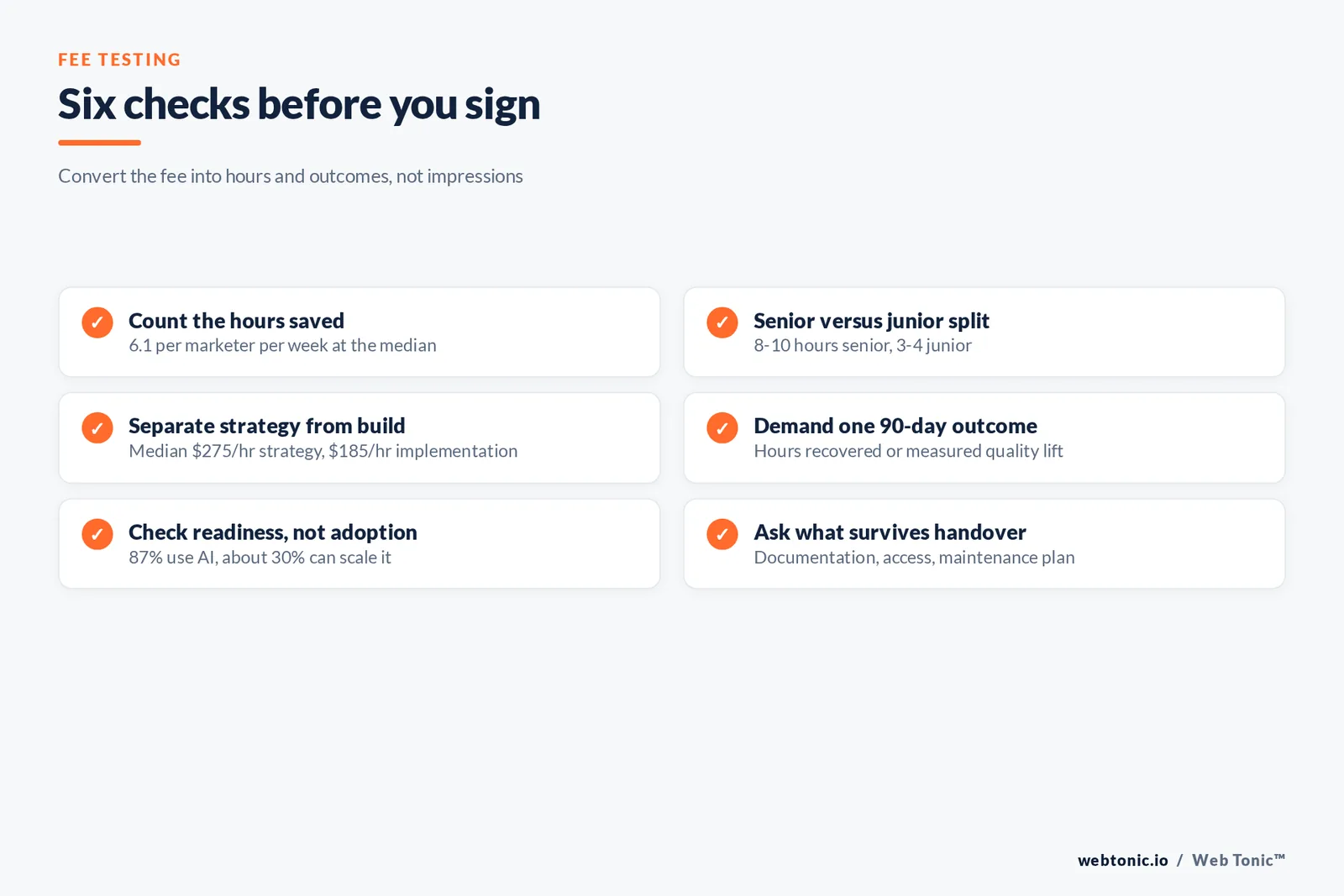
- Savings are measurable. Median reported saving is 6.1 hours per marketer per week — 8–10 for senior staff, 3–4 for junior — which is the number a fee should be tested against.
The four pricing models in use
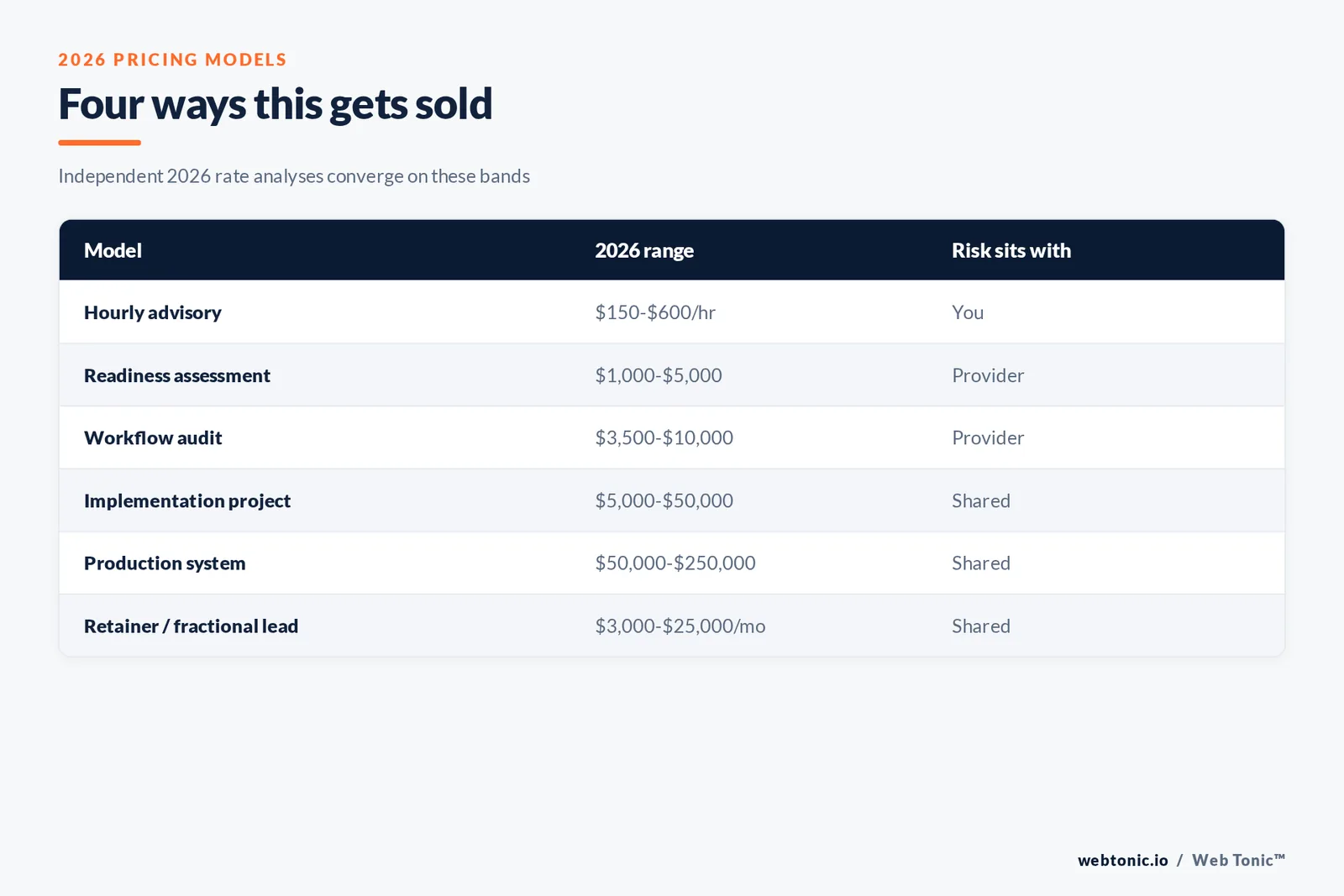
Every quote you receive will be one of four shapes: hourly, fixed-scope assessment, implementation project, or monthly retainer. The shape tells you more about the risk you are carrying than the rate does. Hourly transfers all scope risk to you; fixed-scope transfers it to the provider; retainers split it and require a defined backlog to stay honest.
The tiering is consistent across independent 2026 analyses. One pricing breakdown puts independents at $150–$350 an hour, boutiques at $300–$600 and top-tier strategy firms at $500–$1,000+, with fixed-fee projects starting around $10,000. A 2026 cost analysis spans $80–$600 an hour across the same tiers and adds day rates of $600–$1,200 for freelancers and $1,500–$2,500 for agencies.
| Model | 2026 market range | What you get | Risk sits with |
|---|---|---|---|
| Hourly advisory | $150–$600/hr | Architecture review, tool selection, escalation | You |
| Readiness assessment | $1,000–$5,000 | Written maturity read plus ranked use cases | Provider |
| Workflow audit | $3,500–$10,000 | Process mapping, automation candidates, ROI estimate | Provider |
| Implementation project | $5,000–$50,000 | One or two workflows built, tested, documented | Shared |
| Production system | $50,000–$250,000 | Integrated, monitored systems with governance | Shared |
| Retainer / fractional lead | $3,000–$25,000/mo | Ongoing roadmap ownership and enablement | Shared |
What the retainer bands actually buy
Retainer quotes vary most, because "ongoing AI advisory" covers everything from a monthly call to a team building systems. One 2026 practitioner guide puts the sensible expectation at $3,000–$15,000 a month, or $5,000–$25,000 for a scoped project, tiering independents at $150–$350 an hour against boutique firms at $200–$450. A buyer-side comparison puts freelance practitioners at $150–$300 an hour, boutique agencies at $5,000–$25,000 a month, and project implementations at $10,000–$50,000.
Two useful reference points at the ends of the range. US hiring guidance reports consultants charging $3,500–$9,000 a month for founders under $2M revenue, typically covering 15–25 hours of hands-on work plus strategy oversight — and warns that a flat "AI marketing package" under $1,500 a month is unlikely to contain real senior time. A 2026 rate analysis puts small-business-focused consultants at $150–$300 an hour, fixed-scope assessments at $1,000–$5,000, implementation at $5,000–$50,000 and retainers at $2,000–$10,000 a month.
Why rates settled instead of climbing
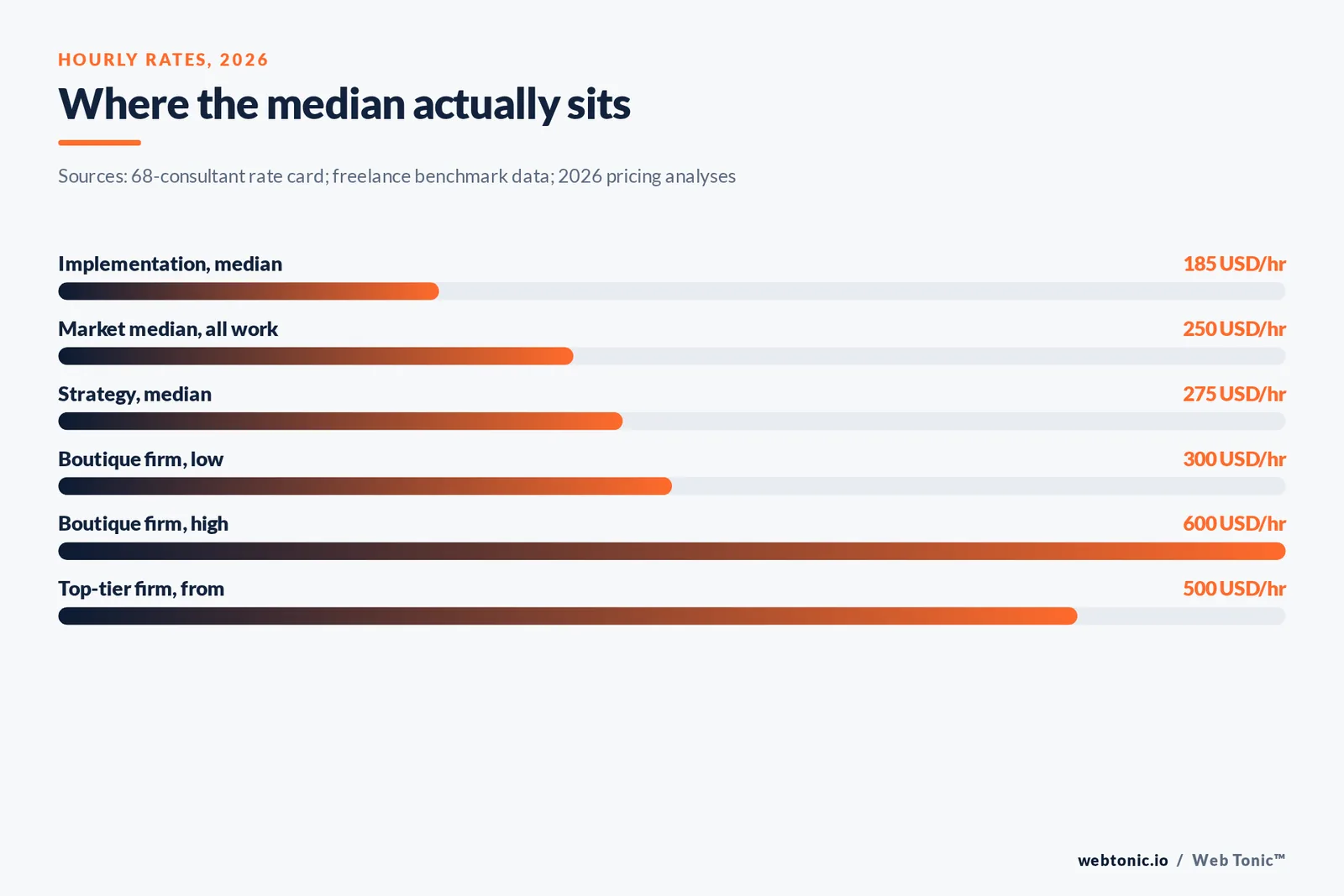
The interesting 2026 development is stabilisation. Freelance benchmark data puts the median AI consulting rate near $250 an hour, ranging from $150 for generalist work to $500+ for C-suite advisory, and reports that rates stabilised after the 2024–2025 spike with the largest premiums now attached to strategic and specialised work. A rate card built from 68 consultants puts the median at $275 an hour for strategy and $185 for implementation, with retainers at $4,000–$25,000 a month and projects from $3,500 for a workflow audit up to $85,000 for enterprise programmes.
That split — strategy above implementation — matters when you compare quotes. Paying a strategy rate for build hours is the most common way to overspend in this category, and paying an implementation rate for the decision about what to build is the most common way to buy the wrong system efficiently. Senior-market rate analysis frames the same structure: $150–$300 an hour for most senior US work, scoped projects mostly between $25,000 and $250,000, and fractional AI leadership at $4,000–$15,000 a month.
The gap that justifies the fee
Advisory is worth paying for when adoption has outrun capability, which is precisely the 2026 pattern. Readiness gap analysis reports CMOs allocating 15.3% of marketing budgets to AI while only about 30% of marketing organisations have the maturity to scale those capabilities, against adoption of roughly 87%. The money is already being spent; the advisory question is whether it is spent on capability or on subscriptions.
The savings side is now well benchmarked, which makes fee-testing straightforward. 2026 adoption and ROI data puts the average saving at 6.1 hours per marketer per week, with senior practitioners at 8–10 hours and junior staff at 3–4. On a five-person team at the median, that is roughly 30 recovered hours a week — worth testing against a $5,000 monthly retainer before signing it, and worth measuring afterwards rather than assuming.
| Price driver | Pushes the quote down | Pushes the quote up |
|---|---|---|
| Deliverable type | Written assessment and roadmap | Built, monitored production systems |
| Provider tier | Independent at $150–$350/hr | Large firm at $500–$1,000+/hr |
| Data condition | Clean, consolidated, documented | Fragmented sources, no governance |
| Governance needs | Internal use, low risk | Regulated content, brand and legal review |
| Enablement scope | Two or three power users | Whole department training and adoption tracking |
| Commitment | 6–12 month engagement | Short pilot with senior time only |
Budgeting a first year, stage by stage
Buying this category well is mostly about order. A defensible first-year shape for a mid-market marketing team is a readiness assessment at $1,000–$5,000, one scoped build of the highest-value workflow at $10,000–$25,000, then a light retainer at $3,000–$5,000 a month to embed adoption and add a second workflow only once the first is measurably in use. That sequence spends real money but never commits to a system before the readiness read exists.
The expensive alternative is familiar: sign a strategic retainer first, spend three months on discovery at senior rates, then discover the data layer cannot support the intended use case. At $300 an hour, discovery you could have bought as a $3,500 fixed-scope audit becomes a five-figure line item. The rule of thumb worth applying is that anything genuinely diagnostic should be bought at fixed price, and anything genuinely uncertain should be bought in the smallest increment that produces a decision.
Two costs belong in the budget beside the fee. Licences, because a real roadmap usually consolidates several tools and adds one; and internal time, since adoption is where these projects fail. A workflow nobody uses saves zero hours regardless of build quality, which is why enablement scope moves quotes as much as technical complexity does.
Where AI advisory ends and other work begins
Some problems arriving under this heading are not AI problems. If attribution is unreliable, no model output will fix the reporting; if the content pipeline has no brief standard, faster drafting produces faster mediocrity. A competent adviser separates those cases out early rather than selling a deployment against them — and the cheapest possible outcome of a readiness assessment is being told that a process fix comes first.
The reverse boundary matters too. Once a build is running, the ongoing need is usually operational rather than advisory: monitoring, prompt and model maintenance, quality review, and enablement for new staff. That work is priced closer to implementation than to strategy, and paying advisory rates for it indefinitely is a slow, quiet overspend. Agree at the start which of the three the retainer covers — decisions, builds, or maintenance — and re-scope it when the mix changes.
Provider types and what changes with each
Three provider types dominate. A single professional practitioner sells depth and speed, and is usually the best value for a first workflow. A boutique firm adds a small delivery team, integration engineering and documentation standards. Enterprise-grade consulting companies add governance, compliance review and the ability to run several client workstreams at once — real value in regulated categories, and overhead everywhere else.
Two scope items reliably move a quote regardless of provider. Integration depth is the first: connecting an agent or model to a CRM, a data warehouse and a content system is engineering work priced closer to implementation rates than to advisory rates. Compliance is the second: where output is regulated or brand-sensitive, review workflows, audit trails and human sign-off are part of the build, and a quote that omits them is not cheaper, only less finished.
What a fair quote contains
Rate cards are easy to compare and almost useless on their own. A quote worth accepting names the use cases in scope, the systems they touch, who does the building, what documentation is handed over, how adoption will be measured, and what happens to the workflows if the engagement ends. 2026 rate guidance separates generalist AI strategy at $200–$500 an hour from specialist technical work at $350–$800 and retained fractional leadership at $5,000–$20,000 a month — a useful check that you are not paying specialist rates for generalist deliverables.
Three specific red flags come up repeatedly in this category. A tool list presented as a strategy, with no workflow map underneath it. Prompt training sold as deployment, where nothing survives the workshop. And pilots priced at senior rates with no defined success condition, which convert into indefinite retainers by default. Ask for one measurable outcome per 90-day period, in hours saved or output quality, and the quote becomes testable.
Comparing two quotes properly
When two proposals differ by a wide margin, the difference is almost always in four places rather than in the rate: how many workflows are in scope, who builds them, whether documentation and handover are included, and whether enablement covers a few power users or the whole department. Line those four up side by side and most apparent price gaps collapse into scope gaps.
A practical way to force comparability is to ask every provider to price the same first deliverable — one named workflow, built, documented and measured — and to quote strategy hours and build hours separately. Whoever cannot do that is either not scoping seriously or is selling a retainer against an undefined backlog, which is the most common way this category becomes expensive without becoming useful.
How Web Tonic scopes it
We start with a bounded readiness read: what your data and workflows can actually support, which use cases pay back first, and what governance the output needs. Every recommendation names the workflow, the owner and the measurement — hours recovered or quality lift — before any build is priced, and we quote strategy and implementation separately so you never buy build hours at advisory rates. Where the honest answer is that a process fix beats an AI deployment, we say so in the report. Detail on the wider service sits under marketing strategy consulting and data intelligence; scoping conversations go through contact.

Frequently Asked Questions
What should a first engagement cost?
A fixed-scope readiness or workflow assessment at $1,000–$5,000, or $3,500-plus on structured rate cards, is the standard entry point. It prices everything that follows and is cheap enough to walk away from if the answer is that your data is not ready.
Are AI consulting rates still rising?
No. Benchmark data for 2026 puts the median near $250 an hour and reports rates stabilising after the 2024–2025 spike, with premiums concentrated in strategic and specialised work rather than in AI exposure generally.
How do we test whether a retainer pays for itself?
Convert it into hours. The median reported saving is 6.1 hours per marketer per week, 8–10 for senior staff. Multiply your team's realistic saving by loaded hourly cost, compare against the fee, then measure the actual figure at 90 days rather than assuming the benchmark.
Why do quotes differ by a factor of ten?
Because tier and deliverable both change. An independent writing a roadmap at $150–$350 an hour and a firm building monitored production systems at $500–$1,000+ an hour are selling different products. Compare deliverables first, rates second.
Should the same provider advise and implement?
Often yes, provided the two are priced separately and documentation plus admin access are deliverables rather than favours. What you want to avoid is paying strategy rates for build hours, or accepting a build nobody on your team can maintain after handover.
Sources
AI consulting pricing models 2026 · What AI consulting costs in 2026 · AI marketing consultant cost guide · AI marketing consulting buyer comparison · AI marketing consultant USA hiring guide · AI consultant cost, real rates · AI consulting rates freelance benchmarks · 2026 rate card from 68 consultants · Neuronify AI consulting rates · AI consulting rates 2026 · AI marketing readiness gap 2026 · AI marketing statistics 2026. More on our approach: Web Tonic blog.