Table of contents
The choice is not advisory versus a hire. It is whether the AI capability you need is a bounded build or a permanent job, because that single question decides which model wastes less money.
Key Takeaways
- An in-house AI marketing hire lands around $105,000–$180,000 in base pay in 2026, with a US median near $140,000 and disclosed job bands centring on $150,000–$203,000 at senior levels.
- Fully loaded, that hire costs roughly 1.25–1.4× base once payroll taxes near 7.65%, benefits at 30–35% of base and recruiting fees of 15–25% of first-year salary are added.
- Advisory sits at $150–$350 an hour for independents and $3,000–$12,000 a month on retainer, with scoped implementation projects at $5,000–$50,000.
- Speed differs by an order of magnitude: advisory is productive in 1–2 weeks, a new hire reaches full productivity in 3–6 months.
- Adoption is no longer the differentiator. Around 87% of marketers already use generative AI in at least one workflow, yet only about 41% of organisations can demonstrate ROI from it.
- The measurable prize is time: a median 6.1 hours saved per person per week, with generative AI embedded in recurring workflows at 87% of teams but full journey automation at only 9%.
- Most mid-market teams end up hybrid — advisory to design and prove, an internal owner to run — and that sequence costs less than either pure model done twice.

The two models, stated without the sales gloss
An AI marketing advisor is bought for judgement and architecture: which workflows are worth automating, which tools survive contact with your data, what governance stops a brand incident. An in-house AI marketing hire is bought for ownership: someone who lives inside the stack, absorbs institutional context and keeps the system running after the interesting part is finished.
Those are different products, and the honest comparison is not rate against salary. It is total cost against the shape of the need. One 2026 buyer comparison frames it plainly: an in-house hire builds capability that compounds but takes longer to reach productivity and costs more if the need turns out to be temporary. Bounded need, buy advisory. Permanent need, hire — and use advisory to define the role before you post it.
| Dimension | AI marketing advisory | In-house AI marketing hire |
|---|---|---|
| Cost shape | $150–$350/hr or $3,000–$12,000/mo, cancellable | $105,000–$180,000 base, plus 25–40% loading, fixed |
| Time to productive | 1–2 weeks | 3–6 months, plus 2–4 months to hire |
| Breadth of exposure | Dozens of stacks, so failure patterns are known | One stack, learned deeply |
| Knowledge retention | Only what documentation captures | Stays with the company |
| Exit cost | Notice period, typically 30 days | Severance, rehire, lost ramp |
| Main failure mode | Deck without deployment | A specialist with no mandate or budget |
What the in-house hire really costs
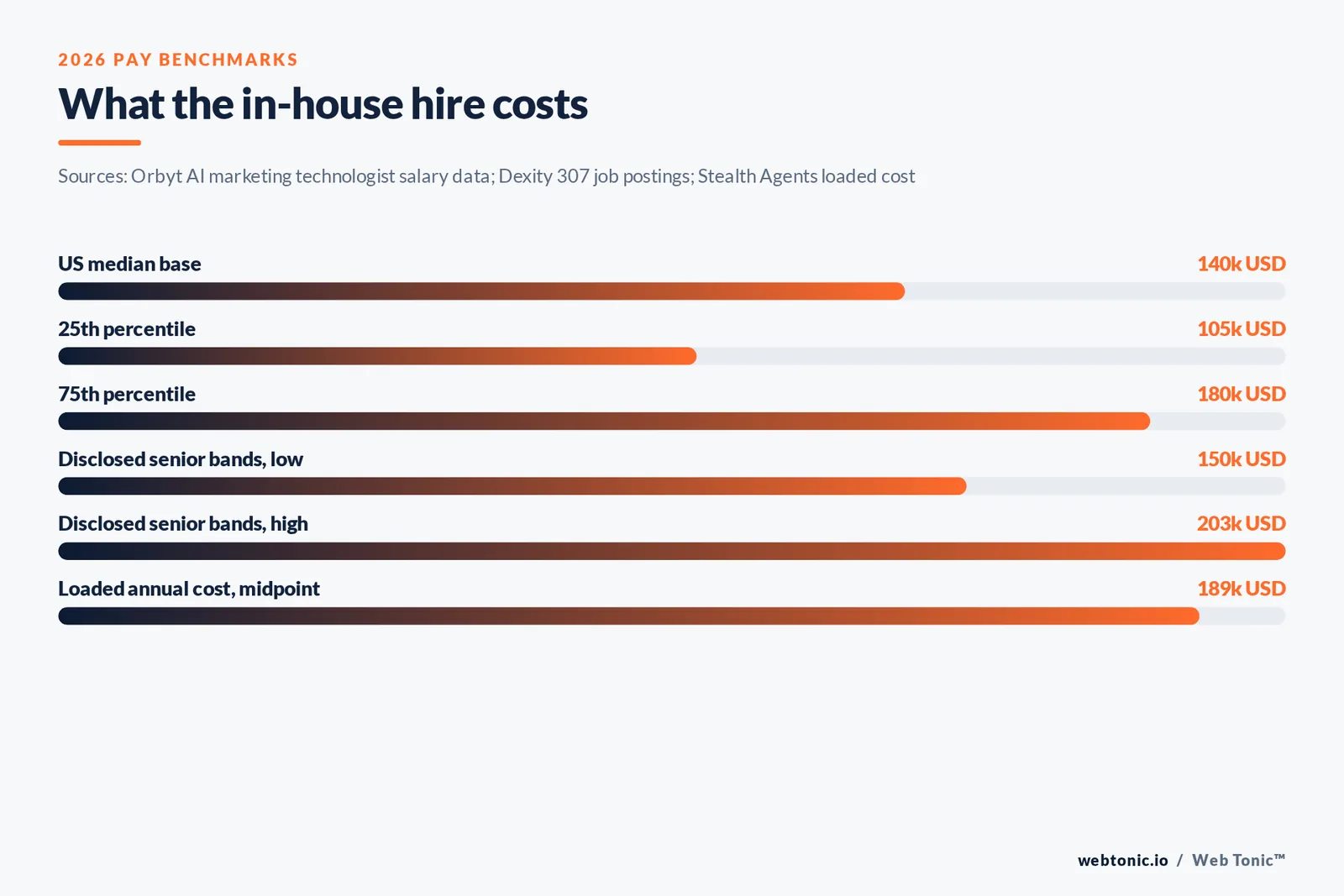
Salary benchmarks for AI-fluent marketing roles are unusually well documented for a job that barely existed three years ago. One multi-city dataset puts the US median at $140,000, with $105,000 at the 25th percentile and $180,000 at the 75th. An analysis of 307 live job postings found that 53% disclosed a band, and those bands centre on $150,000–$203,000, running from about $65,000 to $421,000 across levels. A 2026 salary guide calls the AI marketing manager the fastest-growing role by compensation, at $105,000–$155,000 mid-level and above $180,000 senior, with demand outpacing supply roughly 3:1. Regional medians add the geography premium: about $168,750 in the Bay Area against $128,250 for remote roles at legacy employers.
Then add the parts that never appear in the requisition. A 2026 cost-to-hire study of an adjacent role puts the fully loaded annual figure at $157,000–$221,000 once payroll taxes of 7.65%, benefits of 30–35% of base, recruiting fees of 15–25% of first-year salary and equipment are counted. On the AI role's midpoint, that loading turns a $140,000 salary into something closer to $180,000–$196,000 of committed annual spend — before tooling.
What advisory really costs
Advisory pricing splits by tier rather than by technology. A 2026 pricing breakdown puts independents at $150–$350 an hour, boutiques at $300–$600 and top-tier strategy firms at $500–$1,000+, with fixed-fee projects starting near $10,000. A practitioner guide puts typical consultant engagements at $3,000–$12,000 a month, with focused single-workflow rebuilds at the lower end. A model-by-model comparison lists freelance practitioners at $150–$300 an hour, boutique retainers at $5,000–$25,000 a month and scoped implementation projects at $10,000–$50,000.
Run the arithmetic honestly. A $7,500-a-month retainer is $90,000 a year — cheaper than the loaded hire, but only if the retainer has a defined backlog. An eight-week scoped build at $25,000 is roughly 17% of the loaded first-year cost of a hire, and it either ships or it does not, which is a cleaner test than a probation period.
The question that actually decides it
Both models fail for the same reason: nobody defined the work. The market data makes that failure visible. Adoption research shows 87% of marketers using generative AI in at least one workflow, up from 51% in 2024, so tool access is not the constraint. Operations benchmarks show why the results lag: generative AI appears in recurring workflows at 87% of teams, but only 9% have fully automated customer journeys, 59% are partially automated, and the median time saved is 6.1 hours per person per week. Survey data compiled from the CMO Survey is blunter still: AI performs a mean 24.2% of optimisation and automation effort, and generative AI is used a mean 22.4% of the time. Broad, but shallow.
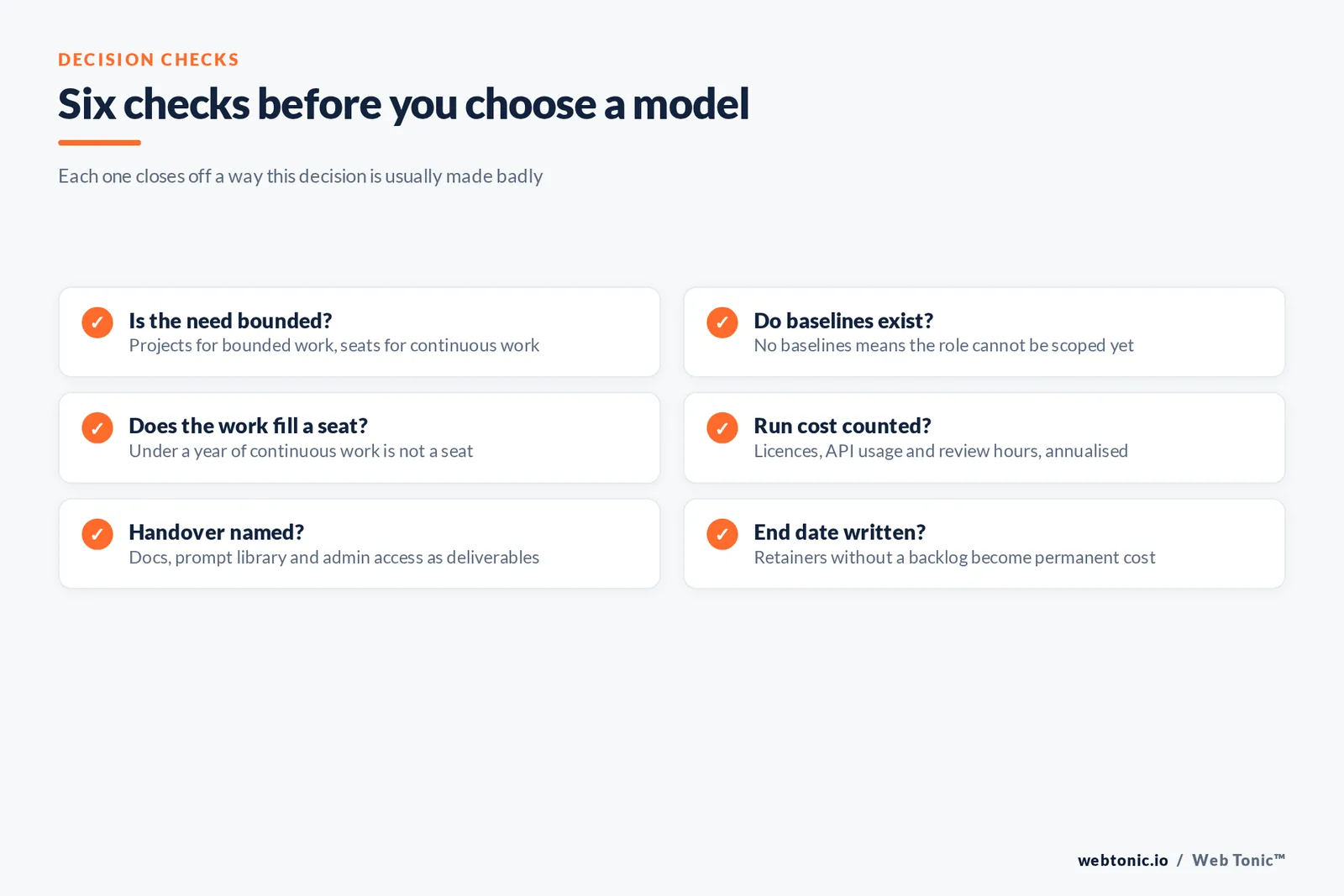
So before you compare a rate to a salary, write the job down. Which three workflows are you automating, what is the current cost per unit of output, and who signs off on quality? If you cannot answer that in a paragraph, a hire will spend two quarters discovering it at full salary. That is the case for buying the diagnosis first — the same logic behind a fixed-scope marketing audit before a retainer.
| Your situation | Buy advisory | Hire in-house |
|---|---|---|
| Need is 1–3 defined workflows | Yes — scoped build, 6–10 weeks | No — permanent cost for temporary work |
| AI touches daily production output | Design phase only | Yes — someone must own quality |
| No baseline metrics exist | Yes — assessment first, $1,000–$5,000 | Not yet — the role cannot be scoped |
| Team under 10 marketers | Usually — utilisation cannot fill the seat | Rarely |
| Regulated data or heavy governance | For the policy build | Yes — continuous accountability required |
| Board expects proof within a quarter | Yes — advisory can report at day 90 | No — still ramping at day 90 |
Where advisory clearly wins
Advisory wins on pattern recognition. Someone who has watched a dozen teams try the same content workflow knows which of the four common failure modes yours will hit, and that knowledge cannot be hired at any single company. It also wins on commitment risk: with 3:1 demand-to-supply pressure on AI marketing talent and roles repricing every few quarters, a $140,000 hire made against a guess is expensive to unwind. And it wins on timing — a 1–2 week productive start against 3–6 months to full productivity matters when the board asked in March.
Where the hire wins is duration and depth. Automation that runs every day needs an owner who notices when output quality drifts, and institutional knowledge — brand nuance, legacy data quirks, which stakeholder rejects what — accumulates only inside. Governance is the same story: policies need a person, not a document. Our own view of this split sits in our data intelligence practice, where design and measurement are engagement work while day-to-day operation belongs to the client's team.
The hybrid most teams land on
The sequence that wastes the least money is not a compromise, it is an order of operations. Buy a fixed-scope readiness assessment at $1,000–$5,000 and get a ranked list of use cases with baselines. Buy a scoped build of the top one or two at $5,000–$50,000, with documentation and admin access as named deliverables. Then hire the operator against a job description written from what the build actually required, not from a template. That final step is now a well-defined role instead of a bet, and the first-year loaded cost of $157,000–$221,000 buys ownership of something that already works.
Two rules keep the hybrid honest. First, documentation is a deliverable, not a favour — the handover pack, prompt library, evaluation criteria and access credentials are line items. Second, the advisory engagement ends on a date. Open-ended retainers with no backlog are how a bounded need quietly becomes a permanent cost with none of the benefits of a hire.

Decide it in one week
Day one, list every workflow where AI would change the cost or speed of output, and write today's baseline next to each — hours per asset, cycle time, error rate. Day two, mark each as bounded or continuous. Day three, price the continuous ones as a role and the bounded ones as projects, using the ranges above. Day four, check utilisation: if the continuous work does not fill a seat for a year, it is not a seat. Day five, decide, and write the success condition before signing anything.
Then hold whichever model you chose to the same standard. Benchmark research found 46% of marketers primarily measure AI tool performance by revenue gains, which is a high bar for a technology mostly deployed against production cost. Pick the metric that matches the work: hours per asset and cycle time for efficiency plays, pipeline for demand plays, and never both loosely. If you want that written down before you commit budget, start with a conversation or read more on the Web Tonic blog.
Two cost lines buyers forget
Tooling is the first. An AI marketing hire arrives expecting a stack, and licences, API usage and monitoring routinely add several thousand dollars a month on top of salary — a cost that exists in the advisory model too, but which advisory usually right-sizes before you commit to annual contracts. Ask either model for the annualised run cost of every workflow they propose, and compare that number, not the headline fee.
The second is review time. Every AI workflow that produces public-facing output needs a human sign-off step, and that time comes out of your existing team whichever model you choose. Teams that forget this report a saving in production and a mysterious loss in senior capacity. Count review hours explicitly in the before-and-after, and the comparison between a $90,000-a-year retainer and a $180,000-plus loaded hire becomes a real calculation instead of a feeling.
One more practical note on sequencing: if you plan to hire within twelve months anyway, use the advisory engagement to write the job description. A role scoped from a real build — with the actual tools, data constraints and review burden named — attracts better candidates and shortens the 3–6 month ramp, because the first ninety days of the new hire's tenure are spent operating something that already works rather than inventing it.
Frequently Asked Questions
Is advisory always cheaper than hiring?
For bounded work, yes, and by a wide margin — a $25,000 scoped build is a fraction of a loaded first-year hire at $157,000–$221,000. For continuous work that fills a seat, the hire is cheaper within about 12–18 months, provided the role has a mandate and a budget.
Can one person really own AI for a marketing team?
For a team of roughly ten or fewer, one owner plus advisory support is normal. Beyond that, the work usually splits between someone accountable for output quality and someone accountable for systems and data, which is a structure question as much as an AI one.
What if we hire and the market reprices the role?
It has already repriced once: mid-level bands moved to $105,000–$155,000 from levels that barely existed in 2024. Budget for a review at twelve months and write the mandate so the role grows into ownership rather than staying a tool operator.
How do we stop advisory from becoming a permanent retainer?
Give the engagement an end date, a written backlog, and a handover pack as a deliverable. If the retainer renews, it should renew against new scope, not against the memory of the original build.
What proves either model worked?
A before-and-after baseline on one workflow. Median reported saving across teams is 6.1 hours per person per week; if your own numbers cannot get near that on the workflows you targeted, the problem is the workflow choice, not the delivery model.
Sources
AI marketing consultant vs in-house 2026 · AI marketing consulting: what to pay · Consultant vs agency vs in-house · AI consulting pricing 2026 · AI marketing technologist salary data · The AI marketer in 2026, 307 job postings · Digital marketing salary guide 2026 · AI marketing salary benchmarks · Cost of hiring a marketing manager 2026 · AI marketing adoption statistics 2026 · AI marketing operations benchmarks 2026 · AI in marketing statistics, verified data · 2026 benchmark study, marketing's AI inflection point.