Table of contents
There is no single "advertising management" line item because three different buyers price it three different ways: agency fee, in-house headcount and management software. This page separates the three so the budget question stops being blended into a media plan and starts being answered against 2026 workforce and compensation data.
Key Takeaways
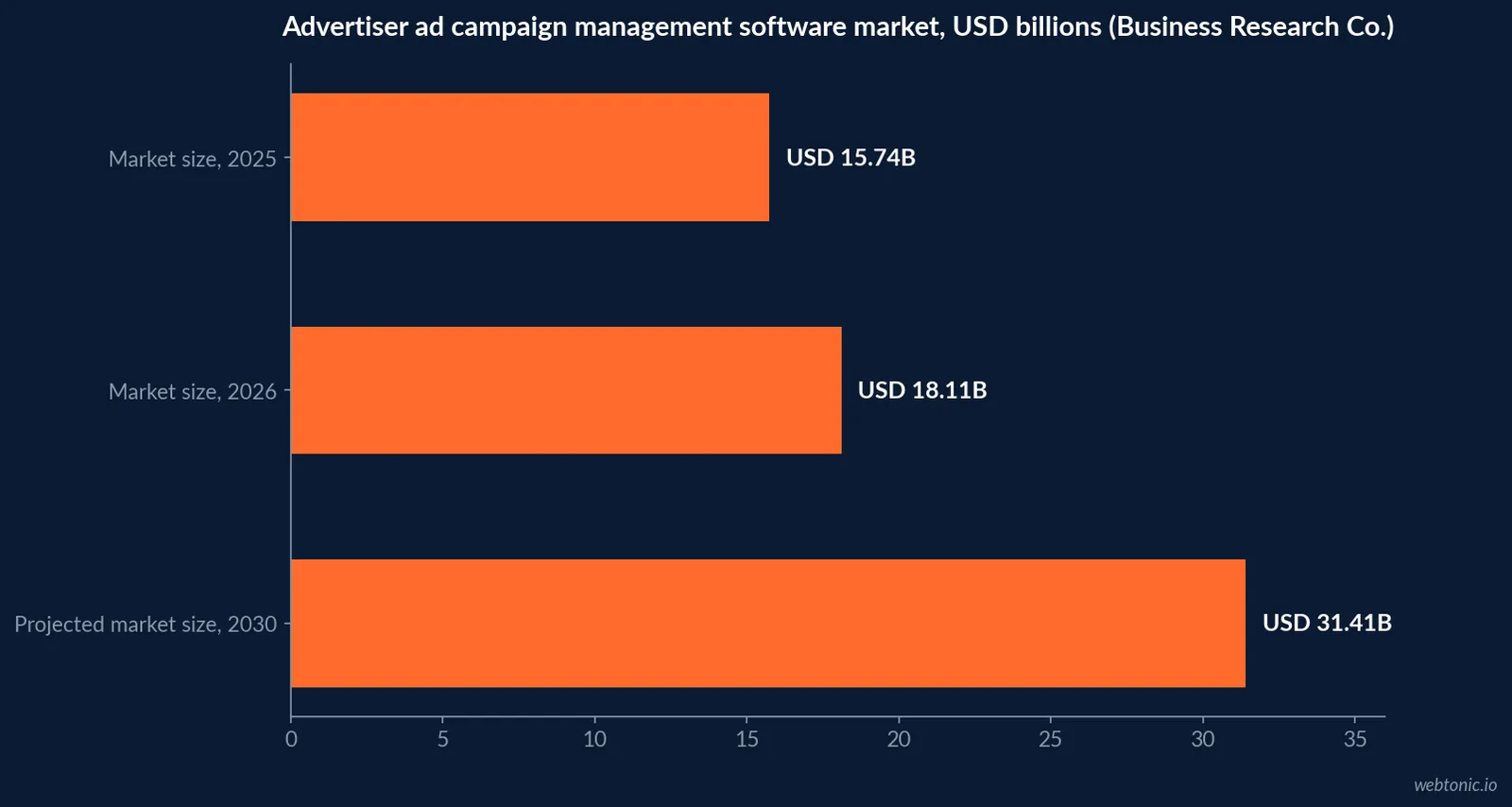
- Ad campaign management software reached USD 18.11 billion in 2026, up 15.1% from 2025.
- The software market is projected to hit USD 31.41 billion by 2030, a 14.8% CAGR.
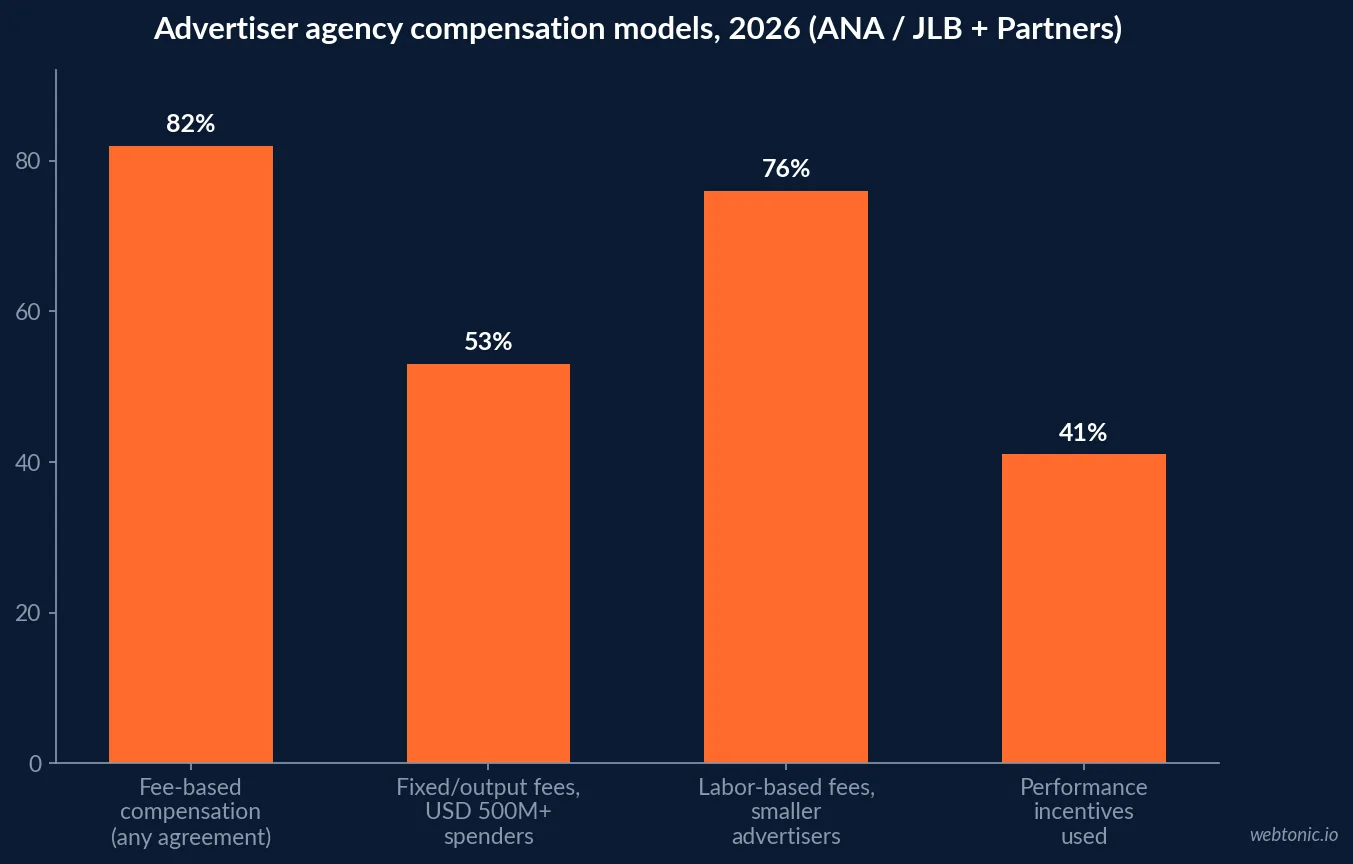
- 82% of advertisers now use fee-based agency compensation, up from 68% a decade earlier.
- 53% of USD 500 million-plus advertisers use fixed or output-based fees, versus 5% before.
- Smaller advertisers still favor labor-based fees at 76%.
- Use of agency performance incentives fell to 41%, down from 61% in 2013.
- 85% of marketers are satisfied with their compensation approach, yet 51% plan to change it anyway.
- Only 9% of marketers now call cost-saving the primary role of an in-house agency.
- 53% expect in-house teams to deliver strategic, brand-building work.
- Jurors are five times more likely to say in-housing is accelerating than pulling back.
- IAB models roughly 434,000 US ad managers behind the campaigns those budgets fund.
- AI-driven measurement efficiency could unlock USD 6.2 billion in industry productivity.
- That equates to about USD 14,400 per planner per quarter.
- 60% to 75% of buy-side marketers say current measurement underperforms on cost efficiency.
- AI-enhanced measurement could redirect USD 14.5 billion to 26.3 billion in ad spend.
- Martech now absorbs 19.4% of the marketing budget, down from 26.6% in 2021.
- 56% of martech budgets already run on consumption-based pricing.
- Only 9% of marketing stacks are called fully AI-optimized.
Why "advertising management" has three different price tags
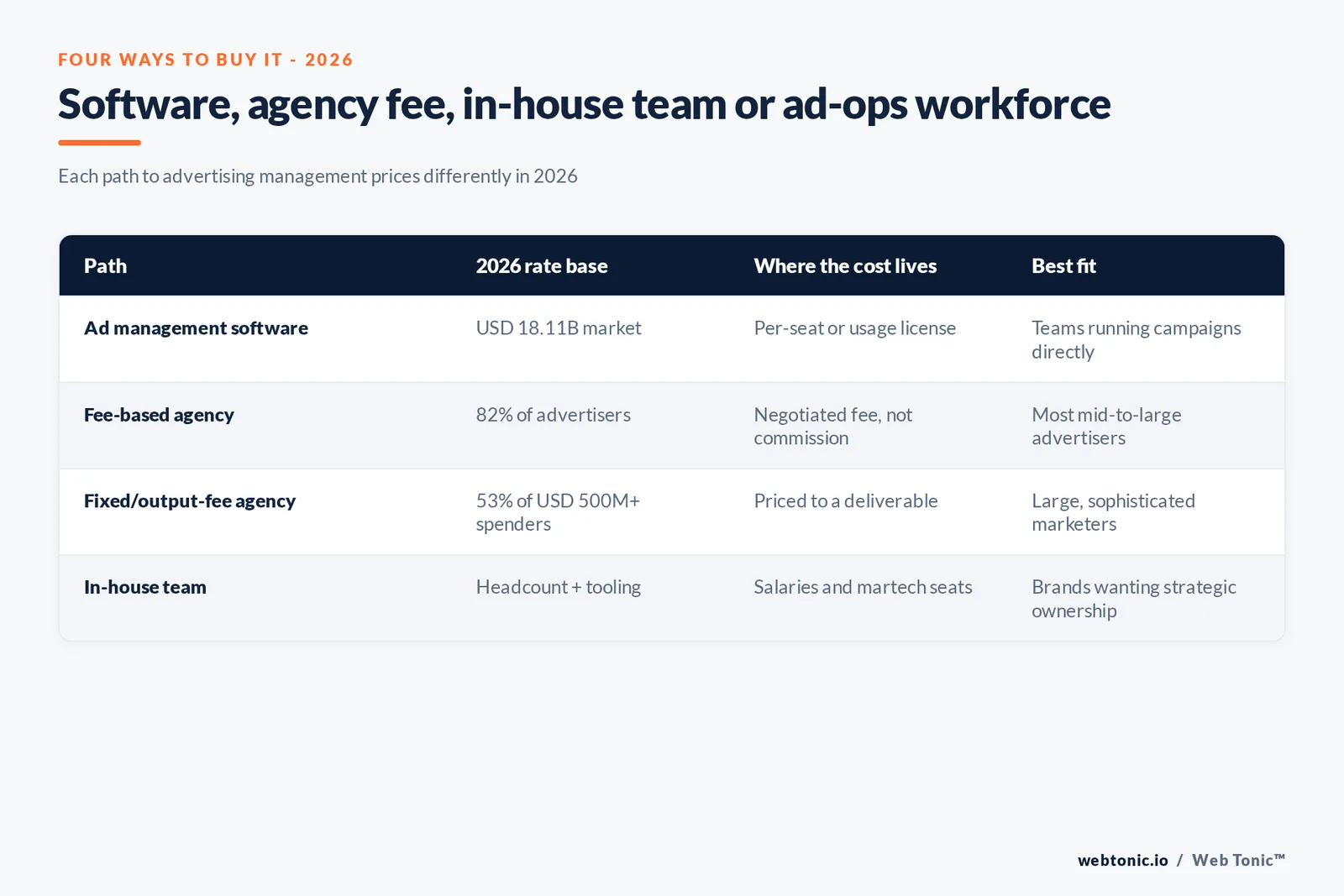
Ask three advertisers what they budget for managing a campaign and you get three different answers, because the work is delivered three different ways: through an agency retainer, through an in-house team's own headcount, or through campaign management software that a buyer runs directly. None of the three publish a combined figure, so treating "management cost" as a single percentage on top of media spend is the first budgeting mistake.
The rest of this page prices each path from its own 2026 evidence base: The Business Research Company for the software market, the ANA's Trends in Agency Compensation study for agency fee structures, the ANA's 2026 in-housing research for the internal-team path, and IAB's State of Data 2026 for the workforce that actually operates all three.
| Path to buy it | 2026 rate base | Where the cost lives | Source |
|---|---|---|---|
| Ad management software | USD 18.11B market, 2026 | Per-seat or usage-based license | The Business Research Company |
| Agency, fee-based | 82% of advertisers use this model | Negotiated fee, not media commission | ANA / JLB + Partners |
| Agency, fixed/output fee | 53% of USD 500M+ spenders | Priced to a deliverable, not hours | ANA / JLB + Partners |
| In-house team | Headcount + tooling, no fee line | Salaries, martech seats, overhead | ANA in-housing research |
| Ad-ops workforce | ~434,000 US ad managers | Time spent on measurement and planning | IAB / BWG Strategy |
The software line: campaign management platforms are the fastest-growing cost
The global market for advertiser and ad campaign management software grew from USD 15.74 billion in 2025 to USD 18.11 billion in 2026, a 15.1% jump in a single year, according to The Business Research Company's 2026 market report. The same report projects the market reaching USD 31.41 billion by 2030, a 14.8% compound annual growth rate, driven by adoption of marketing automation tools, demand for performance measurement, and generative-AI features layered into existing platforms.
That is a cost curve budgets rarely model explicitly. A management-software line that was a rounding error under a media plan three years ago is now growing faster than most channels' media spend, and North America is named the largest regional market.
| Ad management software market | Value (USD billions) | YoY / CAGR | Year |
|---|---|---|---|
| Market size | 15.74 | - | 2025 |
| Market size | 18.11 | +15.1% YoY | 2026 |
| Projected market size | 31.41 | +14.8% CAGR (2026-2030) | 2030 |
The agency fee line: commissions are gone, fees are structured to the work
The ANA's Trends in Agency Compensation research, run with JLB + Partners, found that 82% of respondents now use a fee-based compensation model in at least one agency agreement, up from 68% in 2016. The shift is sharpest among the biggest spenders: marketers spending USD 500 million or more a year use fixed or output-based fees at 53%, compared with just 5% in 2016. Smaller advertisers have not followed the same path and still favor labor-based fee agreements at 76%.
Performance incentives, meanwhile, are becoming less common, not more: 41% of respondents use them, down from 48% in 2016 and 61% in 2013, largely because marketers say they cannot reliably attribute performance to a single agency partner.
| Compensation signal | Prior benchmark | Current benchmark | Direction |
|---|---|---|---|
| Fee-based compensation, any agreement | 68% (2016) | 82% | Rising |
| Fixed/output fees, USD 500M+ spenders | 5% (2016) | 53% | Rising sharply |
| Labor-based fees, smaller advertisers | n/a | 76% | Still dominant |
| Agency performance incentives used | 61% (2013) | 41% | Falling |
| Satisfied with current comp approach | n/a | 85% | High, but unstable |
| Planning to change comp agreements anyway | n/a | 51% | Rising |
The in-house line: budgeted as headcount, justified as strategy
The ANA's 2026 benchmark study on in-housing, The Resilient Rise of the In-House Agency, reframes what that internal budget line is actually buying. Jurors surveyed were five times more likely to say marketers are in-housing more than ever than to say they are pulling back, and 53% agree that the primary role of an in-house agency is to act as a strategic partner delivering brand-building work, not to shave a percentage off agency fees.
That is a real change in what the line item is for. Despite many in-house teams starting as a cost-saving alternative to outside partners, only 9% of respondents now name cost-saving as the primary role of the internal team, which means budgeting an in-house function purely against "what the agency would have charged" understates what it is now expected to deliver.
| In-housing metric (2026) | Figure | What it means for budget |
|---|---|---|
| Jurors saying in-housing is accelerating vs. retreating | 5x more likely | The internal budget line is growing, not shrinking |
| Primary role: strategic partner / brand-building | 53% | Fund senior creative and strategy roles, not just execution |
| Primary role: cost-saving vs. agency | 9% | Cost-avoidance alone no longer justifies the team's budget |
| Top named threat to in-house success | Creative stagnation | Budget for outside perspective, training or rotation |
The workforce line: what ad managers actually spend their time on
IAB's State of Data 2026 study, fielded with BWG Strategy among 400-plus U.S. planning and analytics decision-makers, models roughly 434,000 U.S. ad managers and finds that 60% to 75% of the buy-side say current measurement approaches underperform on rigor, timeliness, trust or operational efficiency. As marketing budgets shrink as a share of company spend, that inefficiency is exactly the cost a management budget has to absorb or eliminate.
The same study estimates that shifting planners' time from data preparation toward strategy work through AI could unlock USD 6.2 billion in industry-wide productivity value, or roughly USD 14,400 per planner per quarter, and that AI-enhanced measurement models could redirect USD 14.5 billion to USD 26.3 billion in ad spend toward currently underrepresented channels over the next one to two years.
| Workforce fact (2026) | Figure | Source |
|---|---|---|
| Estimated U.S. ad managers | ~434,000 | IAB / BWG Strategy |
| Buy-side saying measurement underperforms on efficiency | 60-75% | IAB / BWG Strategy |
| Industry productivity unlocked by AI in measurement | USD 6.2B | IAB / BWG Strategy |
| Value per planner per quarter | USD 14,400 | IAB / BWG Strategy, BLS-based |
| Ad spend AI-enhanced MMM could redirect | USD 14.5B-26.3B | IAB / BWG Strategy |
Where the martech line squeezes the management budget
None of the three paths above are funded from new money. Martech now consumes 19.4% of the marketing budget, down from 26.6% in 2021 as Gartner's CMO Spend research (via chiefmarketer) tracks it, with 56% of martech budgets already running on consumption-based pricing and just 9% of stacks described as fully AI-optimized. A management-software renewal, an agency fee renegotiation and an in-house hire are all competing for the same shrinking martech line, which is why sequencing the decision matters more than the headline cost of any one path.
Our growth marketing practice models that trade-off before a renewal date forces the decision, and our breakdown of what paid search actually costs shows how the same "management versus media" question plays out at the channel level. Chief Marketer's coverage of the same Gartner survey notes that marketers are still planning to invest more in martech even as the share of budget it commands falls, which is exactly the kind of contradiction a management budget review has to resolve rather than inherit.
How to budget across the three paths without double-paying
Price the software separately from the people. If a fee-based agency agreement already prices management as a deliverable, an additional per-seat campaign management license is redundant unless the agency's tooling doesn't cover reporting granularity you need in-house. If the team is in-house, budget the software as its own line and staff to the strategic mandate the ANA data describes, not to the smaller cost-saving mandate the function may have started with.
Whichever path is chosen, benchmark it against the workforce data above: a management function that cannot show where its time goes relative to the 434,000-person industry baseline is difficult to defend at the next budget review. See our wider digital marketing benchmark data for how this fits the rest of the budget, or talk to us about structuring the management layer around your own channel mix.
Frequently Asked Questions
What does advertising management cost on top of media spend?
There is no single management fee because the work is bought three different ways. Ad campaign management software alone is a USD 18.11 billion market in 2026, agencies are increasingly paid fixed or output-based fees rather than a media commission, and in-house teams carry their own headcount and tooling instead of a line-item fee. Budget for whichever of the three you are actually buying, not for a blended industry average that fits none of them.
Are advertisers still paying agencies a media commission?
Less than ever among large spenders. The ANA's Trends in Agency Compensation research found that 82% of surveyed marketers use a fee-based compensation model, up from 68% a decade earlier, and that marketers spending USD 500 million or more a year have shifted hardest, with 53% now on fixed or output-based fees versus just 5% previously. Smaller advertisers still lean on labor-based fee agreements at 76%.
Is in-housing actually cheaper than an agency?
Not automatically, and the ANA's own 2026 in-housing research reframes the question: only 9% of marketers now say cost-saving is the primary reason to run an in-house agency, down from the founding rationale most teams were built on. Jurors in that study were five times more likely to say in-housing is accelerating than pulling back, and 53% now expect the in-house team to deliver strategic, brand-building work rather than a cheaper version of agency output.
How many people actually run advertising management day to day?
IAB's State of Data 2026 study, fielded with BWG Strategy among 400-plus planning and analytics decision-makers, models roughly 434,000 US ad managers and estimates that shifting their time from data preparation to strategy work through AI could unlock USD 6.2 billion in industry-wide productivity value, or about USD 14,400 per planner per quarter. That headcount, not the media budget, is what a management fee is actually paying for.
What is the fastest-growing cost inside advertising management?
Software, not people. The global market for advertiser and ad campaign management software grew from USD 15.74 billion in 2025 to USD 18.11 billion in 2026, a 15.1% jump, and The Business Research Company projects USD 31.41 billion by 2030 at a 14.8% compound annual growth rate. Budgets that still treat management tooling as a rounding error under media spend are underbuilt for where the money is actually moving.
Sources
The Business Research Company - Advertiser (Ad) Campaign Management Software Global Market Report 2026
ANA - Labor-Based Fees Remain Dominant Form of Agency Compensation (Trends in Agency Compensation)
ANA - 2025 Trends in Agency Compensation Report, 19th Edition
ANA - The Resilient Rise of the In-House Agency: 2026 State of In-Housing Report
In-House Agency Leaders Club - ANA report finds IHAs 'more capable, more strategic'
IAB - State of Data 2026: The AI-Powered Measurement Transformation
Chief Marketer - Gartner CMO Spend Survey: Budgets Reflect Increase in Consumption-Based Martech, Paid Media Spend